ADA Public Accommodation Violation NYC: Your Rights and Recovery
Reviewed for accuracy by the ADAhelp team before publishing. ADAhelp is not a law firm; legal work is handled by independent New York attorneys.
Faced an ADA public accommodation violation NYC businesses ignore? NYC law may entitle you to money damages. Learn your rights and get a free case check.
What if the heavy door or steep step that blocked your entry today was worth more than just a headache? If you encountered an ADA public accommodation violation NYC businesses often ignore, you might feel like your only option is to walk away. You shouldn't have to accept being excluded. Do you have a case? Most New Yorkers with a valid claim can secure a financial settlement because city laws go much further than federal rules. While the federal ADA focuses on fixing the physical building, the New York City Human Rights Law focuses on paying the victim.
You are likely tired of hitting physical barriers and feeling like the legal system is too expensive or confusing to use. We are here to help you change that. This guide explains how local laws provide money damages for accessibility hurdles that federal law alone does not cover. We will break down what your claim is worth and how to hold a business accountable without any financial risk. ADAhelp is not a law firm; we provide expert case management to help you determine if you have a valid claim. Our case check is free, and we connect you with independent attorneys who only get paid if you secure a recovery.
Key Takeaways
- Learn how New York City laws provide money damages for accessibility barriers that federal law alone does not cover.
- Identify if an entryway step or heavy door qualifies as an ADA public accommodation violation NYC businesses must fix and pay for.
- Understand why the New York City Human Rights Law allows you to recover money for emotional distress even when federal law does not.
- Follow a clear guide on how to document a barrier with photos and notes to strengthen your potential claim.
- Discover how to secure a free three-minute case check and connect with an attorney without paying any out-of-pocket costs.
What is an ADA public accommodation violation in NYC?
An ADA public accommodation violation NYC occurs when a private business fails to provide equal access to its goods or services. Many people think these rules only apply to government offices. That is not the case. A public accommodation is almost any private business that opens its doors to the general public. The Americans with Disabilities Act of 1990 established these federal standards; however; New York City law creates even stricter requirements for local business owners. If a barrier prevents you from entering or using a business the same way as everyone else; it is a violation of your rights.
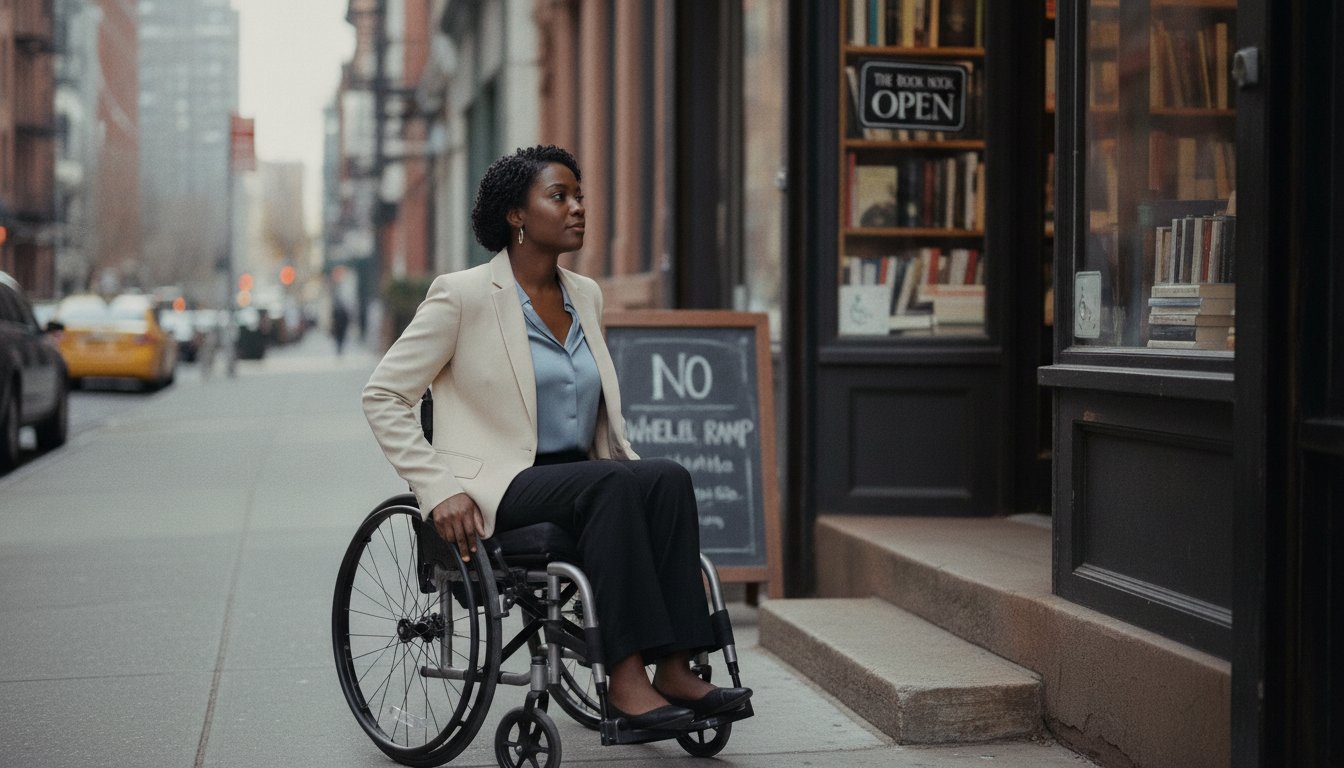
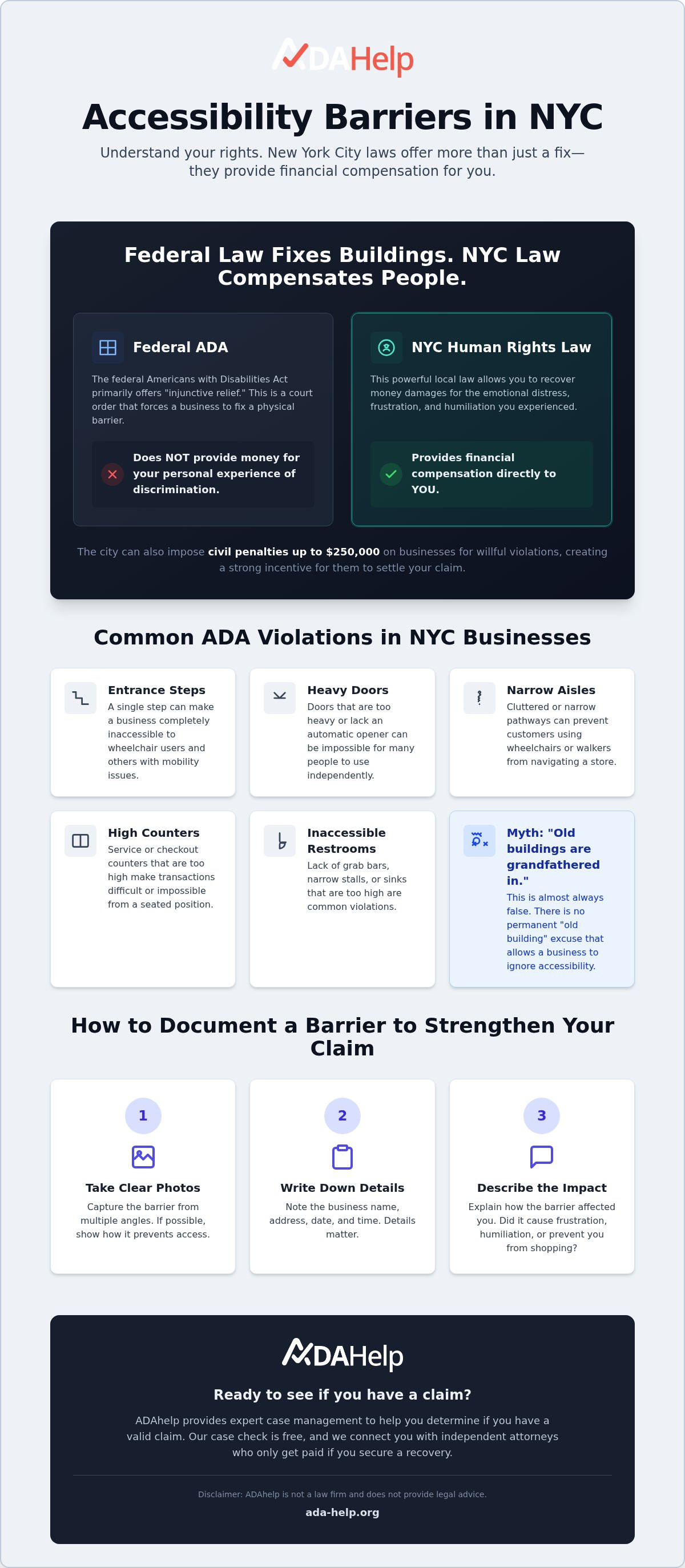
A violation is more than just an inconvenience. It is a legal failure to accommodate. You might encounter an ADA public accommodation violation NYC in several forms. Common examples include a six-inch step at the entrance of a shop; a heavy door that is impossible to pull open; or a service counter that is too high to reach from a wheelchair. Even narrow aisles that prevent movement or bathroom stalls that lack grab bars count as violations. These barriers don't just slow you down. They send a message that you aren't welcome; and the law says you deserve better.
Protected places under the NYCHRL
The New York City Human Rights Law (NYCHRL) covers an incredibly wide range of locations. This includes restaurants; retail stores; hotels; and theaters. It also extends to places you might not expect; such as doctor offices; private schools; and even day care centers. Size does not matter here. Many "mom and pop" shops in the five boroughs believe they are too small to comply. They are wrong. Every business that serves the public must meet accessibility standards. It is important to distinguish these from residential buildings. An apartment complex or a private home follows different housing rules; but any ground-floor shop inside that building is a public accommodation.
The difference between a barrier and a violation
Not every obstacle is a legal violation; but most are. Federal law requires businesses to remove barriers when it is "readily achievable." This means if a fix is easy to do and doesn't cost an astronomical amount of money; the business must complete it. Many NYC business owners claim they are "grandfathered" because their building is old. This is almost always a myth. There is no permanent "old building" excuse that allows a business to ignore accessibility forever. Barriers can also be digital or communicative. A business that refuses to provide Braille signage or fails to offer sign language assistance when it is necessary for communication is also committing a violation. ADAhelp can help you determine if the barrier you faced meets the legal definition of a claim.
Federal ADA vs. New York City Human Rights Law
Federal law is excellent at fixing buildings; but New York City law is better at compensating people. If you encounter an ADA public accommodation violation NYC; the federal Americans with Disabilities Act primarily offers what is known as injunctive relief. This is a court order that forces a business to fix a physical barrier; such as installing a ramp or widening a doorway. While this helps the community; it does not provide you with financial compensation for the discrimination you experienced. This is the main reason why real New Yorkers look to local laws for justice.
The New York City Human Rights Law (NYCHRL) is one of the most powerful anti-discrimination laws in the country. Unlike federal law; the NYCHRL allows you to recover money damages for emotional distress. This includes the frustration; humiliation; and mental anguish caused by being excluded from a business. The city also has the power to hit businesses with heavy civil penalties. For willful violations; the NYC Commission on Human Rights can impose fines up to $250,000. These penalties create a strong incentive for businesses to settle your claim and fix their accessibility issues quickly.
Why money damages matter for your claim
Financial settlements serve two purposes. First; they provide a sense of justice for the time you lost and the frustration you felt. Second; they hold the business owner accountable in a way that a simple warning cannot. Typical recovery amounts vary case by case depending on the severity of the barrier and how often you visited the location. ADAhelp focuses on public access discrimination case management that prioritizes these local damages. If you want to see if your experience qualifies for a settlement; you can start a free three-minute case check today.
New York State Human Rights Law protections
You also have a second layer of protection through the New York State Human Rights Law (NYSHRL). This state law covers the entire state; including all five boroughs. Like the city law; the NYSHRL allows for financial recovery and does not require you to prove the business intended to discriminate. It only requires proof that a barrier existed. In 2023; the New York State Division of Human Rights secured over $6.7 million in compensation for victims of various types of discrimination. You can learn more about these specific state-level rules in our guide to disability discrimination rights New York. Using both state and city laws ensures you have the best chance at a successful recovery.
Common accessibility barriers in NYC businesses
Identifying an ADA public accommodation violation NYC is the first step toward securing your rights. Many business owners in the five boroughs assume that because their building is old; they don't need to make changes. This is a mistake. Barriers aren't just frustrating; they are illegal obstacles that prevent you from living your life. Whether you are grabbing a coffee in Brooklyn or shopping in Manhattan; you have a right to the same access as everyone else.
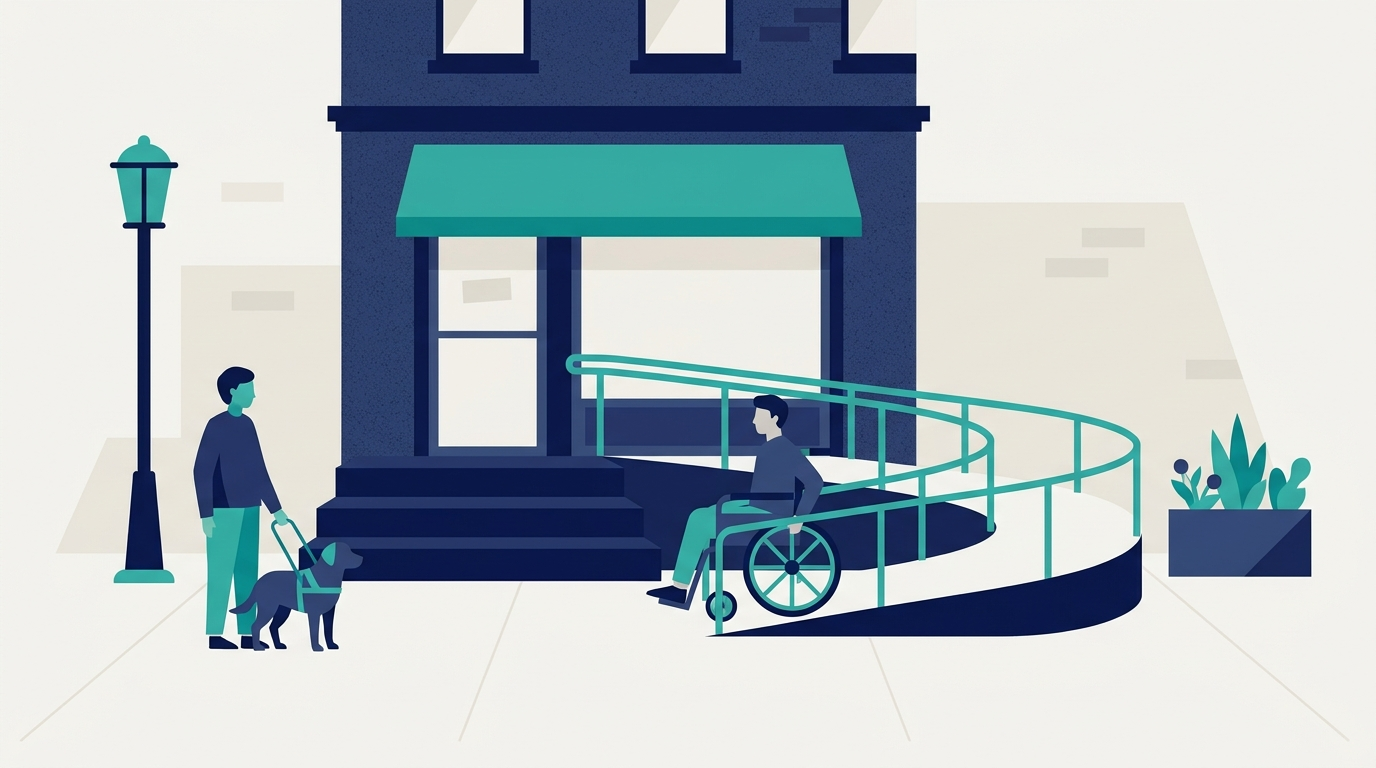
Most violations fall into a few specific categories. Entryway barriers are the most visible. This includes steps without a permanent ramp or a portable ramp that the business refuses to set up. Heavy doors that require too much force to pull open also count. Once you are inside; the layout must allow you to move freely. High service counters; narrow aisles blocked by displays; and inaccessible dressing rooms are common interior issues. Restrooms are another major source of claims. A bathroom is not truly accessible if it lacks grab bars; has a sink that is too high; or uses a door handle that requires tight grasping or twisting.
If you encounter these barriers; you should know that you have options for reporting them. Understanding how to file an ADA complaint is helpful; but many New Yorkers find that working with a case manager is a faster way to secure a settlement. ADAhelp provides the support you need to hold these businesses accountable without any out-of-pocket costs.
Restaurant and retail store violations
Dining and shopping in NYC should be stress-free. In restaurants; owners must provide a path of travel between tables that is wide enough for a wheelchair. They are also required to offer accessible seating options scattered throughout the dining area; not just in one corner. Maneuvering clearance is the clear floor space needed for a person using a wheelchair to turn around or approach a table. Retail stores face similar rules. Clothing racks must be spaced out so you can move through the aisles without hitting merchandise or getting stuck.
Website violations and the physical nexus rule
Digital barriers are just as real as physical ones. If a store's website is not compatible with a screen reader; it is a violation of your access. In New York; courts often look for a "nexus;" which is a direct connection between the website and a physical store. If you can't use a website to check inventory or book a service at a physical NYC location; you may have a claim. This is a complex area of law; and our team specializes in ADA Title III case management New York to help you determine if a digital barrier qualifies for a settlement. In 2023; New York accounted for 73% of all website accessibility lawsuits in the United States; showing how common these violations have become.
How to document a violation for your claim
Success depends on the evidence you collect at the scene. When you encounter an ADA public accommodation violation NYC; your first instinct might be to leave in frustration. Don't walk away just yet. Taking a few minutes to gather proof can turn a bad experience into a successful recovery. ADAhelp provides expert case management to help you organize this evidence and determine if you have a claim. We handle the heavy lifting of the intake process so you don't have to worry about the details.
Start with the basics. Record the exact date and time of your visit. Note the street address and the name of the business as it appears on the sign. If you spoke with an employee or a manager about the lack of access; write down their names and what they told you. Did they offer a portable ramp? Did they tell you to "just come back later"? These details are vital for your case. If you managed to buy something; save your receipt. If you couldn't get inside; a photo of the closed door or the step you couldn't climb proves you attempted to be a customer.
Photos that help your case
Your smartphone is your best tool for documentation. Take close-up photos of the physical barrier; but also take wide shots that show the entire storefront. This proves the barrier belongs to that specific business and not a neighboring shop. For physical obstacles like steps or high counters; place a common object next to them for scale. A phone; a coin; or even a standard water bottle helps show exactly how high or narrow the barrier is. Look for the lack of an ADA doorbell or any missing signage that should indicate an accessible entrance. These visual proofs make it much harder for a business to deny the violation later.
Writing your personal impact statement
Under the New York City Human Rights Law; your personal experience carries weight. An impact statement is a factual account of how the barrier affected your day. Did you have to skip a planned dinner with friends? Did you feel humiliated having to ask for help just to enter a shop? Be specific about the exclusion. This statement helps independent attorneys understand the emotional distress component of your claim; which is where money damages often come from. Providing this information during your free three-minute case check allows our team to quickly assess the value of your situation. If you are ready to hold a business accountable; you can start your case check now to see if you qualify for a settlement.
Start your free NYC case check with ADAhelp
You have seen the barriers and you know your rights. Now it is time to act. If you encountered an ADA public accommodation violation NYC businesses refused to address; you don't have to handle the fallout alone. ADAhelp provides expert public access discrimination case management in New York to guide you through the process. We are not a law firm and we do not provide legal advice. Our role is to act as your advocate and coordinator. We help you determine if you have a valid claim and then connect you with independent contingency-fee attorneys who specialize in these specific cases.
Our free case check is designed for speed and clarity. It takes only three minutes to complete. You provide the details of your experience; and we handle the heavy lifting of evaluating the facts. We look at how the federal ADA and the New York City Human Rights Law apply to your specific situation. This ensures you are pursuing every possible avenue for both physical fixes and financial recovery. We take the confusion out of the legal system by providing a clear; step-by-step path toward justice.
The zero-risk contingency model
One of the biggest hurdles for Real New Yorkers is the fear of high legal costs. We have eliminated that risk. Our service operates on a contingency-fee model. This means any fees are taken as a percentage of the final settlement or recovery. You will never pay any out-of-pocket costs to start your case or work with our team. If you don't win a settlement; you don't owe a dime. This model ensures that justice is accessible to everyone; regardless of their bank account balance. We manage the entire claim process for you; from initial intake to connecting you with the right legal resources.
Your next steps toward resolution
Time is a critical factor in these cases. Physical barriers can be removed; and employees who witnessed the incident might move on to other jobs. You should act quickly to ensure your evidence remains fresh and verifiable. Our team is ready to evaluate your claim based on the latest legal standards in New York. We understand that typical recovery amounts vary based on the specifics of your case; but we are committed to helping you find the best path forward. Don't let a business ignore your rights any longer. Take the first step toward holding them accountable today. You can start your free three-minute case check right now and see if you qualify for a settlement.
Take Action Against Accessibility Barriers Today
You shouldn't have to tolerate being excluded from the shops and restaurants that make New York City great. You now know that local laws like the NYCHRL offer financial recovery for an ADA public accommodation violation NYC that federal law simply doesn't provide. By gathering simple evidence like photos and impact statements; you've already done the hardest part. Our team is ready to take it from here.
ADAhelp provides expert NY case management to handle the paperwork and connect you with our network of independent contingency-fee attorneys. There are no out-of-pocket costs for you; and we only get paid if you win a settlement. This is your chance to hold businesses accountable and secure the justice you deserve without any financial risk. It's time to turn your frustration into a clear path toward resolution.
Don't wait until the evidence disappears or the business changes its layout. You can start your free three-minute case check now to see what your claim is worth. We are here to be your advocate and ensure the system works for you. You have the right to equal access; and we have the tools to help you claim it.
Frequently Asked Questions
Can I sue a business for an ADA violation in NYC?
Yes; you can hold a business accountable for an ADA public accommodation violation NYC by filing a lawsuit or an administrative complaint. While the federal ADA focuses on fixing the physical barrier; the New York City Human Rights Law allows you to seek money damages for emotional distress. Most people find that a combined approach using city and state laws leads to the best financial settlement and ensures the business actually removes the barrier.
How much is the typical settlement for an ADA violation in New York?
Typical settlement amounts vary case by case based on the severity of the barrier and the impact it had on your life. Under the NYCHRL; there is no cap on the money damages you can recover for emotional distress. Some victims have secured settlements over $250,000 for a failure to provide reasonable accommodations; though smaller settlements for physical barriers are also common. ADAhelp can help you determine the potential value of your specific situation.
Do I need a lawyer to file an ADA complaint in NYC?
No; you don't need a lawyer to start the process; but having legal representation usually increases your chances of a settlement. ADAhelp makes this easy by managing your case and connecting you with independent contingency-fee attorneys. You don't have to worry about hourly fees because these lawyers only get paid if you win a recovery. This allows you to hold a business accountable without any personal financial risk or out-of-pocket costs.
What is the statute of limitations for ADA claims in New York?
The time you have to file depends on where you submit your claim. For the New York City Commission on Human Rights; you must file within one year of the violation. If you are filing a complaint with the New York State Division of Human Rights for incidents occurring after February 15; 2024; you generally have three years. Acting quickly ensures your evidence is preserved and makes it easier to secure a successful settlement for an ADA public accommodation violation NYC.
Does a business have to be open to the public to be an ADA violation?
Yes; the business must qualify as a public accommodation to be covered by Title III of the ADA. This includes almost any private business that serves the general public; such as shops; restaurants; and private schools. Private clubs or religious organizations are often exempt from these specific rules; but most commercial spaces in the five boroughs must comply. If you were denied entry to a place that serves others; you likely have a valid claim.
What if the business says they are in a landmarked building?
Being in a landmarked building is not a valid excuse to ignore accessibility laws. Business owners must still remove barriers if the fix is readily achievable and does not destroy the historic significance of the property. In many cases; a business can install a portable ramp or an automatic door opener without violating landmark rules. If they refuse to explore these accessible options; they are still in violation of the law and can be held responsible.

Article by
ADA Help
Written by the ADAhelp editorial team and reviewed for accuracy before publishing. ADAhelp helps New Yorkers find out if they have a disability discrimination claim and manages the process end to end, working with independent attorneys who handle the legal work. We are not a law firm and do not provide legal advice.
Disclaimer
This article is general information about New York law, not legal advice, and reading it does not create an attorney-client relationship. ADAhelp is a case-management and intake service, not a law firm; legal representation is provided by independent attorneys. Recovery amounts and timelines vary by case, and past outcomes do not guarantee future results. For advice about your specific situation, speak with a qualified attorney or start the free case check.
Tags
Discriminated against in New York because of a disability?
A free three-minute check tells you if you can pursue a claim.
Check my case →New York onlyNo upfront costIndependent NY attorneysFree 3-minute check