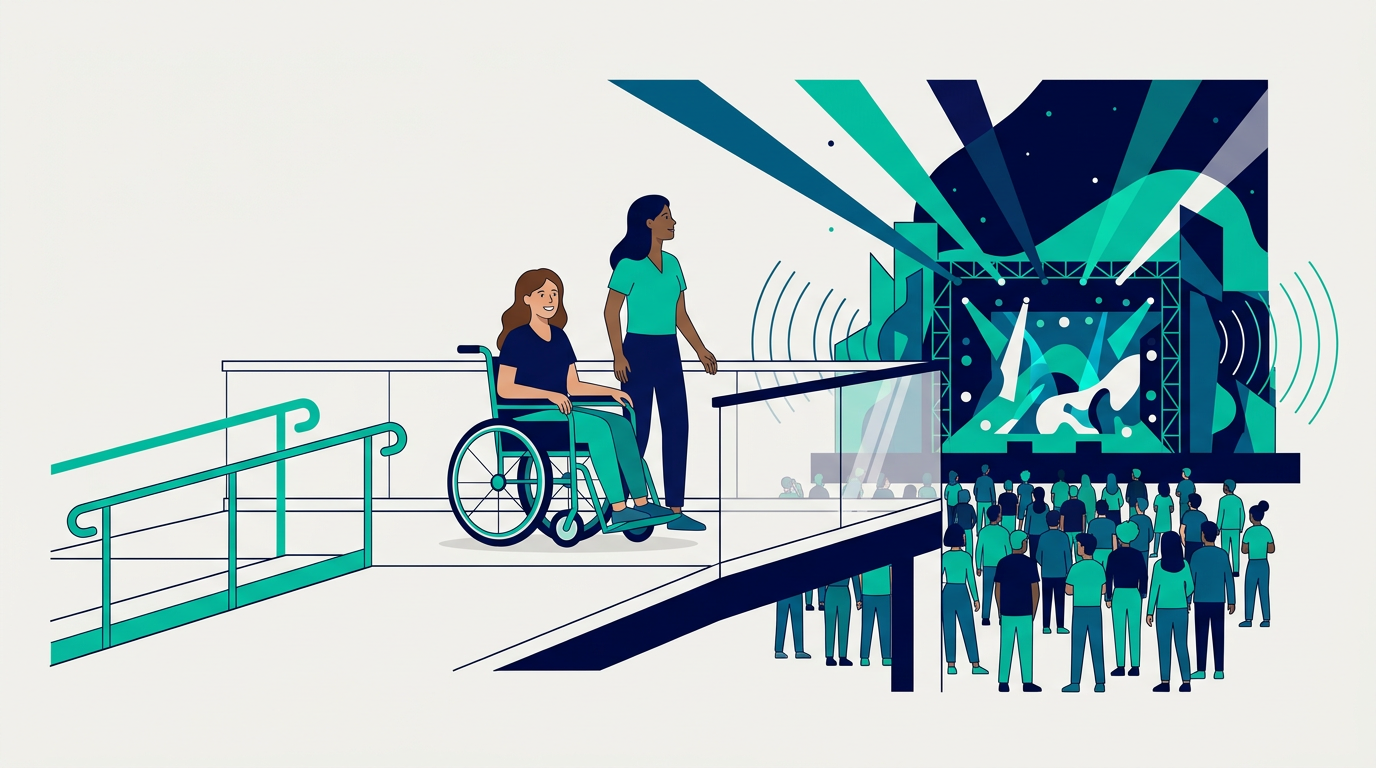
Cinema Accessibility for Wheelchair Users NYC: Rights
Reviewed for accuracy by the ADAhelp team before publishing. ADAhelp is not a law firm; legal work is handled by independent New York attorneys.
Know your rights for cinema accessibility for wheelchair users NYC. Learn how the NYCHRL lets you seek money damages, not just repairs. Free 3-min case check.
Did you know that a broken elevator at your local theater isn't just an inconvenience; it is often a legal violation? If you've ever missed the opening credits because the only lift was out of service, you are not alone. Many New Yorkers feel like an afterthought in theater design. You might deal with being separated from your companions or stuck in a single, poorly positioned spot at the very back of the room. This lack of cinema accessibility for wheelchair users NYC is more than just bad service. It is a breach of your rights under the Americans with Disabilities Act and the New York City Human Rights Law.
We understand the frustration of being treated differently because of a mobility device. You deserve to enjoy a film just like everyone else. This article explains how to tell if your experience violates the law and why New York City residents have stronger protections than those in other states. While federal law often only requires a business to fix the problem, the New York City Human Rights Law allows you to seek money damages for the discrimination you suffered. You can find out if you have a case with a free three-minute check. There are no out-of-pocket costs; fees are only taken if you receive a recovery. Learn how to hold these businesses accountable today.
Key Takeaways
- Learn why the New York City Human Rights Law allows you to seek money damages instead of just fixing the barrier.
- Understand the specific seating rules that require theaters to offer more than just the front or back rows.
- Identify how out-of-service elevators and heavy restroom doors violate your rights as a New Yorker.
- Discover how to document barriers to cinema accessibility for wheelchair users NYC to support your claim.
- See if you qualify for a claim with a free three-minute check that costs you nothing out of pocket.
Understanding Your Rights at NYC Movie Theaters
You shouldn't have to settle for a subpar experience just because you use a wheelchair. Whether you are heading to a blockbuster at a major chain in Times Square or catching an indie film in Brooklyn, the law is on your side. Cinema accessibility for wheelchair users NYC is a legal requirement, not a suggestion. You have a right to the same enjoyment, comfort, and safety as every other moviegoer. When a theater fails to provide this, they aren't just being inconsiderate; they are breaking the law.
In New York City, your protections come from several layers of government. The federal Americans with Disabilities Act (ADA) provides a baseline of accessibility that every public business must follow. However, New York City and New York State have their own laws that offer even stronger protections. Understanding how these laws work together is the first step toward holding a business accountable for discrimination.
The Role of ADA Title III in New York
Title III of the Americans with Disabilities Act focuses on private businesses that serve the public. This includes every movie theater in New York. Cinemas fall under the same public-accommodation rules that cover restaurants, shops, and hotels — see our guide to ADA public accommodation violations in NYC for the wider picture. Under this federal law, theaters must provide accessible seating and clear paths of travel. This means elevators must work; ramps must be the correct grade; and seating must be integrated into the theater layout. The main goal of a federal ADA claim is "injunctive relief." This is a legal term that means the court orders the business to fix the physical barrier. While this helps people in the future, it doesn't provide compensation for the frustration you experienced on the day of your visit.
Why the NYC Human Rights Law Matters to You
This is where New York City stands apart. The New York City Human Rights Law (NYCHRL) and the New York State Human Rights Law (NYSHRL) are much broader than federal law. These local statutes recognize that discrimination causes real harm. Because of this, they allow you to seek money damages for the discrimination you faced. If a theater in the five boroughs ignores cinema accessibility for wheelchair users NYC, they are violating one of the strongest civil rights laws in the nation. This law applies to almost every cinema in the city, from the largest multiplex to the smallest art house.
At ADAhelp, we help you determine if your experience qualifies for a claim under these powerful local laws. We provide end-to-end case management to make the process simple. Our case checks are completely free, and you never pay anything out of pocket. If we find a violation, we connect you with independent attorneys who work on a contingency basis. This means they only get paid if you receive a recovery. You don't have to figure out this system alone.
ADA Requirements for Wheelchair Seating in Cinemas
Have you ever arrived at a theater only to find that the only available wheelchair spot is in the very front row? Straining your neck for two hours isn't a "movie night." It is a violation of your rights. Federal and local laws ensure that cinema accessibility for wheelchair users NYC includes more than just a place to park. You are entitled to a variety of seating options. Theaters cannot simply stick you in the back corner or the front row and call it accessible. The law requires theaters to provide choices that mirror the options available to all other customers.
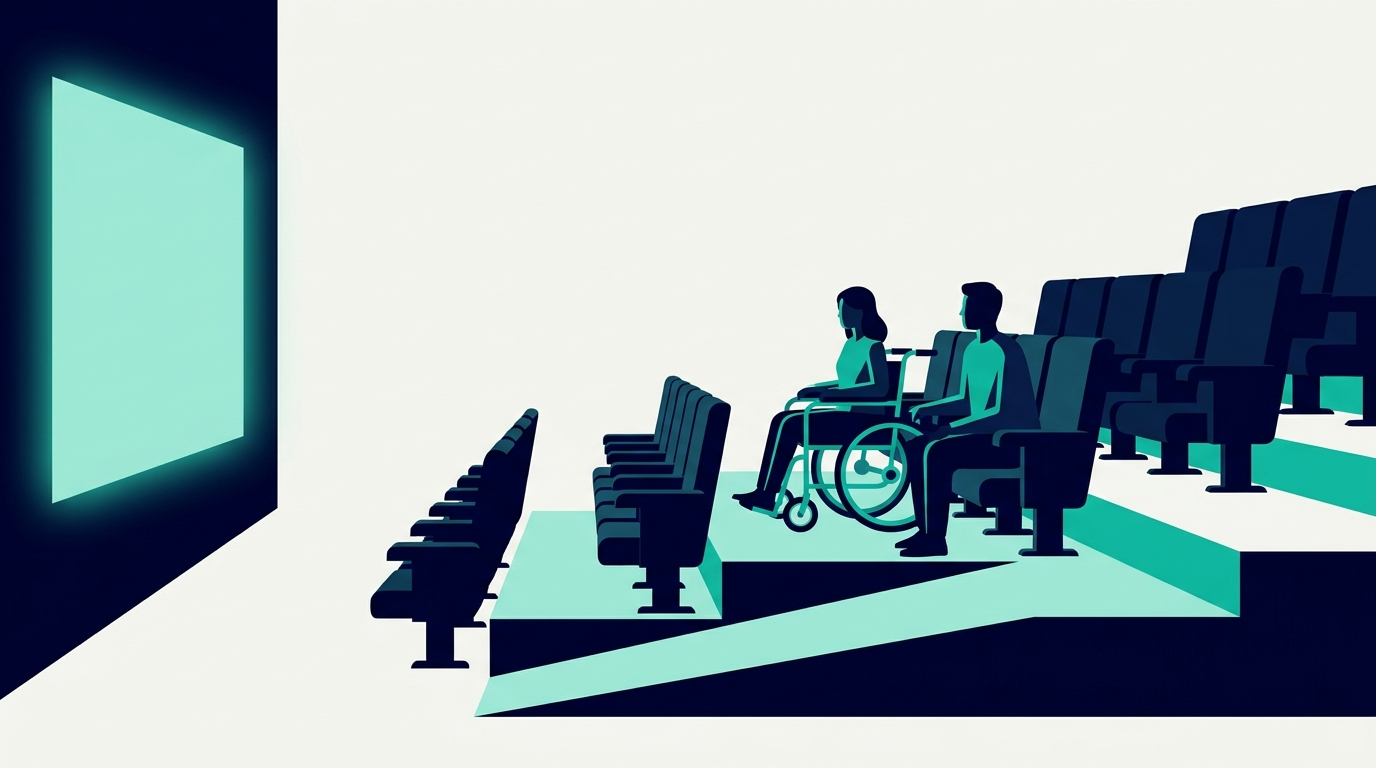
If a cinema has multiple seating levels; they must provide wheelchair spaces on different levels. You should have access to the same "sweet spot" in the middle of the theater that everyone else enjoys. If a theater only offers seating in one specific area; they might be in breach of the NYC Human Rights Law. This law is powerful because it recognizes that being treated as an afterthought is a form of harm that deserves compensation.
Integrated Seating and Line of Sight
"Integrated seating" means that wheelchair spaces must be part of the main seating plan. You shouldn't feel like you are sitting in a separate "disabled section." Your viewing angle must be comparable to the angles offered to other patrons. If you are forced to look up at a sharp angle; or if your view is obstructed by a railing or a wall; the theater is failing its legal obligations. These details matter. The NYCHRL allows you to seek money damages for the frustration and loss of enjoyment caused by these physical barriers. You shouldn't have to work harder than anyone else just to see the screen clearly.
Companion Seating Rules
Watching a movie is a social experience. You shouldn't have to sit alone while your friends or family are several rows away. The law mandates that theaters provide companion seating. These seats must be located immediately next to the wheelchair space. They must be shoulder-to-shoulder; not behind you or across the aisle. Most modern theaters use removable seats to create these spaces on demand. If a theater tells you that your companion must sit elsewhere; they are likely violating the law.
If you've been separated from your group or forced into a "nosebleed" seat; you might have a claim. You can perform a free three-minute case check to see if your experience qualifies for a legal remedy. Remember that ADAhelp is not a law firm. We are case managers who help you hold businesses accountable by connecting you with independent attorneys. These professionals work on a contingency basis; meaning you never pay out-of-pocket fees. Your right to sit with your companions and enjoy cinema accessibility for wheelchair users NYC is protected in all five boroughs.
Common Accessibility Violations in New York City Cinemas
New York City cinemas often operate in aging buildings; but that is not an excuse for poor cinema accessibility for wheelchair users NYC. You might find that the elevator listed as "accessible" on the website has been out of service for weeks. This is a primary violation. If a theater cannot provide a reliable way for you to reach the screening room; they are failing their legal duty. When an elevator breaks; the theater must fix it promptly to maintain access for all patrons. For a broader look at how these barriers show up across the city, see our guide to wheelchair access discrimination in NYC.
Restrooms are another frequent source of discrimination. Many theaters have heavy doors that are impossible to open from a wheelchair without help. Others have stalls so narrow that you cannot safely turn around or close the door. These are not just minor annoyances. They are barriers to your equal enjoyment of the facility. Under the New York City Human Rights Law; these physical barriers can be grounds for seeking money damages because they limit your independence and comfort.
Sometimes the barriers are caused by management rather than the building's architecture. You might see designated wheelchair spaces being used to store extra booster seats; cleaning equipment; or stacks of popcorn boxes. This is an operational failure. Similarly; steep ramps that require a second person to push you are not legally compliant. A ramp must have a safe slope to allow for independent use. If you are forced to struggle with a steep incline; the theater is in violation of both federal and local standards.
Physical Barriers in Older NYC Buildings
Many independent movie houses in the five boroughs are located in historic structures. While these buildings have character; they often have narrow aisles and cramped entrances. The law recognizes these challenges but still requires businesses to remove barriers if it is "readily achievable." This means if a ramp can be installed without massive expense or difficulty; the theater must do it. A lack of a ramp at the main entrance is a major violation that prevents you from even entering the building. If you were turned away altogether, our guide on being barred from entry due to disability in NY covers what to do next.
Operational Failures and Staff Training
Discrimination often involves how you are treated by employees. If staff members refuse to assist you with finding your reserved spot or do not know how to operate the lift; they are creating a barrier to access. Perhaps the most common violation is being told you must enter through a back alley or use a freight elevator. You have a right to use the same entrance as everyone else. Forcing you to go through a "trash room" or a loading dock is a loss of dignity and a clear legal violation of cinema accessibility for wheelchair users NYC.
Documenting Discrimination and Seeking Money Damages
If you encounter a barrier to cinema accessibility for wheelchair users NYC; you have the power to take action. Most people just walk away feeling frustrated. You don't have to be one of them. The first step is documenting exactly what happened. Use your phone to take clear photos of the problem. This might be a "broken" sign on an elevator; a steep ramp; or a locked accessible restroom. These photos are hard evidence that the theater failed to meet its legal obligations.
It is also vital to record the details of your visit. Write down the date and the time you arrived. If you spoke with a manager or a ticket taker; ask for their names. If they refuse to give them; note their physical descriptions. This information helps prove that the business was aware of the issue but failed to act. Under the federal Americans with Disabilities Act; a successful claim usually results in "injunctive relief." This means the court forces the theater to fix the barrier. While this is good for the community; it doesn't compensate you for your time or emotional distress. That is why New York laws are so important.
How to Build Your Case
Building a strong case starts the moment you realize something is wrong. Keep your ticket stub or the digital confirmation from your app. This proves you were a paying customer at that specific location. Note how the experience affected you. Did you feel embarrassed being led through a freight entrance? Did the lack of seating ruin a special occasion? A short; simple description of the barrier and how it made you feel is more effective than a long legal lecture. You are the expert on your own experience.
Typical Recovery in NYC Discrimination Claims
New Yorkers have access to the New York City Human Rights Law and the New York State Human Rights Law. These statutes allow for money damages to compensate you for the harm you suffered. While every case is different; typical recovery ranges vary depending on the severity of the violation and the impact on your life. Recovery is often sought through the New York State Division of Human Rights or in court. These payments help acknowledge the emotional distress of being denied equal access. There is no guarantee of a specific payout; but holding the business accountable is the only way to ensure they change their ways.
You don't have to handle the paperwork or the legal system alone. We provide end-to-end case management to help you determine if you have a valid claim. You can start with a free three-minute case check to see if your experience at a movie theater qualifies for compensation. Our services involve no out-of-pocket costs; and we only get paid if you receive a recovery. Let us help you turn your frustration into a clear path toward justice.
Where to File: Agencies & Deadlines
If a New York City theater denied you equal access, you have more than one place to bring a claim. Each route has its own deadline, and the venue you choose shapes what you can recover. Here is how the four main options compare.
| Where to file | Law | Deadline | What you can recover |
|---|---|---|---|
| NYC Commission on Human Rights | NYCHRL | 1 year | Money damages — usually the strongest route inside the five boroughs |
| NYS Division of Human Rights | NYSHRL | 1 year | Money damages — no filing fee, no lawyer required |
| U.S. Department of Justice | ADA Title III | No fixed deadline to report | Repairs to the barrier (injunctive relief), not money damages |
| EEOC | ADA Title I | 300 days | Employment claims only — not the venue for a customer access complaint |
| New York State court | NYCHRL | 3 years | Money damages, filed directly as a lawsuit |
The city commission and the state division both run administrative complaints, so you do not need a lawyer or a filing fee to start one. The DOJ route is worth using when you want the barrier itself fixed, but a Title III complaint will not compensate you for the visit that went wrong. The EEOC belongs on this list only to rule it out: it handles disability discrimination at work, not against customers.
You can also file directly in court under the New York City Human Rights Law, where the deadline is generally three years from the date of the incident. Because every one of these clocks runs from the day the discrimination happened, acting early keeps the most options open. Not sure which route fits your situation? Our free three-minute case check will point you to the right one.
How ADAhelp Manages Your NYC Discrimination Claim
You shouldn't have to fight for your rights alone. If you've been denied equal access at a theater, the process of holding them accountable can feel overwhelming. ADAhelp is not a law firm. We do not provide legal advice. Instead, we act as your dedicated case managers to handle the heavy lifting of your claim. We specialize in public access discrimination case management in New York. Our goal is to turn your frustration into a clear, stress-free path toward resolution.
When cinema accessibility for wheelchair users NYC fails, we help you determine if you have a valid claim under the ADA, the NYSHRL, and the NYCHRL. Our team understands the specific regional landscape of the five boroughs. We know which theaters have a history of violations and which barriers are most likely to result in a successful case. We gather your evidence, organize your documentation, and manage the intake process from start to finish. You don't have to worry about confusing paperwork or missing deadlines. We keep the process moving quickly so you can focus on your life.
One of the biggest concerns for New Yorkers is the cost of legal action. We remove that barrier entirely. You pay nothing out of pocket for our case management services. We work on a contingency basis, which means we only get paid if your case is successful. If there is no recovery, you owe nothing. This low-risk approach ensures that justice is accessible to every New Yorker, regardless of their financial situation. We connect you with independent, contingency-fee attorneys who are experts in New York civil rights laws.
Our Free Case Management Process
Our process is designed to be fast and efficient. We know your time is valuable, so we've streamlined every step. Here is how we work for you:
- Quick Evaluation: Start with our online check to see if your situation meets the legal criteria for a claim.
- Evidence Review: We examine your photos, ticket stubs, and notes to build a strong foundation for your case.
- Attorney Connection: We match you with independent attorneys who specialize in cinema accessibility for wheelchair users NYC.
- Active Management: We stay involved throughout the timeline to ensure your claim stays on track.
Start Your NYC Case Check Today
Do not let a bad experience at the cinema go unaddressed. Every time a New Yorker stands up against discrimination, it helps make the city more accessible for everyone else. Whether it was a broken elevator in Manhattan or a lack of companion seating in Queens, your experience matters. Holding businesses accountable is the only way to ensure that "movie night" is truly open to all. Take our free three-minute case check now to see if you have a claim for money damages. It is fast, free, and the first step toward the justice you deserve.
Take Action Against Theater Discrimination
You deserve to enjoy the magic of the movies without facing physical or social barriers. Remember that cinema accessibility for wheelchair users NYC isn't a courtesy; it is a legal requirement protected by some of the strongest civil rights laws in the country. Whether you were forced into a front-row seat or separated from your family; these experiences are violations of your rights. By documenting these moments and seeking accountability; you help ensure that every theater in the five boroughs becomes truly inclusive for everyone.
Don't let the frustration of a ruined movie night be the end of the story. You have a clear path forward that requires zero financial risk on your part. Our team of New York City experts is ready to help you determine if you have a valid claim for money damages. We offer a free case evaluation with no upfront costs; and we only get paid if you receive a recovery. It's time to hold these businesses to the standards you deserve. Start your free three-minute case check today and take the first step toward justice. You have the power to make a difference.
Frequently Asked Questions
Does the ADA require all NYC movie theaters to be wheelchair accessible?
Yes, all movie theaters in New York City must comply with the Americans with Disabilities Act. This federal law requires cinemas to provide accessible entrances, paths of travel, and seating areas. Even theaters located in older or historic buildings must remove physical barriers if doing so is "readily achievable." If a theater fails to provide these basic accommodations; they are in violation of your civil rights.
Can a theater charge me more for a wheelchair-accessible seat?
No, movie theaters are strictly prohibited from charging higher prices for accessible seating. You are entitled to purchase a ticket at the same price as any other patron for a seat in the same section. Charging a premium for a wheelchair space is a direct form of discrimination. If you encounter higher prices for accessible spots; you should document the price difference for your claim.
What should I do if the theater elevator is broken when I arrive?
You should document the situation immediately by taking a photo of the broken elevator and any "out of order" signs. Speak with a manager to report the issue and write down their name and the time of the conversation. This evidence is crucial for proving a lack of cinema accessibility for wheelchair users NYC. Accurate documentation shows that the theater failed to maintain its accessible features as required by law.
Am I entitled to money if a movie theater is not accessible in NYC?
Yes, you may be entitled to money damages under the New York City Human Rights Law and the New York State Human Rights Law. While federal ADA claims focus on forcing the business to fix the barrier; New York laws allow for financial compensation. These damages are designed to compensate you for the emotional distress and the loss of enjoyment caused by the discriminatory experience.
How long do I have to file a disability discrimination claim in New York?
You generally have three years to file a lawsuit in court under the New York City Human Rights Law. If you choose to file an administrative complaint with the New York State Division of Human Rights; the deadline is typically one year from the date the discrimination occurred. It is important to start your case check as soon as possible while the details and evidence are still fresh.
Do I need a lawyer to report an ADA violation at a cinema?
You don't need a lawyer to report a violation; but having a professional case manager can simplify the process. ADAhelp evaluates your claim and organizes your evidence to ensure it meets legal standards. We then connect you with independent attorneys who work on a contingency basis. This means you get professional help without any out-of-pocket costs; as fees are only taken from a successful recovery.

Article by
ADA Help
Written by the ADAhelp editorial team and reviewed for accuracy before publishing. ADAhelp helps New Yorkers find out if they have a disability discrimination claim and manages the process end to end, working with independent attorneys who handle the legal work. We are not a law firm and do not provide legal advice.
Disclaimer
This article is general information about New York law, not legal advice, and reading it does not create an attorney-client relationship. ADAhelp is a case-management and intake service, not a law firm; legal representation is provided by independent attorneys. Recovery amounts and timelines vary by case, and past outcomes do not guarantee future results. For advice about your specific situation, speak with a qualified attorney or start the free case check.
Tags
Discriminated against in New York because of a disability?
A free three-minute check tells you if you can pursue a claim.
Check my case →New York onlyNo upfront costIndependent NY attorneysFree 3-minute check