
Mistakes to Avoid When Filing an ADA Claim in New York
Reviewed for accuracy by the ADAhelp team before publishing. ADAhelp is not a law firm; legal work is handled by independent New York attorneys.

Learn the mistakes to avoid when filing an ADA claim in NY. Missed deadlines or simple errors can cost you. Protect your rights and see if you can get paid.
Do you know why most New York disability claims fail before they even reach a courtroom? It is rarely because the discrimination did not happen. Usually, it is because of a missed deadline or a simple paperwork error. Understanding the mistakes to avoid when filing an ADA claim is the only way to ensure your voice is actually heard. While the federal ADA provides for changes to a building or website, the New York State Human Rights Law and the New York City Human Rights Law are typically what provide money damages for the harm you suffered.
You probably feel like the system is designed to be confusing. You are right to be concerned about legal costs or mixing up federal and state rules. This guide will show you exactly how to protect your right to recovery. You will learn the critical errors that lead to denials and how to avoid them. We will cover the specific filing timelines for 2026, the evidence you must save right now, and how to start a case check without any financial risk. You deserve a clear path to justice; let's make sure you get it.
Key Takeaways
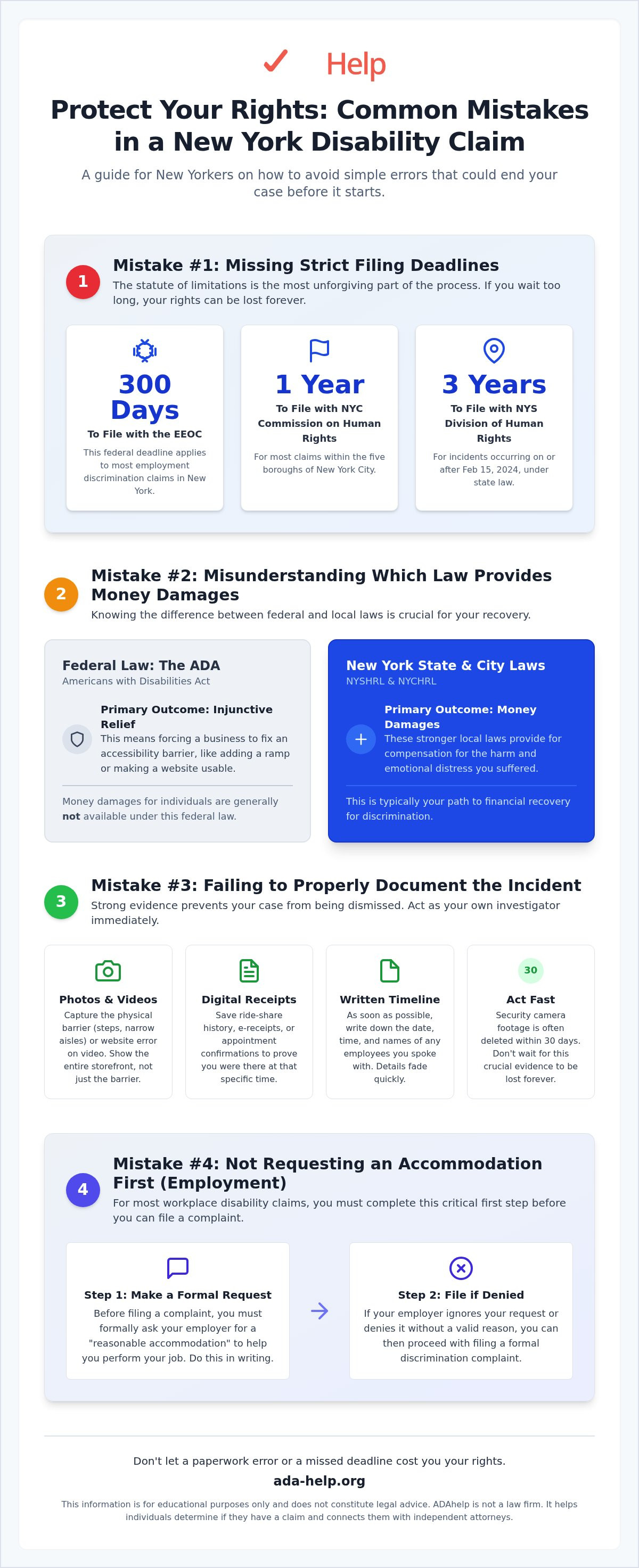
- Missing strict filing windows is the fastest way to lose your rights. You typically have 300 days to file with the EEOC in New York.
- The federal ADA only forces businesses to fix accessibility issues. You must use New York City or State laws to seek money damages for the harm you suffered.
- Strong evidence like photos and digital receipts can prevent your case from being dismissed for lack of proof.
- Understanding the mistakes to avoid when filing an ADA claim ensures your initial paperwork is accurate and ready for review.
- Most employment claims require you to request a reasonable accommodation before you can file a formal complaint.

Missing the Strict Deadlines for Your New York ADA Claim
The statute of limitations is the legal deadline for filing your claim. It is the most unforgiving part of the process. If you wait too long, your case ends before it even begins. One of the primary mistakes to avoid when filing an ADA claim is underestimating how fast these windows close. While the Americans with Disabilities Act (ADA) provides the federal framework for your rights, New York has its own set of rules that can either help or hinder you depending on your timing. You must act while the law still allows you to seek justice.
The EEOC vs. The New York State Division of Human Rights
The Equal Employment Opportunity Commission (EEOC) is the federal agency that handles employment discrimination. In many states, you only have 180 days to file. Because New York has its own anti-discrimination laws, that window is extended to 300 days. This is part of a process called dual filing. When you file with one agency, they often share the information with the other. However, missing that 300-day federal mark can disqualify you from certain federal protections immediately. It effectively shuts the door on one path to recovery.
New York State laws offer a broader safety net. For discriminatory acts occurring on or after February 15, 2024, you have three years to file a complaint with the New York State Division of Human Rights. For a full breakdown of every window that applies to you, see our ADA claim statute of limitations guide. If you are in the five boroughs, the New York City Commission on Human Rights typically requires you to file within one year for most administrative claims. This patchwork of dates is why a free case check is vital. It helps you identify which clock is ticking the fastest for your specific situation without any out-of-pocket cost.
Why Speed Matters for Public Access Claims
Evidence disappears faster than you think. This is especially true for public access violations, such as a restaurant without a ramp or a store with aisles too narrow for a wheelchair. Most businesses overwrite their security camera footage every 30 days. If you wait six months to start your claim, that video evidence is likely gone forever. You lose a powerful tool that could have proven your case instantly.
Witnesses are also a factor. People move, change jobs, or simply forget the details of what they saw. Starting the process early allows for a thorough case management review while the facts are still fresh. You need to secure digital records, receipts, and statements as quickly as possible to protect your right to recovery. Speed is your best defense against a denied claim and ensures you avoid one of the most common mistakes to avoid when filing an ADA claim.
Failing to Document the Discriminatory Incident Properly
You experienced a barrier that made it impossible to enter a business or do your job. That frustration is real. However, a sense of unfairness is not enough to win a case in New York. One of the primary mistakes to avoid when filing an ADA claim is relying solely on your memory of the event. To protect your right to recovery, you must act as your own investigator in the moments following the incident. Evidence disappears quickly; you must capture it while it is still available.
Photos are the gold standard for evidence. If you encountered a physical barrier, take a picture immediately. Beyond photos, you should save every receipt, ticket, or digital record that proves you were at the business. If you used a ride-share app to get there, save the trip history. These records establish that you were a customer or an applicant who was directly impacted by the discrimination. You should also write down a timeline of events as soon as you get home. Include the date, the time, and the names of any employees you spoke with during the incident.
Capturing Architectural Barriers in New York City
New York City is famous for its historic buildings, but age is not an excuse for non-compliance. When you encounter a barrier like a high step or a heavy door, document the surrounding area. Do not just take a close-up of the problem. Capture the entire storefront to show there was no alternative accessible entrance. Use a common object like a water bottle or a dollar bill next to a step to provide a sense of scale. This helps prove that the barrier was significant enough to prevent access. You should also document the lack of required signage or the height of service counters that were out of reach.
Digital Evidence for Website Accessibility Claims
Website accessibility is a rising trend in New York litigation for 2026. If a website does not work with your screen reader or lacks keyboard navigation, you need digital proof. Take screenshots of the specific pages where the errors occurred. If possible, record a short video of your screen while you attempt to use the site. This video can show exactly where the software fails to read a menu or a checkout button. Save any error messages you receive. If you tried to use a "contact us" form to report the issue and it also failed, that failure is a critical piece of evidence. You can use a free three-minute case check to see if your documentation is enough to move forward.
Never delete your digital trail. Text messages to friends or emails to management sent immediately after the incident are valuable. They serve as a record of your experience in real-time. Even a frustrated post on social media can help establish the timing of the event. Keep everything in a dedicated folder so you are ready when it is time to start your claim.
Not Using the Stronger New York City Human Rights Law
Many people assume that filing a federal claim is the only way to get justice. This is one of the most common mistakes to avoid when filing an ADA claim in New York. If you only rely on the federal Americans with Disabilities Act, you might be disappointed with the outcome. The federal law is designed to fix the problem; it is not designed to pay the person who was harmed. Real New Yorkers often find that the city law provides much broader protections and better results for the individual.
Ignoring local law means you might get the business to fix a physical barrier, but you will receive no financial recovery for your experience. You deserve more than just a promise that the business will do better next time. By using the right combination of city and state laws, you can ensure the business is held accountable and you are compensated for the discrimination you faced.
Injunctive Relief vs. Money Damages
You need to understand the difference between these two legal terms. Injunctive relief is a court order that forces a business to change a policy or fix a building. For example, it might require a store to install a ramp or make a website accessible. Money damages are financial compensation for your pain, suffering, and humiliation. While fixing the ramp is good for the community, it does not compensate you for the difficulty you faced. A successful case in NYC typically involves both. You get the barrier fixed and you seek payment for what you went through.
Why the NYCHRL is Your Best Friend
The New York City Human Rights Law (NYCHRL) is one of the most powerful civil rights laws in the country. It covers almost all employers and public spaces within the five boroughs. Unlike federal law, which often has strict limits on who can be sued, the NYCHRL is interpreted broadly to favor the victim. This means it is often easier to prove discrimination under city law than under federal law.
Typical recovery amounts vary from case to case. Recent settlements reported by the New York City Commission on Human Rights for failure to provide reasonable accommodations have seen damages ranging from $5,000 to over $145,000. These amounts are typical for the city, but your specific payout will depend on the facts of your situation; our disability discrimination settlement amounts guide breaks down what drives a case higher or lower. You can start the process with a free three-minute case check to see which laws apply to your claim. This is a low-risk way to ensure you are not leaving money on the table by ignoring the powerful protections available right here in the city.
Failing to Request a Reasonable Accommodation First
You might think your employer already knows what you need. Maybe your disability is visible; or perhaps you have mentioned your struggles in passing. Assuming your boss "should have known" is one of the most damaging mistakes to avoid when filing an ADA claim. In New York, the law generally requires you to take the first step. You must formally ask for an accommodation before you can claim you were discriminated against for not receiving one. A reasonable accommodation is simply a change to your job duties or your work environment that allows you to perform your tasks. Without a formal request; the legal clock for a discrimination claim often never starts ticking.
New York protections are broader than federal rules. While the federal ADA covers employers with 15 or more workers; the New York State Human Rights Law (NYSHRL) covers almost every employer with four or more employees. This means most New Yorkers have a right to ask for help. If you skip this step; you risk having your case dismissed because the employer can claim they were never given the chance to help you. You can start a free three-minute case check right now to see if your situation qualifies as a failure to accommodate.
The Interactive Process in New York
Once you make a request; the law requires an interactive process. This is a fancy way of saying you and your employer must have a conversation in good faith. It is a two-way street. You explain what you need; and they look for a solution that works for the business. In New York City; the rules are even stricter for bosses. An employer cannot simply say "no" and walk away. They must actively look for an alternative that does not cause them an undue hardship. If they stop talking or refuse to help without a valid reason; they may be violating the New York City Human Rights Law (NYCHRL).
How to Ask in Writing
Never rely on a hallway conversation. You must create a paper trail that proves you asked for help. Use clear; direct language. You do not need to be a lawyer to do this. A simple email stating; "I am requesting a reasonable accommodation under the ADA and New York law because of a medical condition;" is often enough to start the process.
- Send your request via email or certified mail so you have proof of delivery.
- Keep a copy of every message you send and every response you receive.
- If they ask for medical documentation; provide a note from your doctor that explains your limitations without giving away your entire medical history.
By keeping these records; you protect yourself if the employer ignores you or retaliates. This documentation is the foundation of a strong case management file. It shows that you did your part and the employer failed to do theirs. Avoiding the "silent request" mistake is the best way to ensure your rights remain protected in the New York workplace.
Filing Your Claim Without a Case Management Review
You are ready to take action. You want to hold a business or employer accountable for discrimination. However; attempting to do this alone is one of the most common mistakes to avoid when filing an ADA claim. Filing a claim without a professional review is a gamble. Most people don't realize that a single missing detail or a wrong date on your initial paperwork can lead to a permanent loss of your rights. The system isn't designed to be easy for the individual; it is designed for those who follow the rules perfectly.
The legal environment in New York is a complex mix of federal; state; and city rules. If you file with the wrong agency or use the incorrect form; the court can dismiss your case before an attorney even sees it. Case management provides a vital layer of protection. It helps organize your evidence and ensures your claim is strong before it reaches the next stage. Our guide to ADA case management New York walks through exactly what that process looks like. This preparation turns a sense of frustration into a clear; stress-free path toward a resolution. You get to focus on your life while a professional handles the heavy lifting of the filing process.
The Benefit of a Free Three-Minute Case Check
You don't have to guess if you have a valid case. A free three-minute case check gives you an immediate answer. It helps you determine if your situation meets the specific legal criteria for a claim in New York. Why waste months on a case that lacks the necessary proof? This check filters out the confusion and tells you exactly where you stand. It's the fastest way to see if you have a path to recovery without spending any money upfront. You can visit ada-help.org for an immediate check.
How Contingency-Fee Case Management Works
Cost is a major concern for many New Yorkers. You might worry about high hourly fees or expensive legal bills. Professional case management at ADAhelp works on a contingency model. This means fees are only taken if you win a settlement or a financial recovery. You never have to pay out-of-pocket for a professional case review. This removes the financial risk of seeking justice and puts the burden of effort on the service provider. You get professional help to organize your claim without the stress of an immediate bill. It's a low-risk way to protect your right to recovery while ensuring your paperwork is accurate.
By using a professional review; you avoid the technical traps that stop most claims in their tracks. This organized approach makes it much easier for independent contingency-fee attorneys to see the value in your case. Don't let a simple paperwork error stand between you and the justice you deserve. Take the first step today with a clear; organized plan.
Where to File: Agencies & Deadlines
Once you have documented the incident, you can file a formal complaint with one or more agencies. Each has its own process and its own deadline, so acting quickly protects your rights.
- New York State Division of Human Rights (DHR): Handles NYSHRL complaints statewide. You generally have three years to file for acts occurring on or after February 15, 2024. Learn more at dhr.ny.gov.
- NYC Commission on Human Rights (CCHR): Enforces the NYCHRL for the five boroughs. The filing deadline is typically one year from the discriminatory act. Details are available at nyc.gov/cchr.
- U.S. Equal Employment Opportunity Commission (EEOC): Handles federal ADA employment discrimination charges. You must generally file within 300 days of the discriminatory act in New York because the state has its own fair employment agency.
- U.S. Department of Justice (DOJ): Oversees broader ADA compliance and can be a useful resource when a situation extends beyond a single business. Learn more at ada.gov.
You do not have to navigate these agencies alone. A free case check helps you determine which path fits your situation and keeps your deadlines on track.
Protect Your Right to Recovery in New York
Your right to recovery depends on acting quickly and documenting every detail. Missing a 300-day filing window or failing to save a digital receipt can end your journey before it starts. One of the most important mistakes to avoid when filing an ADA claim is ignoring the powerful money damages available through the New York City Human Rights Law. While federal rules focus on fixing the building; city rules are what often provide the financial recovery you deserve for the discrimination you faced.
You don't have to handle this burden alone. Expert New York case management ensures your evidence is organized and your paperwork is accurate. It's a risk-free process because we operate on a no recovery; no fee model. You can find out exactly where you stand right now and take your free three-minute case check now.
Justice in New York is possible when you have a capable partner to handle the heavy lifting. Stop worrying about the technicalities and start focusing on your resolution. Take the first step toward the recovery you deserve today.
Frequently Asked Questions
How long do I have to file an ADA claim in New York City?
You have 300 days to file a charge with the EEOC for federal employment claims. For acts occurring on or after February 15, 2024, the New York State Human Rights Law allows three years to file a complaint. If you are filing with the New York City Commission on Human Rights, you generally have one year from the incident. Missing these windows is one of the top mistakes to avoid when filing an ADA claim in New York.
Can I get money for an ADA violation in New York?
Yes; you can seek money damages under state and city laws. While the federal ADA typically only forces a business to fix an accessibility barrier, the New York City Human Rights Law allows for financial compensation. This compensation covers pain; suffering; and emotional distress caused by the discrimination. Typical recovery amounts vary significantly based on the details of your specific case; but damages over $100,000 have been reached in some NYC settlements.
Do I need a lawyer to file a disability discrimination claim?
You don't need to hire a lawyer immediately to start the process. ADAhelp provides expert case management to help you organize your evidence and determine if you have a valid claim. If your case meets the criteria; we connect you with independent contingency-fee attorneys who only get paid if you win. This approach helps you avoid the high cost of hourly legal representation while ensuring your paperwork is handled professionally and accurately.
What happens if I cannot afford to pay for a case check?
You never have to pay out-of-pocket for a case check at ADAhelp. Our initial evaluation is completely free and takes only about three minutes to complete. One of the mistakes to avoid when filing an ADA claim is worrying about the cost of professional help. We operate on a contingency-fee model; which means the financial risk lies with the service providers rather than with you. If we move forward; fees are only taken from a successful settlement.
Is a website accessibility issue a real ADA violation in NY?
Yes; website accessibility is a major focus of disability law in New York. If a website doesn't work with screen readers or lacks keyboard navigation; it may violate both federal and city laws. In 2023 alone; over 1,500 ADA lawsuits were filed in New York courts regarding digital barriers. Businesses must ensure their online presence is accessible to everyone. Documenting these errors with screenshots is a vital part of protecting your right to a recovery.
What is the difference between the ADA and the New York City Human Rights Law?
The main difference is the type of relief they provide and who they cover. The federal ADA applies to employers with 15 or more workers and focuses on fixing physical or digital barriers. The New York City Human Rights Law is much broader; covering employers with as few as four employees. Most importantly; the city law allows you to seek money damages for your experience; whereas federal law generally only provides for changes to policies or buildings.
Can my employer fire me for filing an ADA claim?
It is illegal for an employer to fire or punish you for exercising your rights under the ADA or New York law. This is called retaliation. If you request a reasonable accommodation or file a complaint; you are protected by law. If your employer takes negative action against you after you speak up; you may have an additional claim for retaliation. This protection is a cornerstone of both state and federal civil rights for all workers.
What counts as evidence for a restaurant accessibility case?
Strong evidence includes clear photos of the physical barrier; such as a high step or a narrow restroom door. You should also save your receipt or a digital record of your visit to prove you were a customer. If an employee made a discriminatory comment; write down their name and exactly what they said while the memory is fresh. These details help case managers build a solid file for your potential recovery under New York law.

Article by
ADA Help
Written by the ADAhelp editorial team and reviewed for accuracy before publishing. ADAhelp helps New Yorkers find out if they have a disability discrimination claim and manages the process end to end, working with independent attorneys who handle the legal work. We are not a law firm and do not provide legal advice.
Disclaimer
This article is general information about New York law, not legal advice, and reading it does not create an attorney-client relationship. ADAhelp is a case-management and intake service, not a law firm; legal representation is provided by independent attorneys. Recovery amounts and timelines vary by case, and past outcomes do not guarantee future results. For advice about your specific situation, speak with a qualified attorney or start the free case check.
Tags
Discriminated against in New York because of a disability?
A free three-minute check tells you if you can pursue a claim.
Check my case →New York onlyNo upfront costIndependent NY attorneysFree 3-minute check