What Happens After Filing an ADA Complaint in New York Guide
Reviewed for accuracy by the ADAhelp team before publishing. ADAhelp is not a law firm; legal work is handled by independent New York attorneys.
Wondering what happens after filing an ADA complaint in New York? Our 2026 guide explains the timeline, investigation, and how to seek money damages under NY...
Filing a federal ADA complaint might stop the discrimination, but it won't put a single dollar in your pocket. You've likely already felt the sting of being turned away or ignored; now you're staring at a wall of legal jargon and government websites. It's normal to feel anxious about whether your claim will actually be heard or if it will just disappear into a pile of paperwork. Many New Yorkers wonder what happens after filing an ADA complaint in New York and why the process feels so opaque.
You deserve to know exactly how long the investigation takes and how the New York State Human Rights Law provides the financial recovery that federal law misses. We understand the confusion between federal agencies and local state laws; the path to justice shouldn't be a second source of stress. This 2026 guide explains the timeline of your claim, the role of agencies like the NYSDHR, and how to ensure your case is managed by experts without any out-of-pocket costs. You can stop worrying about the legal heavy lifting and focus on getting the justice you're owed.
Key Takeaways
- Expect a formal acknowledgment letter and a unique case number within 30 days of your submission.
- Learn what happens after filing an ADA complaint in New York as state investigators review evidence and may perform a site visit.
- Mediation offers a voluntary path to settle your case quickly through a meeting with a neutral third party.
- New York state laws allow you to seek money damages for discrimination while federal law only focuses on fixing the physical barrier.
- Start with a free three-minute case check to see if you qualify for professional case management at no out-of-pocket cost.

Receiving Your Official Acknowledgment and Initial Screening
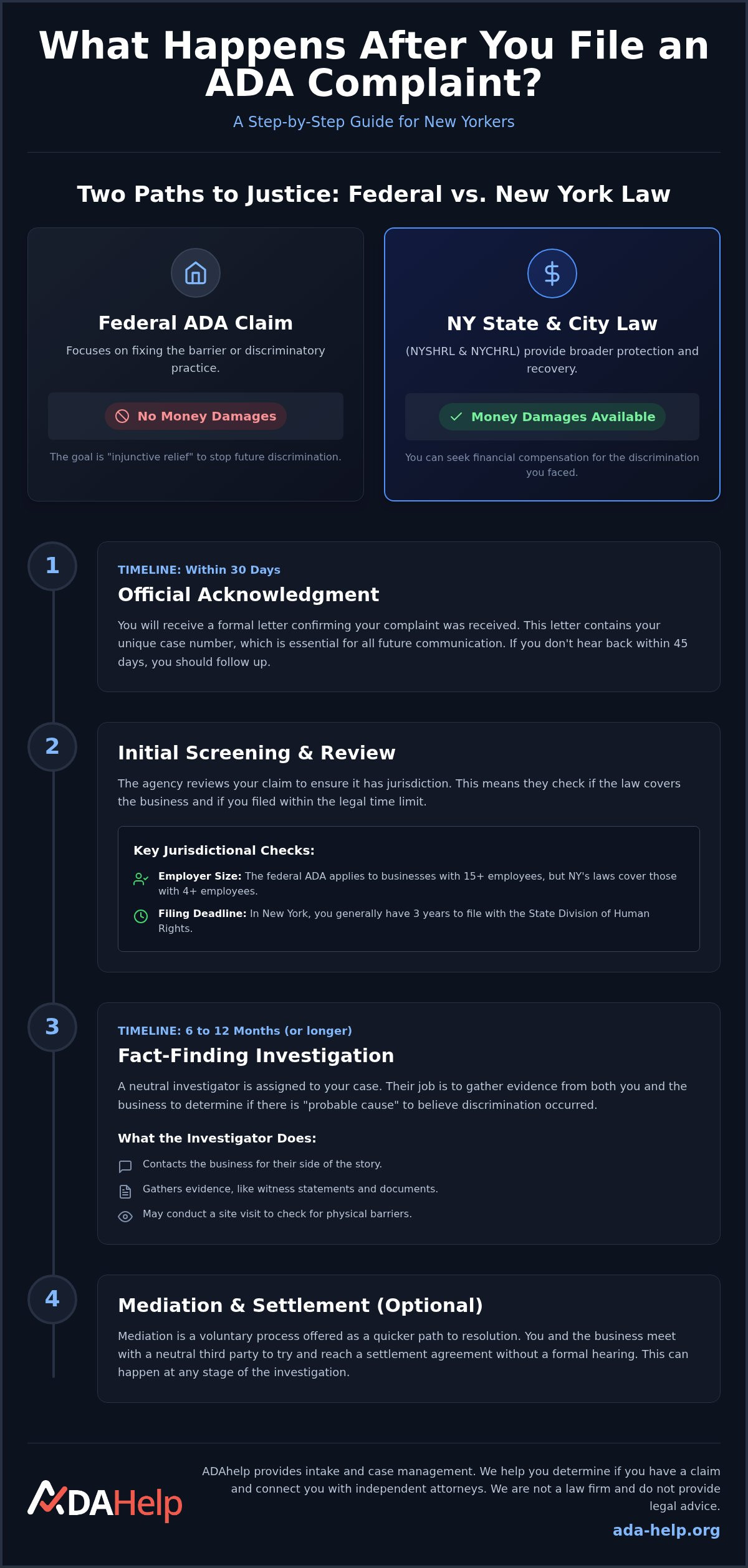
You have hit the submit button. Now you wait. The first thing you will receive is a formal acknowledgment letter from the agency. This usually arrives within 30 days of your submission. This letter is your confirmation that the system is moving. It contains a unique case number. You must use this number in every email or phone call you have with the agency. It is the key to tracking your progress through the state or federal system. Understanding what happens after filing an ADA complaint in New York helps lower your stress during this quiet period.
Most claims start under the Americans with Disabilities Act of 1990. However, in New York, your case often involves the New York State Human Rights Law (NYSHRL) as well. A staff member will review your claim to see if it meets jurisdictional requirements. This means they check if the agency has the legal power to handle your specific situation. They might ask you for more evidence or specific dates during this phase. Do not worry if they ask for more information; it is a standard part of the screening process to build a solid foundation for your case.
The First 30 Days of Your Claim
The month after you file is a waiting period. You should keep a digital and physical copy of your original complaint. Note the exact date and time you sent it. Check your mail and spam folders daily. The agency case number is the most important piece of information you will receive. Do not expect an immediate decision on the merits of your case. This stage is just about opening the file and making sure the basics are in order. If you do not hear anything after 45 days, you should call the agency to confirm they received your documents.
Initial Jurisdictional Review
The agency needs to verify a few things before they start a full investigation. They check if the business is actually covered by the law. For example, the federal ADA applies to employers with 15 or more people, but the NYSHRL covers those with four or more. They also check the clock. In New York, you generally have three years to file with the State Division of Human Rights for incidents occurring after February 15, 2024 — see our breakdown of the cost to file an ADA complaint for what to expect. This review is a critical part of what happens after filing an ADA complaint in New York because it determines if your case stays in the system. If the agency rejects your claim because of a technicality, you still have options. You can seek a private case check at ada-help.org to see if an independent attorney can help you through a different legal path.
The Fact-Finding Investigation by New York Authorities
Once your claim clears the initial screening, the formal investigation begins. An investigator from the New York State Division of Human Rights (NYSDHR) or the Equal Employment Opportunity Commission (EEOC) will take charge of your file. Their first move is to contact the business to get their side of the story. This is a standard part of what happens after filing an ADA complaint in New York. The business usually has a set window of time to provide a written response. You will likely receive a copy of this response, and you may be asked to write a rebuttal to disprove their claims.
Expect this phase to take time. Investigations in New York often last between six months and a full year. The speed depends on the complexity of the case and the current backlog at the agency. During this period, the agency acts as a fact-finder to determine if there is "probable cause" to believe discrimination happened. If you find the back-and-forth communication with government investigators stressful, a free case check can help you determine if professional case management is a better fit for your situation.
The Role of the Investigator
It's vital to understand that the investigator is a neutral party. They are not your personal advocate or your lawyer. Their goal is to collect evidence from both you and the business owner to find the truth. They will interview you about the incident and ask how the discrimination affected your daily life. Be prepared to provide concrete details. If there were people with you who saw what happened, the investigator will want their contact information to take witness statements. Clear, factual evidence is the best way to keep your case moving forward.
Site Visits and Evidence Gathering
For claims involving physical access, the agency might request a site visit. An investigator may go to the business to measure doorway widths, ramp slopes, or the height of service counters. They look for specific violations of the Americans with Disabilities Act. If your complaint involves a website, the investigator will test the digital interface for accessibility. In 2026, the Web Content Accessibility Guidelines (WCAG) are the recognized technical standards for ensuring web content and mobile apps are accessible to users with disabilities.
While you wait for these local findings, you may have also chosen to File an ADA Complaint with the Department of Justice at the federal level. Federal and state agencies often share information, but New York authorities are usually the ones who uncover the evidence needed for money damages. Keep all your photos, receipts, and notes organized. This data is the foundation of your claim and will be essential if your case moves toward a settlement or a hearing.
Mediation and Reaching a Settlement in Your Case
Mediation is often the quickest path to a resolution. It is a voluntary meeting where you and the business owner try to reach an agreement before a formal hearing. This is a key part of what happens after filing an ADA complaint in New York. Instead of waiting months for an investigator to finish their report, you sit down with a neutral third party to talk. This person is a mediator. They don't take sides. They don't decide who is right or wrong. Their only job is to help both parties find a middle ground that works for everyone.
Many New Yorkers prefer mediation because it gives them more control over the outcome. You get to speak your mind and explain how the lack of access impacted your life. If you reach a settlement, the process ends there. If you don't, your case simply goes back to the investigation or moves toward a hearing — our guide to disability discrimination resolution in New York walks through both outcomes. You haven't lost anything by trying. It is a low-risk way to seek justice without the stress of a long trial. Most importantly, it can lead to a faster recovery for the harm you experienced.
What Happens During Mediation
During the session, the mediator will likely put you and the business owner in separate virtual or physical rooms. They move back and forth to share offers and counter-offers. You don't have to talk directly to the person who discriminated against you if you don't want to. The mediator cannot force you to sign any agreement. If the business offers a deal that feels unfair, you can walk away. The investigation will continue exactly where it left off. You remain in the driver's seat throughout the entire conversation.
Typical Settlement Terms
A settlement in New York usually has two main parts. First, the business must promise to fix the accessibility barrier. This might mean installing a ramp, widening a door, or updating a website. Second, because you are in New York, the settlement often includes money damages for your emotional distress or out-of-pocket costs. This is a major difference between federal law and the New York State Human Rights Law. Federal law mostly focuses on fixing the problem; New York law focuses on making you whole.
Settlement agreements are usually confidential. This means you cannot discuss the specific dollar amount with others. They are also legally binding. Once you sign, the business is required by law to follow through on their promises. If you want to see if your case is ready for a settlement, you can check your eligibility at ada-help.org today. Our team can help you understand the strength of your claim before you enter the mediation room. We handle the heavy lifting so you can focus on getting the recovery you deserve.
Transitioning to a Lawsuit and Seeking Money Damages
If the agency investigation does not lead to a settlement, you may decide to take your case to court. This is a critical pivot in what happens after filing an ADA complaint in New York. While government agencies are helpful for finding facts, they often lack the power to force a business to pay you for your experience. Filing a lawsuit in state or federal court changes the stakes. It moves the case from a government office to a judge or jury. This is usually the stage where New Yorkers see the most significant financial results.
Injunctive Relief vs. Money Damages
You need to understand the difference between these two terms. Injunctive relief is a court order that forces a business to fix a physical barrier. Under the federal ADA, this is often all you can get. The judge might tell a store to widen its doors or fix a steep ramp. However, New York law goes much further. The New York State Human Rights Law (NYSHRL) and the New York City Human Rights Law (NYCHRL) allow for money damages. This is payment for the emotional pain and humiliation the discrimination caused you. Typical recovery amounts vary based on how the incident affected your life. In New York City, the local law is widely considered one of the strongest in the country for protecting individuals with disabilities.
The Right to Sue Letter
You cannot always jump straight into court. In many cases, you must first receive a "Right to Sue" letter from the EEOC or the State Division of Human Rights. This letter is a formal notice. It confirms that the agency has finished its initial review and you now have the legal permission to file a private lawsuit. Be careful with the clock. Once you receive this letter, you have a very limited window of time to act. If you miss the deadline, you may lose your right to seek money damages forever. Managing these deadlines is a major part of what happens after filing an ADA complaint in New York.
You don't have to track these dates alone. If you need help with the filing process, you can explore ADA Title III case management New York to ensure your rights are protected. We can help you determine if your case is strong enough for court. Our goal is to connect you with independent attorneys who work on a contingency basis. This means you never pay out-of-pocket for legal representation. Start your free case check today to see if you qualify for professional case management.
Where to File: Agencies & Deadlines
Depending on where the discrimination happened and who was involved, more than one agency may have jurisdiction over your case. Our step-by-step disability discrimination claim process guide covers the filing mechanics in more detail; here is a quick reference for which agency to use and how long you have to act.
- New York State Division of Human Rights (NYSDHR): covers employers with four or more employees and most places of public accommodation statewide. You generally have three years from the incident to file for conduct occurring after February 15, 2024. File at dhr.ny.gov.
- NYC Commission on Human Rights (CCHR): enforces the NYC Human Rights Law for incidents inside the five boroughs, one of the strongest local disability protections in the country. File at nyc.gov/cchr.
- U.S. Department of Justice (DOJ): handles ADA complaints against state and local government (Title II) and public accommodations (Title III). File at ada.gov.
- Equal Employment Opportunity Commission (EEOC): handles workplace disability discrimination under the federal ADA. In New York you generally have 300 days from the incident to file. File at eeoc.gov.
Filing with the wrong agency, or missing a deadline, can end a claim before it starts. If you are not sure which agency fits your situation, a free case check can help you sort it out before you file.
How ADAhelp Manages Your New York Discrimination Claim
You shouldn't have to be a legal expert to get the justice you deserve. The steps we've discussed can feel like a full-time job. That's why ADA Help - NY disability discrimination claims exists. We manage the entire process for you from start to finish. Our goal is to simplify what happens after filing an ADA complaint in New York so you can stay focused on your daily life. We start with a free three-minute case check. This quick tool helps us see if you have a valid claim under the New York State Human Rights Law or the federal ADA.
Once we see you have a case, we take over the heavy lifting. Our team handles the information gathering and the filing process. We know exactly what investigators look for in New York. We organize your evidence to build the strongest possible claim. Then, we connect you with independent attorneys who work on a contingency basis. This means they only get paid if you win a recovery. You never have to worry about out-of-pocket fees or hourly rates. It is a completely risk-free way to hold businesses accountable for their actions.
The ADA Help - NY disability discrimination claims Case Management Process
Our process is designed for speed and accuracy. It begins with our online evaluation tool. You answer a few simple questions about the incident. After that, we help you organize your photos, receipts, and witness statements. These documents are the backbone of your claim. We make sure everything is formatted correctly for New York authorities. Our experts also track every deadline. Missing a single date can end your case. We ensure that never happens by providing constant updates on what happens after filing an ADA complaint in New York.
Zero Risk Advocacy for New Yorkers
It is important to remember that ADA Help - NY disability discrimination claims is not a law firm. We are your proactive case management partner. We work behind the scenes to prepare your case for the experts. By handling the paperwork and organization, we make your claim more attractive to top-tier attorneys. You can learn more about your specific Disability discrimination rights New York protections through our 2026 guide. We take the stress out of the system. We handle the difficult conversations and the complex forms. This zero-risk approach means you can pursue justice without financial fear. If there is no recovery, there is no fee. You can start your path to resolution today with a simple click.
Take Control of Your Recovery Today
You now have a clear map of what happens after filing an ADA complaint in New York. You understand that while federal law focuses on fixing physical or digital barriers; New York state and city laws focus on your personal recovery. The path from the initial acknowledgment letter to a final settlement is complex. It requires constant attention to deadlines and evidence. You don't have to manage this burden alone or worry about hidden legal costs.
Our team provides the expert New York support you need to manage these claims without any financial risk. We handle the heavy lifting; organize your documentation; and connect you with independent attorneys who work on contingency. This means you never pay out-of-pocket fees. Every New Yorker deserves a fair path to justice and a stress-free resolution. You've already taken the first step by learning how the system works. Now; it's time to secure the results you deserve.
Start your free three-minute case check now to see if you qualify for professional case management. We are ready to help you turn your experience into a successful claim.
Frequently Asked Questions
How long does the New York ADA complaint process take?
The investigation process typically takes between six months and a full year. This timeline depends on the complexity of your case and the current backlog at the agency. While you wait; the investigator gathers evidence and interviews witnesses to determine if discrimination occurred. Understanding what happens after filing an ADA complaint in New York helps you manage expectations during this quiet period. We track these timelines for you so you never feel left in the dark.
Can I get money for a disability discrimination claim in New York?
Yes; you can seek money damages under the New York State Human Rights Law and the New York City Human Rights Law. While federal law usually only forces a business to fix an accessibility issue; New York laws allow for financial recovery for emotional distress and other harms. Typical recovery amounts vary based on the specific facts of your case. We help you determine if your situation qualifies for this type of financial compensation through a quick evaluation.
What is the difference between the EEOC and the New York State Division of Human Rights?
The EEOC is a federal agency that enforces the Americans with Disabilities Act; while the NYSDHR enforces state-level protections. In New York; these agencies have a work-sharing agreement. This means filing with one often cross-files with the other automatically. However; the NYSDHR provides access to money damages that the federal EEOC cannot offer. We help you navigate the interplay between these two authorities to maximize your potential recovery and ensure your rights are protected.
Do I need a lawyer to file an ADA complaint in New York?
You are not required to have a lawyer to file an initial complaint. However; having professional case management and access to an attorney is vital if you want to secure a financial settlement. The process involves complex deadlines and legal standards that are difficult to handle alone. We connect you with independent contingency-fee attorneys who handle the legal work while you focus on your daily life. This ensures your rights are fully protected without any upfront costs.
What happens if the business ignores my ADA complaint?
If a business ignores the investigator; the agency may move forward without their input. This often leads to a finding of probable cause against the business because they failed to defend themselves. A lack of response does not stop your claim; it actually makes your case stronger in many situations. The agency can then schedule a public hearing or allow you to move the case to court. We monitor these responses to ensure the business is held accountable.
Is there a time limit to file a disability discrimination claim in NYC?
Yes; you have three years from the date of the incident to file a complaint with the New York State Division of Human Rights for events after February 15; 2024. For federal claims with the EEOC; you only have 300 days. These strict deadlines are a major part of what happens after filing an ADA complaint in New York. If you wait too long; you lose your right to sue. We help you track these dates immediately.
What does a Right to Sue letter actually mean?
A Right to Sue letter is a formal notice that the agency has finished its review of your case. It gives you the legal green light to file a private lawsuit in court. This letter starts a very short clock; often just 90 days; to start your legal action. Receiving this letter is a major milestone in your claim. We help you prepare for this transition so you can move quickly toward a financial recovery without missing your window.
Will I have to pay any money up front to start my case?
No; you never pay any out-of-pocket fees to start your case with our help. We provide a free three-minute case check to evaluate your situation. If we manage your claim; we connect you with attorneys who work on a contingency basis. This means they only get paid if they win money for you. You don't have to worry about hourly rates or expensive retainers. The financial risk stays with the service providers; not with you or your family.

Article by
ADA Help
Written by the ADAhelp editorial team and reviewed for accuracy before publishing. ADAhelp helps New Yorkers find out if they have a disability discrimination claim and manages the process end to end, working with independent attorneys who handle the legal work. We are not a law firm and do not provide legal advice.
Disclaimer
This article is general information about New York law, not legal advice, and reading it does not create an attorney-client relationship. ADAhelp is a case-management and intake service, not a law firm; legal representation is provided by independent attorneys. Recovery amounts and timelines vary by case, and past outcomes do not guarantee future results. For advice about your specific situation, speak with a qualified attorney or start the free case check.
Tags
Discriminated against in New York because of a disability?
A free three-minute check tells you if you can pursue a claim.
Check my case →New York onlyNo upfront costIndependent NY attorneysFree 3-minute check