
ADA Retaliation Claim New York: Your Rights and Recovery
Reviewed for accuracy by the ADAhelp team before publishing. ADAhelp is not a law firm; legal work is handled by independent New York attorneys.

Facing punishment after requesting an accommodation? You may have an ADA retaliation claim New York. Learn your rights and see if you can get money damages.
Did your boss start cutting your hours or criticizing your work the moment you requested a reasonable accommodation? It is a common fear for many workers; however, punishing an employee for asserting their rights is illegal. If you are facing a hostile environment after speaking up about a disability, you may have grounds for an ADA retaliation claim New York. Under the New York State Human Rights Law, it is now explicitly illegal for an employer to retaliate against you just for asking for the tools you need to succeed.
You likely feel anxious about the cost of a lawyer or the risk of losing your job entirely. We understand that this pressure is overwhelming. This guide explains how to identify workplace or public access retaliation and how the New York City Human Rights Law provides broader protections than federal law alone. You will see how money damages for lost wages and emotional distress are possible through state and city statutes. We provide case management to help you determine if you have a claim and connect you with independent attorneys. You can check your case for free; ensuring you never pay out of pocket because fees are only taken if there is a financial recovery.
Key Takeaways
- Learn why you can win an ADA retaliation claim New York even if your original discrimination complaint is eventually dismissed.
- Identify subtle red flags like sudden schedule changes or increased scrutiny that often follow an accommodation request.
- Discover how New York City and State laws provide the financial recovery for emotional distress that federal law typically lacks.
- Find out the specific steps to document your timeline and protect your rights before your filing deadlines expire.
- See how to start a free case check with a partner who manages the process and connects you with contingency-fee attorneys.

What is an ADA Retaliation Claim in New York?
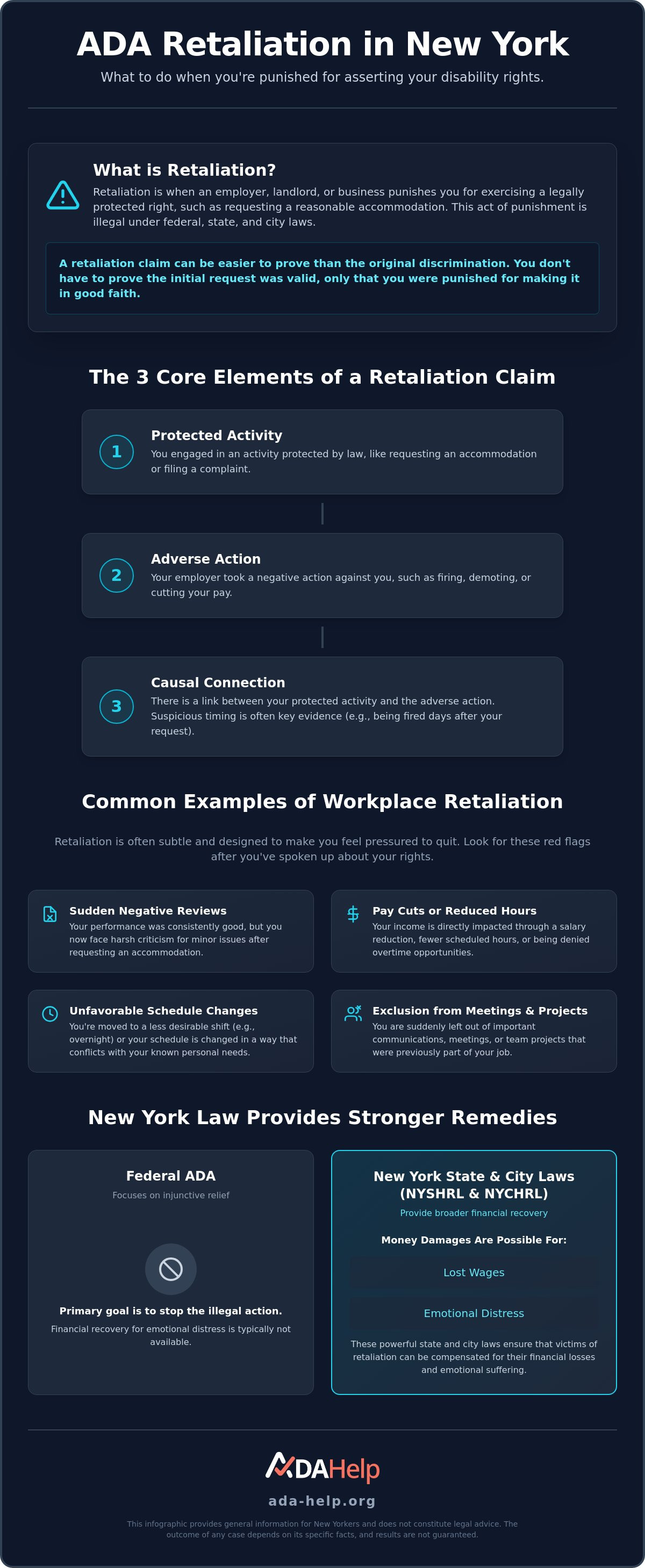
Retaliation happens when an employer, landlord, or business owner punishes you for exercising your legal rights. It's a specific type of violation where the act of standing up for yourself becomes the reason for the punishment. In many cases, an ADA retaliation claim New York is actually easier to prove than the original discrimination. You don't have to prove that the business was definitely discriminating against you; you only need to show they punished you for complaining about it in good faith.
The federal Americans with Disabilities Act of 1990 was designed to ensure that people with disabilities could participate fully in society without fear. Title V of this law specifically prohibits any form of coercion or intimidation against those who assert their rights. Whether you're asking for a desk at a specific height or reporting a store that lacks a wheelchair ramp, the law is on your side. If your situation changed for the worse immediately after you spoke up, you're likely looking at a retaliation case.
To better understand how these situations unfold in real life, watch this helpful video:
The Three Elements of a Retaliation Claim
Building a successful case requires proving three specific things happened. First, you must have engaged in a "protected activity." This means you did something the law encourages, like requesting a reasonable accommodation or filing a formal complaint. Second, you must show that your employer or a public business took an "adverse action" against you. This isn't always a firing; it can be a demotion, a pay cut, or even a sudden, unexplained shift in your job duties. Finally, there must be a "causal connection" between your activity and their action. If you asked for a medical accommodation on a Friday and were "let go" the following Monday, the timing itself suggests the two events are linked.
Protected Activities for New Yorkers
New Yorkers enjoy some of the strongest protections in the country through the New York State Human Rights Law (NYSHRL) and the New York City Human Rights Law (NYCHRL). These laws cover a wide range of actions. You're protected when you report an inaccessible building or a website that doesn't work with screen readers. You're protected when you request a modified work schedule to attend medical treatments. You're even protected if you testify as a witness in a discrimination investigation for a coworker. The law ensures that you don't have to choose between your rights and your livelihood. If you feel you've been targeted for speaking up, it's time to see if you have a case.
Common Examples of Retaliation at Work and in Public
Many New Yorkers believe retaliation only happens when they are fired. In reality, it's often a slow, subtle campaign designed to make you quit your job or give up your housing. This is why an ADA retaliation claim New York is frequently more successful than the original discrimination complaint. You don't have to prove the employer was wrong about your disability; you only have to prove they punished you for speaking up. If your environment changed the moment you asserted your rights, the law considers that a red flag. According to the EEOC Facts About Retaliation, any action that might deter a reasonable person from making a complaint counts as retaliation.
Workplace Retaliation Tactics
Punishment at work often hides behind the label of performance management. If you were a top performer for years and suddenly face harsh reviews after asking for a standing desk, the timing is suspicious. Employers might cut your pay or change your shift to one they know you can't work. They might stop inviting you to meetings or exclude you from important emails. Sometimes, a manager will start "building a file" by documenting minor errors that were ignored before. This increased scrutiny creates a hostile atmosphere. It's meant to pressure you into leaving on your own terms. You might also notice you're being assigned the least desirable tasks or moved to a remote corner of the office. If this sounds like your situation, you should check your case status to protect your career.
Retaliation in Housing and Public Access
Retaliation also happens where you live and shop. A landlord might suddenly refuse to renew your lease after you ask for a grab bar in the shower. They might even threaten eviction because you require a service animal or a designated parking spot. These actions are illegal under the New York State Human Rights Law. In public spaces, a business owner might ban you from their store because you reported their lack of a ramp to the city. Website owners have even been known to block user accounts or disable features after receiving an accessibility complaint. These aren't just "unfortunate" interactions; they are legal violations that can lead to financial recovery for emotional distress and lost access. Documenting these interactions is the first step toward holding the retaliating party accountable. New York City laws are particularly strict about these behaviors, ensuring that you can't be bullied out of your rights.
New York Laws vs. the Federal ADA
Understanding the difference between federal and local laws is the key to your financial recovery. The federal Americans with Disabilities Act (ADA) is excellent for forcing a business to fix a physical barrier or an inaccessible website. However, it rarely puts money in your pocket. If you are filing an ADA retaliation claim New York, you need the added strength of the New York State Human Rights Law (NYSHRL) and the New York City Human Rights Law (NYCHRL). These local laws were written to compensate the victim; not just fix the problem.
While federal law often caps damages based on the size of the employer, New York laws offer much broader protection. In fact, many damages under the NYSHRL and NYCHRL are uncapped. This means your recovery can reflect the actual harm you suffered. If a manager punished you for asking for an accommodation, the law aims to make you whole again through financial compensation. Since December 5, 2025, the NYSHRL has explicitly protected employees who request reasonable accommodations from any form of retaliation.
The NYSHRL and NYCHRL Advantage
The federal ADA applies to employers with 15 or more employees. This leaves many workers unprotected. In contrast, the NYSHRL applies to employers with four or more employees. If you work in the five boroughs, the NYCHRL is even more powerful. It applies to virtually all employers. This city law also has a lower burden of proof. You don't always have to prove your employer was malicious. You only need to show they treated you less well because of your protected activity. Typical recoveries in these cases include back pay for lost wages, front pay for future losses, and compensatory damages for your suffering.
Why Money Damages Matter
Retaliation claims in New York target the financial and emotional harm caused by the punishment. A federal court order to install a ramp won't help you if you've already been fired or demoted. Under New York City law, you can recover money for emotional distress. This compensates you for the anxiety and loss of dignity caused by the retaliation. If the employer's behavior was especially malicious, a court might even award punitive damages. These are designed to punish the retaliating party and stop them from hurting others. For a deeper look at how these rules apply specifically to your job, read our Employment Disability Discrimination New York guide. Your recovery depends on using the right law for your specific situation.
How to Document Retaliation for Your Claim
Evidence is the foundation of every successful retaliation claim. Without a clear record, your employer might claim your demotion or firing was based on performance rather than your request for help. You need to prove that the punishment happened because you asserted your rights. This is why documenting every interaction is critical for your ADA retaliation claim New York. Start your record-keeping the moment you make an initial request for an accommodation or report a barrier. If you haven't started yet, begin today by writing down everything you remember.
Building Your Paper Trail
Building a paper trail is your best defense. Forward every relevant email and text message to a personal account that your employer cannot access. If you are suddenly locked out of your workstation, you won't lose your proof. Maintain a retaliation log that includes dates, times, and the names of anyone who witnessed the behavior. Pay close attention to temporal proximity. This is a legal term for how soon the punishment followed your request. If your hours were cut two days after you asked for a screen reader, that short gap is powerful evidence. Note how you are treated compared to coworkers who didn't ask for help. Are you the only person suddenly being written up for minor errors?
Avoiding Common Mistakes
Don't make impulsive decisions that could hurt your recovery. It's tempting to quit a toxic job immediately; however, doing so without a plan might weaken your claim. You should also avoid signing any severance or release forms without a professional review. These documents often contain waivers that prevent you from ever filing a lawsuit. If your retaliation is happening at home rather than at work, see our guide on Housing Disability Discrimination New York for specific advice. For a step-by-step evidence method, our checklist on documenting workplace discrimination in NY walks through exactly what to save. Your documentation should include every interaction with your landlord or property manager. To see if your evidence is enough to move forward, start your free case check today and let us help you manage the process.
Where to File: Agencies & Deadlines
An ADA retaliation claim New York can be filed with more than one agency, and each has its own deadline. Choosing the right forum protects your right to money damages, so note these windows before you act:
- NY State Division of Human Rights (DHR) — file an administrative complaint under the NYSHRL within 3 years for a court lawsuit, or 1 year for an administrative charge. Start at dhr.ny.gov/complaint.
- NYC Commission on Human Rights (CCHR) — for retaliation in the five boroughs, the NYCHRL gives you 1 year to file with the Commission (or 3 years to sue in court). Learn more at nyc.gov/site/cchr.
- U.S. Department of Justice (DOJ) — for ADA public-access and Title V retaliation issues, report to the DOJ via ada.gov/file-a-complaint.
- EEOC — for federal employment retaliation, you must file within 300 days in New York. See eeoc.gov/filing-charge-discrimination.
Deadlines run from the date of the retaliatory act, and missing one can bar your recovery. If you're unsure which agency fits your situation, a free case check can point you in the right direction.
Start Your New York Retaliation Case Check
You have documented the changes in your workplace. You have saved the emails. Now, you need to turn that evidence into a formal ADA retaliation claim New York. The legal system in New York is powerful; however, it's also complex. Trying to manage the filing deadlines for the EEOC or the New York State Division of Human Rights on your own can be exhausting. ADA Help - NY disability discrimination claims exists to take that burden off your shoulders. We manage the entire process for you; from the initial evaluation of your facts to the final connection with a legal professional.
It's important to understand that ADA Help - NY disability discrimination claims is not a law firm. We don't provide legal advice. Instead, we provide intake and case-management services designed to help you determine if you have a valid claim. We then connect you with independent attorneys who understand the specific interplay between federal and New York City laws. These attorneys work on a contingency-fee model. This means you never pay out-of-pocket for their services. Fees are only taken if they successfully secure a financial recovery for you. Our three-minute case check is free and carries no financial risk to you or your family.
Our Case Management Process
Getting started is simple and takes very little time. First, you will answer a few direct questions about your situation in New York. We need to know where the retaliation happened and what specific actions were taken against you. Second, we gather the necessary details to determine if your case meets the requirements for a claim under the NYSHRL or NYCHRL. If your case is eligible, we connect you with an experienced attorney to fight for your recovery. You don't have to worry about finding a lawyer who specializes in disability rights; we handle that search for you. This streamlined approach ensures your claim moves forward without unnecessary delays.
Why Choose ADA Help - NY disability discrimination claims?
We focus exclusively on New York disability and retaliation claims. We know the local legal environment and the specific protections offered within the five boroughs. While you focus on your life and your health, we handle the heavy lifting of case organization. We ensure that your story is heard and that the retaliating party is held accountable for their actions. There is no cost to see if you have a case, and there is no risk to your personal finances. You have already faced enough punishment for standing up for your rights. It's time to let a proactive partner help you find a resolution. Start your free three-minute case check now to begin your path toward recovery.
Take the Next Step Toward Justice
Standing up for your rights should never cost you your career or your stability. You now understand that New York laws provide much stronger paths to recovery than federal law alone. These local statutes ensure that punishment for asserting your rights leads to real accountability. By documenting your experience and recognizing the strength of an ADA retaliation claim New York, you have prepared yourself to seek justice.
You don't have to face this process without support. ADA Help - NY disability discrimination claims offers specialized case management at no personal financial risk. We are not a law firm; instead, we evaluate your situation and connect you with independent contingency-fee attorneys. These experts only receive payment if you get a recovery. There are no upfront costs or hidden fees. We handle the organizational work so you can focus on moving forward. Our team knows the specific rules in the five boroughs and is ready to help you protect your future.
Get your free three-minute case check today. You have already shown the courage to speak up; now let us help you secure the recovery you deserve.
Frequently Asked Questions
How long do I have to file a retaliation claim in New York?
The deadline depends on the specific law you choose for your case. For an ADA retaliation claim New York under the State Human Rights Law, you generally have three years to file a lawsuit for incidents occurring on or after February 15, 2024. If you prefer to file an administrative complaint with the New York State Division of Human Rights or the NYC Commission on Human Rights, you must act within one year. Federal EEOC charges have a much shorter window of only 300 days.
Can I be retaliated against if my original ADA request was denied?
Yes, you are protected even if your employer or landlord legally denied your initial request. The law protects the act of speaking up in good faith. You do not have to prove that a discrimination violation actually occurred to win a retaliation case. As long as you had a reasonable belief that you were asserting your rights, any punishment that follows is illegal. This ensures that New Yorkers can advocate for themselves without fear of losing their jobs or housing.
What kind of money can I get for an ADA retaliation claim?
You can seek financial recovery for lost wages, future earnings, and emotional distress. While federal law often limits these amounts based on company size, New York State and City laws frequently allow for uncapped compensatory damages. This means your recovery is based on the actual harm you suffered. In cases where the behavior was particularly malicious, New York City law also allows for punitive damages. These are designed to punish the offender and prevent future violations.
Do I need a lawyer to start my case check with ADA Help - NY disability discrimination claims?
No, you do not need a lawyer to begin our process. ADA Help - NY disability discrimination claims is a case management service that helps you evaluate your situation and organize your evidence first. If we determine you have a valid claim, we connect you with independent attorneys from our network. These professionals work on a contingency-fee basis. You never pay out of pocket; fees are only collected if you receive a financial recovery.
Can my employer fire me for filing an ADA complaint?
No, firing an employee for reporting discrimination or requesting a reasonable accommodation is a direct violation of the law. This protection applies whether you made a formal complaint or just sent an internal email to your supervisor. If your termination happened shortly after you asserted your rights, the timing serves as powerful evidence. The law exists to ensure that no New Yorker is forced to choose between their legal rights and their paycheck.
What if I was retaliated against by a landlord in NYC?
Landlords in the five boroughs face strict penalties for retaliating against tenants. If your landlord threatens eviction, refuses to renew your lease, or increases your rent because you requested a modification, they are violating the New York City Human Rights Law. You can file a claim to stop the harassment and seek money damages for the stress and instability caused to your home. NYC laws are specifically designed to protect tenants from being bullied out of their apartments.

Article by
ADA Help
Written by the ADAhelp editorial team and reviewed for accuracy before publishing. ADAhelp helps New Yorkers find out if they have a disability discrimination claim and manages the process end to end, working with independent attorneys who handle the legal work. We are not a law firm and do not provide legal advice.
Disclaimer
This article is general information about New York law, not legal advice, and reading it does not create an attorney-client relationship. ADAhelp is a case-management and intake service, not a law firm; legal representation is provided by independent attorneys. Recovery amounts and timelines vary by case, and past outcomes do not guarantee future results. For advice about your specific situation, speak with a qualified attorney or start the free case check.
Tags
Discriminated against in New York because of a disability?
A free three-minute check tells you if you can pursue a claim.
Check my case →New York onlyNo upfront costIndependent NY attorneysFree 3-minute check