
Documenting Workplace Discrimination NY: A Checklist
Reviewed for accuracy by the ADAhelp team before publishing. ADAhelp is not a law firm; legal work is handled by independent New York attorneys.

Learn how to document workplace discrimination in NY. Our checklist helps you save emails and record conversations to build a strong disability claim. Start ...
Did you know that your private notes and saved emails are the foundation of documenting workplace discrimination NY? You likely feel the weight of a hostile office every day. The fear of retaliation often makes it hard to speak up. It's exhausting to manage a disability while wondering if your supervisor is trying to force you out. We understand that stress. You deserve a workplace that respects the law and your rights.
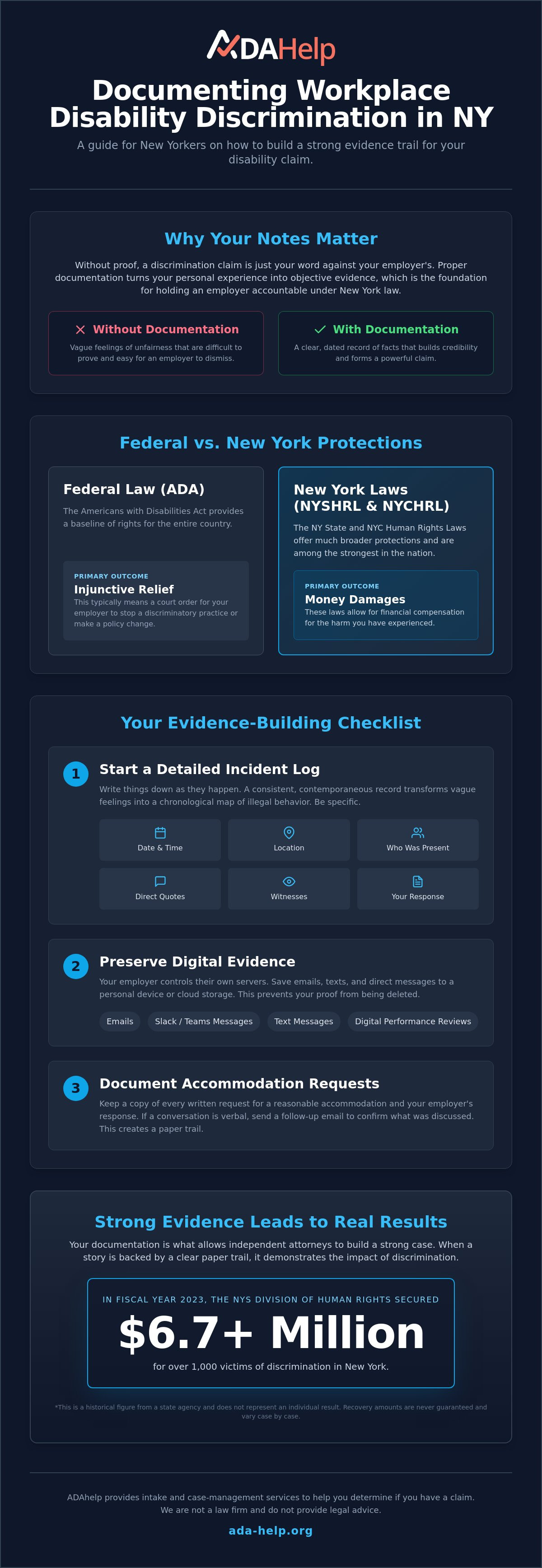
This guide shows you exactly how to build a strong evidence trail for your disability claim. You'll learn which documents to save and how to record conversations safely under New York laws. While the federal ADA provides injunctive relief, money damages typically come from the broader New York State and City Human Rights Laws. ADAhelp is not a law firm; we provide intake and case management to help you determine if you have a claim. We handle the heavy lifting by reviewing your facts and connecting you with independent contingency-fee attorneys. Use this checklist to gain the confidence you need to start your free three-minute case check.
Key Takeaways
- Documentation turns your personal experience into objective proof. It is the key to building a claim under the New York State Human Rights Law.
- Start an incident diary immediately to record specific dates and witnesses. Proper documenting workplace discrimination NY requires capturing details while they are fresh in your mind.
- Preserve all digital evidence including emails, Slack messages, and texts. These records prevent your employer from deleting proof of harassment or unfair treatment.
- Keep a copy of every written request for a reasonable accommodation. This proves you asked for the support you need to do your job effectively.
- Follow your employee handbook when reporting to HR. After you gather your evidence, start a free three-minute case check to see if you have a claim.
Why documenting workplace discrimination in New York matters
You feel the tension the moment you walk into the office. Maybe your boss makes subtle comments about your disability or ignores your requests for a modified schedule. Without proof, these moments are just your word against theirs. You must start documenting workplace discrimination NY to turn your personal experience into objective evidence. This paper trail is the only way to hold a powerful employer accountable. While federal employment discrimination laws like the ADA set a baseline for rights, New Yorkers have access to much broader protections that can lead to financial recovery.
To better understand how small interactions build a larger case, watch this helpful video:
Federal vs. New York disability protections
The Americans with Disabilities Act (ADA) is a federal law that serves as a floor for your rights. It focuses on "injunctive relief," which means fixing access issues or changing policies. If you win an ADA claim, a judge might order your boss to stop their behavior. However, the ADA rarely provides money damages for employees. This is why New York laws are so vital. The New York State Human Rights Law (NYSHRL) and the New York City Human Rights Law (NYCHRL) allow for financial relief. The NYCHRL is widely considered one of the strongest civil rights laws in the nation. It covers almost all employers in the city; even those with only a few employees must follow it. If you work in the five boroughs, your documentation helps you use these unique legal advantages.
The role of evidence in your recovery
What is your case worth? This is the most common question we hear. Recovery amounts are never guaranteed and vary case by case. However, the data shows that the system works when you have proof. In fiscal year 2023, the New York State Division of Human Rights secured over $6.7 million for over 1,000 victims of discrimination. This was the highest total in six years. Your specific recovery depends almost entirely on the strength of your record. Evidence like emails, saved texts, and a detailed log build your credibility. When your story is backed by a clear paper trail, it is harder for an employer to lie about why they fired or demoted you. ADA Help - NY disability discrimination claims handles the intake and case management to determine if you have a claim. This documenting workplace discrimination NY is what allows independent attorneys to build a case for the money damages you deserve.
Creating a detailed disability discrimination incident log
The moment you feel targeted at work, your most powerful tool is a pen or a keyboard. Memories fade quickly. Stress can cloud the details of a hostile meeting or a cruel comment. You need a contemporaneous record. This means you write things down as they happen. An incident log transforms vague feelings of unfairness into a chronological map of illegal behavior. When you are documenting workplace discrimination NY, consistency is your best friend. If you record every event in the same way, you show a clear pattern of harassment rather than a one-time misunderstanding. This evidence is vital because it shows the "who, what, and when" of your experience before your employer has a chance to change the narrative.
What details to include in every entry
Vague notes like "my boss was mean today" won't help your case. You need specifics. Every entry should include the date, exact time, and the specific room or office where the event occurred. List every person who was in the room or even just nearby. These people are potential witnesses who can verify your story later. If a supervisor says, "You're too slow because of your condition," write those words down exactly as spoken. Quote discriminatory comments exactly. Don't summarize or paraphrase. Facts are harder to dispute than opinions. If you receive a discriminatory email, don't just log it. Print a hard copy or forward it to your personal email address immediately. If your boss denies you a reasonable accommodation during a phone call, send a follow-up email to "confirm" the conversation. Then, log the date and time you sent that confirmation. This creates a double layer of proof.
Where to store your documentation safely
Never use a company computer or your work email to keep this log. Your employer owns that data. They can delete it, block your access, or use it against you during an investigation. Use a personal notebook that you keep at home. If you prefer digital notes, use a password-protected personal cloud account or a private email address. A digital log is often easier to search and organize. If you use an app like Google Docs, ensure you are signed into a personal account. Do not use your work Wi-Fi to sync these files. Use your cellular data or home internet to keep your activity private. This extra layer of security prevents IT departments from spotting your preparations. The New York State Division of Human Rights relies on this type of organized evidence when investigating claims. Ensure your log is backed up so you do not lose your evidence if a device fails. Once you have your first few entries, you can check your case eligibility to see if your documentation is enough to move forward.
Preserving digital and physical evidence of harassment
Digital records are often the decisive proof in New York disability cases. While your incident log provides the narrative, digital evidence provides the cold, hard facts. You must act quickly. Employers can often wipe company servers or remote-delete Slack messages without warning. When you are documenting workplace discrimination NY, your goal is to create a permanent archive that your boss cannot touch. This includes everything from formal performance warnings to casual, offensive comments in a group chat. This evidence is what allows you to seek money damages under the New York State Human Rights Law (NYSHRL) and the New York City Human Rights Law (NYCHRL). Without these records, it is much harder to prove that your employer’s actions were motivated by bias.
Saving emails and text messages correctly
Don't rely on your memory or a single device. Forward relevant emails to a personal account if company policy allows it. If you aren't sure about the policy, take clear photos of your screen with a personal phone. Always include the email headers. These headers contain the sender information, date, and specific time. This data is vital for the New York State Division of Human_Rights to verify your timeline and the authenticity of the message. Take screenshots of Slack conversations or text messages immediately. Organize these images into folders by date. This prevents your evidence from getting lost in your camera roll or being deleted by a system administrator.
Gathering performance and comparison evidence
Review your performance evaluations carefully. Note if they turned negative shortly after you disclosed your disability or requested an accommodation. Save copies of your older, positive reviews to show this sharp contrast. Document comparison data as well. If a non-disabled coworker isn't punished for the same mistakes you made, write it down. If they receive the better assignments or promotions while you are sidelined, keep a record of those specific instances. This comparison proves that the "performance issues" your boss claims are actually a cover for discrimination. This is a vital part of documenting workplace discrimination NY effectively. It shows that your disability, not your work quality, is the real reason for the change in treatment.
Collecting these records might feel like a second job. However, this physical and digital trail turns a difficult conversation into a legal fact. You are providing the necessary facts to hold your employer accountable for their actions. If you have gathered these documents, you can start a free case check to see what your claim might be worth. We help you organize these details and connect you with independent attorneys who only get paid if you win. You don't have to carry this burden alone.
Documenting your request for reasonable accommodation
A reasonable accommodation is a change at work that helps you do your job. It might be a screen reader; a modified schedule; or a desk closer to the restroom. Under the New York City Human Rights Law (NYCHRL), most employers must provide these supports unless they can prove it creates a significant difficulty. Your job is to make sure every step of this process is recorded. Documenting workplace discrimination NY starts with your first request. If you don't have a record of asking, it's much harder to prove they said no.
The paper trail for accommodation requests
Always make your request in writing. Send an email to your supervisor and HR. This creates a timestamped starting point. Save a copy of the medical notes or doctor letters you submit. These documents prove your disability and your specific needs. After your request, the law requires an "interactive process." This is a simple term for a back-and-forth conversation about how to help you. Record the dates of every meeting. Note who attended and what was discussed. If your boss suggests an alternative that doesn't work, explain why in an email and save that too.
Recording the employer’s response or denial
If your employer denies your request, they must have a valid reason. Many claim your request is an "undue hardship." This means they believe the change is too expensive or disruptive. However, as of December 5, 2025, New York laws have strengthened your position. The NYSHRL now explicitly prohibits retaliation against anyone who asks for an accommodation. This is a vital part of documenting workplace discrimination NY correctly. If your boss fires you or cuts your hours right after you ask for help, that is a separate legal issue. Save the specific denial letter or email. If the denial was verbal, send a follow-up email to confirm the conversation. This forces them to either agree or clarify their stance.
Track the timeline from start to finish. A long delay in responding can be just as bad as an outright denial. If you've been waiting weeks for an answer, that silence is evidence. You deserve a workplace that follows the law. If your employer is ignoring your needs or retaliating against you, complete a free three-minute case check today. We help you organize your facts and connect you with independent attorneys who fight for New Yorkers.
Reporting to HR and starting your case check
Reporting your experience to Human Resources is often the final internal step before moving toward a formal legal claim. Most New York companies have a specific internal process for handling complaints of bias or harassment. You must review your employee handbook to identify the exact reporting path your employer requires. If you bypass this process, the company may later argue that they were never given a chance to fix the situation. Formal reporting creates a definitive record that your employer was aware of the hostile environment or discriminatory behavior. This is a critical milestone in documenting workplace discrimination NY. Save a copy of the formal complaint you submit. If you use an online portal, take a screenshot of the submission confirmation before you close the window.
How to communicate with Human Resources
When you meet with HR, stay focused on the facts you have already gathered. Use your incident log to list specific dates, locations, and comments. It is natural to feel emotional, but objective evidence is far more powerful during an investigation. Do not just say your supervisor is being "unfair." Instead, explain that your supervisor denied your request for a modified schedule despite your medical documentation. Request a written summary of every meeting you have with HR representatives. If they refuse to provide one, send an email to the HR representative immediately after the meeting. Summarize what you discussed and who was present. This prevents the company from changing their story or "losing" the notes from your conversation later. If you are still seeking support, clearly state that you are requesting a reasonable accommodation under the NYCHRL or NYSHRL.
Moving from documentation to resolution
You have done the hard work of gathering the facts and preserving the record. Now you must organize your files chronologically. A clear timeline makes it easy for a caseworker to understand exactly how your rights were violated. You don't have to carry this burden alone. ADA Help - NY disability discrimination claims provides intake and case management to help you determine if you have a valid claim. We are not a law firm and do not provide legal advice. Our role is to handle the heavy lifting of reviewing your facts and connecting you with independent contingency-fee attorneys. These attorneys work on a model where you only pay if you win. There are never any out-of-pocket costs for our services or for the legal representation we find for you.
The laws in New York are on your side, but they have strict deadlines. The statute of limitations for many claims is only 300 days with the EEOC or three years for a lawsuit under the NYSHRL. You can free three-minute case check right now. We will review your documentation and help you determine if you have a case. Your evidence is the key to your recovery. Start your free three-minute case check to see if you have a claim and find the justice you deserve.
Take control of your workplace rights today
You now have a practical roadmap for protecting your career. By following this checklist, you have moved from feeling targeted to acting as your own advocate. Your log, saved messages, and accommodation records are no longer just files; they are the evidence needed to hold your employer accountable under New York laws. This consistent approach to documenting workplace discrimination NY is what makes a successful claim possible. You have already done the hardest part by choosing to stand up for yourself.
ADA Help - NY disability discrimination claims is here to help you manage the next steps. We provide expert intake and case management to determine if your situation meets the legal standard for a claim. We handle the heavy lifting by reviewing your evidence and connecting you with independent attorneys who specialize in New York disability law. Our process is entirely risk-free. You pay no out-of-pocket fees; these attorneys only collect a fee if they win your case. We are your proactive partner in making the system work for you with minimal friction.
Don't wait for things to get worse or for legal deadlines to pass. Your rights are time-sensitive under both state and city laws. Start your free three-minute case check now to see what your claim might be worth. You deserve a workplace free from bias and the support of New York experts who know how to win. Take the first step toward resolution today.
Where to File: Agencies and Deadlines
If a New York business, employer, landlord, or provider denied you equal access, you can file a complaint with the agency that fits your situation. Each has its own process and deadline, so act promptly:
- U.S. Department of Justice (ADA) — federal complaints about public accommodations and state or local government services. File online at ada.gov.
- NYC Commission on Human Rights (CCHR) — disability discrimination within the five boroughs, with the strong money-damages remedies of the NYCHRL. Report at nyc.gov/cchr.
- NYS Division of Human Rights (DHR) — statewide claims under the NYSHRL, generally within three years of the incident. File at dhr.ny.gov.
- EEOC — federal workplace disability claims, generally within 300 days of the incident. File at eeoc.gov.
Not sure which fits? Start a free case check and we'll help you find the right path.
Related guides: Employment Disability Discrimination New York · ADA Case Assistance New York · Do I Have an ADA Case in New York?.
Frequently Asked Questions
Do I need a "smoking gun" email to prove disability discrimination in New York?
You don't need a single "smoking gun" email to prove your case. Most discrimination is subtle and happens over time. Independent attorneys often build claims using a timeline of smaller events that show a pattern of bias. Your incident log and saved texts are vital for this process. This is why documenting workplace discrimination NY is so important even for minor interactions. The NYCHRL only requires you to show you were treated "less well" because of your disability.
Is it legal to record my boss in New York without them knowing?
New York is a one-party consent state. This means you can legally record a conversation as long as you are a participant. You don't need to tell your boss you are recording. However, you must check your employee handbook first. Some companies have policies against recording that could lead to disciplinary action or termination. Always weigh the benefit of the recording against the risk of violating a specific company rule before you press record.
What should I do if my employer deletes my emails after I complain?
If your employer deletes emails, it may be considered "spoliation" of evidence. This is why you must forward relevant messages to a personal account or take photos of your screen immediately. New York law prohibits employers from destroying or releasing records in retaliation for a complaint. If they wipe your data after you speak up, that action itself can become part of your claim. It shows they may be trying to hide illegal behavior from investigators.
Can I be fired for documenting discrimination at my workplace?
You cannot be legally fired for documenting discrimination. New York State law explicitly prohibits retaliation against employees who report bias or request accommodations. In fiscal year 2024, retaliation was the most common claim type nationally, appearing in nearly 48% of all EEOC filings. If your boss fires you for keeping a log, they are likely breaking the law. Documenting workplace discrimination NY is a protected activity that helps secure your rights and your future claim.
What counts as a "reasonable accommodation" request in New York City?
A reasonable accommodation in New York City is any change to your environment or duties that helps you do your job. This includes flexible schedules, specialized equipment, or leaves of absence. The NYCHRL requires almost all employers to provide these supports unless it causes an undue hardship. Your request doesn't need to use legal language. Simply stating you need a change because of a medical condition is enough to start the required interactive process with your employer.
How long do I have to file a disability discrimination claim in New York?
You have three years to file a claim with the New York State Division of Human Rights for incidents occurring on or after February 15, 2024. If you choose to file with the EEOC, you generally only have 300 days from the date of the incident. Missing these deadlines can result in losing your right to seek a recovery. Start your free case check today to ensure you are within the legal time limits for your specific situation.

Article by
ADA Help
Written by the ADAhelp editorial team and reviewed for accuracy before publishing. ADAhelp helps New Yorkers find out if they have a disability discrimination claim and manages the process end to end, working with independent attorneys who handle the legal work. We are not a law firm and do not provide legal advice.
Disclaimer
This article is general information about New York law, not legal advice, and reading it does not create an attorney-client relationship. ADAhelp is a case-management and intake service, not a law firm; legal representation is provided by independent attorneys. Recovery amounts and timelines vary by case, and past outcomes do not guarantee future results. For advice about your specific situation, speak with a qualified attorney or start the free case check.
Tags
Discriminated against in New York because of a disability?
A free three-minute check tells you if you can pursue a claim.
Check my case →New York onlyNo upfront costIndependent NY attorneysFree 3-minute check