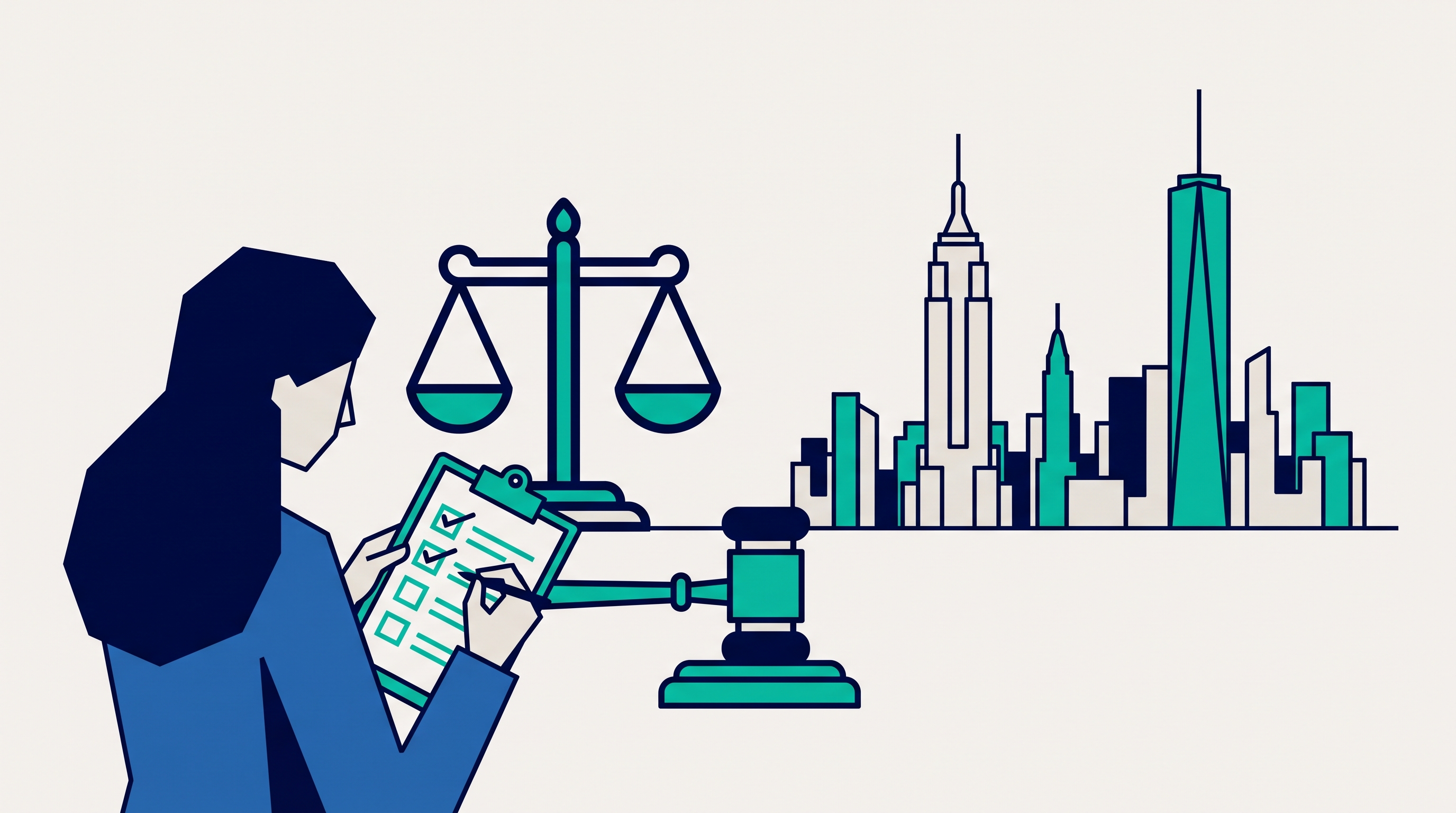
ADA Violation Reporting New York: How to File a Claim
Reviewed for accuracy by the ADAhelp team before publishing. ADAhelp is not a law firm; legal work is handled by independent New York attorneys.
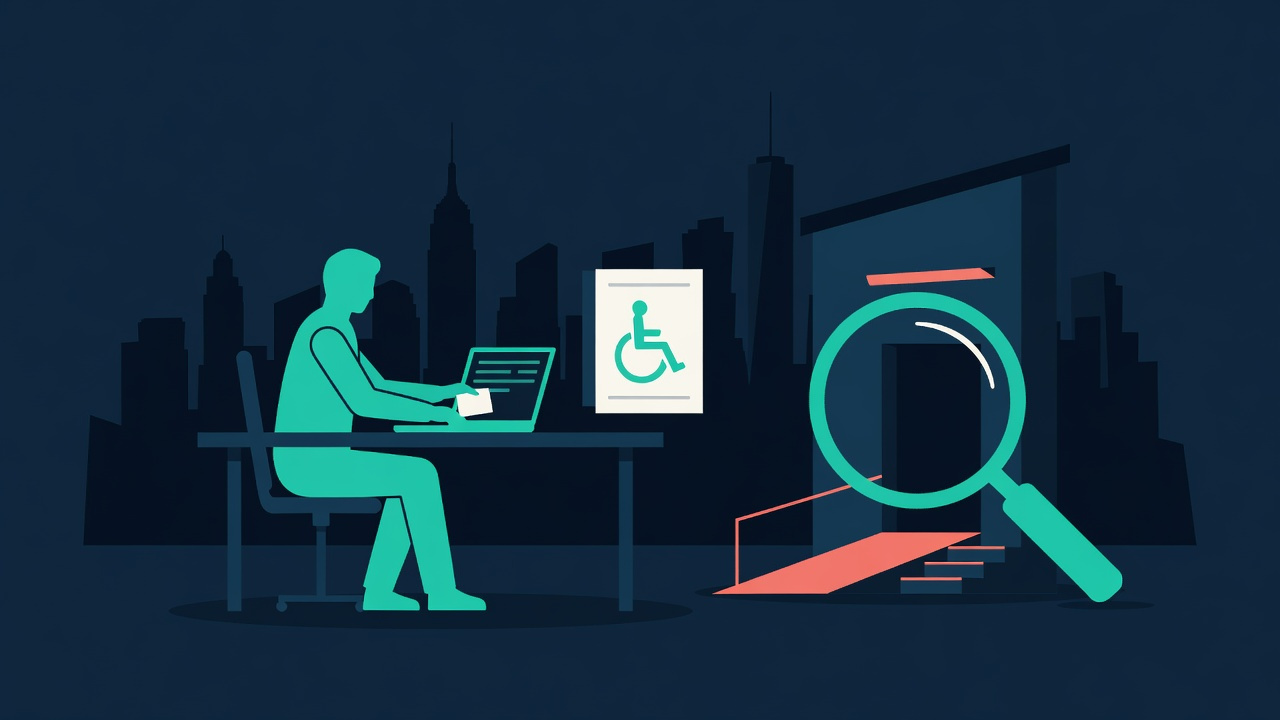
Facing discrimination? Learn ADA violation reporting New York. This guide explains how to file a claim for money damages with no out-of-pocket costs.
Have you ever pointed out an accessibility barrier to a business owner only to be met with a blank stare or a dismissive shrug? If you were denied access to a business or service in New York, you likely have a case that could be worth thousands in money damages. Finding the right path for ADA violation reporting New York shouldn't feel like a full-time job. You don't have to spend hours researching federal agencies or worrying about expensive legal bills just to get the access you deserve. It’s time to stop feeling ignored and start taking action.
We agree that the process of filing a claim should be simple and stress-free for everyone. This guide will show you exactly how to report disability discrimination and help you understand how New York's local laws allow for financial recovery that federal law often misses. You will learn the specific differences between filing with agencies like the EEOC or the New York State Division of Human Rights. We'll also explain how you can start a case check for free and find a path toward justice without any out-of-pocket costs.
Key Takeaways
- Learn to identify ADA Title III violations in public places, including physical barriers like narrow aisles and digital accessibility errors.
- Understand the difference between filing with federal agencies like the DOJ and local options like the New York State Division of Human Rights.
- Discover why ADA violation reporting New York often relies on city and state laws to secure money damages for victims of discrimination.
- Get a clear list of the evidence you need to document your experience, including photos and detailed incident records.
- Find out how to access a free three-minute case check to see if you qualify for professional case management with no out-of-pocket costs.
Identifying an ADA Violation in New York
Identifying a legal violation is the first step toward getting justice. Under Title III of the Americans with Disabilities Act of 1990, private businesses that serve the public must provide equal access to everyone. This includes restaurants, retail stores, and even doctor's offices. When a business fails to remove barriers, they're breaking the law. A violation happens whenever your disability prevents you from using a facility or service in the same way as a person without a disability. If you've been turned away or found it impossible to enter a shop, you likely have a reason for ADA violation reporting New York.
To better understand how these laws protect your rights in the workplace and public spaces, watch this helpful video:
Physical barriers are often the most obvious signs of discrimination. You might find a high curb without a cut or a heavy door that you can't open alone. In a busy city like New York, these issues happen every day. If a business has the resources to fix these problems but chooses not to, you may have a valid claim. New York was the third most active state for ADA lawsuits in 2025, showing that many businesses still fail to meet these basic standards.
Common Public Access Barriers in NYC
NYC has specific rules for public places that go beyond federal standards. Restaurants must have wheelchair ramps that meet strict slope requirements. If a cafe owner tells you to eat outside because they don't have a ramp, that's a violation. Retail stores must keep their aisles wide enough for a wheelchair to pass through easily; you shouldn't have to move boxes just to shop. Inaccessible bathrooms are another frequent issue. If a sink is too high or a stall is too narrow, the business is failing its legal duties. Service animal denials are also common. A business cannot turn you away because you have a guide dog or other service animal.
Digital and Communication Violations
Access isn't just about physical buildings anymore. In 2026, website accessibility is a major focus for New York courts. If a business website doesn't work with screen readers or lacks captions on videos, it's a digital barrier. You have a right to the same online shopping experience as everyone else. You can learn more about your rights regarding a Website Accessibility Violation New York to see if your experience qualifies for a claim. Communication barriers also include a lack of auxiliary aids. This means businesses should provide sign language interpreters or large print materials when requested to ensure you can communicate effectively. Identifying these hurdles is the first step toward a successful claim.
Where to File Your Disability Discrimination Complaint
You’ve faced a barrier and you're ready to act. Now you must decide where to send your complaint. This is a critical step because each agency has different powers. Some can only force a business to fix a physical problem. Others have the authority to seek money damages for the discrimination you experienced. In New York, you have three main options: the federal government, the state, or the city. Knowing which one to choose is the key to a successful outcome.
Federal vs State Filing Agencies
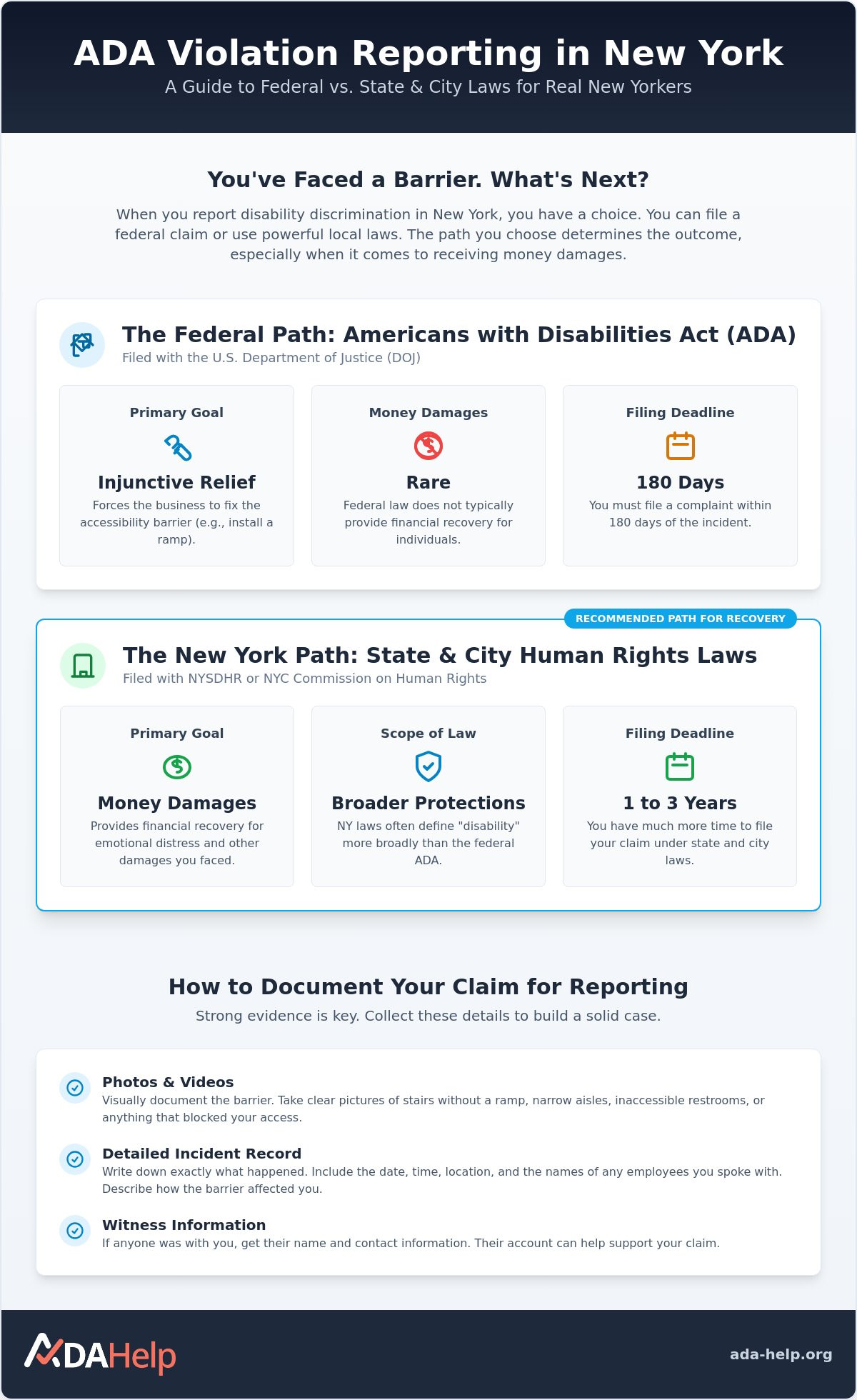
The U.S. Department of Justice (DOJ) handles federal claims under the ADA. You can File a federal ADA complaint if you want the government to investigate a business or government office. The DOJ focuses on injunctive relief. This is a court order that forces a business to fix the violation, such as installing a ramp or widening a door. While this helps the community, it rarely results in a check for the person who filed the claim. If you are reporting a government entity, you must act fast. The deadline for Title II complaints is usually just 180 days from the date of the incident.
The New York State Division of Human Rights (NYSDHR) offers a different path. They enforce the New York State Human Rights Law across the entire state. This law often defines disability more broadly than federal law does. For most state-level claims, you have one year to file your complaint. However, a change in February 2024 extended the statute of limitations to three years for certain disability discrimination claims. This state agency can help you seek money for emotional distress or other damages that federal law might not cover.
The New York City Commission on Human Rights
If the violation happened within the five boroughs, the New York City Commission on Human Rights (CCHR) is often your best bet. They enforce the New York City Human Rights Law (NYCHRL). This is one of the most powerful civil rights laws in the United States. It provides protections that go far beyond what the federal government offers. Effective ADA violation reporting New York often starts here for city residents because the CCHR can impose high civil penalties on businesses that ignore the law.
You should choose city filing when you want the strongest possible legal leverage. The NYCHRL requires businesses to engage in a cooperative dialogue with you; failing to do so is a violation in itself. If you're feeling overwhelmed by these choices, you don't have to handle the paperwork alone. You can start with a free three-minute case check to determine the best path for your specific situation.
Comparing Federal ADA and New York Local Laws
Do you want the barrier fixed, or do you want compensation for the trouble it caused you? Federal ADA laws focus almost entirely on the fix. This is known as injunctive relief. It is a specific court order that requires a business to remove a physical barrier or update a website. While this creates a more accessible world, it does not provide you with financial recovery for the frustration and exclusion you suffered. If you want a check for the discrimination you faced, you must look beyond federal law.
New York is different. Our state and city laws go much further than the federal standard. When you begin ADA violation reporting New York, you are tapping into the New York State Human Rights Law (NYSHRL) and the New York City Human Rights Law (NYCHRL). These statutes allow you to hold businesses accountable for the actual harm they caused you. They provide a path to justice that federal law simply cannot match for individual victims.
Why Local Laws Mean Financial Recovery
Local laws are the only path to money damages in most public access cases. These damages can cover emotional distress and out-of-pocket costs. In some cases, statutory damages are also available. Federal law often only applies to businesses with 15 or more employees for employment claims; however, New York City laws apply to almost every employer regardless of size. This means you have protection even when dealing with a small local shop or a boutique restaurant. New York state also defines disability more broadly than the federal government. This makes it easier for you to qualify for a claim and seek a settlement that reflects your experience.
The NYC Advantage for Public Access
NYC has the strictest accessibility laws in the country. The NYCHRL covers nearly every public accommodation in the five boroughs. This includes everything from private hospitals to tiny coffee shops. If you faced a barrier in a city business, you have a high chance of a successful claim. The city requires businesses to engage in a cooperative dialogue with you. This is a formal process where the business must work with you to find a solution for your needs. If they refuse to have this conversation, they are already violating the law. You can see if your experience qualifies for a claim by visiting our page on Public Access Discrimination New York for a quick case evaluation.
How to Document Your ADA Violation for Reporting
Your memory will fade; your evidence will not. Building a strong case file is the most important thing you can do after experiencing discrimination. Effective ADA violation reporting New York relies on the strength of your proof. You don't need to be a legal expert to gather this information. You just need to be thorough and organized. Start by collecting these five essential items as soon as possible:
- Clear Photos: Take pictures of the physical barrier or a screenshot of the digital error. Capture multiple angles.
- Log the Details: Record the exact date, time, and street address of the incident.
- Identify Staff: Note the names or descriptions of any employees or managers you spoke with during the incident.
- Proof of Visit: Save receipts, tickets, or digital records that prove you were a customer at the business.
- Factual Statement: Write a short summary of what happened while the details are fresh in your mind.
Gathering Evidence at the Scene
If you encounter a physical barrier, pull out your phone immediately. Take photos that show the problem in context. If you have a ruler or a common object like a dollar bill, place it next to a high step or a narrow gap to show the scale. This makes it impossible for a business owner to claim the barrier doesn't exist. Did anyone see what happened? Ask witnesses for their contact information. Their statements can confirm your story if the business disputes your claim. You should also keep a journal of how the incident affected your day. Documenting your frustration or the fact that you had to cancel plans helps establish the emotional impact of the discrimination.
Documenting Workplace or Housing Violations
Discrimination in an office or apartment building often leaves a paper trail. Save every email, text message, and letter. If you requested a reasonable accommodation, keep a copy of that written request. New York law requires employers to engage in an interactive process; this is a formal discussion to find a solution for your needs. If your boss ignored your request or refused to talk, they may have violated the law. For more specific tips on building a housing case, read our guide on Housing Disability Discrimination New York. These records prove that you tried to resolve the issue and were ignored.
Ready to see if your evidence is enough for a claim? Start your free three-minute case check now to find out if you qualify for professional case management.
How ADAhelp Manages Your New York Claim
Do you have a case? Is it worth the effort? Many New Yorkers walk away from valid claims because the paperwork feels like a second job. ADAhelp is a case management service. We are not a law firm and we do not provide legal advice. Our role is to act as your proactive partner and handle the heavy lifting. We simplify the process of ADA violation reporting New York by organizing your evidence and determining if you meet the criteria for a claim. You focus on your life while we focus on the details of your case.
The system is often confusing. You might struggle to choose between federal, state, or city agencies. We take that burden off your shoulders. Our team reviews your documentation, including the photos and statements you gathered. If your situation qualifies, we connect you with independent contingency-fee attorneys. These professionals understand the interplay between the ADA, the NYSHRL, and the NYCHRL. They know how to push for money damages that reflect your experience. Typical recovery amounts vary case by case, and while we never guarantee a specific payout, we ensure your claim is positioned for the best possible outcome.
No Upfront Costs or Risk
You should never have to pay out-of-pocket to fight for your civil rights. Our initial case check is free for everyone. We operate on a low-risk model where the financial burden stays off the client. You will never be asked for a retainer or hourly fees. The attorneys we work with only take a fee if there is a successful recovery. If you don't receive money, you owe nothing. This approach turns your frustration into a stress-free path toward justice. It ensures that every New Yorker has a fair shot at holding businesses accountable regardless of their bank account balance.
Starting Your New York ADA Claim
Deadlines for discrimination claims move fast. In some cases, you may only have 180 days to act. Waiting too long can mean losing your right to any financial recovery. Case management reduces the stress of these tight timelines. We help you move quickly from identifying a problem to filing a formal claim. Don't let a business owner's dismissive attitude be the final word on your rights. Take the first step today by using our free three-minute case check. It is a simple, private way to find out where you stand and how to start your journey toward a resolution.
Take Action on Your New York Accessibility Claim
You now have the tools to turn a frustrating experience into a clear path for justice. Reporting a violation is about more than just fixing a physical barrier; it's about holding businesses accountable for the exclusion they caused. By focusing on the powerful protections of the NYSHRL and NYCHRL, you can seek the money damages you deserve. Your evidence is the foundation of your claim. Keep your photos, logs, and receipts organized to ensure your story is heard by the right authorities.
The process of ADA violation reporting New York doesn't have to be a solo effort. ADAhelp handles the heavy lifting of case management so you don't have to. We offer a low-risk way to determine if you have a valid claim. We connect you with independent attorneys who work on a contingency basis. You never pay out-of-pocket fees. This ensures that the financial risk stays with the service provider, not with you.
Don't let another day pass while a business ignores your rights. Start your free three-minute case check now to see how we can help you move forward. You deserve equal access. We are here to help you secure it.
Frequently Asked Questions
How long do I have to report an ADA violation in New York?
You must act quickly because deadlines vary depending on the agency. For federal Title II claims with the DOJ, you have 180 days. Employment claims with the EEOC give you 300 days. The New York State Division of Human Rights typically allows one year; however, certain disability discrimination claims were extended to a three-year limit in February 2024. Missing these dates can end your case before it starts.
Do I need a lawyer to report an ADA violation?
You aren't required to have a lawyer to file a complaint with a government agency. However, the process is complex and businesses often have their own legal teams. ADAhelp provides case management to organize your evidence and build a strong file. If you have a valid claim, we connect you with independent attorneys who work on a contingency basis. This means you get professional help without paying anything upfront.
Can I get money for a disability discrimination claim in NYC?
Yes, you can recover money damages under New York's city and state laws. While the federal ADA mostly focuses on fixing the physical barrier, the NYCHRL and NYSHRL allow for financial compensation. This can include money for emotional distress or statutory damages. Every case is different; typical recovery ranges depend on the specific facts and the severity of the discrimination you experienced.
What is the difference between the ADA and the New York City Human Rights Law?
The main difference is the type of relief they provide to victims. The federal ADA is designed to fix the problem; this is called injunctive relief. The New York City Human Rights Law is much broader. It covers almost all employers and public places in the five boroughs. It also allows victims to seek money damages, which the federal law often does not provide for private business violations.
How much does it cost to file an ADA complaint with ADAhelp?
It costs you nothing out-of-pocket to use our services. We offer a free three-minute case check to see if you qualify for management. If we move forward with your ADA violation reporting New York, fees are only taken from the final recovery. If there is no recovery, you don't owe us or the attorneys anything. This approach removes the financial risk for you entirely.
What happens after I report an ADA violation to the state or city?
Once a report is filed, the agency will notify the business and start an investigation. They may ask you for more evidence or invite both sides to a mediation session to settle the issue. If the agency finds probable cause that discrimination happened, the case can move to a public hearing. This process can lead to a court order to fix the barrier or a financial settlement for your damages.
Can a business retaliate against me for reporting an ADA violation?
Retaliation is strictly prohibited by federal, state, and city laws. A business cannot fire you, threaten you, or deny you service just because you filed a complaint or requested an accommodation. If they do, that retaliation is a separate and often more serious legal violation. Effective ADA violation reporting New York protects your right to speak up without fear of being punished by a business owner or employer.

Article by
ADA Help
Written by the ADAhelp editorial team and reviewed for accuracy before publishing. ADAhelp helps New Yorkers find out if they have a disability discrimination claim and manages the process end to end, working with independent attorneys who handle the legal work. We are not a law firm and do not provide legal advice.
Disclaimer
This article is general information about New York law, not legal advice, and reading it does not create an attorney-client relationship. ADAhelp is a case-management and intake service, not a law firm; legal representation is provided by independent attorneys. Recovery amounts and timelines vary by case, and past outcomes do not guarantee future results. For advice about your specific situation, speak with a qualified attorney or start the free case check.
Tags
Discriminated against in New York because of a disability?
A free three-minute check tells you if you can pursue a claim.
Check my case →New York onlyNo upfront costIndependent NY attorneysFree 3-minute check