
Denied Promotion Due to Medical Condition New York: Rights
Reviewed for accuracy by the ADAhelp team before publishing. ADAhelp is not a law firm; legal work is handled by independent New York attorneys.

Denied promotion due to medical condition in New York? State and city laws protect you. Learn your rights and how to claim money damages with a free case check.
Can your boss legally pass you over for a move up because of a health issue? In most cases, the answer is no. If you were denied promotion due to medical condition New York laws protect you from this exact type of discrimination. You are likely feeling stuck in your current role despite being the most qualified person for the job. This frustration is valid. The New York State Human Rights Law exists to ensure your health doesn't stand in the way of your career or your ability to pay rising medical bills.
You deserve to know if you have a valid claim and what it might be worth. While federal laws offer some relief, New York City and State laws provide the path to money damages for lost wages and emotional distress. This article will show you how to confirm your rights and how to hold your employer accountable without any financial risk. We'll explain the three-year window you have to file a claim and how a free case check can help you start your recovery today. This process is low-risk; you never pay out-of-pocket, as fees only come from a recovery.
Key Takeaways
- Learn how to determine if you have a valid claim based on your job qualifications and your employer's selection decisions.
- Understand why New York state and city laws offer broader protections and money damages than federal law alone.
- Identify the false reasons, known as pretext, often used when you are denied promotion due to medical condition New York.
- Discover which performance reviews and internal emails you should save to secure compensation for your lost wages.
- See how a free three-minute case check can help you hold your employer accountable with no out-of-pocket costs.

Were you passed over for a promotion in New York because of a medical condition?
You worked late. You hit every target. You expected the title change. Instead; someone else got the job because of your health. Promotion discrimination happens when an employer bases a selection decision on your disability rather than your performance. If you were denied promotion due to medical condition New York laws are on your side. You just need to show you were qualified for the position to have a valid claim. Your employer cannot legally ignore your achievements just because you have a diagnosis or a physical limitation. This type of bias is a direct violation of your rights as a worker in the Empire State.
Federal protections like the Americans with Disabilities Act (ADA) set the floor for workers. However; New York workers have even stronger shields. These laws protect you whether your condition is permanent; temporary; or even just perceived by your boss. Adverse employment actions include more than just losing a new title. They include being blocked from a higher salary tier or a better bonus structure. To better understand how these rights work in practice; watch this helpful video. Note that while this specific video references California; the fundamental concepts of workplace accommodations and discrimination are very relevant to New York employees.
Identifying signs of medical discrimination in the workplace
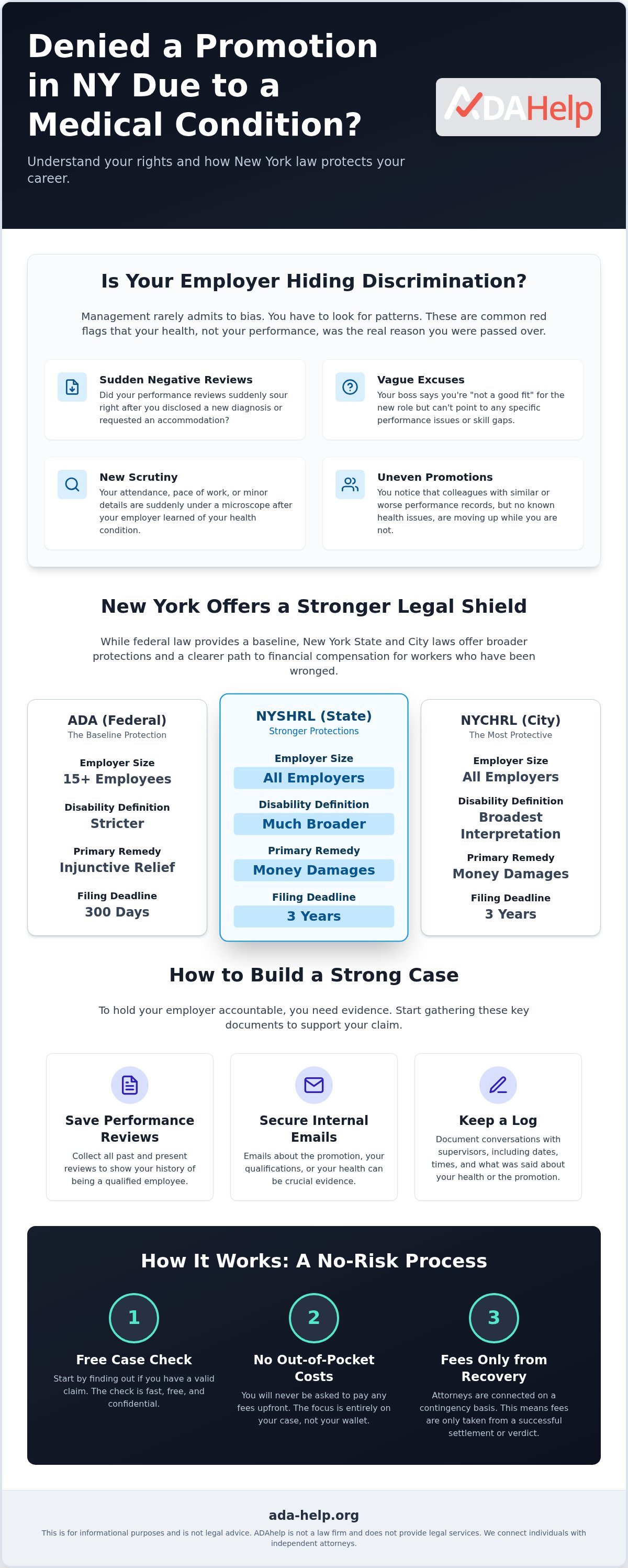
Management rarely admits to discrimination. You have to look for the patterns. Did your performance reviews suddenly turn negative after you disclosed a diagnosis? This is a major red flag. Watch for comments from supervisors regarding your health or your ability to handle stress. If they say you aren't a good fit but can't point to specific performance metrics; they might be hiding the truth. Keep a detailed log of these conversations for your case. Often; an employer will suddenly start scrutinizing your attendance or your pace of work only after learning about your medical history. These shifts in behavior are rarely accidental. You might notice that colleagues with similar performance but no medical issues are moving up the ladder while you remain stagnant. This disparity is a key indicator of bias.
Why New York protections go further than the ADA
The ADA is limited. It only covers employers with 15 or more employees. In contrast; the New York State Human Rights Law applies to every single employer in the state. New York also defines disability much more broadly than federal standards. This means more conditions qualify for protection here. Local laws focus on whether you can perform essential duties with a reasonable accommodation. If you can do the work; you shouldn't be passed over. At ADA Help - NY disability discrimination claims; we help you determine if you were denied promotion due to medical condition New York and guide you toward a resolution. We focus on the specific interplay of city and state laws that provide the best chance for financial recovery. The New York City Human Rights Law requires that we interpret the rules as broadly as possible to protect the worker. This local focus is why having a team that understands the specific New York landscape is vital for your success.
The legal frameworks protecting New York workers
If you were denied promotion due to medical condition New York law provides a multi-layered shield. Most people think only of federal rules. However; your strongest protection usually comes from state or city statutes. Understanding these layers is the first step toward holding your employer accountable. Your rights depend heavily on your specific office location. Whether you work in a skyscraper in Manhattan or a small shop in Buffalo; a specific set of rules governs your career path.
The ADA and the limits of federal injunctive relief
Federal disability discrimination laws, specifically the Americans with Disabilities Act, provide a baseline. To use this law; you must first file a charge with the Equal Employment Opportunity Commission (EEOC) within 300 days of the incident. This is a tight deadline. The federal definition of a disability is often stricter than New York's standards. Federal law also has damage caps ranging from $50,000 to $300,000 depending on the size of the employer. Most importantly; the ADA often focuses on injunctive relief. This means the court might order your employer to give you the promotion or change their policy; but it might not result in a significant financial payout for your personal struggle.
Securing money damages through NYSHRL and NYCHRL
Most New Yorkers find their best path to justice through the New York State Human Rights Law (NYSHRL) and the New York City Human Rights Law (NYCHRL). Unlike federal law; these statutes are designed to provide money damages. This includes back pay for the wages you lost and compensation for emotional distress. Under New York state law; there are no caps on compensatory damages. In cases of willful misconduct; punitive damages may even be available to punish the employer for their actions. This financial recovery helps you cover medical bills and lost income while holding the company accountable.
The New York City law is particularly powerful. It requires a liberal construction. This means the court must interpret the law in the way that most broadly protects the employee. Since February 2020; the state law applies to all employers regardless of size. If you work in the five boroughs; you get the added protection of the city law if your employer has at least four workers. You have three years to file a claim under these local laws for incidents occurring after February 15, 2024. This gives you more time to gather evidence and build a strong case. If you are unsure which law applies to your office; a case check with ADAhelp can clarify your path forward in minutes.
Common excuses employers use to hide medical discrimination
Employers rarely admit that your health influenced their decision. Instead; they rely on pretext. This is a legal term for a false reason given to cover up the real; discriminatory motive. If you were denied promotion due to medical condition New York bosses might claim you lack leadership style or executive presence. These are subjective terms. They are difficult to measure and easy to use as a shield for bias. You should look for inconsistencies in their story. If the reasons for your denial change every time you ask; you are likely facing pretext.
Watch for sudden shifts in the job description. Did the employer add a new requirement; like frequent travel or heavy lifting; only after you applied? This is a common red flag. You should also verify if the company followed its own internal promotion policy. If the employee handbook says promotions are based on tenure; but a junior employee was picked over you; the company has some explaining to do. Breaking internal rules is often strong evidence of a discriminatory motive. It shows that the rules were set aside specifically to keep you out of the new role.
Performance reviews and vague feedback
Your history of evaluations is a vital piece of evidence. Look back at your reviews from before your employer knew about your medical condition. If you had years of positive feedback that suddenly turned negative after a diagnosis; the timing is suspicious. Employers often paper a file with new performance issues to justify a denial. Identifying these new problems that only appeared after a medical leave can help prove your case. Written records are your best defense. Save every email; chat log; and performance report. Vague feedback like not a good fit is much harder for an employer to defend than specific; data-driven metrics.
Retaliation after a reasonable accommodation request
As of December 5, 2025; the New York State Human Rights Law was amended to explicitly protect you when you request a reasonable accommodation. This includes asking for a desk adjustment; a modified schedule; or a quiet workspace. It is illegal for an employer to deny you a promotion because you asked for these changes. Retaliation claims are unique because they can stand even if the original discrimination claim is dismissed. The timing of the denial is the most important factor. If you were denied promotion due to medical condition New York shortly after asking for help; the law often views this as a retaliatory act. You have the right to seek a career path that respects your health and your contributions. At ADA Help - NY disability discrimination claims; we provide the case management you need to challenge these unfair excuses.
How to build a strong case for a denied promotion claim
You need a paper trail to turn your suspicion into a valid claim. If you were denied promotion due to medical condition New York law requires evidence that you were qualified and that the decision was biased. It's not enough to feel the unfairness; you have to prove it. If you suspect you were denied promotion due to medical condition New York; your first task is to secure your records before you lose access to them. Start by gathering every performance review you have ever received. These documents prove your track record before your health became an issue in the eyes of your boss. They serve as the baseline for your professional value.
Save the original job posting for the position you wanted. Employers often change requirements after the fact to justify their choice. Having the original description stops them from moving the goalposts. Write down the names of everyone involved in the hiring process. This includes HR representatives; department heads; and the hiring manager. Never use your company email or work computer to store notes about your situation. Your employer owns that data. They can delete it or monitor it at any time. Use a personal device or a physical notebook to keep your records safe and private.
Comparing your qualifications to the selected candidate
To win; you must show you were as qualified as or more qualified than the person who got the job. Create a side-by-side list. Include your certifications; years of industry experience; and specific project achievements. Did you have more seniority? Documenting that you have five more years of experience than the person promoted is a strong fact. Identify if you actually provided training to the person who was ultimately promoted. Documenting that you taught your "boss" how to do the job is powerful evidence of discrimination. If you have a professional license that the other candidate lacks; make sure to highlight that fact in your notes. This direct comparison makes it much harder for an employer to hide behind vague excuses about fit or style.
The role of witnesses and workplace allies
You are likely not the only one who noticed the unfairness. Identify coworkers who saw your work performance or heard managers make inappropriate comments about your health. Keep a private list of potential allies such as: Sarah in Accounting; who heard the manager complain about your medical appointments; Mike in Sales; who saw your high quarterly numbers; and Linda in HR; who mentioned that the role was "too stressful" for someone with your condition. Note if other employees were passed over for similar health-related reasons. These patterns show systemic bias. Gathering this information early makes the intake process much faster. You can start your free case check now with ADA Help - NY disability discrimination claims to see if your documentation is enough to hold your employer accountable.
Start your New York disability discrimination claim with ADAhelp
You don't have to face this alone. Being denied promotion due to medical condition New York is a violation of your rights. ADAhelp is here to act as your expert guide. We are not a law firm and we do not provide legal advice. Instead; we offer specialized case management services for New Yorkers who have faced workplace bias. We help you determine if you have a valid claim and connect you with independent contingency-fee attorneys. This means you never pay out-of-pocket. We only take a fee if you recover money. The financial risk stays with us; not you. You can seek justice without worrying about hourly legal bills or upfront costs. We believe that every New Yorker deserves a fair shot at career growth regardless of their health status.
How our case management process works
Our team starts by gathering the specific facts of your situation. We look at the details of the promotion you were denied and your medical history. We then evaluate the strength of your claim under the New York State Human Rights Law (NYSHRL) and the New York City Human Rights Law (NYCHRL). This evaluation helps you understand your chances of securing money damages for lost wages and emotional distress. We handle the heavy lifting of organizing your evidence and identifying the right legal path. This allows you to focus on your health and your career while we move your claim forward. Our process is fast; streamlined; and designed for your convenience. We act as your guide to ensure the system works for you. We know the local rules intimately and use that knowledge to support your claim.
Taking the first step toward recovery
Do not wait for your employer to change their mind. Companies rarely fix these mistakes on their own. You must act quickly to protect your rights. Statutes of limitations in New York can be as short as one year for certain administrative filings. While the NYSHRL generally allows three years for claims occurring after February 15, 2024; federal ADA claims must be filed with the EEOC within 300 days. Every day you wait is a day that evidence can disappear or memories can fade. Holding your employer accountable is a low-risk process that starts with a single click. Start your free case check today. It only takes three minutes to find out if you were denied promotion due to medical condition New York and what your next steps should be. You have worked hard for your career; don't let discrimination take it away. We are ready to help you turn your frustration into a clear path toward resolution.
Where to File: Agencies & Deadlines
Once you have documented your experience, you have several venues available for a formal complaint. Your case manager helps you determine which agency fits your situation, but here is an overview of where a denied-promotion disability claim can go in New York.
- New York State Division of Human Rights (DHR): Handles NYSHRL claims statewide. You generally have three years from the date of the denial to file at dhr.ny.gov for incidents occurring after February 15, 2024, or you may go directly to state court.
- NYC Commission on Human Rights (CCHR): If your job is based in one of the five boroughs, the NYCHRL is enforced by the NYC Commission on Human Rights. Complaints must generally be filed within three years of the denial.
- U.S. Equal Employment Opportunity Commission (EEOC): The federal agency that enforces Title I of the ADA for employment claims. Its deadline is much shorter, typically 300 days from the date of the discriminatory act.
- U.S. Department of Justice (DOJ): The DOJ enforces broader ADA compliance. It does not generally process individual promotion-denial complaints, but it maintains the federal ADA standards referenced throughout this guide; see ada.gov for details.
Filing directly with a government agency can be slow and confusing to navigate without help. If you were denied a job because of your disability in addition to being passed over for a promotion, or if the situation escalated and you were terminated for a disability-related reason, our case management team can help you identify every deadline that applies to your situation before it passes.
Secure Your Career and Your Recovery
You worked hard for your career. Don't let a health issue become a barrier to the salary and title you earned. If you were denied promotion due to medical condition New York; remember that local laws are designed to protect your livelihood. The New York State and City Human Rights Laws provide a path to recover lost wages and emotional distress damages. You now know how to spot the red flags of pretextual excuses and which records to save to build your case.
Taking action doesn't have to be a source of stress. ADAhelp provides expert case management for New Yorkers to help you determine if your claim is valid. We connect you with independent contingency-fee attorneys; so you never pay anything out-of-pocket. Fees are only taken from a successful recovery. This is your chance to hold your employer accountable without any financial risk.
Start your free three-minute case check now. Our team has deep expertise in NYSHRL and NYCHRL to guide you toward the resolution you deserve. You have the right to a fair workplace; and we are here to help you secure it.
Frequently Asked Questions
Can I be denied a promotion in New York if I took FMLA leave?
No; your employer cannot use your FMLA leave as a reason to pass you over for a promotion. If you were qualified for the role and the leave was the deciding factor; this may be considered illegal retaliation. New York laws ensure that taking protected medical leave does not stall your career or prevent you from moving into a higher salary tier.
How do I prove my medical condition was the reason I did not get the job?
You prove this by showing that the employer's stated reason was "pretext" or a cover up for bias. If you were denied promotion due to medical condition New York; you should document if your performance reviews were positive until you disclosed your health status. Comparing your certifications and years of experience to the person who received the promotion is also a powerful way to show the decision was not based on merit.
What is the difference between the ADA and the New York City Human Rights Law?
The federal ADA often focuses on changing company policies; while the New York City Human Rights Law is designed to secure money for the victim. The city law is much broader and covers employers with as few as four employees. Unlike federal law; the NYCHRL does not have caps on compensatory damages for emotional distress; making it one of the strongest protections in the country.
Do I need to hire a lawyer to start my discrimination claim?
You do not need to hire a lawyer to see if you have a case. You can start with a free three-minute case check through ADAhelp to determine if you were denied promotion due to medical condition New York. If your claim qualifies; we connect you with independent contingency-fee attorneys. You never pay out-of-pocket because these professionals only get paid if you recover money.
What kind of money damages can I get for a denied promotion in NYC?
You can seek back pay for the difference in salary you would have earned if you had been promoted. You may also be eligible for front pay and significant compensation for emotional distress. In cases where an employer acted with willful misconduct; punitive damages may be available under the NYCHRL to punish the company for its discriminatory actions.
Can my employer fire me for reporting promotion discrimination?
No; firing you for reporting discrimination is a separate illegal act known as retaliation. Protected activity includes filing a formal complaint or even just speaking to HR about your concerns. As of December 5, 2025; New York law explicitly prohibits employers from punishing you for requesting a reasonable accommodation or reporting bias. You can still win a retaliation claim even if the original discrimination claim is not proven.

Article by
ADA Help
Written by the ADAhelp editorial team and reviewed for accuracy before publishing. ADAhelp helps New Yorkers find out if they have a disability discrimination claim and manages the process end to end, working with independent attorneys who handle the legal work. We are not a law firm and do not provide legal advice.
Disclaimer
This article is general information about New York law, not legal advice, and reading it does not create an attorney-client relationship. ADAhelp is a case-management and intake service, not a law firm; legal representation is provided by independent attorneys. Recovery amounts and timelines vary by case, and past outcomes do not guarantee future results. For advice about your specific situation, speak with a qualified attorney or start the free case check.
Tags
Discriminated against in New York because of a disability?
A free three-minute check tells you if you can pursue a claim.
Check my case →New York onlyNo upfront costIndependent NY attorneysFree 3-minute check