
Constructive Discharge Disability NY: Rights & Recovery
Reviewed for accuracy by the ADAhelp team before publishing. ADAhelp is not a law firm; legal work is handled by independent New York attorneys.
Forced to quit your job due to a disability? Learn if you have a constructive discharge disability NY claim for back pay and damages. Free case check.
Do you have a valid case if you were forced to quit your job due to disability discrimination in New York? The answer depends on whether your employer created an environment so hostile that a reasonable person would feel they had no choice but to resign. In New York, these claims can lead to financial recovery for back pay and emotional distress. This guide explores your rights under the constructive discharge disability NY framework and explains how state and city laws provide broader protections than federal rules.
It is exhausting to feel like your employer is intentionally pushing you out because of a medical condition. You shouldn't have to choose between your career and your well-being. We will show you how the New York State Human Rights Law and the New York City Human Rights Law offer a route to justice without the strict damage caps found in federal law. You will learn the specific criteria for a claim and how to start a free case check. ADA Help - NY disability discrimination claims acts as your guide to evaluate your situation and connect you with independent contingency-fee attorneys. You face no financial risk; fees only come from a successful recovery.
Key Takeaways
- Learn why New York law treats a forced resignation as a legal termination when your working conditions become truly intolerable.
- Understand the high legal bar for a constructive discharge disability NY claim and what you must prove to show your employer’s actions were deliberate.
- Identify how the New York State and City Human Rights Laws offer financial recovery for emotional distress and back pay without federal damage caps.
- Discover the risks of resigning voluntarily and how it can impact your right to seek damages or back pay from your employer.
- Access a free three-minute case check to determine if you have a valid claim and get connected with contingency-fee attorneys at no personal cost.

What is Constructive Discharge for Disability in New York?
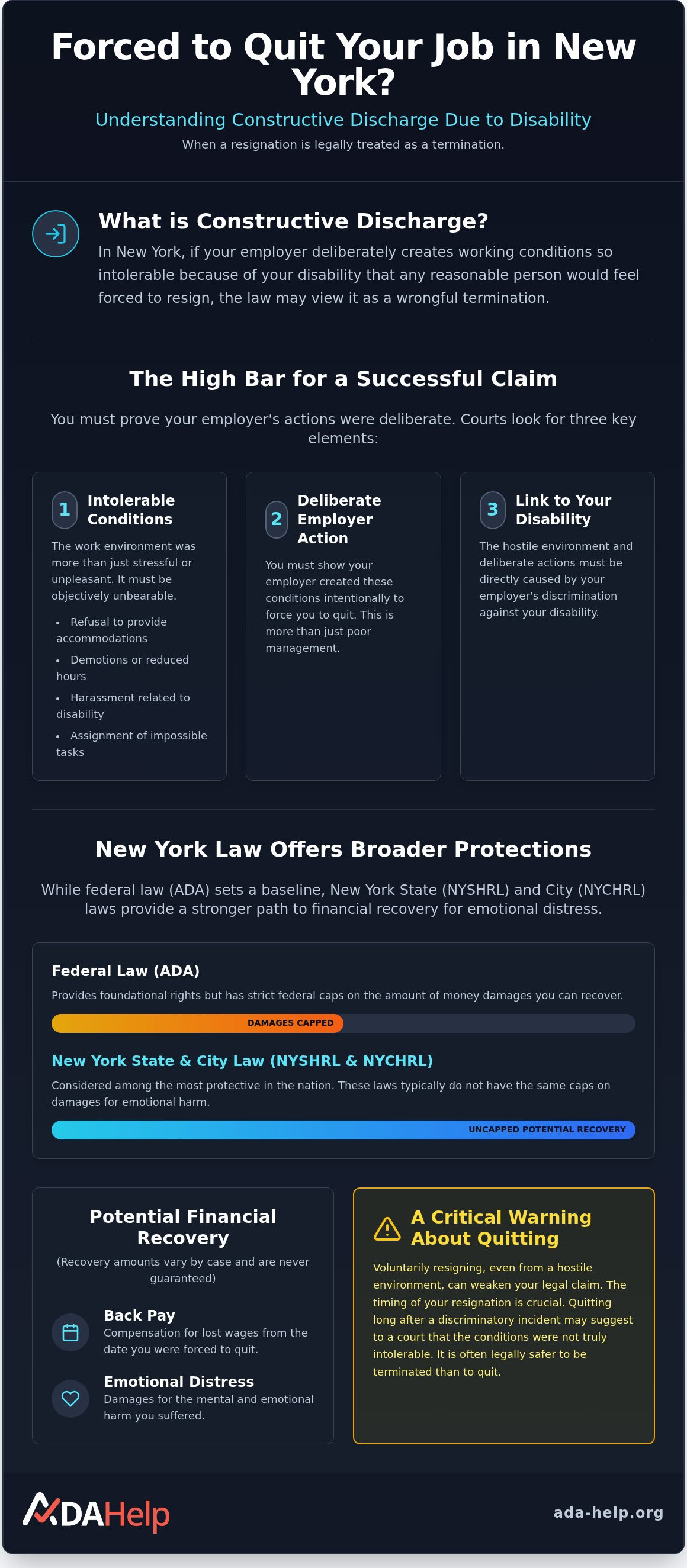
You might feel like you made the choice to leave your job; however, if you resigned because your employer made your daily life a nightmare, the law sees it differently. In New York, a forced quit is legally known as a constructive discharge. This happens when an employer deliberately creates working conditions so intolerable that no one could be expected to stay. Instead of a voluntary resignation, the legal system treats this as a termination. Proving a claim for constructive discharge disability NY means showing that your disability was the root cause of the intolerable conditions you faced. This treatment triggers your rights under state and city laws to seek back pay and damages for the harm you suffered.
This legal concept, often called Constructive Discharge, ensures that employers cannot escape liability by simply making your life miserable until you hand in your notice. In New York City and State, the protections are especially strong. While federal laws like the ADA Title I set a baseline, the New York City Human Rights Law (NYCHRL) often provides a more flexible path for employees to seek justice. You don't have to prove the employer intended to fire you; you only need to show they created the conditions that led to your departure from the company. For a closer look at how hostile-environment tactics build toward a forced resignation, see our guide on being forced to quit due to a hostile work environment.
To better understand how these cases work from start to finish, watch this helpful video:
The Reasonable Person Standard
New York courts don't just look at how you felt personally. They use an objective reasonable person standard to evaluate your claim. This asks if any typical employee in your exact situation would have felt they had no other choice but to quit. It isn't enough to have a difficult boss or a stressful job. The reasonable person test in New York disability law asks if an objective individual, faced with the same lack of accommodations or harassment, would feel they had no choice but to resign. ADA Help - NY disability discrimination claims can help you evaluate your specific facts to see if they meet this high legal bar.
When Resignation is Actually Firing
Employers often use shadow firing tactics to avoid wrongful termination lawsuits. They might refuse accommodation requests, cut your hours, or assign you to physically impossible tasks until you can't stay. The law recognizes these actions as a forced resignation. This gives you the same legal rights as someone who was officially fired. These protections apply to all New York employers with four or more employees. ADA Help - NY disability discrimination claims provides case management to help you determine if your quit was actually an illegal firing under the ADA or New York human rights laws. We connect you with independent attorneys who work on a contingency basis, so you never pay out of pocket for your case check.
The High Legal Standard for Disability Claims in NY
Winning a case for constructive discharge disability NY requires more than showing your workplace was stressful or unfair. You must prove your employer deliberately made your environment so bad that you had no choice but to leave. Courts in New York look for evidence that the company intended to force your resignation. This is a high legal bar to meet. If you are unsure if your situation fits, you can use a free case check through ADA Help - NY disability discrimination claims to see where you stand.
Timing is a critical factor in these claims. If you quit six months after a single incident, the court may see your resignation as voluntary. If you quit immediately after a series of hostile actions or a final refusal to accommodate your disability, your case becomes much stronger. The proximity of the employer's bad behavior to your resignation date serves as evidence of their intent. You must show that the conditions were objectively intolerable, meaning any reasonable person would have felt compelled to resign.
Proving Deliberate Intent
Your employer must have actively sought to push you out of the company. This isn't just about bad management; it's about a specific goal to end your employment without firing you directly. Sometimes, simply ignoring a problem counts as maintaining an intolerable environment. If you requested a reasonable accommodation and your manager repeatedly ignored you, this helps establish intent. If your employer denied your request outright, see our guide on responding to an accommodation denial for your next steps. You should keep a detailed log of every request for help you made. Documentation shows the company knew about the situation and chose not to act, which is vital for your claim.
Intolerable vs. Unpleasant Conditions
There is a massive legal difference between a job that is unpleasant and one that is legally intolerable. Intolerable means that continuing to work is actually impossible for your health or safety. A single rude comment from a coworker usually doesn't meet this standard. However, a consistent pattern of denying reasonable accommodations often qualifies. For example, if you have a medical condition that requires a specific desk setup and your boss denies it while making disparaging remarks about your productivity, that moves closer to the legal standard. You can read more about these definitions in this guide on Constructive Discharge: Were You Forced to Resign?.
The New York City Human Rights Law (NYCHRL) offers broader protections than federal law for those working in the five boroughs. While the federal ADA applies to companies with 15 or more employees, the NYCHRL covers employers with as few as 4 employees. This means real New Yorkers at smaller firms still have a path to recovery. ADA Help - NY disability discrimination claims can guide you through these specific local rules to determine if your forced resignation counts as disability discrimination.
Why Quitting Can Hurt Your Discrimination Case
If you are thinking about quitting your job right now, stop and read this first. If your employer terminated you outright instead, our guide to wrongful termination due to disability in New York covers that situation. Resigning from your position can significantly damage your ability to recover money damages later. When you quit voluntarily, the law assumes you left of your own free will. This shifts the burden of proof entirely onto you. You must then prove a constructive discharge disability NY claim, which is much harder than proving you were fired for a discriminatory reason.
Your employer will use your resignation letter against you. They will argue you left because of a better job offer, a long commute, or personal family issues. If they can convince a court that you quit for any reason other than their intolerable behavior, your case could be dismissed. It is usually better to stay in your role while you build your evidence. Building a strong case requires clear documentation while the events are still happening. You should wait until you have a case evaluation before handing in your notice to ensure you don't accidentally waive your rights.
The Risk to Your Back Pay
Back pay is the money you would have earned if you had stayed at your job. It is one of the most common forms of recovery in New York discrimination cases. If you quit, you usually lose the right to back pay unless you can prove your resignation was legally forced. Under the New York State Human Rights Law, back pay functions as a remedy to compensate you for the exact amount of salary and benefits you lost because of the discriminatory environment. Without proving constructive discharge, your financial recovery could be limited only to emotional distress damages, which are often harder to quantify.
What to Do Before You Resign
Don't hand in your notice until you have a plan. You need to create a paper trail that shows you tried to fix the situation. This makes it harder for the company to claim they didn't know there was a problem. Follow these steps to protect your rights:
- Report the hostile conditions or the lack of accommodations to HR or a supervisor in writing.
- Save copies of all emails and messages sent to management regarding your disability.
- Keep a private log of every time your disability was mentioned or used as a reason to treat you differently.
- Consult with a case manager to review your situation before you walk out the door.
Following the ADA complaint process New York ensures that you have met the necessary requirements to hold your employer accountable. ADAhelp provides a free three-minute case check to help you understand if your situation meets the legal standard for a claim. We handle the heavy lifting of evaluating your case so you don't have to face the system alone. We connect you with independent contingency-fee attorneys, meaning you pay nothing unless they win your case.
Recovery and Damages Under New York Laws
When you pursue a claim for constructive discharge disability NY, you need to know which laws apply to your situation. The federal Americans with Disabilities Act (ADA) is a powerful tool, but it has limits. Under the ADA, courts often focus on injunctive relief. This means they force an employer to change their policies or make a workplace physically accessible. If you are seeking financial recovery for the pain you endured, the ADA has strict damage caps. These caps range from $50,000 to $300,000 depending on how many people the company employs. This is why Real New Yorkers typically look to state and city laws for financial justice.
NYSHRL vs. NYCHRL Protections
The New York State Human Rights Law (NYSHRL) applies to all employers across the state. Unlike federal law, the NYSHRL does not have a cap on compensatory damages for emotional distress. If you live or work in the five boroughs, you are also protected by the New York City Human Rights Law (NYCHRL). This law is one of the most protective in the entire country. It allows for back pay, front pay, and even punitive damages. Punitive damages are meant to punish an employer for especially bad behavior. Recovery amounts vary case by case, but the lack of caps means your recovery is based on the actual harm you suffered.
What is Your Case Worth?
Determining the value of your case depends on several specific factors. These include your lost wages, the loss of health benefits, and the severity of the emotional distress the discrimination caused. In July 2026, the NYC Commission on Human Rights highlighted settlements that show what is possible. For instance, a failure to provide a reasonable accommodation claim recently settled for over $250,000 in emotional distress damages and penalties. Another disability discrimination claim settled for $45,000. These figures are typical examples, but your specific result will depend on the evidence of your constructive discharge disability NY claim.
Your recovery can include several types of compensation:
- Back pay: Wages lost from the time you were forced to quit until the case is resolved.
- Front pay: Compensation for future earnings if you cannot find a comparable job.
- Emotional distress: Money for the mental and physical toll the hostile environment took on your life.
For more details on how these laws work together, see our guide on Employment Disability Discrimination New York.
You don't have to guess what your case is worth or which laws apply to you. ADAhelp is not a law firm and does not provide legal advice, but we act as your proactive partner. We handle the heavy lifting by evaluating your claim and connecting you with independent attorneys who work on a contingency basis. This means you never pay out-of-pocket fees. Start your recovery today by completing a free three-minute case check to see if you have a valid claim.
How ADAhelp Manages Your Discrimination Claim
ADAhelp acts as your proactive partner in a system that often feels overwhelming. We are not a law firm; we don't provide legal advice. Instead, we provide end-to-end case management for New Yorkers who have been pushed out of their jobs. Our team handles the heavy lifting of evaluating your situation to see if it meets the high legal standard for constructive discharge disability NY. We focus on the facts of your case so you can focus on your health and your future.
Many people hesitate to start a case because the process seems long and confusing. We simplify this by managing the information gathering process. We look at your documentation; we analyze your timeline; and we help prepare your claim for the proper authorities. Whether your claim falls under the ADA; the New York State Human Rights Law; or the New York City Human Rights Law; we ensure it is positioned for the best possible outcome. You don't have to face your former employer or the legal system alone.
The Free Three-Minute Case Check
You can find out if you have a claim without leaving your home. Our free three-minute case check asks simple questions about your specific situation in New York. You will provide basic details about your disability; the conditions at your workplace; and why you felt forced to resign. This check gives you an immediate sense of whether your constructive discharge disability NY claim is valid. There is no cost to start and no risk to your current finances. It's a fast way to move from frustration to a clear path toward resolution.
No Upfront Costs
We believe that your right to financial recovery shouldn't depend on how much money you have in the bank. You never pay out-of-pocket for our case management services. We connect you with independent attorneys who work on a contingency fee basis. This means they only get paid if they secure a recovery for you. If there is no recovery; there is no fee. This model removes the financial barrier to justice and ensures that everyone has access to high-quality representation. Start your ADA Title III case management New York today to secure your rights and begin your journey toward financial recovery.
Take Control of Your Future Today
You don't have to carry the weight of a hostile work environment alone. New York laws are designed to protect you when an employer's actions make staying at your job impossible. You have a clear path to financial recovery for emotional distress and lost wages. By focusing on city and state protections; you can avoid the strict limits of federal law.
If you believe your situation counts as a constructive discharge disability NY case; the next step is simple and risk-free. ADAhelp provides the regional expertise you need to evaluate your claim. We handle the heavy lifting by gathering evidence and connecting you with independent attorneys. Because they work on a contingency basis; you never pay out of pocket. Fees are only taken if you recover money. Don't let a forced resignation be the end of your career. Take a proactive step toward the justice you deserve today.
Start your free three-minute case check now to determine if you have a valid claim. You have the right to a fair workplace; and we are here to help you secure it.
Where to File: Agencies & Deadlines
If you believe your resignation was legally a constructive discharge, you can file a charge with one or more of the agencies below. Each has its own deadline, so it helps to know your options before you decide where to start.
- New York State Division of Human Rights (DHR): Handles claims under the NYSHRL. You generally have three years to file for conduct occurring on or after February 15, 2024. File online or find your regional office at dhr.ny.gov.
- NYC Commission on Human Rights (CCHR): Enforces the NYCHRL for conduct in the five boroughs. Most claims must be filed within one year. Learn more at nyc.gov/cchr.
- U.S. Department of Justice (DOJ) / ADA: Oversees ADA enforcement guidance and the federal framework at ada.gov.
- U.S. Equal Employment Opportunity Commission (EEOC): Handles federal ADA employment charges. You generally have 300 days from the discriminatory act to file. Start a charge at eeoc.gov.
Filing with one agency does not always rule out the others, and deadlines run independently, so acting quickly preserves the most options. A case manager can help you determine which agency fits your timeline and facts.
Frequently Asked Questions
Do I have a case for constructive discharge if I quit my job in NYC?
You have a case if you can prove your employer deliberately created working conditions so hostile that no reasonable person could stay. In NYC, the New York City Human Rights Law provides a broader standard than federal law. You must show that your disability was the reason for this treatment. A claim for constructive discharge disability NY is a high bar, so documenting every refusal of a reasonable accommodation is essential for your success.
Can I get unemployment benefits if I quit because of disability discrimination?
You can typically receive unemployment benefits in New York if you demonstrate you quit for good cause. The New York State Department of Labor recognizes illegal discrimination and a hostile work environment as valid reasons for leaving a job. You must show that you tried to resolve the issue with your employer before resigning. Keeping copies of written complaints to HR will help prove that you had no other choice but to quit.
What is the "reasonable person" test in New York employment law?
The reasonable person test is an objective standard used by New York courts to evaluate your claim. Instead of looking only at your personal feelings, the court asks if a typical, objective employee in your situation would have felt compelled to resign. It ensures that constructive discharge isn't based on a subjective reaction to a stressful day. The conditions must be so severe that any reasonable person would find continuing to work there impossible.
How long do I have to file a constructive discharge claim in New York?
Deadlines vary depending on which agency you use. For the New York State Division of Human Rights, you generally have three years to file for acts occurring on or after February 15, 2024. If you file with the federal EEOC, the deadline is 300 days from the discriminatory act. Most claims with the NYC Commission on Human Rights must be filed within one year. Missing these deadlines can permanently end your right to seek financial recovery.
What is the difference between the ADA and the New York City Human Rights Law?
The federal ADA applies to employers with 15 or more workers and often focuses on changing workplace policies. It also has strict caps on money damages. The New York City Human Rights Law is much more powerful for local employees. It covers businesses with as few as four employees and has no caps on compensatory damages for emotional distress. This makes the city law the primary path for seeking significant financial recovery in the five boroughs.
Do I need to hire a lawyer to report disability discrimination?
You don't need to hire a lawyer immediately to report discrimination to state or city agencies. However, navigating the system alone is difficult and risky. ADAhelp provides end-to-end case management to handle the heavy lifting for you. We evaluate your claim and connect you with independent contingency-fee attorneys. This means you get professional support without paying any out-of-pocket costs or hourly fees. You only pay if your case results in a successful financial recovery.

Article by
ADA Help
Written by the ADAhelp editorial team and reviewed for accuracy before publishing. ADAhelp helps New Yorkers find out if they have a disability discrimination claim and manages the process end to end, working with independent attorneys who handle the legal work. We are not a law firm and do not provide legal advice.
Disclaimer
This article is general information about New York law, not legal advice, and reading it does not create an attorney-client relationship. ADAhelp is a case-management and intake service, not a law firm; legal representation is provided by independent attorneys. Recovery amounts and timelines vary by case, and past outcomes do not guarantee future results. For advice about your specific situation, speak with a qualified attorney or start the free case check.
Tags
Discriminated against in New York because of a disability?
A free three-minute check tells you if you can pursue a claim.
Check my case →New York onlyNo upfront costIndependent NY attorneysFree 3-minute check