
Disability Discrimination in Hiring Process NY (2026)
Reviewed for accuracy by the ADAhelp team before publishing. ADAhelp is not a law firm; legal work is handled by independent New York attorneys.

Facing disability discrimination in hiring process NY? Learn your 2026 rights, spot illegal interview red flags, and get the money you deserve. Free case check.
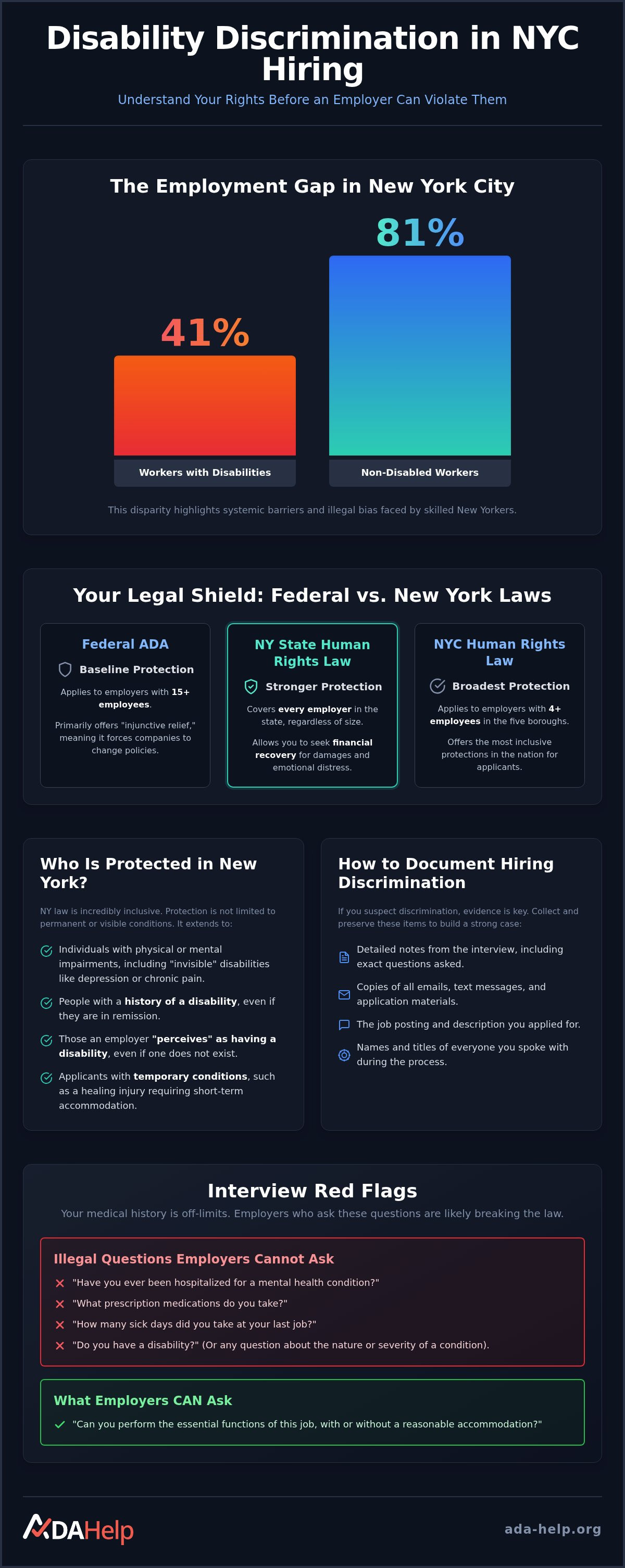
In New York City, the employment rate for workers with disabilities is just 41%, while non-disabled workers see a rate of 81%. This massive gap isn't just a coincidence. It's often the result of systemic barriers and illegal bias. If you've walked out of an interview feeling judged or ignored, you're likely facing disability discrimination in hiring process NY. It's exhausting to feel invisible when you know you have the skills to do the job.
You shouldn't have to navigate complex labor laws alone or worry about expensive legal fees just to get a fair shot. We'll help you identify the specific interview red flags that violate your rights and show you how to secure the money damages you deserve. By the end of this guide, you'll understand the latest 2026 protections and find a low-risk path to hold discriminatory employers accountable. Your career shouldn't be sidelined by illegal hiring practices. Let's look at what the law says about your situation right now.
Key Takeaways
- Identify illegal interview questions about your health and medications that New York employers are legally required to avoid.
- Understand your right to reasonable accommodations during the application process and how to trigger a mandatory cooperative dialogue.
- Spot the red flags of disability discrimination in hiring process NY to confirm if your rights were violated during a recent job search.
- Learn exactly what evidence to collect, from text messages to interview notes, to ensure you can prove your case later.
- Find out how to start a claim for financial recovery without any upfront costs or the stress of managing complex legal paperwork.

Disability Discrimination in the New York Hiring Process
Discrimination isn't always obvious. It's when an employer treats you unfairly because of a disability during the application or interview. In New York, the law is on your side from the moment you click "apply." Facing disability discrimination in hiring process NY can feel like a dead end, but the state has some of the strongest protections in the country. These rules ensure that your skills, not your medical history, determine your future.
The Americans with Disabilities Act of 1990 set the baseline for rights across the country. It was a massive step forward, but New York laws go much further. They don't just ask an employer to stop being biased; they allow you to seek financial recovery for the harm you've suffered. This includes money for lost wages and the emotional toll of being rejected for the wrong reasons.
To better understand how this bias shows up during the search for a job, watch this helpful video:
Federal ADA vs. New York Human Rights Laws
The federal ADA is a great starting point, but it has limits. It generally applies only to employers with 15 or more employees. If you're applying to a smaller company, the ADA might not help you at all. Even when it does apply, the federal government often focuses on "injunctive relief." This means they tell the company to change their policies, which doesn't always help you personally.
New York is different. The New York State Human Rights Law (NYSHRL) applies to every single employer in the state, regardless of their size. If you're in the five boroughs, the New York City Human Rights Law (NYCHRL) offers the broadest protections in the nation. It covers any employer with four or more people. These local laws are designed to hold companies accountable and provide you with a clear path toward financial resolution.
Who is Protected in New York?
You don't need a permanent or visible condition to qualify for protection. New York law is incredibly inclusive. It covers applicants with physical or mental impairments that limit major activities like walking, working, or sleeping. This includes "invisible" disabilities such as depression, epilepsy, or chronic pain. If you've been a victim of disability discrimination in hiring process NY, the law protects you regardless of how your condition looks on the outside.
Protection also extends to your history and how others see you. New York law covers:
- People with a history of a disability, even if they are currently in remission.
- Individuals the employer "perceives" as having a disability, even if they don't have one.
- Applicants with temporary conditions, such as a healing injury, that require short-term accommodations.
If an employer assumes you can't handle the workload because of a medical condition, they're likely breaking the law. You have the right to be judged on your ability to do the work.
Interview Red Flags: A Checklist for New York Applicants
Knowing your rights is only half the battle. You also need to spot the moment those rights are violated. In New York, the hiring process is strictly regulated to prevent bias before you even get through the door. Employers cannot use the interview as a fishing expedition for your medical history. If they do, they are likely engaging in disability discrimination in hiring process NY. You have the right to be judged on your talent, not your medical records.
The New York State Department of Labor is clear about what is off-limits. An interviewer can ask if you can perform essential job duties with or without an accommodation. They cannot, however, ask about the nature or severity of your condition. If you find yourself answering questions about surgeries, medications, or past hospital stays, the law has already been broken. These questions are designed to weed out "expensive" or "unreliable" candidates, which is illegal.
Illegal Questions During the Hiring Stage
Some questions are so common that applicants don't realize they are illegal. Watch out for these specific inquiries during your next meeting. If an interviewer asks these, they're crossing a legal line:
- "Have you ever been hospitalized for a mental health condition?" Your past treatments and hospital stays are private.
- "How many days were you sick at your last job?" This is a backdoor way to screen for chronic illness or disability.
- "Are you currently taking any prescription drugs?" Employers don't have a right to your medicine cabinet.
Employers also cannot ask about past workers' compensation claims or how you became disabled. These questions serve no purpose other than to judge your perceived risk as an employee. If an interviewer presses for these details, stop and take note. It's often the first sign that you're being unfairly screened out of a position you're qualified to hold.
Behavioral Red Flags to Watch For
Discrimination isn't always spoken. Sometimes it's seen in the interviewer’s actions or a sudden shift in the room's energy. Pay attention to how the tone changes during your interaction. Did the interviewer cut the meeting short the moment they saw your mobility aid or service animal? That's a major red flag. If the conversation goes from enthusiastic to cold after you disclose a condition, you're likely witnessing bias in real time.
Other red flags include:
- The employer rescinds a job offer immediately after learning about a medical condition.
- You are forced to take a physical or mental test that other applicants don't have to complete.
- The interviewer makes dismissive comments about your ability to "keep up" with the team.
If these scenarios sound familiar, you don't have to just walk away. If you were passed over for the role itself, see our guide on what to do when you're denied a job because of your disability. Otherwise, you can check your case eligibility in just a few minutes to see if you have a claim for financial recovery. Documenting these moments now is the first step toward holding them accountable.
Reasonable Accommodations During the Application Stage
Applying for a job is hard enough. It's even harder if the application process itself is built with barriers. You have a legal right to request changes so you can compete on a level playing field. If an employer refuses to provide a simple adjustment, they might be committing disability discrimination in hiring process NY. This protection starts before you even meet the team. It covers the online application, the first phone screen, and the final interview.
An employer cannot reject your application simply because you asked for help. If you're the best person for the job, your need for an accommodation shouldn't matter. Groups like the Center for Independence of the Disabled, New York work to ensure that these rights are respected by local businesses. If you feel you were passed over because of your request, it's time to take a closer look at your case. You deserve a fair shot at every opportunity.
The Cooperative Dialogue Requirement in NYC
If you're applying for a job within the five boroughs, you have an extra layer of protection. New York City law requires employers to engage in a "cooperative dialogue." This isn't just a casual chat. It's a formal requirement to discuss your needs in good faith. The law is very specific about how this should work.
The process must follow clear steps. First, the employer must talk to you about why you need the accommodation. Next, they must explore potential solutions together with you. Finally, they must provide a written decision once the dialogue is finished. If an employer ignores your request or refuses to talk, they've already violated the law. You don't have to prove they were being mean; you only have to prove they didn't follow this required process.
Common Accommodation Examples for Applicants
Accommodations are usually simple and low-cost. Don't let an employer tell you that your request is too difficult or expensive. Most adjustments are quick fixes that allow you to show your true potential. Common examples include:
- Providing application materials in large print or braille for those with visual impairments.
- Allowing a job coach or advocate to sit in on the interview.
- Changing the format of a pre-employment test to give you more time or a different way to answer.
- Ensuring the interview happens in a building with a working elevator or ramp.
If you asked for one of these and were told "no" without a real discussion, you may have a reasonable accommodation denied claim. You can start your case check today to see if your rights were ignored during the hiring stage. We handle the heavy lifting so you can focus on your career.
How to Document Hiring Discrimination in NY
If you walk away from an interview feeling like you were treated unfairly, your first instinct might be to vent to a friend. Instead, pick up a pen. Proving disability discrimination in hiring process NY requires more than just a gut feeling; it requires a paper trail. The moments immediately following a bad interaction are the most critical for building a strong case. Your notes serve as a real-time record that carries significant weight when filing a claim.
Don't wait until the next day to record what happened. Memory fades fast. Write down exactly what the interviewer said, especially any comments regarding your health, mobility, or need for accommodations. Note the names and titles of every person you spoke with, from the receptionist to the hiring manager. This helps establish who was responsible for the decision-making process. You should also save the original job posting and your submitted application immediately. Companies often delete these listings once they fill a role. If you don't have a copy, it's much harder to prove you were qualified for the specific requirements they listed.
Creating a Timeline of Events
A clear timeline is your best weapon. Record the date and time of every single interaction, from the first recruiter call to the final rejection email. Be specific about when you disclosed your disability or when it became obvious to the employer. Did the tone change after that moment? Document it. If the hiring process suddenly stalled right after a discussion about accommodations, that timing is a key piece of evidence. This cause and effect pattern is exactly what case managers look for when evaluating your claim.
Preserving Digital Evidence
Digital footprints are easy to lose if you aren't careful. Take screenshots of everything. This includes rejection notices in application portals, LinkedIn messages from recruiters, and even social media interactions with the company. Never delete an email or text message, even if it seems minor or friendly. A simple "we've decided to move in a different direction" email is a vital piece of the puzzle when paired with your interview notes. It shows exactly when the potential disability discrimination in hiring process NY occurred.
Gathering this info can feel overwhelming when you're already dealing with the stress of a job search. We can help you organize these details and handle the heavy lifting of your claim. You can start a free case check today to see if the evidence you've gathered is enough to secure financial recovery.
Starting Your Case with ADAhelp Case Management
You've identified the red flags and gathered your evidence. Now, you need a partner who knows how to turn those notes into a successful claim for recovery. Many people hesitate to act because they fear the complexity of the legal system or the high cost of hiring an attorney. ADA Help - NY disability discrimination claims is here to remove those barriers. We aren't a law firm; we are a dedicated case management service. Our job is to simplify the entire process of addressing disability discrimination in hiring process NY. We handle the stressful parts so you can move forward with confidence.
Our team takes the lead on information gathering and filing. We know exactly what the NYSHRL and NYCHRL require for a valid claim in the current 2026 legal environment. By letting us manage the paperwork, you ensure that every detail is captured correctly from the start. Once your case is ready, we connect you with independent attorneys who specialize in these specific types of claims. These professionals understand the local landscape and have the expertise needed to secure the best possible outcome for you. You don't have to worry about missing a deadline or filing the wrong form.
The Free Three-Minute Case Check
You don't need to spend hours researching laws to find out if you have a claim. Our process starts with a simple, high-speed evaluation that respects your time. You'll answer a few straightforward questions about your interview experience and the treatment you received from the employer. It's designed to be fast and stress-free. There is no guesswork involved, and you don't need to have a law degree to understand the results. We strip away the jargon to give you a clear answer.
This check gives you an immediate sense of whether your rights were violated during the application stage. There's no waiting around for a call back or wondering if your situation matters. If your experience qualifies as disability discrimination in hiring process NY, we help you take the next step immediately. Start your free case check here to get the answers you need right now. It is the fastest way to turn your frustration into a plan for resolution.
No Out-of-Pocket Costs for New Yorkers
Financial risk shouldn't stand in the way of justice. We've built our service to be completely low-risk for you. You never pay ADA Help - NY disability discrimination claims for the initial case evaluation or our management services. Our goal is to make recovery accessible to every New Yorker, regardless of their current bank balance. We believe the burden of effort and financial risk should never fall on the person seeking fairness after being treated poorly by a potential employer.
The independent attorneys we connect you with work on a contingency model. This means they only get paid if you win a settlement or a court award. If there is no recovery, there is no fee. This structure ensures that your legal team is just as motivated as you are to reach a successful resolution. We take the pressure off your shoulders so you can focus on your future career goals instead of legal bills. It's a clear, streamlined path toward resolution that prioritizes your peace of mind.
Take Control of Your Career Path
You now have the tools to identify illegal interview red flags and understand the power of a documented timeline. New York laws are designed to protect your right to a fair hiring process, but these protections require you to step forward. Facing disability discrimination in hiring process NY shouldn't be the end of your professional journey. It's simply a barrier we can help you remove. You've already done the hard work of identifying the problem; now it's time to find a solution.
Our team offers expert case management with no out-of-pocket costs, connecting you with specialists who fight for your rights. We handle the complex paperwork and filing so you can stay focused on your next career move. Start your free three-minute case check now to find out if you're eligible for financial recovery. This simple step can turn a frustrating experience into a clear path toward justice. You deserve to be judged on your skills and experience alone. Don't let an employer's bias hold you back from the future you've earned.
Where to File: Agencies & Deadlines
Once you've documented what happened, you have several places to file a formal complaint. Each agency has its own process and deadline, so it helps to know your options before you pick where to start. For a full walkthrough of what happens after you file, see our step-by-step guide to the claim process.
- New York State Division of Human Rights (DHR): Handles complaints under the NYSHRL for employers of any size. You generally have three years from the discriminatory act to file with the Division of Human Rights.
- NYC Commission on Human Rights (CCHR): Covers NYC employers with four or more employees under the NYCHRL. Complaints to the NYC Commission on Human Rights also carry a three-year filing window.
- U.S. Equal Employment Opportunity Commission (EEOC): Enforces the federal ADA for employers with 15 or more employees. You generally have only 300 days to file, far shorter than the state and city deadlines.
- U.S. Department of Justice (DOJ): Investigates broader patterns of disability discrimination and enforces ADA compliance nationwide, though it doesn't handle individual hiring complaints the way DHR, CCHR, and the EEOC do.
Because deadlines vary so much between agencies, it's worth filing with whichever body applies to your case as soon as possible. You can start your free case check to confirm which agency fits your situation.
Frequently Asked Questions
Is it illegal to ask about my medical history in a NY interview?
Yes, it's strictly illegal for New York employers to ask about your medical history, past hospitalizations, or medications before making a job offer. They can only ask if you can perform essential job duties with or without an accommodation. If you're asked about your health or medications, you're likely experiencing disability discrimination in hiring process NY. These questions are prohibited to ensure bias doesn't influence hiring decisions.
What is the difference between federal and NYC disability laws?
The federal ADA applies to employers with 15 or more employees and often focuses on changing company behavior rather than providing individual payouts. In contrast, the New York City Human Rights Law covers employers with four or more employees and offers much broader protections. NYC law is specifically designed to provide financial recovery for the applicant, whereas federal law often results in non-monetary court orders or policy changes.
Can I get money damages for hiring discrimination in New York?
Yes, New York laws allow you to recover money damages for lost wages and emotional distress if you've been unfairly denied a job. Unlike federal law, which has strict caps on certain awards, the NYSHRL and NYCHRL empower applicants to seek settlements that compensate them for the actual harm caused by bias. This financial recovery holds employers accountable and helps you get your career back on track after a setback.
What if my disability is not visible during the hiring process?
You're protected regardless of whether your disability is visible or "invisible," such as depression, epilepsy, or chronic pain. The law also covers you if an employer simply "perceives" you have a disability, even if you don't. If an interviewer treats you differently after you disclose a non-visible condition, it's still a violation of your rights under the disability discrimination in hiring process NY guidelines. Your privacy doesn't cancel your protections.
How long do I have to file a hiring discrimination claim in NY?
You generally have three years to file a claim under the New York State Human Rights Law for incidents occurring on or after February 15, 2024. If you're filing with the EEOC at the federal level, the deadline is much shorter at only 300 days. It's best to start your documentation immediately while the details of the interview are still fresh. Waiting too long can make it harder to gather necessary evidence.
Do I need to pay upfront for an ADA case check?
No, you don't have to pay anything for our initial case evaluation or management services. Our goal is to make justice accessible without any financial risk to you. If we connect you with an attorney, they work on a contingency basis. This means they only take a fee if you successfully win a settlement or award at the end of your case. You don't pay unless you win.
Can an employer rescind a job offer if they find out I have a disability?
No, it's illegal for an employer to take back a job offer simply because they learned you have a medical condition. This is a common form of discrimination that often happens after a background check or a voluntary disclosure. If a firm rescinds your offer after learning about your health status, they're violating both state and city human rights laws. You have the right to hold them accountable for that lost opportunity.
What is a cooperative dialogue in New York City?
A cooperative dialogue is a mandatory good-faith conversation between an NYC employer and an applicant who requests an accommodation. The employer must discuss your specific needs and potential solutions to help you participate in the hiring process. This process isn't complete until the employer provides you with a written decision. Failing to engage in this dialogue is a standalone violation of NYC law, even if an accommodation wasn't ultimately possible.

Article by
ADA Help
Written by the ADAhelp editorial team and reviewed for accuracy before publishing. ADAhelp helps New Yorkers find out if they have a disability discrimination claim and manages the process end to end, working with independent attorneys who handle the legal work. We are not a law firm and do not provide legal advice.
Disclaimer
This article is general information about New York law, not legal advice, and reading it does not create an attorney-client relationship. ADAhelp is a case-management and intake service, not a law firm; legal representation is provided by independent attorneys. Recovery amounts and timelines vary by case, and past outcomes do not guarantee future results. For advice about your specific situation, speak with a qualified attorney or start the free case check.
Tags
Discriminated against in New York because of a disability?
A free three-minute check tells you if you can pursue a claim.
Check my case →New York onlyNo upfront costIndependent NY attorneysFree 3-minute check