Reasonable Accommodation Denied New York: Your Rights Guide
Reviewed for accuracy by the ADAhelp team before publishing. ADAhelp is not a law firm; legal work is handled by independent New York attorneys.

Reasonable accommodation denied New York? A flat "no" is often illegal. Learn your rights, how to recover damages, and get help with no upfront costs.
Did your employer give you a flat "no" when you asked for a change to help you do your job? In many cases; a simple rejection is actually against the law. You likely feel ignored or even fear that you're being pushed out of your position just for asking for help. It's frustrating to feel like your career is at risk because of a health condition or disability.
If you had your reasonable accommodation denied New York laws provide powerful ways to protect your rights and recover money for lost wages or emotional distress. You can confirm if your employer broke the law and find a path to hold them accountable without any upfront costs. This guide will show you how to turn your frustration into a clear plan for resolution.
We'll walk through the strict "cooperative dialogue" requirements that New York City employers must follow. You'll learn the differences between federal and local protections and how to identify if a denial was illegal. We also cover what a typical recovery looks like and how the right support can help you secure the justice you deserve.
Key Takeaways
- Learn why a "cooperative dialogue" is a legal requirement in NYC and why a flat rejection is often a violation of your rights.
- Discover how to recover actual money damages for emotional distress and lost wages under New York State and City Human Rights Laws.
- Find out if having your reasonable accommodation denied New York qualifies for a claim through a free three minute case check.
- Identify the specific steps to document your request and your employer's response to build a strong foundation for your case.
- Understand how to access professional case management and legal connections on a contingency basis with no out of pocket expenses.

What counts as a reasonable accommodation denial in New York?
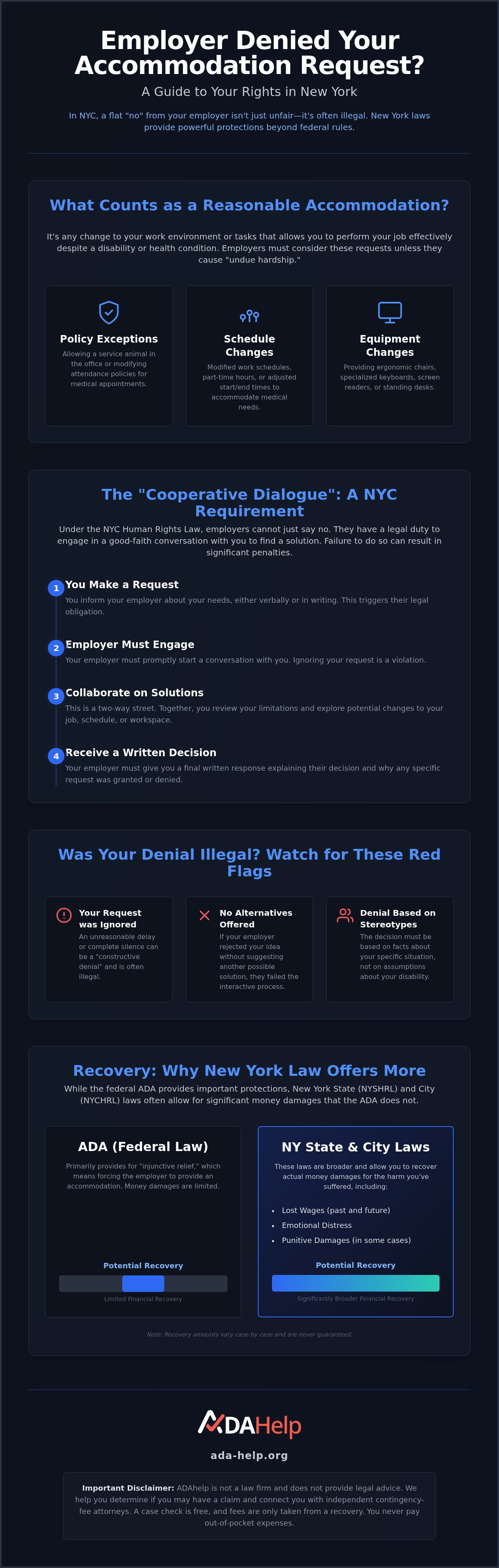
Imagine you've asked for a standing desk or a later start time to manage your health; but your boss just shakes their head. A Reasonable accommodation is any change in your work environment or how tasks are handled that allows you to do your job effectively. Under the New York State Human Rights Law; a reasonable accommodation is an action taken by an employer which permits an employee with a disability to perform in a reasonable manner the activities involved in the job or occupation sought or held. If you had your reasonable accommodation denied New York employers often claim it's too difficult; but they must prove it causes an "undue hardship" to legally say no.
Denials aren't always a formal "no" in an email. Sometimes a manager ignores your request for weeks; hoping you'll just drop it. This is known as a constructive denial. Other times; they might tell you that "we don't do that here" without looking into your medical documentation. Both scenarios can count as a violation of your rights because they bypass the required conversation about your specific needs.
To better understand how these denials happen and how you can respond; watch this video:
Common examples of accommodations in New York workplaces
New York workers have broad protections that cover many different needs. These standard requests help you stay productive and successful in your role:
- Modified work schedules or part-time hours to allow for medical treatments.
- Physical equipment changes like ergonomic chairs; specialized keyboards; or screen readers.
- Policy exceptions such as allowing a service animal in a retail space or office.
When a denial is actually a legal violation
A denial is often illegal if your employer fails to follow specific steps. You may have a claim if any of the following occurred:
- The request was ignored for an unreasonable amount of time.
- The employer denied the request without suggesting an alternative solution.
- The denial was based on a stereotype about your specific disability rather than facts.
If you had your reasonable accommodation denied New York laws allow you to take action to protect your career. You don't have to accept being pushed out of your job or ignored. By visiting ada-help.org; you can start a free three-minute case check. This process helps you determine if you can recover lost wages or damages for emotional distress without any out of pocket costs.
The interactive process: Why a flat 'no' is often illegal in NYC
In New York City; your employer cannot just say "no" and walk away. The New York City Human Rights Law (NYCHRL) requires what is called a "cooperative dialogue." This is a mandatory; good faith conversation between you and your boss. Once you ask for help; the law requires them to engage with you to explore possible solutions. If you had your reasonable accommodation denied New York City laws might have been violated the moment they refused to talk. Failing to engage in this dialogue can result in civil penalties of up to $125,000.
This process is a two-way street. It is not a lecture where the employer dictates all the terms. Instead; it is a collaborative effort to keep you working and productive. According to the EEOC Guidance on Reasonable Accommodation; this interactive process is vital for identifying the precise limitations resulting from your disability. In New York; the burden is on the employer to prove they actually attempted to find a solution before giving up.
What the interactive process looks like in practice
You shouldn't be left guessing about your employment status after making a request. A proper; legal process in New York usually follows a clear path:
- Meeting with HR or your supervisor to discuss your specific medical limitations.
- Reviewing potential changes to your job duties; equipment; or physical workspace.
- Receiving a written response from the employer explaining why a specific request was granted or denied.
The 'Undue Hardship' defense in New York
Employers often try to hide behind the phrase "undue hardship." They might claim your request is too expensive or will disrupt the whole office. However; in New York; an undue hardship must be a significant difficulty or expense. This isn't just a minor inconvenience or a small cost. The law looks at the company's total size and financial resources.
For a large corporation in NYC; proving a request is a "hardship" is very difficult. They have deep pockets and a high legal bar to clear. If they didn't even try to find a middle ground; their defense will likely fail in court. You can get a free case check to see if your employer's refusal was actually illegal and if you are entitled to compensation.
Recovery and damages: Why New York laws offer more than the ADA
While the federal Americans with Disabilities Act (ADA) helps fix workplace issues; it often falls short on financial compensation. If you had your reasonable accommodation denied New York state and city laws provide the teeth needed to recover actual money. The ADA mostly offers injunctive relief; which means a court orders the employer to change their ways. In contrast; the New York State Human Rights Law (NYSHRL) and the New York City Human Rights Law (NYCHRL) allow you to sue for your financial losses and pain. You don't have to settle for just a policy change when your livelihood has been impacted.
Money damages are essential if you were forced to quit or were fired after the denial. You can recover lost wages and compensation for the emotional toll the situation took on you. These laws ensure that the burden of discrimination falls on the employer; not the worker. By visiting ada-help.org; you can see if your specific situation qualifies for these types of financial recovery through a quick case check.
ADA vs. New York City Human Rights Law
The NYCHRL is one of the most powerful anti-discrimination laws in the country. It requires a liberal construction; which means NYC courts must interpret the law in a way that favors you; the employee; whenever possible. Unlike federal law; the city law allows for punitive damages. These are designed to punish employers for particularly bad behavior and deter others from doing the same. For willful or malicious violations; civil penalties can reach up to $250,000. This high bar for employers is why NYC is often the best place to file a claim.
Calculating your potential recovery
Your recovery is based on how the denial affected your life and bank account. Typical recovery amounts include several different categories of damages:
- Back pay: This covers the money you lost from the date of the violation until your case is resolved.
- Front pay: This covers future lost earnings if you cannot find a comparable job in your field.
- Emotional distress: This compensates you for the stress; anxiety; and pain caused by being discriminated against.
Recovery amounts vary case by case. Recent NYC Commission on Human Rights settlements have ranged from $35,000 to over $250,000 depending on the severity. Most successful claims also include attorney fees paid by the employer; meaning you keep more of your recovery. Holding an employer accountable is about more than just fairness; it is about restoring the financial security you lost when they ignored your rights.
How to document a denied accommodation claim in New York
Documentation is the most important part of any disability discrimination claim in New York. Without a clear record; a case often becomes your word against your employer's version of events. If you had your reasonable accommodation denied New York laws require you to prove that the request was made and that the employer failed to act. You must act as your own investigator by keeping every piece of evidence that shows you asked for help. This record is what allows an attorney to build a strong case for your recovery.
Start by saving every email; text message; or internal chat where your request was discussed. If your manager denies you during a face to face meeting; send a follow up email immediately. Summarize what was said and who was there. This creates a time stamped paper trail that is hard for a company to dispute later. You should also create a timeline of events. Include the dates of all meetings; the names of everyone involved; and exactly how you were treated after you asked for help. Keep copies of your original request and any medical notes you provided to HR.
The importance of the written request
Always make your accommodation request in writing. A verbal request is easy for an employer to "forget" or misinterpret. Use clear; direct language to state that you are requesting a "reasonable accommodation for a disability." This specific phrasing triggers the employer's legal duty to start a cooperative dialogue. For more help on building your evidence folder; you can use this guide for documenting workplace discrimination NY as a step by step checklist.
Deadlines for filing your claim in NY
Time is a critical factor in New York discrimination cases. You generally have three years to file a lawsuit under the New York State Human Rights Law or the New York City Human Rights Law. However; if you choose to file an administrative complaint with the EEOC; the deadline is much shorter. You often have only 300 days from the date the discriminatory act occurred to take action. For claims with the NYC Commission on Human Rights; you typically have one year to file.
Missing these deadlines can permanently end your right to recover money damages. You should start your free case check today to ensure your timeline is protected. ADAhelp evaluates your situation quickly so you don't lose your chance to hold your employer accountable due to a calendar error.
Where to File: Agencies & Deadlines
Once you've documented your denied accommodation, you have several agencies where you can file a formal complaint. Each one has its own deadline, so acting quickly protects your right to recover damages.
- New York State Division of Human Rights (DHR): Handles state-level discrimination claims under the NYSHRL. You generally have three years from the date of the violation to file at dhr.ny.gov.
- NYC Commission on Human Rights (CCHR): Enforces the NYC Human Rights Law for employers within the five boroughs. Complaints can be filed at nyc.gov/cchr, generally within three years of the violation.
- U.S. Equal Employment Opportunity Commission (EEOC): Enforces the federal ADA for employment claims. You typically have only 300 days from the discriminatory act to file, a much shorter window than the state or city deadlines.
- U.S. Department of Justice (DOJ): Oversees broader ADA compliance and can pursue systemic violations. You can review your rights directly from the source at ada.gov.
Because deadlines vary so widely, from 300 days with the EEOC to three years with DHR or CCHR, filing with the wrong agency or missing a deadline can end your claim before it starts. If you're unsure which path fits your situation, a free case check can help you confirm the right agency. You may also want to review how a denied job claim is filed in New York for a related step-by-step process.
Get a free case check for your denied accommodation in New York
You have rights. If you had your reasonable accommodation denied New York employers often count on you being too overwhelmed to fight back. You don't have to face this alone or risk your savings to get justice. ADAhelp is here to handle the heavy lifting for you. We offer a free three minute case check to help you understand if your employer violated the law. This is a simple; stress free way to find out if you are entitled to money damages for lost wages or emotional distress. If you had your reasonable accommodation denied New York laws are on your side; but the process can be complex.
Our process is built on a contingency model. This means we only get paid if you win a recovery. You never have to pay us anything out of pocket. We take on the financial risk so you can focus on your health and your future. If we take your case; we manage the entire process from start to finish. This includes gathering your evidence; organizing your timeline; and filing your claim with the correct government authorities like the EEOC or the New York State Division of Human Rights. We are your advocates in a system that often feels designed to ignore the individual.
How ADAhelp manages your New York claim
We provide specialized case management tailored to the unique legal environment of New York. Our team evaluates your specific situation against federal; state; and city laws to find the strongest path forward. We look for violations of the ADA; the New York State Human Rights Law (NYSHRL); and the New York City Human Rights Law (NYCHRL). Once we confirm a valid claim; we connect you with independent; experienced attorneys who specialize in New York disability law. We handle the administrative burden; so you don't have to worry about missing deadlines or filling out confusing paperwork.
Start your free case check today
Taking the first step toward justice shouldn't be intimidating. There are no cold law offices to visit and no complicated legal jargon to decode. You can start the process right now by visiting ada-help.org for a simple three minute intake. We ask the right questions to determine if your rights were ignored and what your case might be worth. For more information on your broader protections; read our guide on Wrongful Termination Disability NY: Rights & Recovery. Let us help you hold your employer accountable today.
Secure the recovery you deserve in New York
Your employer's refusal to help is not the final word. In New York; a flat denial without a real conversation is often a legal violation. You now know that the New York City Human Rights Law provides some of the strongest protections in the country. This law allows you to seek money for lost wages and the emotional stress you have endured. By keeping a clear record of your requests; you build the foundation for a successful claim.
If you had your reasonable accommodation denied New York laws allow you to hold your employer accountable without any financial risk. ADAhelp provides a free case evaluation for New Yorkers and manages your claim on a contingency basis. This means there are no out of pocket costs for you. We handle the administrative burden and connect you with independent experts who fight for your rights. Our team ensures that the burden of effort lies with us; not you.
Take the first step toward resolution today. Start your free three-minute case check now to confirm if you have a valid claim. You deserve a workplace that respects your needs and follows the law. We are ready to help you move forward with confidence.
Frequently Asked Questions
Can my employer in New York ask for medical proof before granting an accommodation?
Yes; your employer is generally allowed to ask for medical documentation to confirm your disability and the need for a change. However; they cannot demand your entire medical history or records unrelated to the specific request. The documentation should only provide enough information to verify that you have a disability as defined by the law and explain how the requested accommodation helps you perform your job duties.
What should I do if my boss ignores my accommodation request in NYC?
If your boss ignores you; this silence often counts as a constructive denial. Under New York City law; employers have a legal duty to engage in a "cooperative dialogue" once a request is made. Failing to respond is a violation of that duty. You should document every follow up attempt you make in writing. If you had your reasonable accommodation denied New York City laws provide a path to hold them accountable for their inaction.
Is it legal for my employer to fire me after I ask for a reasonable accommodation?
No; it is illegal for an employer to fire or punish you for requesting an accommodation. The New York State Human Rights Law was amended in late 2025 to explicitly protect workers from retaliation after making these requests. If you are terminated shortly after asking for help; it often serves as strong evidence of discrimination. You can recover damages for wrongful termination and emotional distress if this happens to you. Read more about being fired for a health condition in New York and what your rights look like in that situation.
How much is a denied reasonable accommodation case worth in New York?
Recovery amounts vary case by case based on your specific lost wages and the severity of the discrimination. Typical settlements in New York City can range from $35,000 to over $250,000 for serious violations involving willful behavior. These amounts often include back pay; front pay; and compensation for emotional pain. While no payout is ever guaranteed; New York laws allow for significantly higher recoveries than federal laws like the ADA.
Do I need a lawyer to file a disability discrimination claim in New York?
You are not required to have a lawyer to file a claim with the EEOC or the New York State Division of Human Rights. However; the process is complex and employers often have their own legal teams. Using a case management service helps you determine if you have a valid claim and connects you with independent contingency fee attorneys. This allows you to get expert help without paying any money out of pocket.
What is the difference between the ADA and the New York City Human Rights Law?
The main difference lies in the level of protection and the potential for money damages. The federal ADA applies to employers with 15 or more employees; while the NYC law covers employers with as few as four workers. Additionally; the NYC law requires a mandatory "cooperative dialogue" and allows for punitive damages to punish bad behavior. If you had your reasonable accommodation denied New York City laws offer much broader financial protections.

Article by
ADA Help
Written by the ADAhelp editorial team and reviewed for accuracy before publishing. ADAhelp helps New Yorkers find out if they have a disability discrimination claim and manages the process end to end, working with independent attorneys who handle the legal work. We are not a law firm and do not provide legal advice.
Disclaimer
This article is general information about New York law, not legal advice, and reading it does not create an attorney-client relationship. ADAhelp is a case-management and intake service, not a law firm; legal representation is provided by independent attorneys. Recovery amounts and timelines vary by case, and past outcomes do not guarantee future results. For advice about your specific situation, speak with a qualified attorney or start the free case check.
Tags
Discriminated against in New York because of a disability?
A free three-minute check tells you if you can pursue a claim.
Check my case →New York onlyNo upfront costIndependent NY attorneysFree 3-minute check