Evidence for Disability Discrimination Case: NY Checklist
Reviewed for accuracy by the ADAhelp team before publishing. ADAhelp is not a law firm; legal work is handled by independent New York attorneys.

Learn what evidence for a disability discrimination case you need in New York. Our guide lists key documents to build a strong claim. Get a free case check.
Did your manager suddenly stop inviting you to meetings after you mentioned your medical condition? It feels isolating and unfair when a New York employer ignores your rights. You shouldn't have to guess which documents matter or worry about how you'll afford to hold them accountable. Proving your claim starts with gathering the right evidence for disability discrimination case; the process is simpler than it seems.
We understand that legal jargon and the fear of hidden costs can keep you from seeking justice. This guide provides a clear checklist of the medical records, emails, and witness statements you need to build a strong claim under the New York City Human Rights Law. You will learn why local laws often provide better chances for money damages than federal rules. We also show you how to start a free case check. ADA Help - NY disability discrimination claims is not a law firm; instead, we review your details and connect you with independent contingency-fee attorneys. This means you can pursue your rights without any upfront costs or personal financial risk.
Key Takeaways
- Determine what counts as direct evidence and why written logs are vital for proving unfair treatment.
- Understand how New York City law defines disability more broadly than the ADA to help you qualify for financial recovery.
- Identify the specific types of digital and witness proof needed for employment and public access claims.
- Learn exactly how to gather the required evidence for disability discrimination case without any personal financial risk.
- Use a free three minute case check to see if you have a claim and get connected with a contingency fee attorney.

What is considered evidence for a disability discrimination case?
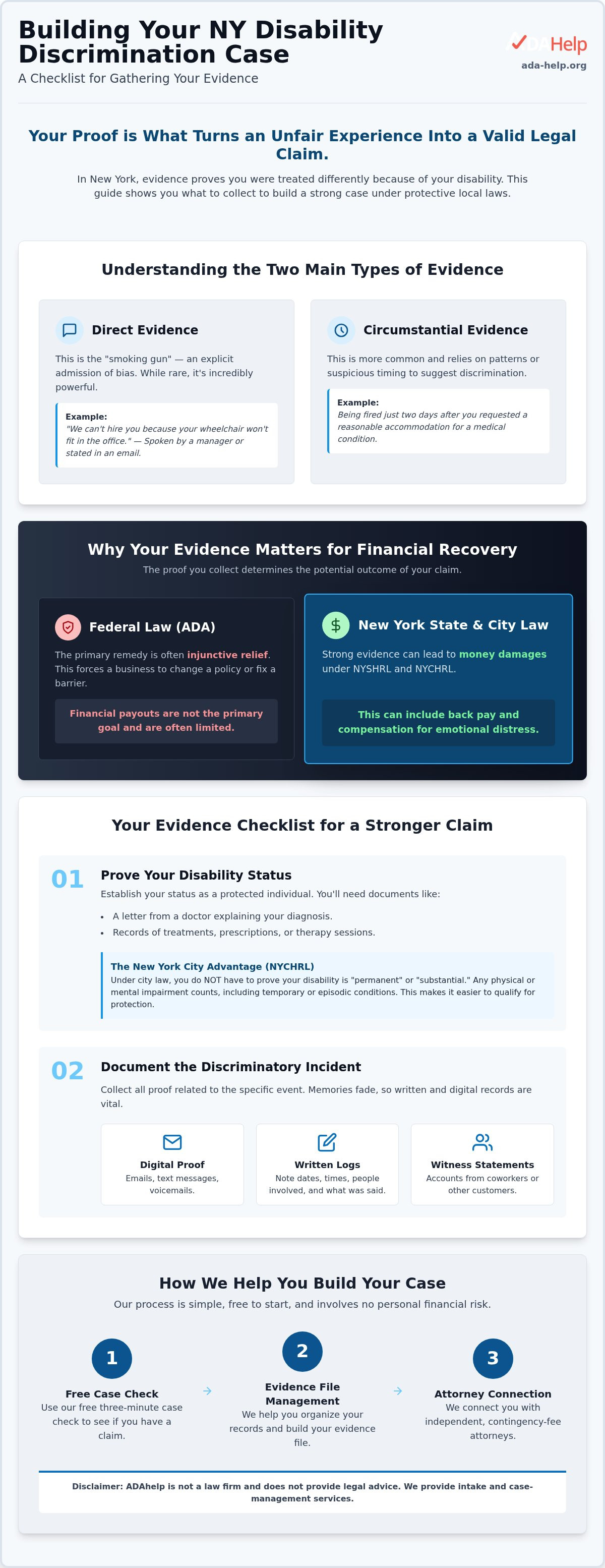
Evidence is any detail that proves you were treated differently because of your disability. It is the foundation of your claim. In New York, the law looks at how you were treated compared to your coworkers or other customers. If you were denied a job, fired, or harassed because of a physical or mental impairment, your proof is what turns your experience into a valid legal claim. Gathering strong evidence for disability discrimination case is the first step toward a resolution.
Direct vs circumstantial evidence in New York
Direct evidence is often called the "smoking gun." This happens when an employer or business owner explicitly admits to bias. An example is a manager telling you they won't hire you because your wheelchair won't fit in the office. These situations are rare because most people know not to say these things out loud. Even so, if you have a voicemail, email, or text message with these types of comments, you have powerful direct proof.
Circumstantial evidence is much more common. It relies on a pattern of behavior or suspicious timing to suggest discrimination. For instance, if a store manager only asks customers with service animals to leave while allowing other pets, that shows a pattern. Another example is being fired two days after you requested a desk adjustment for a back injury. The timing suggests a link between your request and the firing. The New York City Human Rights Law (NYCHRL) is especially protective for New Yorkers. It often requires less proof than federal laws because you only need to show you were treated "less well" than others due to your disability.
Why your evidence matters for money damages
The type of proof you collect dictates what you can win. Under the Americans with Disabilities Act (ADA), the primary remedy is often injunctive relief. This means the court forces a business to fix a physical barrier or change a discriminatory policy. While this helps the community, it does not always provide you with a financial payout for the harm you've suffered.
Strong evidence for disability discrimination case is what triggers financial recovery under New York State and City laws. These local statutes allow for money damages, including back pay and compensation for emotional distress. Your proof helps determine if your case is worth a settlement. ADA Help - NY disability discrimination claims provides a free three-minute case check to help you understand the strength of your evidence. We are not a law firm; we are a dedicated partner that manages the information gathering process and connects you with independent contingency-fee attorneys. You can check your eligibility at ada-help.org without any out-of-pocket costs.
Proving your disability under New York law
Proving your medical status is the first hurdle in any claim. While the previous section focused on the act of discrimination, this part focuses on your status as a protected individual. In New York, the definition of disability is far more inclusive than in many other states. Establishing this status early protects your claim from being dismissed. It serves as the primary medical evidence for disability discrimination case.
Medical records and doctor statements
You don't need a massive file to prove your condition. A simple letter from a licensed professional often suffices. It should explain your diagnosis and how the impairment limits your daily activities. For example, if you have a chronic respiratory issue, the letter should note how it affects your ability to work in certain environments. Keep track of your treatment dates, prescriptions, and physical therapy sessions. ADA Help - NY disability discrimination claims helps you organize these records to ensure nothing is missed. You can start a quick case check to see how your medical history supports your claim.
The NYCHRL advantage for New Yorkers
New York City residents have a distinct legal advantage. The New York City Human Rights Law (NYCHRL) does not require you to prove your disability is "permanent" or "substantial" like federal law often does. Any physical or mental impairment counts. This includes conditions that are temporary, episodic, or currently in remission. The New York State Division of Human Rights also enforces state laws that broaden these protections further. This means more people qualify for protection here than under federal standards. Having this broader definition makes it much easier to validate your evidence for disability discrimination case. We manage the intake process and build your file for review by independent attorneys without any out-of-pocket cost to you.
Documenting the discriminatory incident
Memories fade quickly. To build strong evidence for disability discrimination case, you must record the details while they are fresh. Don't wait until the next day. Grab a notebook or use your phone to log exactly what happened. Include the date, the time, and the specific address where the incident occurred. If you spoke to a manager or an employee, write down their name or a physical description. These small details prove you were there and that the event actually happened.
Describe the specific barrier or unfair treatment you faced in plain language. Did a bus driver refuse to deploy the ramp? Did a store clerk tell you that your service animal wasn't allowed inside? Write down the exact words they used. This log serves as a contemporaneous record, which is often more reliable than a memory shared months later.
How to log a public access violation
If you encounter a barrier at a business, your phone is your best tool. Public access claims often involve physical obstacles that prevent you from using a space safely. Use these steps to document the scene:
- Take clear photos of broken ramps, narrow aisles, or heavy doors that you cannot open.
- Use a common object like a dollar bill or a soda can in the photo to show the scale of the problem.
- Save your receipt or a bank statement to prove you were a customer at that location on that day.
- If you were denied entry to a restaurant or retail store, note the names of any witnesses who saw it happen.
These photos and receipts provide objective evidence for disability discrimination case that a business cannot easily deny. They show that the violation existed on a specific date and that you were personally affected by it.
Documenting workplace or housing issues
Discrimination in your home or job is often more subtle, and our guide to documenting disability harassment at work covers this in more detail. It usually leaves a paper trail. You should save every piece of communication regarding your disability or your request for a reasonable accommodation. A reasonable accommodation is a change to rules or a physical space that allows you to do your job or live comfortably. Use this checklist for your records:
- Save every email and text message where you asked for help or reported a problem.
- Keep copies of your performance reviews, especially if they turned negative after you disclosed your disability.
- Log any verbal comments made by your landlord or manager about your medical equipment.
- Note the dates of meetings where your disability was discussed and who attended.
This log creates a clear timeline. It helps determine if your employer or landlord followed the New York City Human Rights Law. At ADAhelp, we help you organize these logs into a clear case file. We aren't a law firm; instead, we manage the intake process and connect you with independent contingency-fee attorneys. You can start your journey with a free three-minute case check to see if your documentation is enough to move forward.
Gathering digital and witness evidence
While your personal logs and medical records provide a strong foundation, external proof adds significant weight to your claim. Unbiased third-party accounts or digital records are often the most persuasive evidence for disability discrimination case. They show that the unfair treatment was visible to others or recorded by a system. These details make it much harder for a business to claim that an incident was a simple misunderstanding.
Finding and contacting witnesses
Witnesses don't have to be your friends or family members. In fact, a stranger who saw you being mistreated at a restaurant or a coworker who overheard a biased comment can be more effective. They have no personal stake in the outcome of your claim. If someone stops to help you or speaks up during an incident, ask for their phone number or email address immediately. You don't need a formal statement yet; you just need a way to reach them later.
If the incident happened in a public place like a retail store or a bank, there is likely security footage. Most New York businesses delete these recordings within 30 days. You must act quickly to ask the business to preserve the footage. A simple written request can prevent the most important video proof from being erased. This type of objective evidence for disability discrimination case is vital for proving physical barriers or verbal harassment.
Digital proof for website and online claims
Many New Yorkers now face discrimination in digital spaces. If a company website isn't compatible with your screen reader or lacks closed captioning, it is a barrier to public access. Under the New York City Human Rights Law, digital storefronts are often treated with the same strict standards as physical ones. Use your phone or computer to capture the following:
- Take screenshots of the specific page where the website fails to function.
- Record a short video of your screen while you try to use a screen reader or keyboard navigation.
- Save any "access denied" messages or error screens you encounter while trying to buy a product or book a service.
This digital footprint shows a technical failure to comply with accessibility standards. It provides clear, undeniable proof that you were excluded from a service available to others. Organizing these technical files can be difficult, but you don't have to do it alone. ADAhelp acts as your proactive partner to manage these details. We aren't a law firm; instead, we handle the intake process and build your case file for review by independent attorneys. You can take a free three-minute case check today to see if your digital or witness proof is enough to start a claim.
How ADAhelp builds your evidence file
Organizing a pile of documents is overwhelming when you are already dealing with the stress of mistreatment. ADAhelp simplifies the process by acting as your proactive partner. We are not a law firm and we do not provide legal advice. Instead, we manage the entire intake process for you. We help you identify the strongest evidence for disability discrimination case and organize it into a professional file. This preparation ensures that your claim is clear and factual from the very beginning, the same groundwork covered in our case preparation checklist.
Our team understands the specific interplay between federal and New York local laws. While the ADA might force a business to fix a broken ramp, the New York City Human Rights Law is what often leads to financial recovery for the harm you've faced. We focus on these local protections to help you seek the justice you deserve. By handling the information gathering and filing with the proper authorities, we take the burden off your shoulders.
The benefits of case management
The most significant advantage of working with us is the lack of personal financial risk. We operate on a contingency model. This means you never pay out-of-pocket fees. If your case qualifies, we connect you with independent contingency-fee attorneys who only get paid if you win a recovery. We handle the complex paperwork and timelines so you don't have to. This allows you to focus on your life while we ensure your evidence for disability discrimination case is handled with care.
Start your free case check today
You don't have to guess if you have a valid claim. Visit ada-help.org to begin your evaluation. Our free three-minute case check asks a few simple questions about your experience in New York. We look at your specific situation to see if you have enough proof to move forward. It is a low-risk way to start your journey toward a resolution. Answer the questions honestly and let us help you build the foundation for your claim. Whether you faced issues at work, in a store, or on a website, we are here to help you hold the responsible parties accountable.
Where to File: Agencies & Deadlines
Once you have gathered your evidence for disability discrimination case, filing with the right agency before the deadline is what protects your right to recover.
- New York State Division of Human Rights (DHR). Handles NYSHRL claims statewide. For acts on or after February 15, 2024, you have three years to file. Details at dhr.ny.gov.
- NYC Commission on Human Rights (CCHR). Handles NYCHRL claims for the five boroughs, with a one-year filing deadline. Details at nyc.gov/cchr.
- U.S. Equal Employment Opportunity Commission (EEOC). Handles federal ADA employment charges, generally within 300 days in New York. See eeoc.gov.
- U.S. Department of Justice (DOJ). Enforces the ADA's Title I employment provisions alongside the EEOC. General guidance is at ada.gov.
Your evidence file only matters if it reaches the right agency in time. ADAhelp helps you determine which agency fits your claim and manages the filing so nothing is missed. Take a free three-minute case check to get started.
Take Control of Your Discrimination Claim Today
Proving your case doesn't have to be a lonely or confusing struggle. By gathering medical records, detailed incident logs, and witness contacts, you build the essential evidence for disability discrimination case. Remember that New York City and State laws are designed to protect you. They offer a path toward financial recovery that federal laws alone might not provide. Typical settlements vary based on your specific situation, but we are here to help you identify your potential for a successful outcome.
ADAhelp is your proactive partner in this process. We are not a law firm; instead, we manage the intake process and handle the heavy lifting so you don't have to. There are no out-of-pocket fees for our case management services. We work to connect you with independent contingency-fee attorneys who fight for your rights. You can start your free three-minute case check now to see if your claim qualifies. Don't let unfair treatment go unchallenged. You deserve a fair environment, and we are ready to help you find the justice you deserve.
Frequently Asked Questions
Do I need a lawyer to gather evidence for a disability case?
You do not need a lawyer to begin collecting information. You can start by saving emails and writing down what happened in a personal log. ADAhelp provides case management services to help you organize this evidence for disability discrimination case. We review your details for free and connect you with independent contingency fee attorneys if your claim qualifies. This allows you to build a strong foundation without paying any upfront legal fees.
What is the most important piece of evidence in a discrimination case?
A contemporaneous log of events is often the most persuasive proof. This is a written record made at the same time the incident occurred. It should include dates, names, and specific quotes. When you combine this with medical records from a licensed professional, it creates a clear picture of the discrimination. These documents show both your protected status and the unfair treatment you faced. Strong documentation is the best way to trigger the broad protections of New York law.
How much is a typical disability discrimination settlement in New York?
Typical settlement amounts vary significantly based on the specific facts of your situation. In 2026, the NYC Commission on Human Rights reported settlements like a $154,000 payment for service animal discrimination and a $45,000 payment for other disability claims. While the federal ADA focuses on fixing barriers, money damages usually come from the New York City Human Rights Law. For more detail on typical ranges, see our disability discrimination settlement amounts guide. We help you identify your recovery potential through our free case check process.
Can I still file a claim if I do not have photos of the incident?
You can absolutely file a claim without photos. While pictures of physical barriers are helpful, other proof like witness contact info or bank receipts can prove your case. Your personal log of the incident and any follow up emails are also powerful. New York law looks at the total body of information to decide if discrimination occurred. If you aren't sure if your current proof is enough, our team can evaluate your situation in minutes.
Does ADAhelp charge a fee for evaluating my evidence?
ADAhelp never charges a fee for evaluating your information. Our three minute case check is completely free for all New Yorkers. We operate on a contingency model; this means you only pay if you receive a recovery. There are no out of pocket costs for our case management services. This low risk approach ensures that every individual has a chance to seek justice regardless of their current financial situation.
What happens if I lost my medical records or receipts?
You can still move forward even if you have misplaced some documents. Most medical providers keep digital records and can provide a new copy of your diagnosis upon request. Banks and credit card companies also allow you to download past statements to prove you visited a specific business. Our case managers can guide you on how to recover this evidence for disability discrimination case. Having a proactive partner makes the process of rebuilding your file much easier.
Is a verbal comment enough evidence to win a case in NYC?
A single verbal comment can be enough to start a claim in New York City. The NYCHRL has a very broad standard. You only need to prove that you were treated "less well" than others because of your disability. A biased remark from a manager or a store clerk is direct evidence of this treatment. Writing down the exact words used and the names of anyone who heard them will significantly strengthen your claim.

Article by
ADA Help
Written by the ADAhelp editorial team and reviewed for accuracy before publishing. ADAhelp helps New Yorkers find out if they have a disability discrimination claim and manages the process end to end, working with independent attorneys who handle the legal work. We are not a law firm and do not provide legal advice.
Disclaimer
This article is general information about New York law, not legal advice, and reading it does not create an attorney-client relationship. ADAhelp is a case-management and intake service, not a law firm; legal representation is provided by independent attorneys. Recovery amounts and timelines vary by case, and past outcomes do not guarantee future results. For advice about your specific situation, speak with a qualified attorney or start the free case check.
Tags
Discriminated against in New York because of a disability?
A free three-minute check tells you if you can pursue a claim.
Check my case →New York onlyNo upfront costIndependent NY attorneysFree 3-minute check