How to Document Disability Harassment at Work in New York
Reviewed for accuracy by the ADAhelp team before publishing. ADAhelp is not a law firm; legal work is handled by independent New York attorneys.

Learn the steps for documenting disability harassment at work in NY. We show you how to save emails and keep a log to build a case for financial recovery.
Have you ever left a meeting feeling shaken because a manager made a cruel comment about your medical condition? You might worry that it's just your word against theirs; especially when you fear that speaking up could lead to retaliation. It's incredibly stressful to work in a hostile environment while wondering if you even have enough proof to make the behavior stop.
We understand how isolating this feels. Documenting disability harassment at work is the most effective way to protect your rights and move toward a resolution. This article provides the exact steps to record workplace mistreatment so you can seek a financial recovery under the New York State and City Human Rights Laws. We'll show you how these local protections often provide more help than the federal ADA.
You will learn which emails to save; how to keep a legal diary; and why New York recording laws might be on your side. We also explain how to see if you have a case through a free check. ADAhelp is not a law firm and does not provide legal advice. We connect you with attorneys who work on a contingency basis; so you don't pay anything out of pocket unless there is a recovery.
Key Takeaways
- Learn how documenting disability harassment at work transforms your personal story into the factual evidence needed for a New York claim.
- Identify the specific emails; performance reviews; and text messages you must save to prove your employer's behavior changed.
- Master the simple method for keeping a private harassment log that meets the standards of the New York State Division of Human Rights.
- Understand your rights under New York's one-party consent law; which allows you to record conversations you participate in yourself.
- Find out how to organize your proof to connect with a contingency-fee attorney through a free case check. (ADAhelp is not a law firm).

Why is documentation critical for your New York claim?
When you face mistreatment; it feels like your word against theirs. Managers might deny their comments or claim you misunderstood a joke. Workplace harassment can be subtle; making it hard to explain to someone else. This is where documenting disability harassment at work becomes vital. It turns your private frustration into objective proof. A solid paper trail removes the guesswork and shows a clear pattern of behavior that an employer cannot easily ignore.
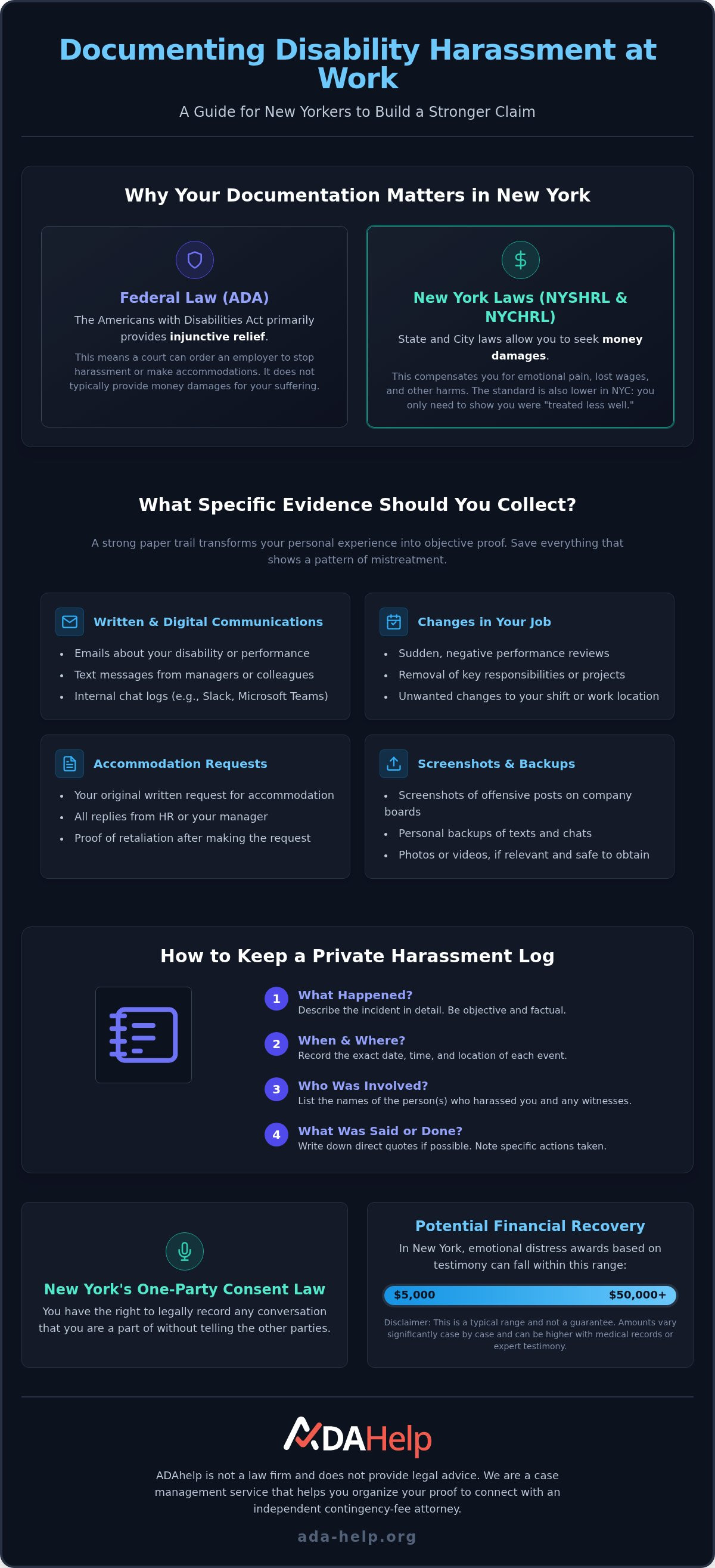
You must understand that different laws offer different solutions. The federal Americans with Disabilities Act (ADA) mostly focuses on injunctive relief. This means a court might order your employer to stop the harassment or provide a reasonable accommodation. While this is helpful; it doesn't always compensate you for what you've endured. New York State and City laws go much further. The New York State Human Rights Law (NYSHRL) and the New York City Human Rights Law (NYCHRL) allow you to seek money damages for your emotional pain and lost wages.
Understanding the New York City standard
If you work in the five boroughs; you have some of the strongest protections in the country. The NYCHRL is broader than federal law. Federal standards usually require harassment to be severe or pervasive to count as a legal violation. In NYC; that bar is lower. You only need to prove you were treated less well because of your disability. Your documentation proves that the conduct was a consistent problem rather than a petty slight or a one-time annoyance. Every entry in your log helps establish that you were targeted.
How evidence leads to a financial recovery
Detailed records are the foundation of a successful recovery. When you track every incident; you provide the data that independent attorneys use to calculate your case value. For example; if the harassment caused you to miss work or seek medical help; those records directly impact your potential back pay and compensatory damages. In New York; emotional distress awards based on a person's testimony typically range from $5,000 to $50,000. These amounts can increase if you have evidence like medical records or expert testimony. While settlement figures vary case by case; having a clear list of facts is the most common factor in securing a recovery.
You don't have to guess if your situation qualifies. A free three-minute case check at ada-help.org can help you understand your options. Remember; ADAhelp is a case management service; not a law firm. We don't provide legal advice. Instead; we help you organize your proof so you can connect with a professional who can fight for you. Our goal is to handle the heavy lifting of organizing your claim so you can focus on your health.
What specific evidence should you collect?
Proving harassment requires more than just a memory of what happened. You need a timeline that an employer cannot explain away. Documenting disability harassment at work means gathering every piece of data that shows you were treated differently because of your health or medical condition. This process turns your experience into a factual record that independent attorneys can use to build a claim for money damages.
Start by saving every written communication that mentions your disability. This includes emails; text messages; and internal chat logs. If a manager makes a comment about your mobility aid or your medical leave in a Slack message; save it immediately. You should also keep a copy of your original request for a reasonable accommodation and the company's response. A 2026 amendment to the New York State Human Rights Law explicitly protects you from retaliation for making these requests. Having the original date and text of your request is vital if your boss starts treating you poorly afterward.
Look for changes in your job duties or work schedule. Did your boss suddenly move you to a less desirable shift after you disclosed a diagnosis? Did they strip away your most important projects? These changes are often used as "stealth" harassment. Keep your performance reviews from both before and after the harassment started. If you were a top performer for years but suddenly received a "poor" rating after requesting an accommodation; that shift is powerful evidence of discrimination.
Written proof and digital footprints
Digital evidence is often the hardest for employers to deny. Take screenshots of offensive posts or comments on company message boards. Don't rely on the company to keep these records; as internal logs can be deleted or archived. If you receive a text message on a personal phone; back it up to a cloud service or print it out. These digital footprints help the New York State Division of Human Rights understand the frequency and nature of the abuse you faced.
Tracking verbal and physical incidents
Verbal harassment rarely leaves a paper trail. You must create one yourself. Write down the exact words used in offensive jokes or slurs as soon as they happen. Note the harasser's tone of voice and their body language. Did they loom over your desk? Did they mimic your symptoms? Record the date; time; and specific location of every incident. If a coworker or a client saw what happened; write down their name. These witnesses can provide the outside confirmation needed to support your story.
Collecting this much information is a heavy lift when you are already dealing with a hostile environment. You can check your case for free in about three minutes to see if your documentation is enough to move forward. ADAhelp is not a law firm and does not provide legal advice; but we help you organize your proof so you can connect with a professional who works on a contingency basis.
How to start and maintain your harassment log
How do you prove a pattern of behavior that happens in small; daily bites? Keeping a journal is the most effective way to stay organized. It prevents your memories from fading and creates a timeline that is hard to dispute. Documenting disability harassment at work requires a disciplined approach to record-keeping. You should choose a format that you can update every day. This could be a physical notebook kept in your bag or a private app on your personal phone. The goal is to create a "contemporaneous record;" which is a log written at the time the events occurred.
Use the "Who; What; Where; and When" method for every entry. Be as specific as possible. Instead of writing "My boss was mean;" write "My supervisor; John Doe; mocked my stutter during the 10:00 AM team meeting in the main conference room." Write these entries as soon as possible after the incident happens. Fresh details are more credible than memories recorded weeks later. Keep your log factual. While you are likely feeling hurt or angry; avoid using overly emotional language. Stick to the facts of what was said and done. This makes your log look like professional evidence rather than a personal vent session.
Securing your documentation
Where you keep your log is just as important as what you write in it. Never store your log on a work computer or a company-issued phone. You should also avoid saving files to a company cloud account like OneDrive or Google Drive. Assume your employer can access anything on their network or devices. If you use a digital format; use a personal email address that your employer does not know about. Many New Yorkers prefer a physical notebook kept safely at home. This ensures your proof remains in your hands; even if you are suddenly locked out of your work accounts.
Best practices for entries
Always note if there were any witnesses present. Even if a coworker didn't say anything at the time; their presence is a fact that can be verified later. You should also describe how the harassment affected your ability to do your job. For example; if a comment about your medical equipment made it impossible for you to focus on a presentation; write that down. Link the harassment to your disability clearly. If a manager suggests you are "too slow" because of your condition; record that specific connection. This level of detail helps a case manager at ada-help.org determine if you have a claim under the NYSHRL or NYCHRL. Remember that ADAhelp is not a law firm and does not provide legal advice; but we can help you organize this information for an attorney.
Handling recordings and internal complaints in New York
Can you hit record when your boss starts making offensive comments about your medical condition? In New York; the answer is often yes. New York is a "one-party consent" state for audio recordings. This means it is legal to record a conversation as long as you are a participant in it. You don't need to ask for permission or notify the other person that you are recording. However; documenting disability harassment at work through audio requires a careful strategy to avoid unintended consequences.
Reporting harassment to HR is a major step that you should take only after you have started your own private documentation. If you complain before you have proof; a dishonest employer might try to delete emails or change internal records. Having your own log first gives you the upper hand. It ensures that your version of events is backed by specific dates and details that the company cannot easily erase or deny during an investigation.
The risks and rewards of recording
Audio recordings can be powerful proof of verbal slurs; threats; or mocking behavior that doesn't happen in writing. A recording captures the tone of voice and the exact words used; making it much harder for a harasser to claim they were "just joking." But you must be careful. Check your employee handbook for specific rules against recording in the office. While recording is legal under New York state law; violating a company policy can still lead to discipline or termination. An employer might fire you for breaking their rules; even if the recording proves they were harassing you. You should consult with a case manager to understand how to use these recordings safely before sharing them with anyone at work.
Filing an internal complaint
When you are ready to speak up; use your log to write a clear; factual complaint to HR or your supervisor. Focus on the facts you have gathered. Describe the incidents; the dates; and how the behavior has affected your ability to perform your job. Always keep a copy of the formal complaint and any response you receive on a personal device or in a physical folder at home. Never leave your only copy of these records on a work computer.
Documentation is your best defense against retaliation. Under a 2026 amendment to the New York State Human Rights Law; it is a protected activity to request a reasonable accommodation or report discrimination. This means your employer cannot legally punish you for speaking up. If they try to fire or demote you after you file a complaint; your records will prove the timing of their actions. You can start your free case check now to see if your documentation is strong enough to move forward. ADAhelp is a case management service; not a law firm; and we do not provide legal advice. We help you organize your proof so you can connect with independent contingency-fee attorneys.
Turning your documentation into a recovery case
You've spent weeks or months recording every slight and slur. Now; you need to put that work to use. Documenting disability harassment at work is not just a way to vent; it is the foundation for a legal claim that can result in a financial recovery. You don't have to handle the complex legal system on your own. Many New Yorkers feel overwhelmed by the thought of filing a formal complaint or finding a lawyer. This is where professional case management makes the process simpler.
A strong; organized log is exactly what independent attorneys look for before they agree to take a case. They need to see a pattern of behavior that violates the New York State Human Rights Law (NYSHRL) or the New York City Human Rights Law (NYCHRL). When your evidence is clearly dated and detailed; it allows an attorney to quickly assess the value of your claim. This increases your chances of finding a legal partner who will work on a contingency-fee basis.
How ADAhelp supports your claim
We act as your proactive partner to handle the heavy lifting of organizing your evidence. Our team reviews your situation to see if you meet the specific requirements for a New York disability claim. We focus on the facts you have gathered; such as your harassment log and saved emails. We help you understand the interplay between federal and local laws. For instance; while the ADA might stop the behavior; the NYSHRL and NYCHRL are often the sources of money damages for your suffering. You can learn more about employment disability discrimination New York to see how these local protections work in your favor.
ADAhelp is not a law firm and does not provide legal advice. Instead; we connect you with experienced attorneys who handle the filing and litigation process. These professionals work on a contingency model; meaning they only get paid if they win a settlement or a court award for you. This removes the financial risk from your shoulders.
Your next steps for justice
The path to a resolution starts with a simple check of your facts. You can take our free three-minute case check at ada-help.org to get started. This tool helps you see if your documentation supports a claim before you spend time or money on legal fees. There are no upfront costs to use our service. We believe that every New Yorker deserves a fair workplace; and we are committed to making the system work for the individual with minimal friction. If you have done the work of recording the harassment; we are here to help you turn that proof into progress.
Where to File: Agencies & Deadlines
Once your documentation is solid; you have several agencies where you can file a formal complaint. Each one has its own rules; deadlines; and potential remedies; so it helps to understand your options before you choose a path.
New York State Division of Human Rights (DHR)
The New York State Division of Human Rights investigates violations of the NYSHRL. For incidents occurring after February 15; 2024; you generally have three years from the date of the harassment to file a complaint.
NYC Commission on Human Rights (CCHR)
If your workplace is in one of the five boroughs; the NYC Commission on Human Rights enforces the NYCHRL; which offers some of the strongest worker protections in the country. Most claims must be filed within one year of the last incident.
U.S. Department of Justice (DOJ) and EEOC
Federal claims under the Americans with Disabilities Act generally go through the Equal Employment Opportunity Commission (EEOC) first. You typically have 300 days from the harassment to file an EEOC charge; and the agency can refer serious violations to the DOJ for further action.
Because deadlines vary by agency and can be shorter than you expect; it helps to start your free case check as soon as your documentation is in order. ADAhelp is not a law firm and does not provide legal advice; but we can help you understand which filing option fits your situation before you connect with an independent attorney.
Take control of your career and your recovery
You have the power to change your situation. By documenting disability harassment at work; you are building a factual record that an employer cannot ignore. Remember that New York City and State laws provide specific paths to money damages that federal laws often miss. You now know how to save digital footprints; keep a private log; and handle recordings safely under one-party consent rules. Now it is time to put that information to work.
ADAhelp is here to handle the heavy lifting. We are not a law firm and don't provide legal advice; but we specialize in case management for New Yorkers like you. We offer a secure and confidential evaluation of your workplace claim. There are no upfront fees because we only get paid if you win a settlement or court award. This contingency model means the financial risk stays with us; not you.
Start your free three-minute case check now to see if your documentation supports a claim. You deserve a workplace free from harassment. Let us help you find the justice and recovery you are entitled to under the law.
Frequently Asked Questions
What counts as disability harassment in a New York workplace?
Disability harassment includes any unwelcome conduct based on your medical condition. Under the NYCHRL; the behavior does not have to be severe or pervasive to be illegal. You only need to show you were treated less well than coworkers because of your disability. Common examples include offensive jokes; slurs; or mocking your symptoms. Documenting disability harassment at work helps prove these incidents are more than just petty slurs or minor annoyances.
Can I be fired for documenting harassment at work?
It is illegal for your employer to fire or punish you for documenting disability harassment at work. New York law protects you from retaliation when you are gathering evidence of discrimination. A 2026 amendment to the NYSHRL specifically makes it a protected activity to report harassment or request an accommodation. However; you should never use company computers or phones for your log. Using personal devices ensures you don't violate company equipment policies.
Do I need a lawyer to start documenting my case?
No; you can start your documentation on your own right now. Collecting evidence early actually helps you when you are ready to seek legal help. ADAhelp is not a law firm and does not provide legal advice; but we help you determine if you have a valid claim. We offer a free three-minute case check to review your situation. We then connect you with independent contingency-fee attorneys who handle the legal heavy lifting.
Is a handwritten journal better than a digital log for evidence?
Both formats work well as long as they are kept on your personal property. A handwritten notebook is excellent because it cannot be deleted or hacked remotely. Digital logs are useful because they allow you to attach screenshots of text messages or emails. The most important part is that the record is contemporaneous; meaning you wrote it at the time the harassment happened. Always include dates; times; and names of any witnesses.
What if I do not have physical proof of the harassment?
Physical proof like emails is helpful; but your own detailed testimony is also evidence. A consistent log of verbal abuse can be enough to win a claim in New York. Garden variety emotional distress awards; which are based on your testimony; typically range from $5,000 to $50,000. These figures can increase if you have medical records or expert testimony. Don't assume you don't have a case just because the harassment was verbal.
How long do I have to file a disability harassment claim in NYC?
Your deadline depends on where you file. For incidents after February 15; 2024; you have three years to file with the New York State Division of Human Rights. If you choose the New York City Commission on Human Rights; you generally have one year for most claims. Federal EEOC charges must be filed within 300 days of the harassment. It is vital to act quickly to protect your right to a financial recovery.
Can I record my boss without them knowing in New York?
New York is a one-party consent state; so it is legal to record a conversation that you are participating in. You do not need to notify your boss or coworkers. However; you must be careful about company policies. Many New York employers have rules in their employee handbooks that prohibit recording in the office. Violating these rules could lead to your termination; even if the recording itself is not a crime under state law.

Article by
ADA Help
Written by the ADAhelp editorial team and reviewed for accuracy before publishing. ADAhelp helps New Yorkers find out if they have a disability discrimination claim and manages the process end to end, working with independent attorneys who handle the legal work. We are not a law firm and do not provide legal advice.
Disclaimer
This article is general information about New York law, not legal advice, and reading it does not create an attorney-client relationship. ADAhelp is a case-management and intake service, not a law firm; legal representation is provided by independent attorneys. Recovery amounts and timelines vary by case, and past outcomes do not guarantee future results. For advice about your specific situation, speak with a qualified attorney or start the free case check.
Tags
Discriminated against in New York because of a disability?
A free three-minute check tells you if you can pursue a claim.
Check my case →New York onlyNo upfront costIndependent NY attorneysFree 3-minute check