Deaf Discrimination Claim New York: Step-by-Step Guide
Reviewed for accuracy by the ADAhelp team before publishing. ADAhelp is not a law firm; legal work is handled by independent New York attorneys.
Denied an ASL interpreter? Learn how to file a deaf discrimination claim in New York and get money damages. Our free guide explains your rights under NY law.
What if the silence you experienced at a hospital or a local retail store wasn't just a misunderstanding, but a violation of your civil rights that could lead to financial recovery? It's incredibly frustrating to be ignored by staff or denied an American Sign Language (ASL) interpreter when you're trying to access essential services. You may feel like your voice isn't being heard; however, New York laws are specifically designed to protect you. Many people feel overwhelmed trying to decide if they should file a deaf discrimination claim New York under federal or state rules.
We understand the barriers you face every day in a city that moves fast and often ignores those who communicate differently. This guide will show you how to hold businesses accountable and secure the compensation you deserve. You'll learn how the New York State Human Rights Law and the New York City Human Rights Law provide for money damages that the federal ADA does not typically offer. We'll walk you through the process of determining if you have a case and how our case management services can help you find a path toward resolution with no financial risk to you. We're here to handle the heavy lifting so you can focus on getting the access you need.
Key Takeaways
- Identify when a communication barrier becomes a legal violation, such as being denied an ASL interpreter at a hospital or retail store.
- Learn why New York laws offer financial recovery for a deaf discrimination claim New York while the federal ADA usually only requires the business to fix the issue.
- Collect evidence early by saving all emails and text messages to prove the business ignored your requests for access.
- Understand the importance of the three year statute of limitations for filing your complaint with the New York State Division of Human Rights.
- Discover how a free case check can start your path toward justice with no out of pocket costs and no financial risk to you.

Do You Have a Deaf Discrimination Claim in New York?
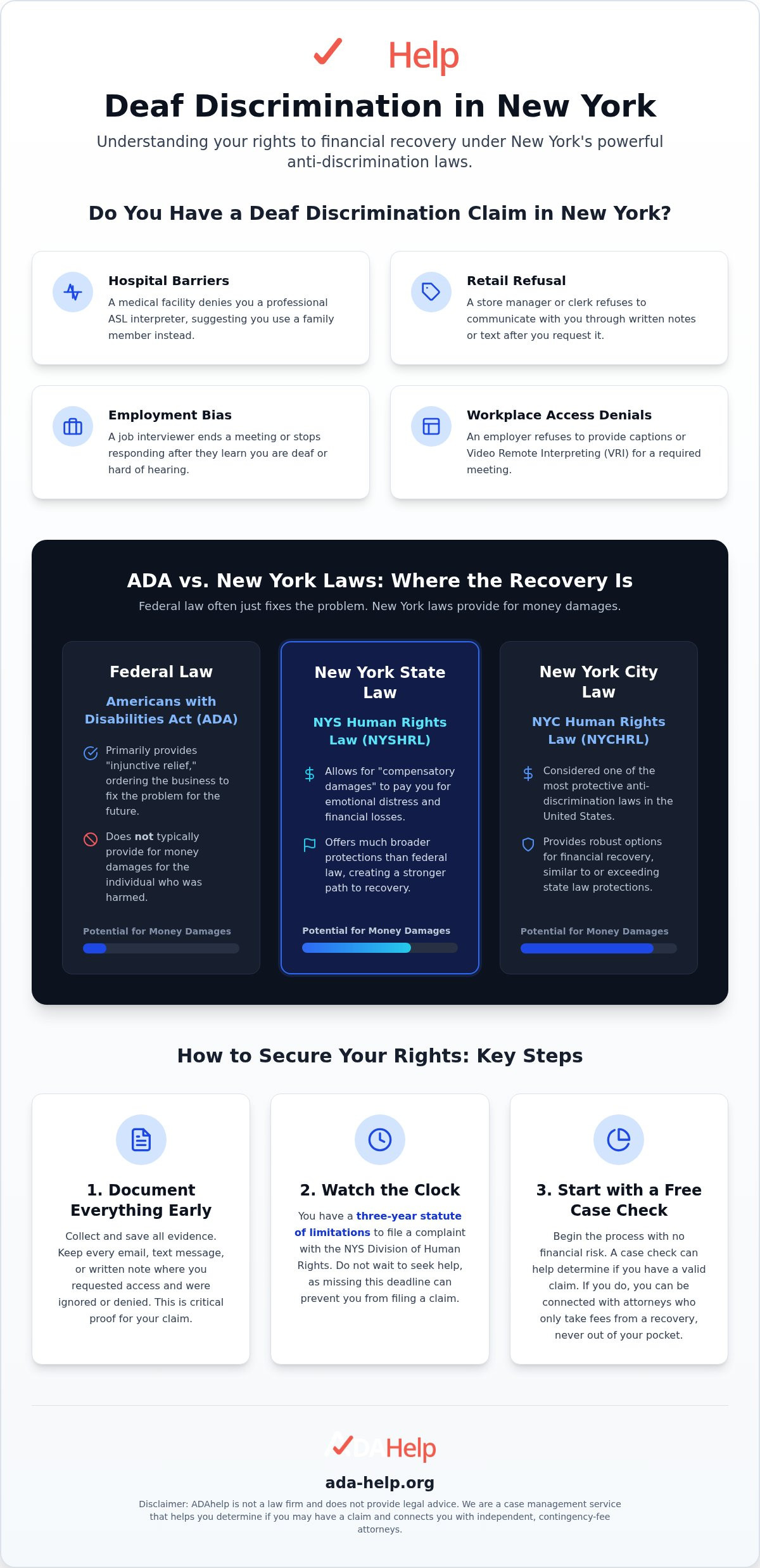
Have you ever visited a doctor in Manhattan and been told you must bring your own interpreter? Or perhaps a store clerk in Brooklyn refused to write notes and simply ignored you? These experiences are more than just frustrating; they are likely violations of your civil rights. If a business or employer fails to provide effective communication, you may have a valid deaf discrimination claim New York. Discrimination happens when you're treated differently or denied the same access as hearing people because of your hearing loss.
The foundation for your protection is the Americans with Disabilities Act of 1990. This federal law requires businesses to provide auxiliary aids and services to ensure effective communication. However, while the federal law is important, it often only forces a business to change its future behavior. For "Real New Yorkers" seeking financial recovery, we focus on the New York State Human Rights Law (NYSHRL) and the New York City Human Rights Law (NYCHRL). These local statutes are much broader and allow for money damages to compensate you for the harm and humiliation you suffered.
To better understand how discrimination affects the community, watch this helpful video:
Common Signs of Deaf Discrimination
You might not always realize when a business has crossed a legal line. Here are clear signs that your rights were violated in a New York business or workplace:
- Hospital Barriers: A medical facility tells you to use a family member to interpret instead of providing a professional ASL interpreter.
- Retail Refusal: A store manager refuses to communicate through text or written notes even after you request it.
- Employment Bias: A job interviewer suddenly ends a meeting early or stops responding once they realize you are deaf.
- Access Denials: An employer refuses to provide captions or video remote interpreting (VRI) for a mandatory staff meeting.
Where Discrimination Happens in New York
Discrimination can occur anywhere that is open to the public or where people work. In New York, your rights are protected in almost every corner of daily life. This includes public accommodations like restaurants, hotels, and private doctor offices. It also covers the workplace, protecting you during the hiring process and daily operations. Finally, government buildings, public schools, and housing complexes in New York City must also follow these strict access rules. If you've been ignored or pushed aside at any of these locations, you deserve to see if you have a case.
At ADA Help - NY disability discrimination claims, we are not a law firm and we don't provide legal advice. We act as your case management partner to help you determine if your experience qualifies for a claim. If it does, we connect you with independent attorneys who work on a contingency-fee basis. This means fees are only taken from a recovery; you never pay anything out of pocket. You can check your case status at ada-help.org in just a few minutes.
ADA vs. New York Human Rights Laws: Where the Recovery Is
Most people have heard of the Americans with Disabilities Act. It is a vital federal law; however, it often falls short when it comes to personal compensation. If you pursue a deaf discrimination claim New York solely through federal court, you are usually seeking "injunctive relief." This is a legal term meaning the court orders the business to fix the problem. For example, a judge might force a business to provide ASL interpreters in the future. While this helps the community, it does not put money in your pocket for the harm you already endured.
New York laws go much further than federal rules. The New York State Human Rights Law (NYSHRL) allows you to seek compensatory damages. These are payments meant to make up for your actual losses and the emotional pain caused by the discrimination. You can file a complaint with the New York State Division of Human Rights to start this process. This state agency handles cases involving public places, housing, and employment across the entire state. Unlike federal law, the state law recognizes that your frustration and humiliation have a financial value.
Why New York City Laws Are Stronger
If the incident happened within the five boroughs, the New York City Human Rights Law (NYCHRL) is your strongest ally. This law is famous for being one of the most protective in the country. It has a lower threshold for proving discrimination than federal law. You don't always have to prove the business was "severely" or "pervasively" hostile; you just have to show you were treated less well because of your disability. The NYCHRL applies to any business or employer with four or more employees. This means even small local shops are held accountable. Most importantly, it allows for punitive awards; these are extra payments meant to punish a business for especially bad behavior.
Understanding Your Recovery Potential
It is natural to wonder what your case is worth. Recovery amounts vary significantly based on the details of your situation. Typical cases involve settlements for a total lack of effective communication, such as being denied an interpreter during a critical meeting or high-stakes interaction. Factors like the length of the delay and the emotional distress you felt play a huge role in the final amount. Because every situation is unique, we never guarantee a specific payout. However, holding a business financially accountable is often the only way to ensure they take your rights seriously in the future. You can check your eligibility today with a free ADA case review New York. Our team at ADA Help - NY disability discrimination claims is ready to help you determine if your experience qualifies for a claim under these powerful local laws.
How to Document a Discrimination Incident for Your Claim
Winning a deaf discrimination claim New York depends on the strength of your evidence. Businesses often try to claim they didn't understand your request or that an interpreter wasn't necessary. You can stop these excuses by keeping a clear, detailed record of everything that happened. Start by saving every text message, email, and letter related to the incident. If you used a relay service to call a business, keep the call logs and any transcripts provided by the service.
Details matter when you're building a case. Write down the exact date, time, and location where the denial occurred. If you don't know the name of the employee who refused to help you, write a physical description or note their job title. Did they have a name tag? Were they the manager on duty? Taking photos of the scene can also be powerful evidence. For instance, if a business has a sign saying they don't provide interpreters, or if there is a visible lack of access equipment, snap a photo with your phone immediately.
Documenting Communication Failures
When a business fails to provide an interpreter, the burden is on them to show they provided an alternative form of effective communication. You should document every time you asked for help. If you handed a bank teller or a government clerk a written note requesting assistance, try to get a photo of that note. Record the names of any friends, family members, or other customers who witnessed the refusal. If you are unsure about the federal process, you can learn more about How to file an ADA complaint through the official government portal. However; remember that your documentation will also support your much stronger claims under New York state and city laws.
Evidence for Employment Claims
Discrimination in the workplace can be harder to spot; therefore, your records must be even more precise. Keep copies of the original job description and your own qualifications to show you were the right person for the role. Save any emails or performance reviews where a supervisor mentions your deafness as a "difficulty" or a "challenge" for the team. These comments are often used to prove bias during a case check. For more specific tips on handling these situations, you can read more on workplace disability discrimination at work. Collecting this information now makes it much easier for our team at ADA Help - NY disability discrimination claims to evaluate your situation later.
Steps to File a Deaf Discrimination Claim in New York
Filing a deaf discrimination claim New York requires a clear strategy to move from a frustrating incident to a successful resolution. Your first step is to categorize the violation. Did this happen at your workplace, or were you denied access at a public business like a bank or a hospital? Identifying the category helps determine which specific laws apply. For example, workplace issues often involve Title I of the ADA, while public businesses fall under Title III. In New York, you'll also look to the state and city human rights laws for the strongest protections.
Once you identify the type of claim, you must verify the timing. New York recently expanded your window for justice. For any acts of discrimination that occurred on or after February 15, 2024, you have three years to file a complaint with the New York State Division of Human Rights. Before this date, the deadline was only one year. If you wait too long, you may lose your right to seek any financial recovery. Gathering the documentation we discussed in the previous section is your next priority. Having your notes, photos, and witness names ready will make the filing process much smoother.
Choosing the Right Filing Path
You have several options for filing your claim, and the path you choose affects your speed and recovery. The U.S. Equal Employment Opportunity Commission (EEOC) handles federal employment claims. While they are a powerful authority, their process can be slow. In New York, the EEOC and the state division have a work-sharing agreement; filing with one often counts as filing with both. However, keep in mind that the New York State Division of Human Rights acts as a neutral investigator. They are not your personal advocate. Their goal is to find facts, not necessarily to maximize your recovery. Using a private case management partner allows you to connect with attorneys who focus specifically on securing the compensation you deserve.
Timing Your Claim
Acting quickly is the best way to ensure your evidence remains strong. Memories fade and employees at businesses often move on to other jobs. If you are filing an employment charge with the EEOC in New York, you have 300 calendar days from the date of the incident. This is a shorter window than the three years allowed under New York City and State laws for public access claims. If you've been ignored or denied an interpreter, don't let the clock run out on your rights. Start your free three-minute case check now at ada-help.org to see if your incident qualifies for a claim.
Where to File: Agencies & Deadlines
Several agencies can accept a deaf discrimination claim New York, and the right one depends on where the incident happened and who was involved. The New York State Division of Human Rights (DHR) handles complaints statewide under the NYSHRL, with a three year deadline for incidents on or after February 15, 2024. If the incident happened in one of the five boroughs, you can also file with the NYC Commission on Human Rights (CCHR) under the NYCHRL, which generally follows the same three year window as the state process for most claims, though it is best to confirm current deadlines when you file. For federal matters, the U.S. Department of Justice (DOJ) accepts ADA Title II and Title III complaints and recommends filing as soon as possible, since it has no fixed deadline but delays can weaken an investigation. Workplace claims instead go to the U.S. Equal Employment Opportunity Commission (EEOC), which requires filing within 300 calendar days of the incident in New York. Because these windows differ, filing promptly with the right agency preserves the most options for recovery.
How Our Case Management Secures Your Rights and Recovery
Government websites often focus on massive settlements between federal agencies and large entities like NYCHA. While those results are good for the city, they don't always help you get the personal justice you need. If you've been ignored by a business, you shouldn't have to wait months for a government investigator to call you back. That's why ADAhelp exists. We act as your proactive case management partner to move your deaf discrimination claim New York forward with speed and efficiency. We are not a law firm and we don't provide legal advice; instead, we handle the logistics of your claim from start to finish.
Our process starts with a free three-minute case check. We ask simple questions about what happened, where it happened, and what evidence you've collected. Once we determine you have a valid claim, our team manages the entire information-gathering and filing process. We then connect you with independent attorneys who specialize in New York civil rights laws. You don't have to worry about the confusing paperwork or deadlines. We handle the heavy lifting so you can focus on your life while we work toward a resolution.
The Benefits of Contingency-Fee Management
Starting a legal claim can feel intimidating because of the potential costs. We've removed that barrier entirely. Our case management services and the attorneys we connect you with operate on a contingency-fee model. This means you pay nothing out-of-pocket. Fees are only taken from a successful recovery. If there is no recovery, you owe us nothing. This approach ensures you face zero financial risk when pursuing justice. It also means we only take on cases we believe have a strong chance of success. Our goal is a fair resolution that compensates you for the humiliation and communication barriers you've endured. We want to see businesses in the five boroughs and across the state finally provide the access you deserve.
Start Your Claim Today
Do not let another day go by where a business ignores your rights. Every time a hospital denies an interpreter or a store clerk refuses to communicate, they are breaking the law. You have the power to hold them accountable and secure your future access. Use our ADA Title III case management New York service to begin your journey toward justice. Our quick online intake form is designed for Real New Yorkers who need results without the stress of a complicated legal system. Take the first step today at ada-help.org and let us help you turn your incident into a successful case for recovery.
Secure the Access and Recovery You Deserve
You now have the tools to turn a frustrating experience into a successful deaf discrimination claim New York. We've seen how documenting your requests for an ASL interpreter and noting the names of staff can build a strong foundation for your case. While federal laws help fix future problems; New York state and city laws are your best path to financial recovery for the harm you've already suffered. You don't have to handle this process alone or worry about expensive legal fees.
ADAhelp provides a free case evaluation and end-to-end case management. We use a contingency-fee model; so you pay no out-of-pocket costs. Our team provides specialized New York expertise to manage your claim and connect you with independent attorneys. We are here to handle the heavy lifting while you focus on moving forward.
Start your free three-minute case check now to begin holding businesses accountable. Justice is within reach; and we are ready to help you secure it.
Frequently Asked Questions
Do I need to pay for an ASL interpreter at a doctor's office in New York?
No; you're never required to pay for an ASL interpreter at a medical office in New York. Both the Americans with Disabilities Act and the New York State Human Rights Law require doctors to provide "effective communication" at their own expense. If a clinic tries to charge you or tells you to bring a family member; they're violating your civil rights. You can use this specific incident to start a deaf discrimination claim New York today.
Can a business refuse to serve me because I am deaf?
No; a business can't turn you away or treat you differently because you are deaf. Public accommodations like restaurants; banks; and retail stores must provide equal access under the New York City Human Rights Law. If a manager asks you to leave or refuses to communicate through written notes; you've been discriminated against. This behavior is illegal and serves as grounds for a formal claim to hold the business accountable for their actions.
How much is a deaf discrimination settlement worth in New York City?
Typical recovery amounts vary based on the severity of the incident and the emotional distress you experienced. While the federal ADA doesn't usually provide money damages to individuals; the New York City Human Rights Law allows for compensatory and punitive awards. Every case is unique; so there's no guaranteed payout or specific result. A case check helps determine if your specific situation qualifies for a financial settlement through an independent contingency fee attorney.
What should I do if my employer refuses to provide a video relay service?
You should immediately document the refusal in writing and save all related emails or text messages. Employers in New York must provide reasonable accommodations; which often include video relay services or other assistive communication technologies. If your supervisor ignores your request or treats you poorly because of your hearing loss; it's likely time to pursue an employment discrimination claim. We'll help you organize your evidence and connect you with a lawyer to seek justice.
Is it legal for a landlord to refuse a deaf tenant in New York?
No; it's strictly illegal for a landlord to refuse to rent to you or treat you differently because of your hearing loss. The New York State Human Rights Law protects tenants from disability discrimination in housing. This protection includes a landlord's duty to allow reasonable modifications; such as visual doorbells or strobe smoke alarms. If a landlord denies your application after learning you're deaf; you may have a strong housing discrimination case for recovery.
Can I file a claim if the discrimination happened on a company website?
Yes; you can file a claim if a business website isn't accessible to deaf or hard of hearing users. New York courts increasingly recognize that websites are public accommodations that must provide equal access. This includes providing captions for videos or ensuring the site works with assistive technology. If a company's digital barriers prevented you from using their services; it may qualify as a valid deaf discrimination claim New York that our team can help manage.

Article by
ADA Help
Written by the ADAhelp editorial team and reviewed for accuracy before publishing. ADAhelp helps New Yorkers find out if they have a disability discrimination claim and manages the process end to end, working with independent attorneys who handle the legal work. We are not a law firm and do not provide legal advice.
Disclaimer
This article is general information about New York law, not legal advice, and reading it does not create an attorney-client relationship. ADAhelp is a case-management and intake service, not a law firm; legal representation is provided by independent attorneys. Recovery amounts and timelines vary by case, and past outcomes do not guarantee future results. For advice about your specific situation, speak with a qualified attorney or start the free case check.
Tags
Discriminated against in New York because of a disability?
A free three-minute check tells you if you can pursue a claim.
Check my case →New York onlyNo upfront costIndependent NY attorneysFree 3-minute check