Communication Access Discrimination NY: Rights Guide
Reviewed for accuracy by the ADAhelp team before publishing. ADAhelp is not a law firm; legal work is handled by independent New York attorneys.
Denied an interpreter in NY? Learn about communication access discrimination NY and your right to money damages for humiliation. Check your case for free.
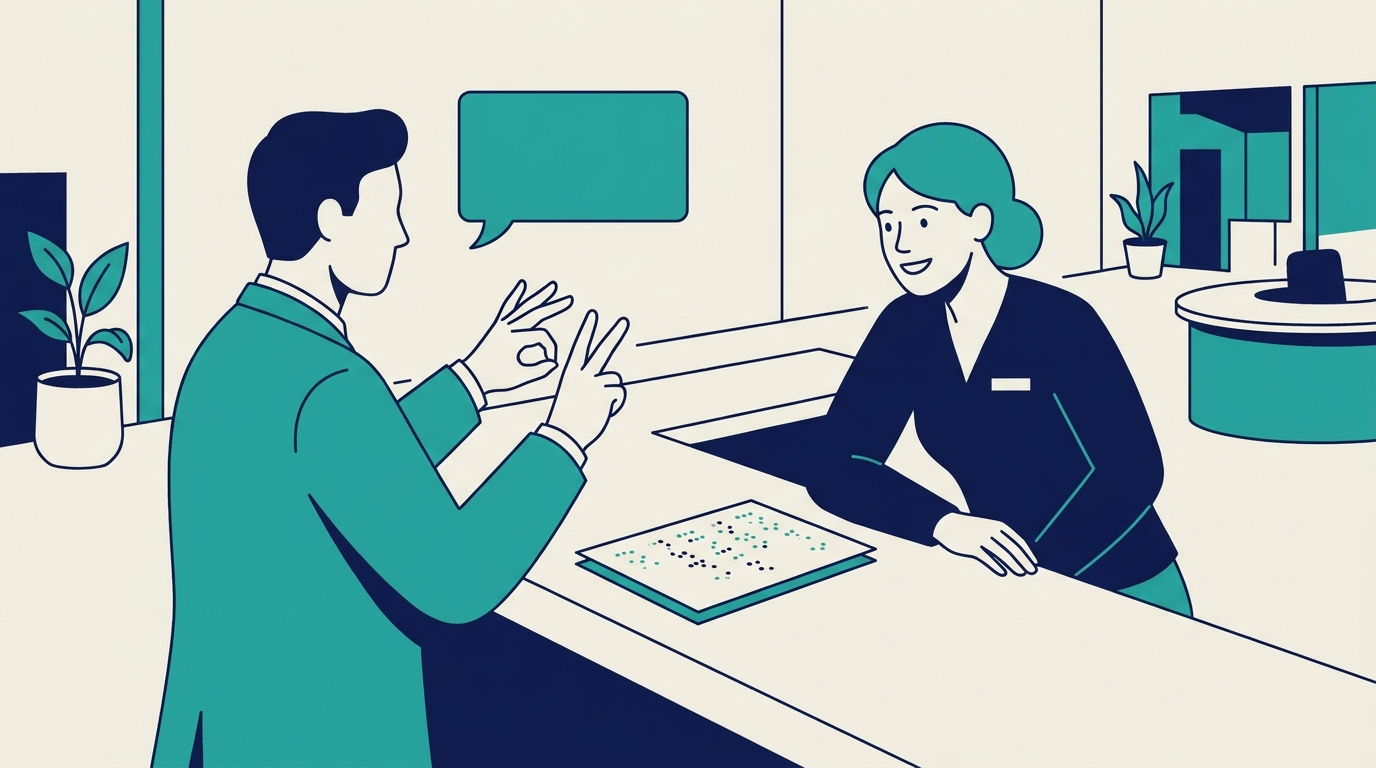
Do you have a case for communication access discrimination NY if a business refuses to provide a sign language interpreter or a Braille menu? In New York, the answer is often yes; your claim could be worth significant money damages for the humiliation you suffered. You shouldn't have to feel invisible in public spaces or struggle to get basic information. It's frustrating when businesses act like providing access is an optional favor rather than a legal requirement. You deserve to be heard and understood in every store, office, or restaurant you visit.
This guide explains how New York laws protect your right to effective communication and how to start a claim without any out-of-pocket costs. We'll look at the powerful protections under the New York State Human Rights Law and the New York City Human Rights Law. ADAhelp isn't a law firm; instead, we help you determine if you have a valid claim and connect you with independent attorneys. You'll learn how the process works, what your case might be worth, and how to ensure the business finally fixes the problem for good.
Key Takeaways
- Learn why effective communication is a mandatory right in New York rather than a business courtesy.
- Identify common examples of communication access discrimination NY; such as refusing sign language interpreters or failing to provide Braille menus.
- Understand how the NYSHRL and NYCHRL allow you to seek money damages for the humiliation caused by these barriers.
- Discover what evidence you need to prove a business was aware of your needs but failed to act.
- Find out how to secure a recovery without paying any out-of-pocket costs or legal fees.

What Is Communication Access Discrimination in New York?
Communication access discrimination NY occurs when a public business fails to provide the tools you need to communicate clearly. This isn't just about being polite. It's about your right to participate in society. In New York, hospitals, retail stores, and hotels must ensure that their communication with you is as effective as it is for anyone else. If they refuse to provide a necessary aid or service, they are likely breaking the law. You shouldn't have to guess what a doctor is saying or struggle to read a menu because a business is being lazy.
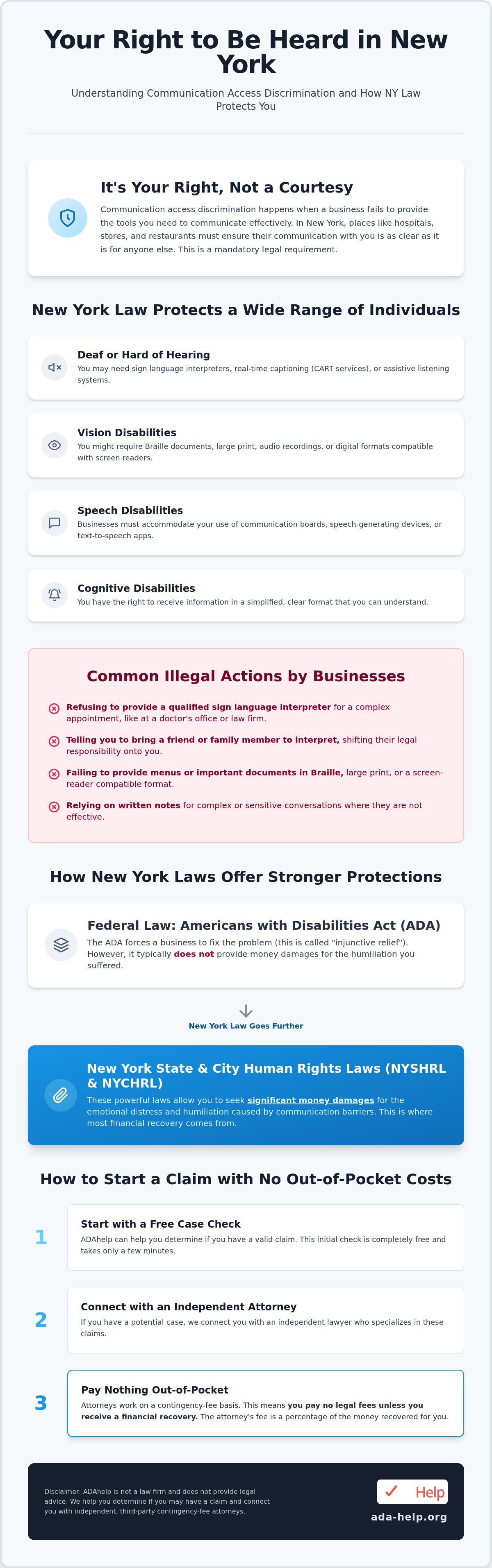
The federal Americans with Disabilities Act (ADA) requires businesses to remove these barriers. However, for New Yorkers, the New York State Human Rights Law (NYSHRL) and the New York City Human Rights Law (NYCHRL) offer even stronger protections. While the ADA can force a business to change its ways, the state and city laws are where you can often secure money damages for the humiliation and frustration you experienced. You have the right to be heard and understood without feeling like a burden.
Defining Effective Communication
Effective communication isn't a one size fits all rule. It depends on how complex the interaction is. If you're just buying a shirt at a store, a simple exchange of written notes might be enough. But if you're at a doctor's office or a legal meeting, a qualified sign language interpreter is usually necessary. The goal is simple: you should have the same level of understanding as a person without a disability. If a business tells you to just bring a friend to interpret, they're likely violating your rights. They're responsible for providing the service, not you.
Who Is Protected Under NY Law?
New York laws protect a wide range of individuals who face communication barriers. You have rights if you fall into any of these categories:
- Deaf or hard of hearing: You may need sign language interpreters, real-time captioning, or hearing loops.
- Vision disabilities: You might require Braille, large print, or digital documents compatible with screen readers.
- Speech disabilities: You may use communication boards or text-to-speech devices that the business must accommodate.
- Cognitive disabilities: You have the right to receive information in simplified, clear language that you can understand.
If you've been denied these tools, you don't have to handle the fallout alone. ADAhelp provides a free three-minute case check to see if you have a claim. We aren't a law firm, but we manage the process and connect you with independent attorneys who work on a contingency basis. This means you pay nothing out of pocket. You only pay if you receive a recovery. Don't let a business make you feel invisible when the law says you have a right to be heard.
Common Communication Access Violations in NYC Businesses
Have you ever been told to bring a friend or family member to interpret for you at a professional appointment? This is one of the most frequent forms of communication access discrimination NY residents face. Businesses often try to shift the burden of access onto you; but the law says the responsibility belongs entirely to them. Whether it is a refusal to hire a qualified sign language interpreter or ignoring a customer who uses a speech-generating device; these actions are illegal. You have a right to independent and private communication in every public space.
In New York City; the local Human Rights Law is particularly strict. It requires businesses to provide "auxiliary aids and services" to ensure you aren't left out of the conversation. When a business ignores your request for a Braille document or a digital format that works with your screen reader; they are creating a barrier that prevents you from using their services. These violations are not just minor inconveniences. They are civil rights infractions that can lead to money damages for the emotional distress and humiliation you experienced. If you are unsure if your experience counts as a violation; you can complete a free three-minute case check to get clarity on your situation.
Barriers in Medical and Professional Settings
Medical discussions are complex and high-stakes. Doctors and hospitals cannot rely on unqualified staff or your children to interpret medical information. This practice is dangerous and illegal. Similarly; banks must provide accessible statements or assistance for those with vision disabilities. If a lawyer or accountant refuses to provide a sign language interpreter for a consultation; they are denying you the professional service you are paying for. These professionals are required to cover the cost of these aids as a part of doing business in New York.
Retail and Entertainment Access Issues
Discrimination also happens in the places where we spend our free time. Restaurants that don't have Braille menus or staff who refuse to read the menu aloud are violating your rights. Movie theaters often have closed-captioning devices; but if those devices are broken or unavailable; the theater is failing its legal duty. Hotels must provide visual alarms and TTY devices to ensure the safety and comfort of guests who are Deaf or hard of hearing. Even in a simple retail store; staff must be willing to use written notes or other aids to assist you. When they walk away or ignore you; they are choosing to discriminate. You don't have to accept this treatment as "just the way it is."
New York Laws and Potential Recovery for Communication Barriers
Do you have a case and what is it worth? If you have experienced communication access discrimination NY, you aren't limited to just federal laws. While the Americans with Disabilities Act (ADA) sets a baseline, New York State and City laws go much further to ensure you receive justice. These local laws don't just ask a business to do better next time. They allow you to hold them financially accountable for the harm they caused. You have the right to seek money damages for the humiliation of being ignored or excluded. For a broader look at how these protections apply across public accommodations, see our guide to public access discrimination in New York.
New York laws prioritize the dignity of every resident. When a business fails to provide a sign language interpreter or a Braille menu, they aren't just making a mistake; they are violating your civil rights. ADAhelp provides a free three-minute case check to help you understand your options. We aren't a law firm; but we manage the intake process and connect you with independent contingency-fee attorneys who handle the legal heavy lifting. You never pay anything out of pocket.
ADA vs. New York City Human Rights Law
The ADA is a powerful tool for change, but it has specific limits. Under Title III of the ADA, a private lawsuit against a business usually only results in "injunctive relief." This means a court orders the business to fix the problem; such as hiring an interpreter for future appointments. It doesn't typically provide money to the victim. The New York City Human Rights Law (NYCHRL) is different. It allows for compensatory damages; which is money paid to you for the emotional distress and humiliation you suffered. If a business shows willful neglect, the NYCHRL even allows for punitive damages to punish the business. These local laws also cover smaller businesses that might be exempt from certain federal rules.
What Is a Typical Recovery Worth?
Every case is different, and recovery amounts vary based on the specific facts of your experience. Typical settlements depend on how severe the communication failure was and how much it affected your life. For example, medical denials often lead to higher recoveries. If a hospital refuses an interpreter during a surgery consultation, the risk to your health and the level of fear you feel is extreme. Repeated denials are also significant. If you asked for an auxiliary aid three times and were ignored every time, the potential for a higher recovery increases. While every case varies, New York laws are designed to ensure that businesses pay for the harm they cause to your dignity and well-being. For more on how these amounts are calculated, see our guide on what your ADA violation case could be worth.
How to Prove Your Communication Access Claim
Proving a claim for communication access discrimination NY doesn't require a law degree. It requires a clear record of what happened. Success depends on two main things. First; you must show the business knew you needed an aid or service. Second; you must show that their refusal created a real barrier to your access. You don't need to guess if your evidence is "legal" enough. Just focus on the facts. Start documenting everything as soon as the incident occurs. Fresh details provide the best accuracy for your case.
Every piece of information you gather strengthens your position. You are building a timeline that shows the business chose to ignore your rights. You don't have to carry this burden alone. ADAhelp is here to manage the intake process and connect you with independent attorneys who work on a contingency basis. If you have your notes and evidence ready; start your free three-minute case check now to see if you have a claim.
Steps to Take During the Incident
Your actions in the moment are vital. Clearly request the specific aid you need; such as an ASL interpreter or a document in Braille. If the business refuses; ask for the name and title of the person making that decision. This identifies who was responsible. Take photos of any physical barriers or equipment that isn't working; like a broken captioning device. If you exchanged emails or written notes with the business before or during the visit; keep every single one of them. These documents prove the business had notice of your needs and chose to ignore them.
Documenting the Impact
Once you leave the business; find a quiet place to write down exactly what happened. Don't wait until the next day. Describe the conversation and the tone of the staff. Explain how the lack of communication made you feel. Were you humiliated? Did you miss important medical instructions? Did you feel invisible? These details help establish the emotional distress that leads to money damages under New York law. Note any witnesses who saw the refusal; such as other customers or staff members. Save your receipts or appointment confirmations to prove you were actually at the location when the incident happened.
Where to File: Agencies & Deadlines
Once you've documented the incident, you have several places to file a formal complaint. Each agency has its own process and deadline, so it helps to know which one fits your situation before you start the clock.
New York State Division of Human Rights (DHR)
The New York State Division of Human Rights investigates communication access discrimination NY complaints under the NYSHRL. You generally have one year from the incident to file an administrative complaint with DHR, or three years to go directly to state court.
NYC Commission on Human Rights (CCHR)
If the business is located within the five boroughs, the NYC Commission on Human Rights enforces the NYCHRL. You typically have one year to file an administrative complaint with the Commission, or three years to file a lawsuit in court.
U.S. Department of Justice (DOJ)
For violations of Title III of the federal ADA, you can file a complaint with the U.S. Department of Justice. The DOJ doesn't set a strict filing deadline, but a complaint is strongest when filed while the details and evidence are still fresh.
Equal Employment Opportunity Commission (EEOC)
If the communication barrier happened at work rather than in a public accommodation, the EEOC handles that claim instead, and you generally have 300 days to file.
Because these deadlines can run at the same time, don't wait to figure out which one applies to you. ADAhelp's free three-minute case check can help you identify the right agency and confirm you're still within your filing window.
Start Your Free 3-Minute Case Check with ADAhelp
ADAhelp makes it simple for you to take action against communication access discrimination NY. You shouldn't have to spend hours researching complex rules or talking to expensive consultants just to see if you have a claim. We manage the entire process for you from start to finish. It is vital to remember that ADAhelp is not a law firm. We do not provide legal advice. Instead; we act as your dedicated case managers. We handle the heavy lifting of gathering information and determining if your experience violates the NYSHRL or NYCHRL. Our team is here to ensure that your rights are respected without adding to your stress.
Our goal is to remove the confusion from the legal process. If a business refused you an interpreter or ignored your request for accessible documents; they should be held accountable for that choice. We identify the strength of your claim and connect you with independent; experienced attorneys who understand the New York legal system. These attorneys work on a contingency basis. This means you never have to worry about the cost of seeking justice. You can focus on your daily life while we help you move toward a resolution.
The No-Risk Case Management Model
You can find out if you have a case in less time than it takes to order a sandwich. The initial case check is completely free and takes only three minutes of your time. You never pay any out-of-pocket fees for our management services. We believe that your financial situation should never be a barrier to exercising your rights. Fees are only taken from the final recovery if your case is successful. If there is no recovery; you don't owe anything. To get started; visit ada-help.org and complete your check today. This low-risk approach puts the power back in your hands.
Why Real New Yorkers Choose ADAhelp
We focus exclusively on the specific needs of New Yorkers. The interplay between New York City and State laws is complex; but we know how to use these tools to your advantage. We handle the information gathering and filing tasks that often feel overwhelming to individuals. By choosing us; you gain a proactive partner who is committed to making the system work for you with minimal friction. You can learn more about our specific approach to ADA Title III case management New York to see how we secure your rights. We act as your champion against businesses that choose to ignore the law. Let us handle the details while you focus on moving forward.
Secure Your Right to Be Heard
You don't have to accept being ignored or excluded by New York businesses. Effective communication is your legal right under the state's powerful civil rights laws. By documenting the incident and gathering evidence; you take the first step toward holding a business accountable for communication access discrimination NY. Whether it was a hospital refusing an interpreter or a store ignoring your request for Braille; you have a clear path to seek justice and secure money damages for the humiliation you suffered.
ADAhelp is here to handle the heavy lifting for you. We are New York disability rights specialists who manage the entire intake process and connect you with independent contingency-fee attorneys. You'll never pay a dime out of pocket. Our model is simple: no recovery; no fee. We are not a law firm; but we are your proactive partners in making the legal system work for you with minimal friction. Don't let your frustration turn into silence when the law is on your side.
Start your free three-minute case check now to determine if you have a valid claim. You deserve to be treated with dignity and respect in every public space across New York.
Frequently Asked Questions
What exactly is considered 'effective communication' in New York?
Effective communication means the business provides aids that ensure you understand everything as well as any other customer. In New York; the requirement shifts based on the situation. While a quick question in a retail shop might only need a written note; a legal or medical appointment almost always requires a qualified professional. The goal is to prevent communication access discrimination NY by ensuring you are never left in the dark during important interactions.
Do businesses have to pay for a sign language interpreter themselves?
Yes; the business is legally required to cover the entire cost of any auxiliary aid or service. They cannot pass this expense on to you or ask you to pay a surcharge. In New York; providing access is considered a standard cost of operating a business that serves the public. If a business tells you that you must pay for your own interpreter; they are likely violating the law and your civil rights.
Can I get money damages if a store doesn't have braille menus?
You can often receive money damages under the NYSHRL or NYCHRL if a business fails to provide accessible materials like Braille menus. While the federal ADA only requires the business to fix the barrier; New York's local laws allow you to seek compensation for the humiliation and emotional distress you suffered. These damages are designed to hold businesses accountable for the harm caused by their neglect of your right to communicate.
Is it enough for a business to offer me a pen and paper instead of an interpreter?
Pen and paper is only acceptable for very short and simple interactions. If you are discussing a mortgage; a medical diagnosis; or a legal contract; a handwritten note is not a substitute for a qualified interpreter. The law requires communication to be effective. If you cannot fully understand or participate in the conversation using pen and paper; the business must provide a more appropriate solution to meet your needs.
Does communication access discrimination apply to business websites?
Yes; communication access rights extend to digital spaces under New York law. If a business website isn't compatible with screen readers or lacks closed captioning for videos; it may be considered a form of communication access discrimination NY. Public accommodations must ensure their digital tools are just as accessible as their physical locations to avoid excluding New Yorkers with disabilities from using their services online.
How long do I have to file a communication access claim in NYC?
In New York City; you generally have three years to file a lawsuit in court under the NYCHRL. However; if you choose to file a complaint with the City Commission on Human Rights; the deadline is usually one year. It's best to act quickly while your evidence and memory are still fresh. Starting your case check early ensures you don't miss these critical legal windows for seeking a recovery.
What if the business says an interpreter is too expensive for them?
Businesses often claim an interpreter is too expensive; but the legal standard for an "undue burden" is very high. Most businesses; especially large chains or medical groups; cannot use cost as an excuse to deny you access. The law expects businesses to plan for these expenses. If they refuse you service based on price; they are likely failing their legal obligations and you should check your claim.
Do I need to hire a lawyer before contacting ADAhelp?
No; you do not need to have a lawyer before you contact ADAhelp. We are case managers who help you determine if you have a valid claim first. If our free three-minute check shows you have a case; we connect you with independent attorneys who work on a contingency basis. This means you don't pay anything out of pocket. You only pay if you receive a money settlement.

Article by
ADA Help
Written by the ADAhelp editorial team and reviewed for accuracy before publishing. ADAhelp helps New Yorkers find out if they have a disability discrimination claim and manages the process end to end, working with independent attorneys who handle the legal work. We are not a law firm and do not provide legal advice.
Disclaimer
This article is general information about New York law, not legal advice, and reading it does not create an attorney-client relationship. ADAhelp is a case-management and intake service, not a law firm; legal representation is provided by independent attorneys. Recovery amounts and timelines vary by case, and past outcomes do not guarantee future results. For advice about your specific situation, speak with a qualified attorney or start the free case check.
Tags
Discriminated against in New York because of a disability?
A free three-minute check tells you if you can pursue a claim.
Check my case →New York onlyNo upfront costIndependent NY attorneysFree 3-minute check