
Failure to Accommodate Disability at Work NY: Rights
Reviewed for accuracy by the ADAhelp team before publishing. ADAhelp is not a law firm; legal work is handled by independent New York attorneys.

Facing a failure to accommodate disability at work in NY? Your state and city rights are stronger than the ADA. Learn your options for a financial recovery.
Did you know that New York City and State laws often provide much stronger protections than the federal ADA? It's frustrating to feel like your employer is ignoring your needs or pushing you out because of a medical condition. You might worry that speaking up will lead to retaliation or a lost paycheck. If your employer refused a reasonable request that would have allowed you to do your job, you likely have a claim for a failure to accommodate disability at work NY. Do you have a case? If your request was ignored or denied without a valid reason, the answer is usually yes.
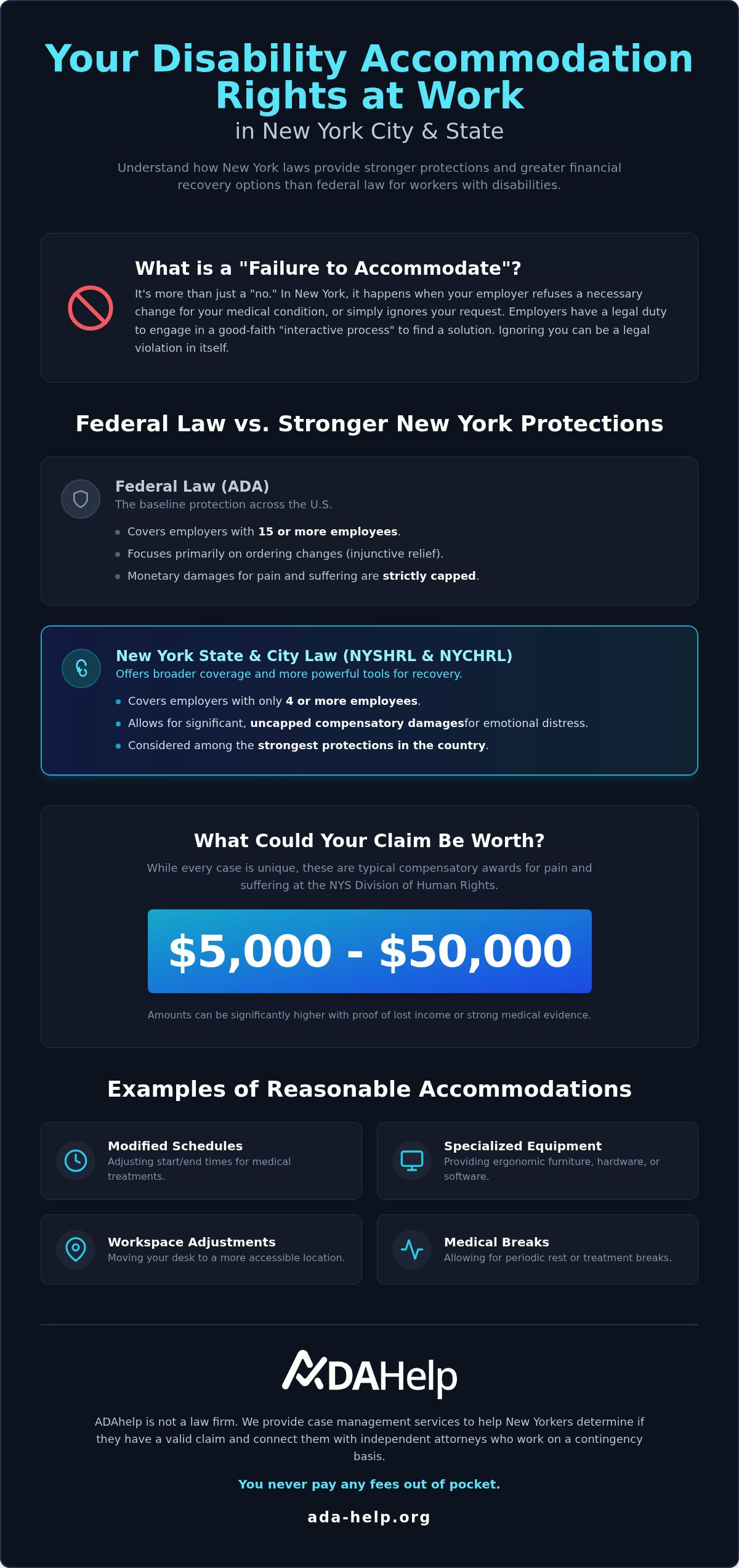
What is your claim worth? While every situation is unique, typical compensatory awards for pain and suffering at the New York State Division of Human Rights range from $5,000 to $50,000. These amounts can increase significantly with medical evidence or proof of lost income. ADAhelp is not a law firm; we are case management experts who help you determine if you have a valid claim. We connect you with independent attorneys who work on a contingency basis, so you never pay anything out of pocket. This guide explains how the New York State Human Rights Law (NYSHRL) and the New York City Human Rights Law (NYCHRL) protect you and how to start your path toward a financial recovery.
Key Takeaways
- Identify a failure to accommodate disability at work NY and learn about your employer's legal duty to discuss your needs.
- Compare the ADA with the NYSHRL and NYCHRL to see why state and city laws often lead to higher financial recoveries.
- Review specific examples of reasonable accommodations like modified schedules or equipment changes that New York law requires.
- Follow a guide to documenting your accommodation requests to protect your rights and your income.
- Learn how ADAhelp provides free case management and connects you with attorneys who only get paid if you win.

What is a failure to accommodate disability at work in New York?
A failure to accommodate disability at work NY happens when your employer refuses to make necessary changes that would allow you to do your job. It isn't just about a final "no." Under the New York State Human Rights Law (NYSHRL), your employer has a legal duty to engage in a meaningful conversation with you. This is called the interactive process. Think of it as a formal dialogue where both sides work together to find a solution. When you tell your employer about your disability and request help, they cannot simply ignore you. They must work with you to find a balance between your needs and the requirements of the business.
If an employer stays silent or shuts down the conversation without exploring options, they may have already violated your rights. This remains true even if the specific accommodation you asked for wasn't possible. The law requires them to try. Ignoring a request is often considered a legal violation in itself in New York. You don't have to figure this out alone. At ADAhelp, we manage the intake and case-management process to help you determine if your rights were ignored.
Who is protected in New York?
New York offers some of the strongest protections in the country. You are protected if you have any physical, medical, or mental impairment that impacts your life. While the federal Americans with Disabilities Act (ADA) covers businesses with 15 or more employees, New York laws go much further. Both the NYSHRL and the New York City Human Rights Law (NYCHRL) cover employers with four or more workers. These protections apply from the moment you apply for a job through your last day of employment. Whether you are a full-time staff member or a job applicant, you have the right to a fair workspace.
The legal definition of an accommodation
An accommodation is any change to your work environment, schedule, or job duties. The goal is to remove barriers so you can perform your essential job functions. Under the NYSHRL, a reasonable accommodation is an action taken by an employer which permits an employee with a disability to perform in a reasonable manner the activities involved in the job.
Common examples include:
- Adjusting your start or end times to allow for medical treatment.
- Providing specialized office furniture, hardware, or software.
- Moving your workspace to a more accessible location.
- Allowing for periodic medical breaks throughout the day.
If your employer has refused these types of requests, you may be entitled to financial recovery. We help New Yorkers identify these failures and connect them with independent attorneys who work on a contingency basis. This means you don't pay any fees unless there is a recovery in your case.
Understanding your rights under New York and Federal law
Many New Yorkers assume that federal law is their only protection. While the federal government sets a baseline, New York laws provide much more leverage for workers. If you have experienced a failure to accommodate disability at work NY, you need to know which law applies to your specific situation. The three main pillars of your protection are the federal Americans with Disabilities Act (ADA), the New York State Human Rights Law (NYSHRL), and the New York City Human Rights Law (NYCHRL). Each serves a different purpose in securing the recovery you deserve.
Federal ADA vs New York State Law
The federal ADA is the most famous disability law, but it has limits. It generally focuses on injunctive relief. This means a court might order your employer to fix a physical barrier or change a policy. While it allows for some money damages, these are strictly capped based on the size of your employer. You can learn more about these federal standards in the EEOC guide Your Employment Rights as an Individual With a Disability.
The NYSHRL offers broader coverage for New Yorkers. It applies to any employer with four or more employees, whereas the ADA requires 15. Most importantly, state law allows for compensatory damages without the strict federal caps. As of 2026, the NYSHRL continues to provide a path for recovering lost wages and emotional distress damages that often exceed what is available under federal law alone. If you aren't sure which law covers your office, you can take a free three-minute case check to see where you stand.
The power of the New York City Human Rights Law
If you work within the five boroughs, the NYCHRL is your most powerful tool. It is widely considered one of the most pro-worker laws in the country. Unlike federal law, the NYCHRL has no cap on compensatory damages for emotional distress. It also allows for civil penalties of up to $250,000 for conduct that is willful or malicious.
The biggest advantage of the NYC law is the burden of proof. In many cases, the employer must prove that providing an accommodation would cause an "undue hardship" on their business. This shift favors you. It forces the company to justify why they didn't help you, rather than making you prove exactly how they could have. This makes a failure to accommodate disability at work NY much easier to challenge in the city. At ADAhelp, we help you manage these complex filings so you can focus on your health while we handle the paperwork.
What qualifies as a reasonable accommodation in NY?
A reasonable accommodation is any change in the work environment or the way things are usually done that helps you perform your job duties. It is not a special favor or a gift. It is a legal right designed to level the playing field for workers with disabilities. If your employer refuses a request that is both effective and affordable, they may be guilty of a failure to accommodate disability at work NY. You shouldn't have to choose between your health and your paycheck.
Common accommodations include:
- Modified work schedules. You might need to start later because of medication side effects or leave early for physical therapy appointments.
- Specialized equipment. This could be a screen reader for a visually impaired worker or an ergonomic chair for someone with a chronic back injury.
- Policy adjustments. An employer might need to change a "no food at desks" rule for an employee who has diabetes.
- Communication aids. This includes providing sign language interpreters for meetings or offering written training materials for hearing-impaired staff.
Common examples of workplace changes
Modern New York workplaces must be flexible. Remote work or telecommuting is now a very common and often reasonable request. If your job can be done from a laptop, your employer might struggle to explain why you must be in an office if your disability makes commuting difficult. For those with mental health conditions, a quiet workspace or a desk away from high-traffic areas can be a vital change. Physical modifications are also standard. This includes installing ramps, widening doorways, or providing adjustable desks for those who cannot sit for long periods. If your company ignored these needs, it might be a failure to accommodate disability at work NY.
When can an employer say no?
Your employer isn't required to do the impossible. They can refuse your request if they can prove it causes an "undue hardship" on the business. In New York, this means the change would cause significant difficulty or expense. However, the bar is high. A large corporation with a massive budget cannot claim a five hundred dollar piece of equipment is an undue hardship. The NYCHRL and NYSHRL look at the company's total resources; they don't just look at one department's budget. Size matters in these cases. A small shop with four employees has different obligations than a global bank in Midtown. We help New Yorkers manage the intake process to see if an employer's refusal was actually legal. You can use our free three-minute case check to get clarity on your specific situation.
How to request an accommodation and document a refusal
Your employer cannot read your mind. To protect your rights, you must be proactive. If you believe you are experiencing a failure to accommodate disability at work NY, the strength of your claim depends on the evidence you collect. Most claims fail because there is no proof that a request was ever made or that it was unfairly denied. You must build a paper trail that shows you did your part to find a solution. This documentation is what allows case managers and attorneys to hold your employer accountable.
Start by submitting your request in writing. Emails are better than verbal conversations because they have timestamps and recipient logs. Keep copies of every medical note you provide to your manager or HR department. Do not leave your only copy with the office; always keep a digital or physical copy for your personal records. You should also log the dates and times of every meeting where your disability or accommodation was discussed. If your employer gives you a reason for a denial, write it down immediately. This level of detail makes it much harder for a company to change their story later.
Starting the interactive process
You don't need to be a legal expert to get help. You do not even need to use the phrase "reasonable accommodation" to start the legal process. You simply need to let your employer know that you have a medical condition and need a change to do your job. State clearly what you need and why you need it. This simple act triggers their legal duty to engage in a dialogue with you. If you want to learn more about your general protections, read our guide on employment disability discrimination New York.
Documenting the denial
What happens if they say no? If your boss tells you "no" in person, go back to your desk and send a follow-up email. Write something like, "To confirm our conversation earlier today, my request for a modified schedule was denied because the department is too busy." This forces the conversation into the written record. You should also save a copy of your current job description. This helps prove that you can perform your essential job functions if you are given the right tools. Finally, gather contact information for any colleagues who witnessed the refusal or heard the reasons given — the same approach we cover in our guide on documenting disability harassment at work. If your request was ignored or rejected, you can start a free three-minute case check to see if you have a valid claim for a failure to accommodate disability at work NY.
How to get help with your New York disability claim
Dealing with a failure to accommodate disability at work NY is exhausting. You likely feel isolated and unsure of your next move. You don't have to manage this complex process alone. ADAhelp is your proactive partner in New York. We are not a law firm; we are case management specialists who handle the entire claim process from start to finish. Our goal is to turn your frustration into a clear, stress-free path toward a resolution. We handle the heavy lifting so you can focus on your health.
Our team begins by evaluating your specific situation to see if you have a valid claim. We look for evidence that your employer ignored the interactive process or denied a reasonable accommodation without proof of undue hardship. Once we determine you have a case, we handle the information gathering and filing with the proper authorities. This includes managing communications with the New York State Division of Human Rights or the NYC Commission on Human Rights. We understand the specific requirements of the NYSHRL and NYCHRL. Finally, we connect you with independent attorneys who specialize in New York disability law. These professionals work on a contingency basis, ensuring you have expert representation without the stress of hourly billing.
No upfront cost for New Yorkers
Many workers hesitate to seek help because they fear high legal fees. We have removed that barrier. Our initial case check is free and takes only three minutes to complete. You will never pay out of pocket for our case management services. We operate on a contingency model, meaning our fees are only taken from a successful recovery. This low-risk approach ensures that the burden of financial risk lies with us, not you. This model allows real New Yorkers from all backgrounds to seek justice. If there is no recovery, you owe nothing.
Start your claim today
Waiting only gives your employer more time to build a defense or potentially retaliate. In New York, strict deadlines apply to filing discrimination claims. Taking action now is the best way to protect your rights and your future income. Do not let a failure to accommodate disability at work NY go unchallenged. Beyond the workplace, we also provide ADA Title III case management New York for public access issues. Take the first step toward justice and a fair recovery by starting your free case check right now.
Where to File: Agencies & Deadlines
A failure to accommodate disability at work NY can be filed with more than one agency, and each has its own deadline. Filing with the right agency, on time, is what preserves your right to a financial recovery.
- New York State Division of Human Rights (DHR). Covers claims under the NYSHRL statewide. For acts on or after February 15, 2024, you have three years to file. Learn more at dhr.ny.gov.
- NYC Commission on Human Rights (CCHR). Covers claims under the NYCHRL for anyone who works or lives within the five boroughs. The filing deadline is one year from the discriminatory act. Details are available at nyc.gov/cchr.
- U.S. Equal Employment Opportunity Commission (EEOC). Handles federal ADA claims. You generally have 300 days to file a charge in New York. Federal standards and your rights are outlined at eeoc.gov.
- U.S. Department of Justice (DOJ). The DOJ enforces the ADA's Title I employment provisions in coordination with the EEOC and can pursue broader public enforcement actions. General ADA guidance is published at ada.gov.
Filing with the wrong agency, or missing a deadline, can permanently bar your recovery. ADAhelp helps you determine which agency fits your situation and manages the filing process so nothing slips through the cracks. Take a free three-minute case check to get started.
Secure Your Rights and Recovery in New York
You have the legal right to a workplace that respects your medical needs. A failure to accommodate disability at work NY is a serious violation that can lead to significant financial recovery for lost wages and emotional distress. Remember that New York City and State laws provide much broader protections than federal law alone. By documenting every request and keeping a clear paper trail; you put yourself in the strongest position to hold your employer accountable.
ADAhelp is here to handle the heavy lifting for you. We provide expert case management specifically for New Yorkers; ensuring your claim is filed correctly with the right authorities. Our process is designed to be entirely stress-free. There are no upfront fees; and our case evaluation is completely free. We connect you with independent attorneys who only get paid if you win. Don't let a denial of your rights stand. Take control of your professional future today.
Start your free three-minute case check now to see what your claim is worth. You deserve a fair workspace and the recovery you are entitled to under the law.
Frequently Asked Questions
Do I have a case for failure to accommodate in New York?
You likely have a case if you have a medical condition and your employer refused a reasonable request that would help you work. A failure to accommodate disability at work NY occurs when a company ignores your needs or shuts down the conversation. Under the NYSHRL and NYCHRL; employers with four or more workers must provide help unless it causes an undue hardship. We can help you check your claim for free in three minutes.
What is the interactive process under New York law?
The interactive process is a mandatory; good-faith dialogue between you and your employer to find a workable solution. Once you make a request; your employer cannot simply say "no" or stay silent. They must actively explore options with you. If they fail to participate in this back-and-forth discussion; they have likely violated New York law. This process is a key factor in determining the success of your discrimination claim and your eventual financial recovery.
Can my employer fire me for requesting a disability accommodation?
No; your employer cannot legally fire you for requesting an accommodation. This is considered illegal retaliation under both state and city laws. New York has seen a surge in retaliation claims recently. The law protects you from being demoted; harassed; or terminated for asserting your rights. If you were fired after asking for help; you may be entitled to significant damages for lost wages and emotional distress. We can help you evaluate your retaliation claim today.
How much is a failure to accommodate case worth in NY?
Recovery amounts vary case by case; but New York laws offer high potential for damages. For "garden variety" claims based on testimony; awards at the New York State Division of Human Rights typically range from $5,000 to $50,000. Under the NYCHRL; there are no caps on compensatory damages for emotional distress. You may also recover back pay for lost income. We connect you with attorneys who handle a failure to accommodate disability at work NY on a contingency basis.
Is there a deadline to file a disability discrimination claim in NYC?
Yes; strict deadlines apply. For acts on or after February 15, 2024; you have three years to file with the New York State Division of Human Rights. NYC Commission filings have a one-year deadline. Federal EEOC claims must be filed within 300 days. Missing these dates can bar your recovery. Act quickly to protect your rights and your ability to secure a financial settlement. We offer a free three-minute case check to help you start your claim.
Do I need a lawyer to report a failure to accommodate?
You do not need a lawyer to start; but professional management is highly recommended. ADAhelp provides end-to-end case management to help you determine if you have a valid claim. We handle the intake; gather evidence; and connect you with independent contingency-fee attorneys. This ensures your case is managed professionally without any upfront costs or out-of-pocket fees. We are a case management service; not a law firm; and we handle the heavy lifting for you.

Article by
ADA Help
Written by the ADAhelp editorial team and reviewed for accuracy before publishing. ADAhelp helps New Yorkers find out if they have a disability discrimination claim and manages the process end to end, working with independent attorneys who handle the legal work. We are not a law firm and do not provide legal advice.
Disclaimer
This article is general information about New York law, not legal advice, and reading it does not create an attorney-client relationship. ADAhelp is a case-management and intake service, not a law firm; legal representation is provided by independent attorneys. Recovery amounts and timelines vary by case, and past outcomes do not guarantee future results. For advice about your specific situation, speak with a qualified attorney or start the free case check.
Tags
Discriminated against in New York because of a disability?
A free three-minute check tells you if you can pursue a claim.
Check my case →New York onlyNo upfront costIndependent NY attorneysFree 3-minute check