NYC Commission on Human Rights Complaint Process Guide
Reviewed for accuracy by the ADAhelp team before publishing. ADAhelp is not a law firm; legal work is handled by independent New York attorneys.

Learn the NYC Commission on Human Rights complaint process. Our guide explains how to file for disability discrimination and get financial recovery. Free cas...
Did you know that the NYC Commission on Human Rights handled over 15,000 inquiries in 2025; with disability discrimination ranking as a top concern? If you've been blocked from entering a shop or using a website; you likely have a case that could lead to financial recovery and a permanent fix for the accessibility barrier. It's common to feel confused by the differences between city, state, and federal laws. You might worry about high legal fees or wonder if the NYC Commission on Human Rights complaint process is right for your specific situation.
This process is one of the most effective tools for New Yorkers to demand fairness and hold businesses accountable. While federal laws often focus on fixing a physical barrier; the New York City Human Rights Law provides a path to actual money damages for the discrimination you faced. You don't need to be a legal expert or pay out-of-pocket to seek justice. This guide explains how the filing steps work; what your claim might be worth; and how to ensure a business finally makes its services accessible to every New Yorker.
Key Takeaways
- Understand how the NYC Commission on Human Rights complaint process offers financial recovery for discrimination that federal law often misses.
- Learn why the NYC Human Rights Law is one of the most powerful tools in the country for protecting your rights in public spaces.
- Identify the specific evidence you need to collect; such as photos of physical barriers; to build a strong case against a business.
- Discover how our case management services handle the heavy lifting of documenting discrimination in public places or on websites.
- Learn the critical one-year deadline for filing your complaint to ensure you can hold a business accountable for its lack of accessibility.
What is the NYC Commission on Human Rights complaint process?
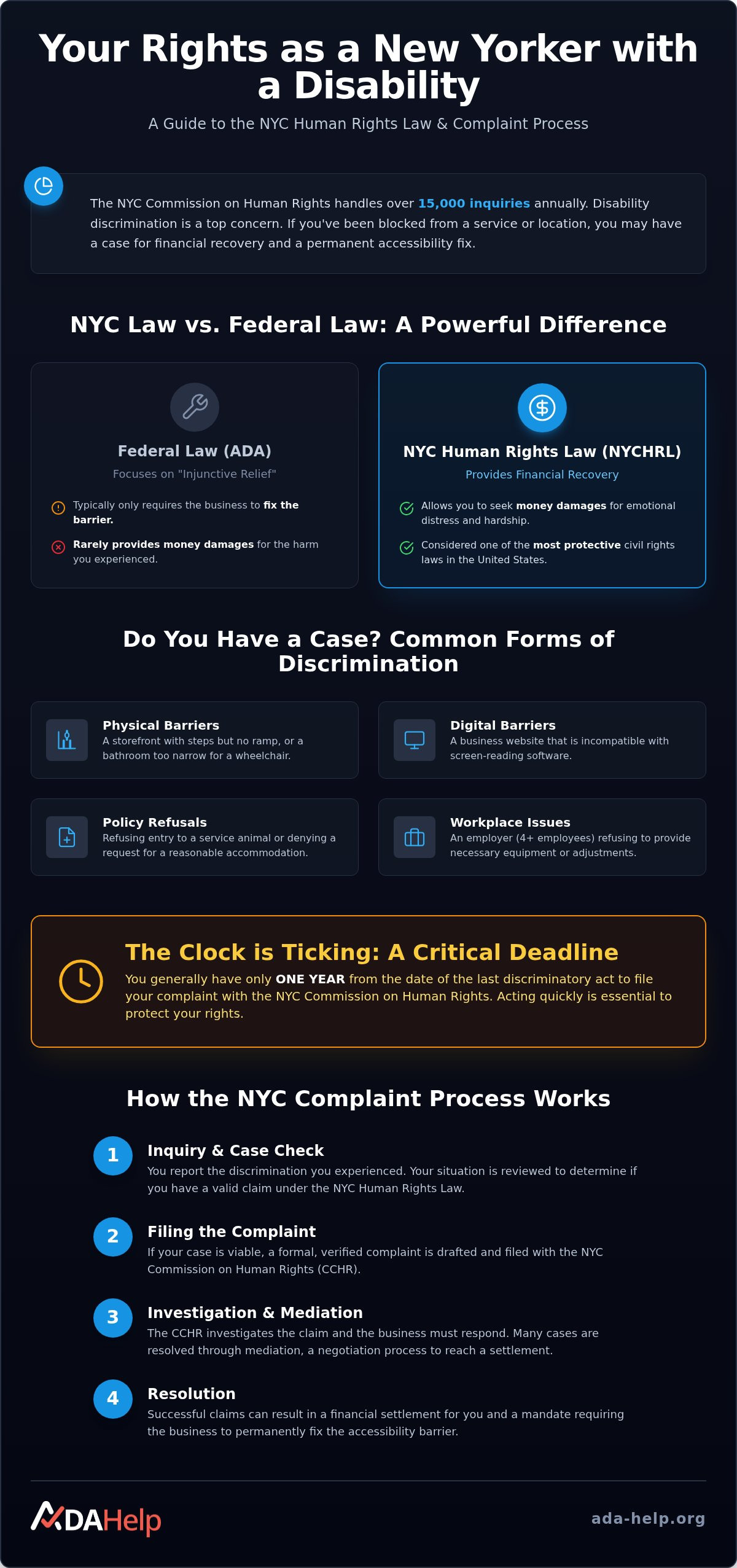
The NYC Commission on Human Rights (CCHR) is the local agency responsible for enforcing the New York City Human Rights Law. This specific law is widely considered one of the most protective civil rights statutes in the United States. The NYC Commission on Human Rights complaint process provides a structured path for you to report discrimination in public places; housing; and workplaces across the five boroughs. It's designed to be a low-barrier system where any New Yorker can seek justice without the immediate need for expensive legal retainers. While federal laws like the ADA often focus on forcing a business to fix a physical barrier; the city's process allows for financial recovery to address the harm you experienced.
Who can file a complaint in NYC?
If you have experienced disability discrimination anywhere in New York City; you have the right to file an inquiry. This protection extends to residents; commuters; and even tourists visiting the city. Whether you were denied entry to a Broadway theater or couldn't access a doctor's office in Queens; the law is on your side. You must act quickly; however; because the statute of limitations for filing with the CCHR is typically one year from the date of the last discriminatory act (see the full ADA claim statute of limitations for other agencies). Waiting too long can permanently close your window for recovery. At ada-help.org; we provide a free case check to help you understand if your situation fits these requirements before the clock runs out.
What counts as disability discrimination?
Disability discrimination occurs when a business or housing provider fails to offer the same level of access to you as they do to someone without a disability. It often involves a failure to provide "reasonable accommodations." Common scenarios that trigger the NYC Commission on Human Rights complaint process include:
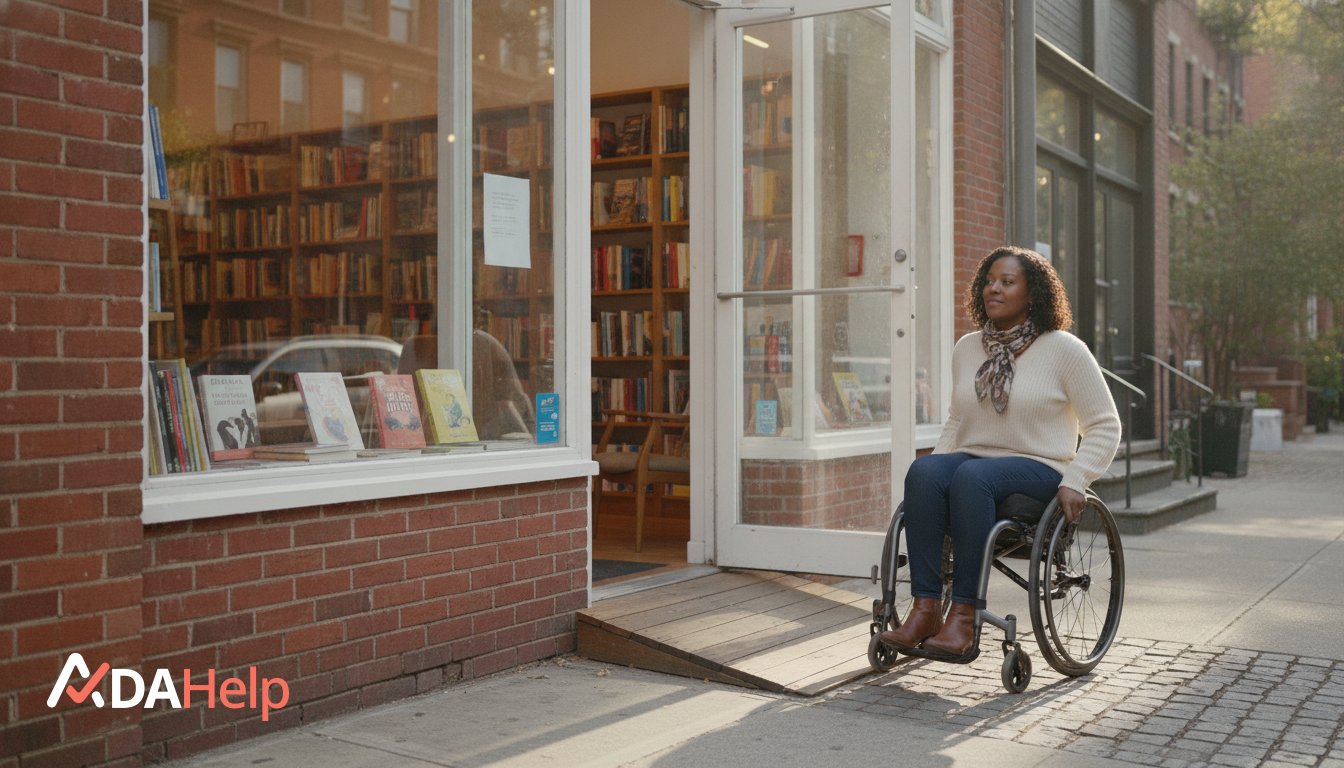
- Physical Barriers: A storefront with steps but no ramp; or a bathroom that is too narrow for a wheelchair.
- Digital Barriers: A business website that is not compatible with screen-reading software; preventing you from shopping or booking services.
- Policy Refusals: A landlord denying your request for a grab bar in the shower or a store refusing entry to your service animal.
- Workplace Issues: An employer with four or more employees refusing to adjust your desk height or provide a necessary piece of equipment.
If you encountered any of these hurdles; the business may be in violation of city law. Identifying these issues is the first step toward securing a settlement and ensuring the business fixes the problem for everyone. We help you document these barriers so you can present a clear; factual case to the Commission.
How NYC law protects you differently than the ADA
Many New Yorkers believe the Americans with Disabilities Act (ADA) is the only law protecting them. While the federal ADA is vital; it has significant limitations. If you encounter a barrier at a local business; the ADA typically only requires the owner to fix the problem. This is called injunctive relief. It doesn't compensate you for the frustration or exclusion you felt. The NYC Commission on Human Rights complaint process operates under the New York City Human Rights Law (NYCHRL); which goes much further by allowing you to seek money damages for emotional distress and hardship.
Local businesses with as few as four employees must follow these rules. This is a much lower threshold than many federal requirements. If you've been turned away from a small neighborhood shop; you might still have a valid claim. You can learn How to File a Complaint directly; but using a professional to guide you through the NYC Commission on Human Rights complaint process can ensure no detail is missed.
The power of the NYCHRL
The NYCHRL is designed to be broadly interpreted in favor of the person experiencing discrimination. It uses a wider definition of disability than federal standards; making it easier to prove your case. Under this law; a business cannot simply say an accommodation is too difficult. They must prove that providing access would cause an undue hardship to their operations. This high burden of proof often leads to a faster resolution and a financial settlement that reflects the impact on your daily life.
Why federal law is not always enough
Relying solely on federal law can be a missed opportunity for New Yorkers. ADA Title III lawsuits in federal court are often expensive and time-consuming if you try to handle them alone. Most importantly; federal law rarely provides a path to personal financial recovery. By using the city-specific process; you can pursue both a physical fix for the barrier and compensation for the discrimination. If you aren't sure which law applies to your incident; you can check your case online to see if you qualify for a claim under the NYCHRL.
Our team at ADAhelp focuses specifically on these local protections. We are not a law firm; but we act as your guide to the right legal resources. We know that Real New Yorkers need results that go beyond just a new ramp. We help you use the strength of the NYCHRL to hold businesses accountable without the stress of upfront costs. Since we connect you with contingency-fee attorneys; you only pay if you win a recovery.
Steps to file your NYC Commission on Human Rights complaint
Starting the NYC Commission on Human Rights complaint process doesn't have to be overwhelming. You've already faced enough frustration at a business or building. Now is the time to organize your facts so the city can take action. The process moves from a simple inquiry to a formal investigation. You don't need a lawyer to start; but having your evidence ready makes the system work faster for you.
Preparing your information
Success depends on the details. Before you contact the Commission; you should pull together everything related to the incident. Don't worry if you don't have a professional video; a simple smartphone photo of the barrier is often enough. Make sure you include:
- The exact location: Get the full street address and the name of the business.
- The date and time: Be as specific as possible about when the discrimination happened.
- Staff details: Write down the names or descriptions of any employees you spoke with.
- Proof of visit: Save your receipts; digital tickets; or even a screenshot of your GPS history.
- Visual evidence: Take clear photos of the stairs; the narrow entrance; or the lack of a ramp.
If you're unsure if your evidence is strong enough; we can help (avoid the common mistakes to avoid when filing an ADA claim). At ada-help.org; we offer a free three-minute case check to review your situation and help you prepare for the next steps.
The intake interview
Once you provide your initial details; the Commission schedules an intake interview. This is a conversation with an intake attorney from the Law Enforcement Bureau. They aren't your personal lawyer; their job is to see if the city has the power to act on your claim. They will check if the business is within the five boroughs and if the incident happened within the last year. They will also ask questions to determine if the facts show a clear violation of the city's human rights laws. This step is entirely free for all New Yorkers.
Signing the verified complaint
If the Commission decides to move forward; they will draft a formal document called a verified complaint. This is a written version of your story. You must review it carefully and sign it under oath. Once you sign; the Commission officially serves the complaint to the business. This starts the formal investigation. The business then has a set amount of time to provide a written answer to your claims. This is where the pressure on the business truly begins. The NYC Commission on Human Rights complaint process is now officially in motion; and the business must respond to the city regarding your experience.
What to expect after you report discrimination in NYC
Once you sign the verified complaint; the Commission serves it to the business. They are now officially the "respondent." The business has a set amount of time to provide a written answer to your claims. This is their chance to defend their actions or deny that a barrier exists. The NYC Commission on Human Rights complaint process then enters a formal phase where the city looks for the truth (see our full breakdown of what happens after filing an ADA complaint). You've done your part by reporting the issue; now the city's Law Enforcement Bureau takes the lead to verify your experience.
The investigation phase
An investigator from the Law Enforcement Bureau takes charge of your case. They don't just take your word for it. They look for hard evidence to back up your claim. This might include interviewing witnesses; reviewing security footage; or talking to employees who were on-site during the incident. Sometimes the Commission conducts a physical site visit to measure a doorway or test a ramp's slope. This phase can take several months to complete. A 2025 audit found that some complex cases can take significantly longer; so staying organized is vital. You may be asked to provide more details or respond to the business's written defense during this time. Our team at ADAhelp manages this information gathering for you; ensuring the investigator has exactly what they need to move forward.
Resolving the case
The city often tries to resolve cases through "conciliation." This is a voluntary settlement process designed to reach a fair agreement without a trial. It is often the fastest way to secure a recovery for New Yorkers. A successful settlement under the NYCHRL usually includes two parts: a plan to fix the accessibility issue and money damages for the harm you suffered. Typical recoveries vary based on the severity of the discrimination; but they aim to compensate you for the emotional distress and hardship caused by the barrier. If the business refuses to settle and the Commission finds "probable cause;" the case may move to a public hearing before an administrative law judge. This is similar to a trial where evidence is presented and a recommendation is made for a final decision.
Don't wait years for a result. Start with a free three-minute case check to see if your claim is ready for the NYC Commission on Human Rights complaint process.
A successful case ends with a "Final Order." This is a binding legal document. It requires the business to pay damages and make specific changes to their property or policies. While federal ADA cases often stop at fixing the building; the city's process ensures you are compensated for the exclusion you faced. This makes the city's system a powerful tool for holding businesses accountable while making New York more accessible for everyone.
How ADAhelp manages your NYC discrimination claim
You don't have to face the NYC Commission on Human Rights complaint process alone. ADA Help - NY disability discrimination claims acts as your proactive partner to take the weight off your shoulders. Our service is built for New Yorkers who want results without the stress of upfront legal costs. We aren't a law firm; but we know exactly how to organize your claim so it gets the attention it deserves. We handle the heavy lifting so you can focus on your daily life.
Our free three-minute case check
You can start right now from your phone or computer. Our check asks simple questions about your experience at the business or building. Did they have stairs without a ramp? Was the entrance too narrow? You won't get a dry legal lecture from us. Instead; you get an immediate sense of whether your rights were violated under city law. This quick check is the first step toward holding a business accountable and seeking the recovery you deserve. It's fast; confidential; and requires no commitment.
Why use a case management service?
Filing a complaint with the city can be a slow; confusing experience if you try to do it by yourself. Government agencies are often stretched thin; and they cannot provide you with personalized guidance. We fill that gap. The team at ADA Help - NY disability discrimination claims manages the documentation phase by helping you organize photos; receipts; and witness details. We ensure your claim highlights the specific violations of the New York City Human Rights Law; which is often the best path for securing money damages.
We understand the critical differences between federal and local protections. While the ADA is important for fixing physical barriers; the NYC law is what typically provides financial settlements for emotional distress. Once your information is ready; ADA Help - NY disability discrimination claims connects you with independent attorneys who work on a contingency basis. These lawyers only get paid if they win a recovery for you. You pay nothing out-of-pocket for our case management services. Our goal is to move you through the NYC Commission on Human Rights complaint process as efficiently as possible; securing both a fix for the barrier and a settlement for your hardship.
You deserve an advocate who knows the local system and fights for the underdog. ADA Help - NY disability discrimination claims helps you turn a frustrating incident into a clear path for justice. By handling the paperwork and the legal connections; we make the system work for you with minimal friction. Start your free three-minute case check today to see how we can help you hold a business accountable.
Take Action Toward Accessibility and Justice
You now have a clear roadmap for holding businesses accountable for discrimination. Remember that the NYC Commission on Human Rights complaint process is specifically built to protect your right to equal access across the five boroughs. Unlike federal cases that often only focus on physical fixes; the city's law allows you to seek money damages for the emotional hardship you've endured. Acting within the one-year filing window is vital to preserving your claim and ensuring your voice is heard.
You don't have to manage the paperwork or the stress of the system on your own. At ADAhelp; we provide specialized case management to simplify the path toward justice. We offer a free case evaluation and connect you with independent attorneys who work on a contingency basis. This means you only pay if there is a financial recovery; never out-of-pocket. Start your free three-minute case check now to see if your experience at a NYC business qualifies for a claim. It's time to turn your frustration into a resolution that makes our city more accessible for everyone.
Frequently Asked Questions
How much does it cost to file a complaint with the NYC Commission on Human Rights?
Filing a complaint directly with the Commission costs nothing. It is a public service available to all New Yorkers. Similarly; our case management services at ADAhelp require no out-of-pocket payments. We operate on a contingency model; which means fees are only collected if you win a financial recovery. This ensures you can hold a business accountable without worrying about upfront legal bills or hidden costs.
Do I need a lawyer to file a discrimination claim in NYC?
You are not required to have a lawyer to start the NYC Commission on Human Rights complaint process. The system is designed for individuals to handle the steps on their own. However; businesses often have their own legal teams. We help you level the playing field by connecting you with independent; contingency-fee attorneys. These professionals manage the legal complexities while you focus on your recovery and daily life.
What is the statute of limitations for NYC human rights complaints?
You must file your complaint within one year of the last discriminatory act for most claims involving public places or housing. This is a strict deadline for the City Commission. If you miss this window; you may lose your right to seek damages under city law. Some state-level claims now allow up to three years; but acting within the first year is the safest way to protect your rights in NYC.
Can I get money for a disability discrimination claim in New York City?
Yes; you can seek financial compensation for the harm you experienced. While the federal ADA usually only forces a business to fix a physical barrier; the New York City Human Rights Law allows for money damages. This includes compensation for emotional distress; mental anguish; and the hardship of being excluded. Typical recovery amounts vary case by case; but the goal is to provide a sense of justice for the discrimination you faced.
What is the difference between the NYC Commission and the State Division of Human Rights?
The NYC Commission handles violations within the five boroughs; while the State Division covers the entire state. The NYC law is often more protective and covers smaller businesses with at least four employees. It's important to know that you generally cannot file the same claim with both agencies. Choosing the right path depends on where the incident happened and which law offers the strongest protections for your specific situation.
How long does the NYC Commission on Human Rights investigation take?
The length of an investigation varies based on how complex your case is. Many cases take several months to reach a resolution. A December 2025 audit showed that some housing-related complaints took an average of over two years to close. Using a case management service can help speed up the NYC Commission on Human Rights complaint process by ensuring all your evidence is organized and ready for the investigator from day one.
Can I file a complaint if the discrimination happened at a private business?
Yes; you can file a complaint against almost any private business that serves the public. This includes restaurants; retail stores; theaters; and even private doctor offices. If a business is open to New Yorkers; it must follow the city's accessibility laws. Whether the barrier is a physical step or an inaccessible website; private owners are legally required to provide reasonable accommodations to ensure you have equal access to their services.
What happens if the business ignores the NYC Commission complaint?
If a business ignores a formal complaint; the Commission has the power to move forward without them. This can lead to a "notice of default;" which often works in your favor. The Commission can still investigate; hold hearings; and issue a final order requiring the business to pay damages and fix the barrier. Ignoring the city's legal process is a serious mistake for a business and can result in significant civil penalties.

Article by
ADA Help
Written by the ADAhelp editorial team and reviewed for accuracy before publishing. ADAhelp helps New Yorkers find out if they have a disability discrimination claim and manages the process end to end, working with independent attorneys who handle the legal work. We are not a law firm and do not provide legal advice.
Disclaimer
This article is general information about New York law, not legal advice, and reading it does not create an attorney-client relationship. ADAhelp is a case-management and intake service, not a law firm; legal representation is provided by independent attorneys. Recovery amounts and timelines vary by case, and past outcomes do not guarantee future results. For advice about your specific situation, speak with a qualified attorney or start the free case check.
Tags
Discriminated against in New York because of a disability?
A free three-minute check tells you if you can pursue a claim.
Check my case →New York onlyNo upfront costIndependent NY attorneysFree 3-minute check