Restaurant ADA Violation New York: Your Rights Checklist
Reviewed for accuracy by the ADAhelp team before publishing. ADAhelp is not a law firm; legal work is handled by independent New York attorneys.
Denied access in NYC? A restaurant ADA violation New York may entitle you to damages. Learn how to document issues and file a no-cost claim in minutes.
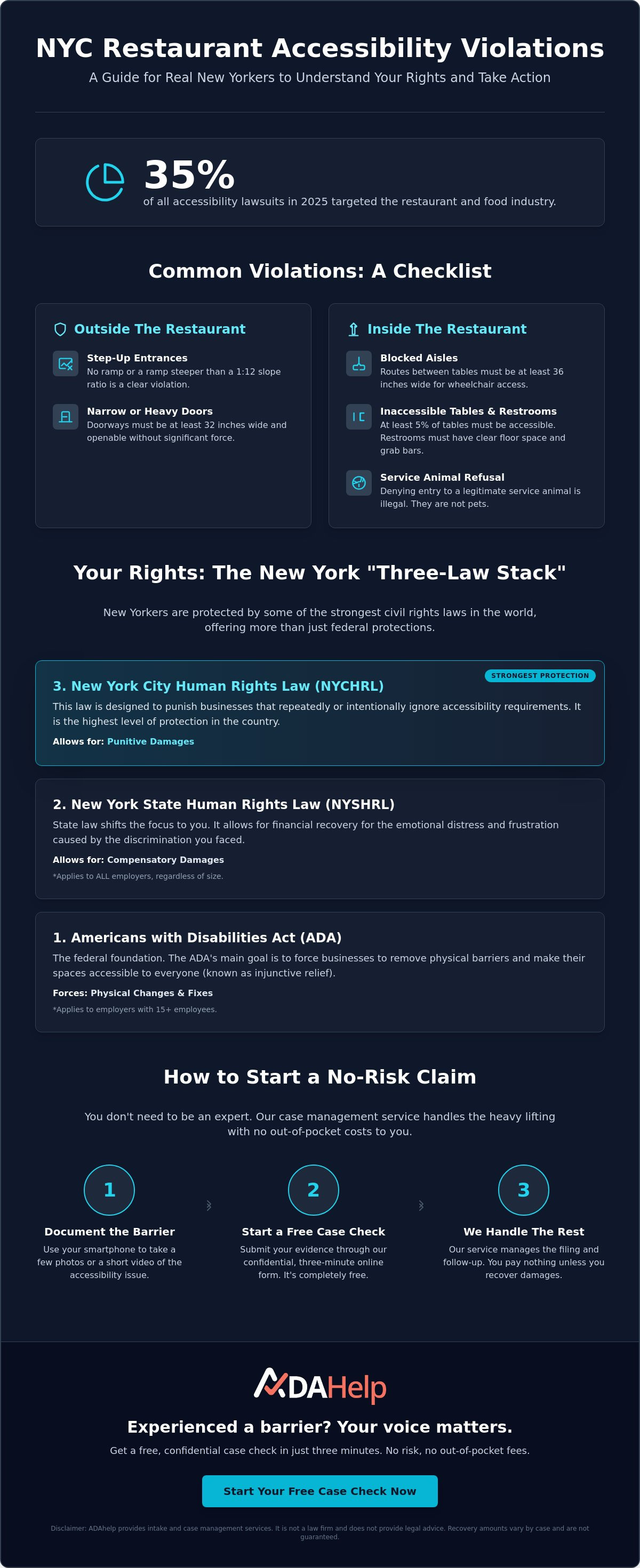
Did you know that the restaurant and food industry was the most targeted sector for accessibility lawsuits in 2025, accounting for nearly 35% of all filings? If you have ever been unable to enter a dining room or navigate an online menu, you have likely encountered a restaurant ADA violation New York. It's a frustrating experience that often leaves you feeling unwelcome and wondering if you have any real recourse. You might worry about the high cost of legal fees or feel overwhelmed by the "Three-Law Stack" of federal, state, and city regulations that govern accessibility in the Big Apple.
We believe that everyone deserves equal access without the burden of personal financial risk. You can quickly identify if your rights were violated and learn how to start a no-risk claim in minutes. This article breaks down the specific physical and digital requirements for New York businesses. We'll show you how to use city and state laws to your advantage and provide a clear path toward justice that keeps the effort on the service provider, not on you.
Key Takeaways
- Spot hidden barriers like heavy doors or step-up entrances that prevent you from enjoying your favorite local spots.
- Navigate the "Three-Law Stack" to see how New York state and city regulations offer you more protection than federal law.
- Identify if a restaurant ADA violation New York qualifies you for compensatory damages for your frustration and emotional distress.
- Learn the exact steps to document accessibility issues using just your smartphone and a few minutes of your time.
- Discover how our case management service handles the heavy lifting of filing a claim so you don't have to.
Common Restaurant ADA Violations in New York
You shouldn't have to guess if a business is breaking the law. When you're out for a meal, a restaurant ADA violation New York can turn a simple evening into a series of stressful hurdles. These barriers aren't just "architectural quirks" of old buildings; they are legal failures. While the Americans with Disabilities Act (ADA.gov) set the federal standard decades ago, many establishments still fail to meet the basic requirements of accessibility and inclusion. For the bigger picture beyond restaurants, see our guide to public access discrimination in New York.
To see how these issues impact real communities and the consequences businesses face, watch this report on a local enforcement action:
Entrance and Exterior Barriers
Your experience starts before you even sit down. If you encounter a step-up entrance without a permanent or portable ramp, that's a major red flag. New York regulations require a ramp with a specific slope ratio of 1:12 to ensure safety. Doors are another frequent problem. A doorway must have a minimum width of 32 inches to be considered accessible. If the door is so heavy that a wheelchair user cannot open it independently, or if the doorbell is placed too high to reach, the restaurant is effectively shutting you out. These exterior obstacles are often the most visible signs of a restaurant ADA violation New York, signaling that the business hasn't prioritized your access.
Interior and Dining Area Obstacles
Once inside, the challenges often continue. You might find that the aisles between tables are packed so tightly that a wheelchair cannot pass through. Law requires an accessible route at least 36 inches wide throughout the dining area. Seating is also strictly regulated. At least 5% of all tables must be accessible, meaning they need a height of 28 to 34 inches and at least 27 inches of knee clearance. It's common to see these specific tables used for storage or high-chair stacks, which is a direct violation of your rights. If the bar or service counter is too high for you to reach or interact with staff, the restaurant is failing to provide equal service.
Restrooms and service policies are the final pieces of the checklist. Many New York restaurants have restrooms with stalls too narrow for a wheelchair or lack the necessary grab bars for safety. Beyond physical barriers, some managers still wrongly refuse service animals based on "no pets" policies. Under the law, service animals are not pets; they are essential assistants. Whether it's a physical barrier or a discriminatory policy, these issues are valid grounds for a claim. We handle the heavy lifting of documenting these failures so you can focus on getting the justice you deserve.
Your Rights Under the New York Three-Law Stack
Living in New York means you're protected by some of the toughest civil rights laws in the world. When you encounter a restaurant ADA violation New York, you aren't just relying on one federal law. You're backed by a "Three-Law Stack" that includes federal, state, and city protections. Each layer adds a new level of accountability for the business and a new path for your resolution. It's not just about getting a ramp installed; it's about making sure your rights are respected. A restaurant is just one kind of public accommodation under the ADA in NYC, and the same three-law framework applies.
The base of this stack is the Americans with Disabilities Act. This federal law requires restaurants to follow the 2010 ADA Standards for Accessible Design. Its main goal is to remove physical barriers. If a doorway is too narrow or a bathroom is inaccessible, the ADA forces the business to fix it. While this is helpful, federal law alone often doesn't compensate you for the frustration or embarrassment you experienced. If you believe your rights were ignored, you can start a simple case check to see which protections apply to your experience.
Federal vs. Local Protection
Think of these laws as a safety net with three layers. The ADA focuses on the building itself, ensuring the restaurant physically changes to accommodate everyone. New York State law shifts the focus to you. The New York State Human Rights Law (NYSHRL) allows for compensatory damages, which means you can receive money for the emotional distress caused by the discrimination. Finally, the New York City Human Rights Law (NYCHRL) acts as a deterrent. It allows for punitive damages. These are designed to punish businesses that repeatedly or intentionally ignore the law. It's the highest level of protection in the country.
Why Employer Size Does Not Matter in NY
Don't let the size of a restaurant discourage you from standing up for your rights. While some federal regulations have limits based on the number of employees, New York State and City laws are much broader. They cover almost every public space, regardless of whether it's a massive chain or a tiny corner bistro. You are protected from a restaurant ADA violation New York even if the business only has one or two employees. Fair access is a right, not a privilege reserved for large corporations. Whether it's a mom-and-pop shop or a high-end Manhattan eatery, the law requires them to welcome you without barriers.
What is a Restaurant ADA Violation Case Worth?
When you face a barrier at a local eatery, you might wonder if standing up for your rights is worth the effort. It's a fair question. A restaurant ADA violation New York isn't just a minor inconvenience; it's a legal breach that impacts your dignity and your day. While every situation is unique, the value of a case is generally measured by the severity of the discrimination and the specific laws that were broken. Your recovery isn't just about a dollar amount. It's about ensuring that the next person who visits that restaurant doesn't face the same wall you did.
Recovery usually falls into two categories: fixing the problem and compensating you for the experience. Injunctive relief is the first step. This is a court-ordered requirement that the restaurant must fix the physical barrier, such as installing a ramp or widening a restroom door. Beyond the physical fix, New York's specific laws allow for financial recovery that federal law often misses. This is where the local "Three-Law Stack" we discussed earlier becomes your greatest asset.
Types of Financial Recovery
It's important to distinguish between money that goes to the city and money that goes into your pocket. Federal law focuses primarily on the building. It forces the business to comply with accessibility standards but rarely offers a check to the individual. However, New York State and City laws are different. They recognize that being turned away from a public space causes real emotional distress and frustration.
Compensatory damages are designed to cover this emotional toll. While amounts are never guaranteed, they reflect the impact the discrimination had on your life. For context, industry data from 2025 shows that the average out-of-court settlement for an ADA lawsuit is approximately $30,000, while a court judgment can average $85,000. These figures include various legal factors, but they highlight that the system takes these violations seriously. You can check your specific case details to see how these recovery types might apply to your situation.
The Role of Punitive Damages in NYC
If the violation happened within the five boroughs, you have access to a powerful legal tool: punitive damages. This feature is unique to the New York City Human Rights Law. Unlike compensatory damages, which focus on your experience, punitive damages focus on the restaurant's behavior. They are meant to punish businesses that intentionally ignore the law or fail to fix repeated issues.
New York City is one of the few places in the country where these damages apply to accessibility cases. This makes a restaurant ADA violation New York in the city much more "expensive" for a business to ignore. When a restaurant knows they could face heavy penalties for intentional neglect, they are far more likely to take accessibility seriously. We handle the entire process of identifying these factors so the burden of proof doesn't rest on your shoulders.
How to Document a Restaurant Accessibility Issue
You shouldn't have to be a legal expert to protect your rights. If you encounter a restaurant ADA violation New York, your smartphone is your best witness. Documentation is the bridge between a frustrating afternoon and a successful resolution. It turns your personal experience into a clear, undeniable record that forces the business to take responsibility. Don't just walk away; take a few minutes to gather the details that will power your claim.
A strong case relies on specific facts. While the experience is fresh, make sure you collect the following information:
- Exact Location: Note the restaurant name and the full street address.
- Date and Time: Record exactly when the incident happened.
- Staff Names: Check name tags or ask for the names of any staff or managers you spoke with.
- Receipts: Keep your dining receipt or a digital record of your reservation as proof of your visit.
- Witnesses: If you're with friends or family, note their names. If a bystander saw the incident, ask for their contact info.
Once you have these basics, you can submit your documentation for a three-minute case check to see if you have a valid claim for compensation.
Photographing the Violation
A photo truly is worth a thousand words in an accessibility case. Capture the barrier from multiple angles to give a full view of the problem. If there is a step-up entrance without a ramp, take a wide shot of the storefront and a close-up of the step. Use a common object, like a dollar bill or a water bottle, next to the barrier to provide a reference for scale. This helps prove that a threshold is too high or a path is too narrow. When photographing restrooms, focus on the lack of grab bars or the narrow stall door. Always be mindful of privacy; focus only on the physical barrier and avoid taking photos of other customers or staff members.
Recording Your Experience
The emotional impact of being excluded is a vital part of your story. Write a brief description of what happened while the details are still vivid. Did the manager dismiss your concerns? Did a staff member tell you to "just use the back entrance"? These comments are important evidence. Describe how the barrier made you feel or how it limited your day. Under the New York laws we discussed earlier, your emotional distress is a key factor in determining compensatory damages. Note any specific physical struggle you faced, such as being unable to open a heavy door or having to leave because there was no accessible seating. This narrative helps us handle the heavy lifting of your case by providing the human context behind the violation.
Where to File Your Complaint: Agencies & Deadlines
Once your evidence is organized, you have a few places to file a restaurant ADA violation New York complaint, and each has its own deadline:
- NYC Commission on Human Rights (CCHR): for restaurants in the five boroughs. File the CCHR complaint generally within one year of the incident.
- NY State Division of Human Rights (DHR): for anywhere in the state. The DHR administrative complaint deadline is generally one year (and up to three years to bring a case directly in court).
- U.S. Department of Justice (DOJ): for a purely federal Title III barrier — though this route rarely puts money in your pocket as an individual.
There is no fee to file with these agencies, and you do not need a lawyer to start. Because one missed deadline can end a valid claim, many New Yorkers let a case manager handle the filing and follow-ups.
Get Your Free Three-Minute Case Check
Encountering a restaurant ADA violation New York is more than a minor hurdle; it's a breach of your civil rights. You might feel a mix of frustration and hesitation. Is it worth the fight? How much will it cost? These are the questions that often stop people from seeking justice. We're here to change that narrative. Our public access discrimination case management in New York is designed for real people who need a capable partner to handle the complexities of the system. You've done the hard part by facing the barrier. Let us handle the rest.
The path to justice after a restaurant ADA violation New York shouldn't be blocked by confusion or high costs. Our approach is built on low-risk reassurance. We understand that the idea of standing up for your rights can feel cold and intimidating. That's why we've stripped away the stuffiness. We focus on results, speed, and fairness. By choosing a case management partner, you ensure that the burden of effort lies with the business that failed to provide access. We believe in a stress-free path toward resolution where your voice is heard without you having to manage a mountain of paperwork.
How Our Case Management Works
It's important to understand our role in your journey. We are not a law firm, and we don't provide direct legal advice. Think of us as your proactive project managers for justice. We handle the heavy lifting of the process from start to finish. Once you provide your evidence, we manage the information gathering and the filing of your claim. We know the regional landscape intimately. We know how the city and state laws interact. If you want the full picture of managed help, our overview of ADA case assistance in New York explains the process end to end. This expertise allows us to move quickly and efficiently, turning a confusing process into a simple, step-by-step progression.
Start Your Claim Today
Don't let another day pass feeling like your rights don't matter. Taking the first step is easier than you think. You can find out if your experience qualifies for a claim under the powerful NYC and NY state laws in just moments. Our free three-minute case check is the most efficient way to see if you have a valid case. We operate on a strict contingency model. This means no recovery equals no fee. You'll never face out-of-pocket costs for our services. We only get paid if we successfully secure a win for you. This model ensures that we're completely aligned with your goals.
Fairness shouldn't be expensive. You deserve a champion who's committed to making the system work for the individual with minimal friction. Every successful claim helps make New York a more accessible place for everyone. Stop wondering if you have a case and start getting answers. Start your free case check now at ADAhelp.
Take Control of Your Access Rights Today
You now have the tools to identify when a business fails to meet its legal obligations. By understanding the "Three-Law Stack" and knowing exactly how to document barriers, you've moved from frustration to empowerment. Don't let a restaurant ADA violation New York go unaddressed. Every time you stand up for your rights, you help create a more inclusive city for everyone.
We're ready to handle the heavy lifting for you. Our expertise in NYSHRL and NYCHRL claims ensures your case is managed with professional authority and empathetic advocacy. We offer a free case evaluation for New Yorkers with absolutely no out-of-pocket costs. Our contingency-based model is simple: if there's no recovery, there's no fee. This low-risk approach puts the power back in your hands without the stress of legal bills.
Ready to see if you have a valid claim? It only takes a few minutes to start your journey toward justice. Start your free three-minute case check now. You deserve to move through this city with dignity, and we're here to make sure you do.
Frequently Asked Questions
Do I need a lawyer to report a restaurant ADA violation in New York?
You don't need to hire a lawyer on your own to start seeking justice. Our case management service handles the heavy lifting, from gathering evidence to managing the filing process. We provide a supportive, low-risk path that avoids the cold and intimidating atmosphere of a traditional law office.
What are the wheelchair ramp requirements for NYC restaurants?
NYC restaurants must provide a ramp with a slope ratio of 1:12 if there are steps at the entrance. The ramp must be at least 36 inches wide to allow for safe and easy passage. These specific measurements are essential to prevent a restaurant ADA violation New York and ensure the space is welcoming to everyone.
Can a restaurant refuse a service animal in New York City?
No, a restaurant cannot refuse entry to a service animal, even if they have a strict "no pets" policy. Under the law, service animals are essential assistants rather than pets. Refusing them entry is a discriminatory act that violates both federal and New York City human rights laws.
How much does it cost to file an ADA claim in New York?
Filing a claim through our service involves no out-of-pocket costs for you. We operate on a contingency basis, which means we only receive a fee if we successfully recover money on your behalf. This model ensures that the financial risk lies with the service provider, not the individual.
What happens if a restaurant in an old NYC building says they cannot be accessible?
Older buildings are not "grandfathered" in a way that allows them to ignore accessibility. Restaurants are required to remove physical barriers whenever it is "readily achievable" to do so. While some structural limits exist, businesses must make a genuine effort to provide equal access to all customers.
How long do I have to report disability discrimination in New York?
You should act as soon as possible because legal deadlines are very strict. In New York, you generally have one year to file an administrative complaint or three years to file a lawsuit in court. Starting your case check immediately helps ensure that your documentation is fresh and your claim is filed on time.
Are bathrooms in NYC restaurants required to be ADA compliant?
Yes, restaurant restrooms must meet specific accessibility standards if they are open to the public. This includes having stalls wide enough for a wheelchair to turn and installing sturdy grab bars at the correct height. A restroom that you cannot use safely is a clear restaurant ADA violation New York.
Can I get money for a restaurant accessibility violation in NYC?
Yes, you can receive financial compensation under New York state and city laws. While federal law primarily focuses on fixing the physical building, the NYSHRL and NYCHRL allow for compensatory damages. These payments are designed to address the emotional distress and frustration you experienced during the incident.

Article by
ADA Help
Written by the ADAhelp editorial team and reviewed for accuracy before publishing. ADAhelp helps New Yorkers find out if they have a disability discrimination claim and manages the process end to end, working with independent attorneys who handle the legal work. We are not a law firm and do not provide legal advice.
Disclaimer
This article is general information about New York law, not legal advice, and reading it does not create an attorney-client relationship. ADAhelp is a case-management and intake service, not a law firm; legal representation is provided by independent attorneys. Recovery amounts and timelines vary by case, and past outcomes do not guarantee future results. For advice about your specific situation, speak with a qualified attorney or start the free case check.
Tags
Discriminated against in New York because of a disability?
A free three-minute check tells you if you can pursue a claim.
Check my case →New York onlyNo upfront costIndependent NY attorneysFree 3-minute check