
ADA Discrimination Claim Statute of Limitations New York
Reviewed for accuracy by the ADAhelp team before publishing. ADAhelp is not a law firm; legal work is handled by independent New York attorneys.

Learn the ADA discrimination claim statute of limitations New York requires. Don't miss the 3-year deadline for money damages. Check your case for free in 3 ...
Did you know that missing a single filing deadline by just one day could permanently cost you your right to financial recovery? You have a case if you were treated unfairly due to a disability. While the federal ADA focuses on fixing access, New York state and city laws are where money damages typically come from. At ADA Help - NY disability discrimination claims, we help you determine if you have a claim and what it's worth through a free case check that takes just three minutes. If you've faced discrimination in New York, you're likely feeling the pressure of complex timelines and wondering if it's too late to take action.
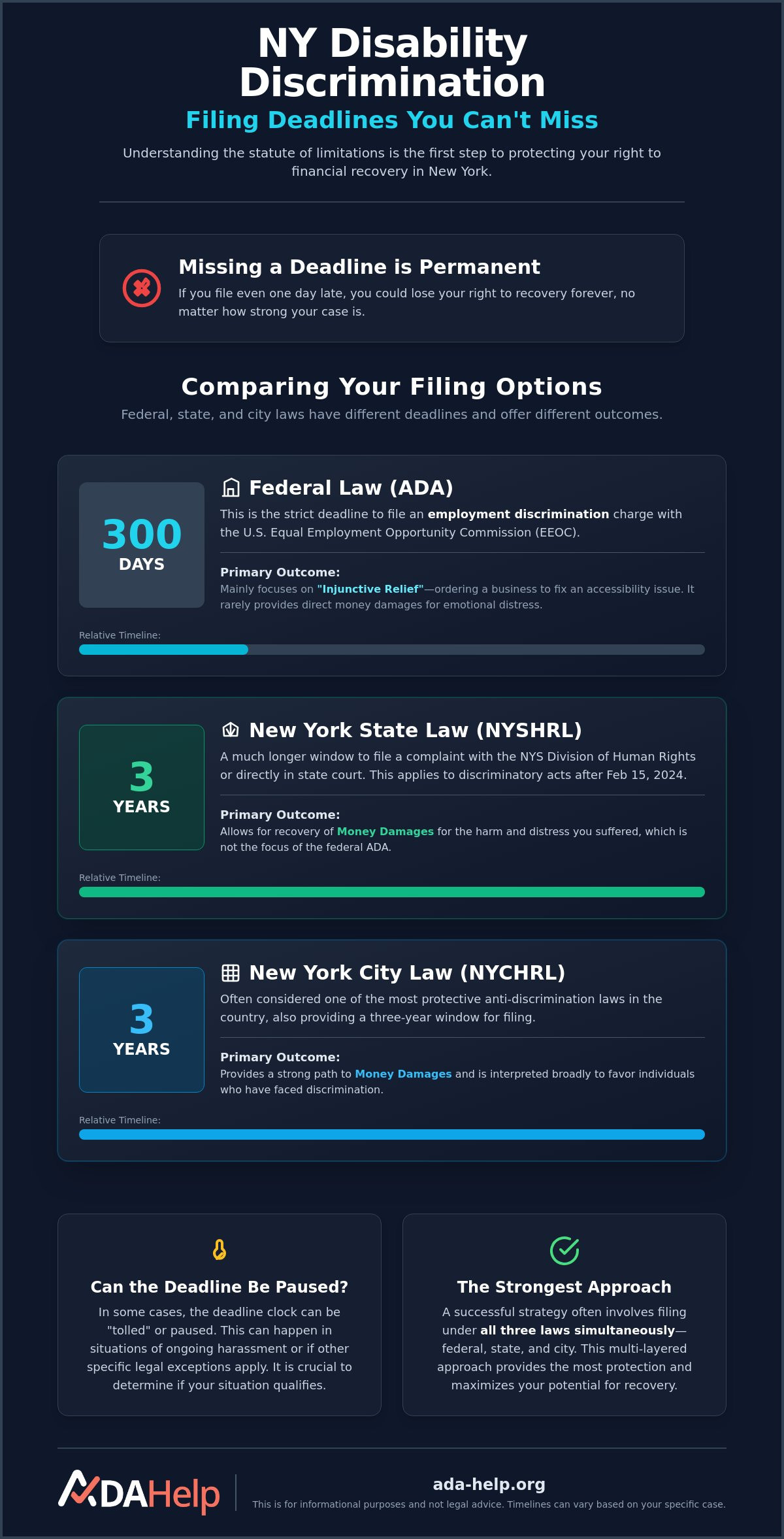
Understanding the ADA discrimination claim statute of limitations New York requires is the first step in protecting your rights. You might feel overwhelmed by the difference between the federal 300-day window to file with the EEOC and the three-year deadline for most New York State Human Rights Law claims. This 2026 guide explains the exact timelines you must meet and how to start your claim without any financial risk. We'll break down the rules for state and federal filings so you can move forward with confidence while we connect you with independent attorneys who only get paid if you recover money.
Key Takeaways
- Identify the exact deadlines for your situation so you don't lose your right to financial recovery.
- Learn why the ADA discrimination claim statute of limitations New York uses is often longer under state law than federal rules.
- Discover how to pursue money damages through New York laws instead of just seeking access changes under federal law.
- Find out if your deadline has been paused or extended because of ongoing harassment or other legal exceptions.
- Find a low-risk way to connect with contingency-fee attorneys who handle the heavy lifting for your case.

What is the Statute of Limitations for ADA Claims in New York?
A statute of limitations acts as a legal expiration date for your right to hold someone accountable. It is the hard deadline for filing a formal complaint after you've experienced unfair treatment. If you don't take action before this clock runs out; you lose your right to recovery forever. It doesn't matter how strong your evidence is; a late claim is almost always dismissed. Understanding the ADA discrimination claim statute of limitations New York requires is the only way to ensure your path to justice remains open.
To better understand this concept; watch this helpful video:
New York is unique because it offers some of the most protective filing windows in the country. While the Americans with Disabilities Act of 1990 sets the national floor; New York's own state and city laws often provide more time to seek money damages. ADA Help - NY disability discrimination claims assists you in sorting through these overlapping rules with a free three-minute case check. This helps you identify which specific deadline applies to your unique situation without any personal financial risk.
The Three-Year New York State Rule
For most New Yorkers; the state law provides a significant safety net. For discriminatory acts occurring on or after February 15; 2024; you generally have three years to file a complaint with the New York State Division of Human Rights. This is a major extension from the old one-year rule. This three-year window also applies if you choose to skip the administrative process and file a lawsuit directly in a New York State court. The clock starts on the day the discrimination happened. If you were denied a reasonable accommodation or treated unfairly because of a disability; that date is your starting point.
Federal Deadlines and the EEOC
Federal rules are much stricter and move much faster than state laws. If you want to pursue a claim under the federal ADA for employment issues; you must usually file a charge with the Equal Employment Opportunity Commission (EEOC) first. In New York; you typically have only 300 days from the date of the incident to do this. This is a very tight window. If you miss this 300-day mark; you might lose your ability to sue in federal court. However; because New York state law is so broad; you may still have a valid claim under state rules even if the federal deadline has passed.
Comparing Federal vs New York State and City Filing Deadlines
Choosing which law to file under is a strategic decision that impacts your final recovery. You don't have to pick just one path. Most successful claims in New York involve filing under federal, state, and city laws simultaneously. This multi-layered approach protects you if one part of your claim faces a technical challenge. While the federal ADA focuses on fixing the physical or digital barrier, New York's local laws focus on the harm done to you. Understanding how these deadlines overlap is the best way to ensure you don't leave money on the table.
The federal ADA is primarily designed for "injunctive relief." This is a legal term meaning the court orders a business to change its behavior; such as installing a wheelchair lift or updating an inaccessible website. It rarely results in a direct payout to the victim for emotional distress. In contrast, the New York State Human Rights Law (NYSHRL) and the New York City Human Rights Law (NYCHRL) allow for broader financial recovery. These laws recognize that discrimination causes real damage to your life and finances. You can verify your specific ADA discrimination claim statute of limitations New York window by starting a free three-minute case check today.
The 300-Day Federal Employment Window
If your case involves a job or a workplace, you must track the federal filing deadlines closely. For Title I ADA claims in New York, you generally have 300 days to file a formal charge with the U.S. Equal Employment Opportunity Commission (EEOC). This is a mandatory step. You cannot walk into a federal court and sue your employer until the EEOC has reviewed your claim and issued a "right-to-sue" letter. This 300-day clock moves quickly. If you wait too long, you lose your ability to use federal law to hold your employer accountable.
The Three-Year Local Window for Money Damages
For those living or working within the five boroughs, the NYCHRL is often the most effective tool available. It provides a generous three-year statute of limitations to file a claim directly in court. This law is widely considered one of the most protective in the nation. It allows for compensatory damages to cover your actual losses and punitive damages to punish businesses for intentional discrimination. Because this window is longer than the federal one, documentation becomes your most important asset. You should save every email, performance review, and witness statement. A strong paper trail ensures that your claim remains powerful even if it takes years to reach a resolution. We can help you organize this information and determine which local laws apply to your specific situation.
Statutes of Limitations for Public Access and Inaccessible Buildings
Public access discrimination doesn't just happen at work. It happens when you can't enter a restaurant because there's no ramp or when a medical office doesn't have an accessible exam table. These situations fall under Title III of the federal ADA. In New York, your protection is even stronger because the ADA discrimination claim statute of limitations New York provides under state law is typically three years. This gives you more time to hold businesses accountable for physical barriers that prevent you from living your life fully.
The legal rules changed significantly when New York Extends Discrimination Claim Deadline was officially announced. This extension aligned administrative filing deadlines with the three-year window for state court lawsuits. It applies to private businesses like stores, hotels, and theaters. If you've been excluded from a public space, you have a right to seek both a fix for the problem and financial compensation for the harm caused. We provide a free three-minute case check to help you determine if your specific encounter still falls within these legal windows.
Deadlines for Retail and Restaurant Violations
The clock for a public access claim usually starts the moment you encounter a barrier. If you visited a shop in Brooklyn today and couldn't get inside because of a step, your three-year window begins now. This applies to physical issues like narrow aisles or inaccessible restrooms. It also covers digital spaces. If a business's website is not compatible with screen readers, it is considered a barrier to public access. You can learn more about your digital rights by reading about a Website Accessibility Violation New York and how it impacts your claim. Don't wait until the last minute to gather evidence. Take photos of the barrier. Save your receipts to prove you were at the location.
Government and School Building Access
Claims against the government follow a completely different set of rules that can trap the unwary. If you were discriminated against at a public school, a city-run hospital, or a government office, you may have as little as 90 days to act. Many New York agencies require a formal "Notice of Claim" before you can even think about filing a lawsuit. This 90-day deadline is incredibly strict. If you miss it, you might lose your right to sue the city or state entirely. This is why you must verify the specific agency deadline immediately after the incident. We help you identify these hidden deadlines so you can protect your right to recovery before it's too late.
Exceptions and Rules for Tolling the Deadline in New York
Tolling is a legal term you should know if you think you've missed your chance to file. It acts as a pause button on your filing clock. While the ADA discrimination claim statute of limitations New York provides is usually three years for state claims; certain life circumstances can stop that clock from ticking. This ensures the system remains fair for people who were physically or legally unable to start their case on time. It protects your right to seek justice even when immediate action was impossible.
For example; if the person facing discrimination is a minor; the three year window typically doesn't start until they turn 18. Similar rules apply to individuals with a mental incapacity. These exceptions ensure that vulnerable New Yorkers aren't barred from recovery because of factors beyond their control. You can see if your situation qualifies for a pause by starting a free three minute case check now. We help you determine if your time is still running or if a pause applies to your situation.
The Continuing Violation Doctrine
This doctrine is a powerful tool for victims of ongoing discrimination. It applies when the unfair treatment isn't a single event but a consistent pattern of behavior. If you face daily harassment at work or live in an apartment building that refuses to fix a broken elevator for months; the clock might reset with every new discriminatory act. This keeps your claim alive as long as the behavior continues. It prevents businesses from escaping liability just because their bad behavior has lasted a long time. Instead of the deadline starting on the first day; it may start from the most recent incident.
The Importance of Early Documentation
Evidence fades faster than the legal deadline expires. Witnesses move away or forget what they saw. Emails can be deleted. Digital records of an inaccessible website might be updated and erased. You need to act like your deadline is much shorter than it actually is. The stronger your evidence is today; the better your chances of a successful recovery later. ADA Help - NY disability discrimination claims handles the heavy lifting of organizing this information so you don't have to. You can check your specific rights for employment disability discrimination in New York to see what evidence you should save today.
Where to File: Agencies and Deadlines
Knowing your deadline only matters if you file with the right agency. Most strong New York claims are filed with more than one, since each covers different ground and pays out differently.
- New York State Division of Human Rights (DHR) — state law claims, a three-year window for most private discrimination. File with DHR.
- NYC Commission on Human Rights (CCHR) — city law claims for anyone discriminated against within the five boroughs, also a three-year window. File with CCHR.
- U.S. Equal Employment Opportunity Commission (EEOC) — the required first step for federal employment claims, a 300-day window. File with the EEOC.
- U.S. Department of Justice (ADA.gov) — federal Title III complaints for inaccessible businesses and public accommodations. File with the DOJ.
You do not have to identify the right agency on your own. Our free three-minute case check helps you find out which of these apply to your situation, and if you are not yet sure you have a claim at all, start with Do I Have an ADA Case in New York? Check Your Claim Now.
How ADA Help - NY disability discrimination claims Manages Your New York Case
Starting a case can feel like taking on a second job. You have to track dates and figure out which government agency handles your specific issue. This is where ADA Help - NY disability discrimination claims steps in as your proactive partner. We are not a law firm and do not provide legal advice. Instead; we act as a bridge. We handle the effort of organizing your information and determining if you have a valid claim before connecting you with independent attorneys.
Many people worry they've already missed the ADA discrimination claim statute of limitations New York requires for their situation. Others are anxious about the high cost of hiring a lawyer just to see if they have a case. We remove that stress by providing a streamlined path toward justice. We handle the coordination so you can focus on moving forward with your life. Our team ensures your information is ready for legal review without any upfront financial burden.
The Free Three-Minute Case Check
You can find out where you stand right now. Our free three-minute case check is designed for real New Yorkers who need answers fast. You simply answer a few simple questions about your experience. We don't use confusing jargon or ask for complex legal theories. We just need the facts of what happened. Once you complete the check; you get an immediate assessment of your potential claim. This helps you know instantly if you are still within the legal filing windows we discussed earlier.
Case Management Without Out-of-Pocket Costs
You should never have to pay to find out if your rights were violated. Our contingency model means that the financial risk stays with us and the legal team; not you. You never pay out-of-pocket for our case evaluation or management services. We only receive a fee if you successfully recover money from your claim. This "no recovery; no fee" approach allows you to focus on your personal recovery while we handle the paperwork. We connect you with independent attorneys who specialize in NYSHRL and NYCHRL claims. This ensures you have a tireless advocate fighting for the money damages you deserve.
Protect Your Right to Recovery Today
You now know that time is your most valuable asset when facing discrimination. Missing the ADA discrimination claim statute of limitations New York provides means losing your chance for justice forever. Remember that while federal deadlines are short; New York state and city laws often give you a three-year window to seek money damages. Don't wait for evidence to fade or witnesses to move away. Taking action now ensures your story is heard while the facts are still fresh.
We handle the intake and case management so you don't have to worry about the paperwork. Our process is designed to be stress-free and completely transparent. You get a specialized team to organize your facts and connect you with independent contingency-fee attorneys. You never pay out-of-pocket because we only get paid if you win. Our no recovery; no fee model means the burden of risk stays with us; not you. We focus on the deadlines so you can focus on your life.
Start your free three-minute case check now to see if your claim is still valid. You deserve a fair path to resolution; and we are here to help you find it.
Frequently Asked Questions
How long do I have to file a disability discrimination claim in New York City?
You generally have three years to file a lawsuit under the New York City Human Rights Law. This timeline applies to claims filed directly in court or with the NYC Commission on Human Rights. If you are filing an employment claim under federal rules; the deadline is much shorter at 300 days. Acting within the first year is always best to ensure your evidence remains strong and your witnesses are still available.
What happens if I miss the 300-day EEOC deadline?
Missing the 300-day EEOC deadline usually prevents you from filing a federal lawsuit under the ADA. However; you may still be eligible for financial recovery under state or city laws. The ADA discrimination claim statute of limitations New York provides under the NYSHRL is three years; which often keeps your case alive even after the federal window closes. We can help you determine if your state law options are still open.
Does the three-year statute of limitations apply to website accessibility?
Yes; website accessibility claims in New York typically follow the three-year statute of limitations under state and city law. Digital barriers are treated as public access violations. Since websites are considered places of public accommodation; you have the same timeframe to hold a business accountable for an inaccessible digital experience as you would for a physical ramp violation. You should document the digital barrier with screenshots immediately.
Can an employer shorten my time to sue in an employment contract?
Some employment contracts include clauses that attempt to shorten the time you have to file a claim. However; New York courts have recently restricted the ability of employers to drastically cut these deadlines. If your contract says you only have six months to sue; it might not be legally enforceable under current state rules. You should never assume you are barred from filing just because of a clause in your handbook or contract.
Is there a difference between the state and federal statute of limitations?
There is a significant difference between the two systems. Federal ADA claims for employment require action within 300 days while New York state law provides a much more generous three-year window for most discrimination claims. This difference is why many New Yorkers choose to pursue money damages under state law rather than focusing solely on federal access rules. We help you navigate these overlapping timelines to find the best path forward.
Do I need a lawyer to check my statute of limitations?
You don't need a lawyer to find out if you are still within your legal window. We offer a free three-minute case check that identifies your specific deadlines immediately. While we are not a law firm; we handle the intake and connect you with independent contingency-fee attorneys if your case is still valid. This saves you the cost and stress of an initial legal consultation while ensuring your rights are protected.

Article by
ADA Help
Written by the ADAhelp editorial team and reviewed for accuracy before publishing. ADAhelp helps New Yorkers find out if they have a disability discrimination claim and manages the process end to end, working with independent attorneys who handle the legal work. We are not a law firm and do not provide legal advice.
Disclaimer
This article is general information about New York law, not legal advice, and reading it does not create an attorney-client relationship. ADAhelp is a case-management and intake service, not a law firm; legal representation is provided by independent attorneys. Recovery amounts and timelines vary by case, and past outcomes do not guarantee future results. For advice about your specific situation, speak with a qualified attorney or start the free case check.
Tags
Discriminated against in New York because of a disability?
A free three-minute check tells you if you can pursue a claim.
Check my case →New York onlyNo upfront costIndependent NY attorneysFree 3-minute check