Courthouse Accessibility Complaint NY: A Step-by-Step Guide
Reviewed for accuracy by the ADAhelp team before publishing. ADAhelp is not a law firm; legal work is handled by independent New York attorneys.
Faced courthouse barriers in NY? Learn how to file a courthouse accessibility complaint NY and get money damages. Free case check to see if you have a claim.
How can you expect a fair day in court if you can't even get through the front door? If you've struggled with a heavy entrance, a broken elevator, or a lack of ramps, filing a courthouse accessibility complaint NY is the first step toward fixing the problem. It's frustrating to feel excluded from the justice system because of a physical barrier. You're right to believe that this isn't just an inconvenience; it's a violation of your legal rights.
This guide explains how to identify barriers and hold the right agencies accountable. You'll learn how the Americans with Disabilities Act protects your access while the New York State Human Rights Law (NYSHRL) and New York City Human Rights Law (NYCHRL) may provide money damages for your experience. We'll preview the process for filing with the New York State Division of Human Rights and how to get professional case management for your paperwork. You can check your case for free in three minutes and fees are only taken if you get a recovery. We aren't a law firm, but we can help you determine if you have a claim and connect you with attorneys who can help.
Key Takeaways
- Identify common courthouse barriers like broken elevators or missing ramps that violate your rights.
- Learn why the NYSHRL and NYCHRL offer stronger paths to money damages than federal law alone.
- Follow a clear process to file a courthouse accessibility complaint NY with the right court coordinators or state agencies.
- Find out how to document barriers with photos and notes to build a strong foundation for your claim.
- Discover how a free case check can help you secure your rights without any upfront legal fees.
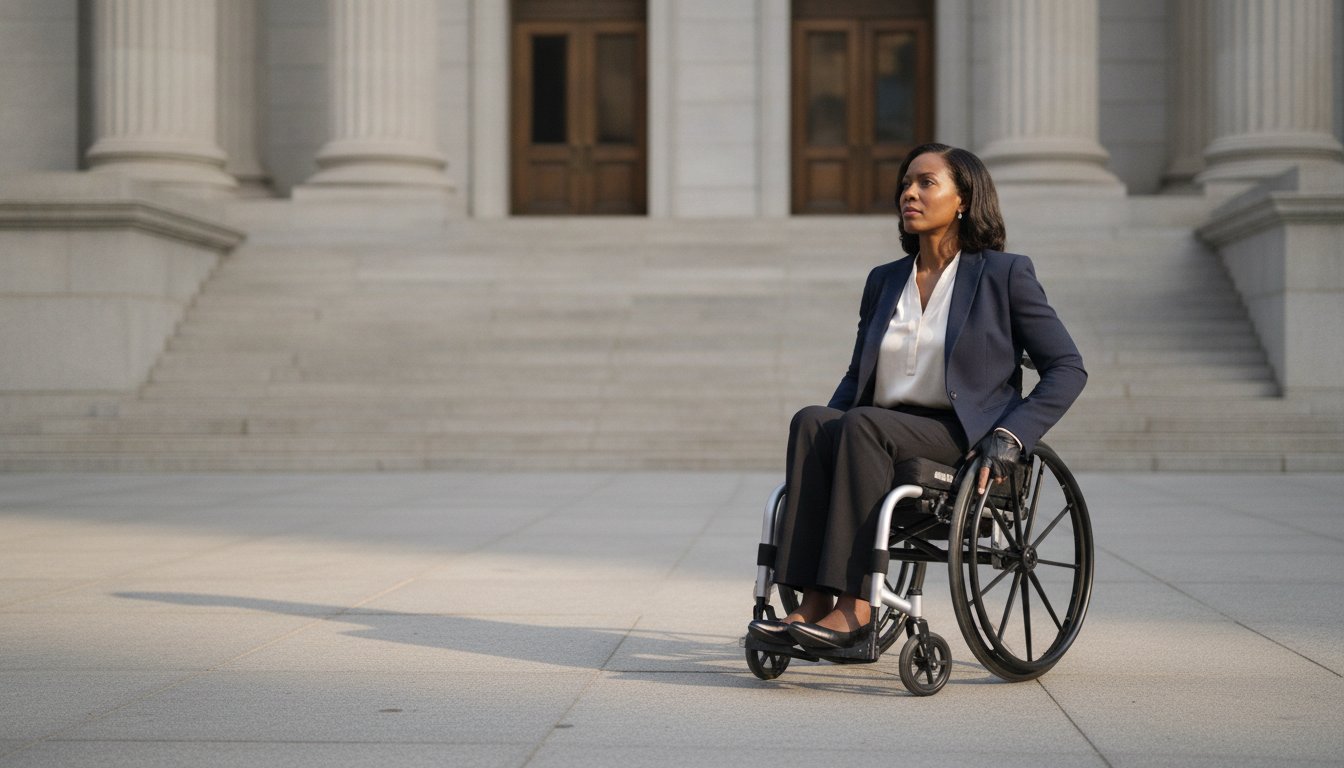
Common Courthouse Accessibility Barriers in New York
Have you ever arrived at a New York courthouse only to find the "accessible" entrance locked or blocked by construction? Courthouse accessibility is the legal requirement that ensures all court buildings, services, and programs are usable by people with disabilities. It's a fundamental right. When a building fails to provide these basics, it creates a wall between you and the justice system. This isn't just a minor inconvenience; it's a violation of the Americans with Disabilities Act (ADA).
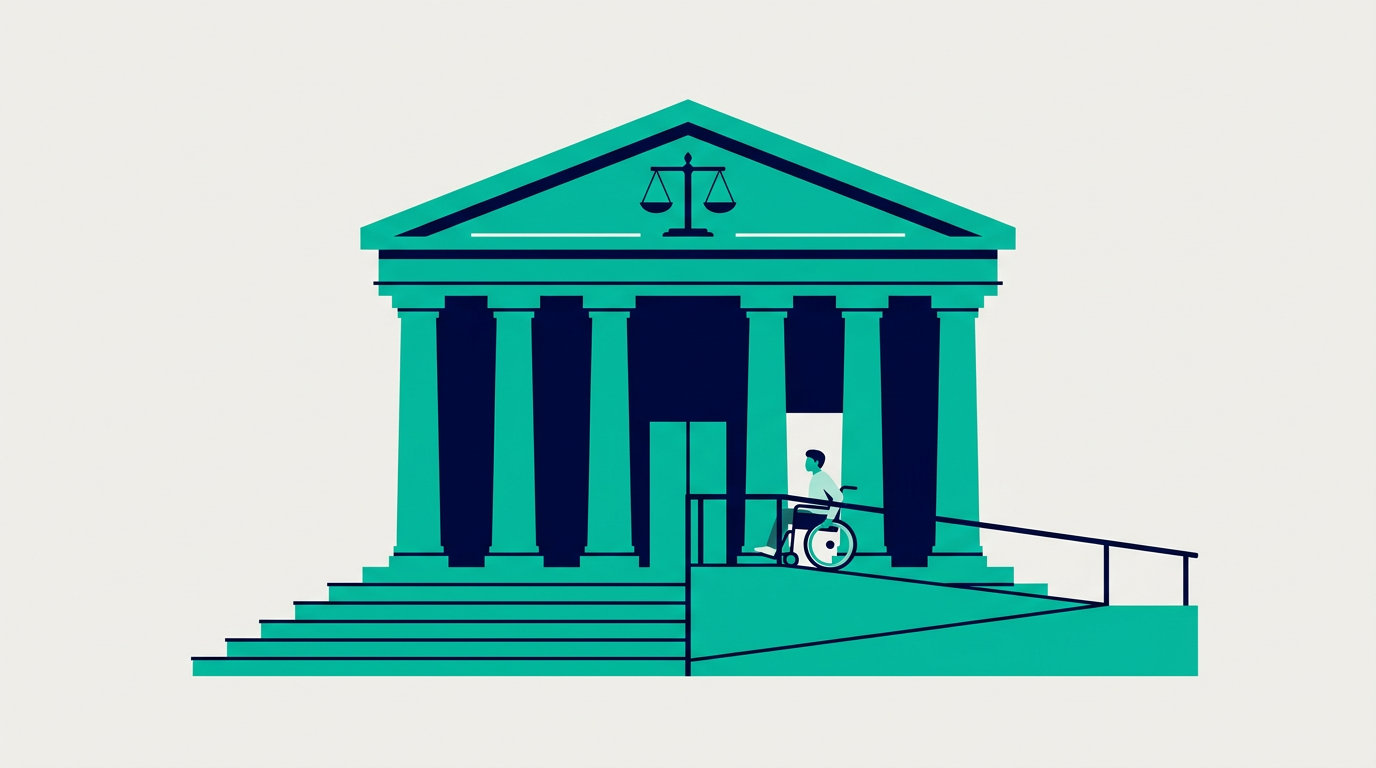
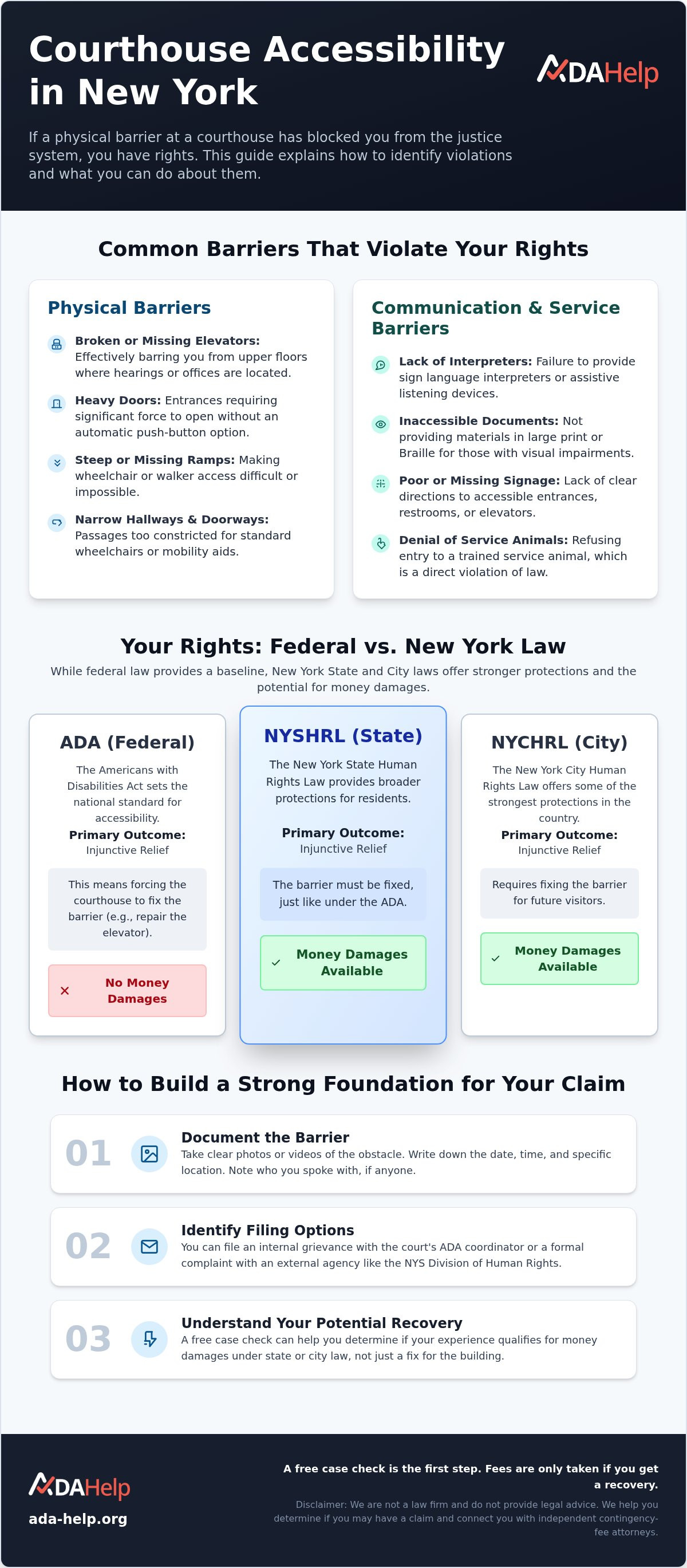
Many New Yorkers face physical hurdles before they even see a judge. Broken or missing elevators are a primary culprit. If your hearing is on the fourth floor and the elevator is out of service, you are effectively barred from the room. Heavy exterior doors also pose a challenge. If a door requires more than five pounds of force to open and lacks an automatic push-button, it's a frequent Title II violation. These barriers make a courthouse accessibility complaint NY necessary to force a change and protect your rights.
Participation in a hearing requires more than just being in the room. If you are deaf or hard of hearing, the court must provide sign language interpreters or assistive listening devices. Without these, you cannot understand the proceedings or defend your interests. A failure to provide these services is just as much a barrier as a flight of stairs. You shouldn't have to struggle to hear or be heard in a place meant to uphold the law.
Physical Barriers in Older NY Buildings
New York is home to many historic courthouses that were built long before modern accessibility standards existed. While these buildings have character, they often have steep ramps that are difficult or dangerous to climb. You might also encounter narrow hallways or doorways that cannot accommodate a standard wheelchair or walker. In some cases, the only accessible restroom is located in a different wing or on a different floor from the courtrooms. These architectural failures shouldn't be your burden to solve. You can see how building code accessibility violations are evaluated in older NYC structures to understand how these same standards apply to a courthouse. If you've encountered these issues, documenting the specific location and date is vital.
Communication and Service Barriers
Barriers are often invisible until you need a specific service. This includes the court's failure to provide legal documents in large print or braille for individuals with visual impairments. Clear signage is also a requirement. If you spend twenty minutes searching for an accessible entrance because there are no signs, the system has failed you. Court staff also cannot refuse entry to your service animal. If you've been turned away or told your service animal isn't allowed, you have experienced a direct violation of both state and federal law. These incidents are clear grounds for a formal grievance.
Your Rights Under New York Disability Laws
If you've been blocked from entering a courthouse or accessing a clerk's office, you aren't just dealing with a building problem. You're dealing with a legal violation. The federal Americans with Disabilities Act (ADA) requires state and local governments to provide equal access to all their programs and services. This means every courtroom and public office must be reachable and usable. However, for New Yorkers, the ADA is often just the starting point. You have additional layers of protection that go much further than federal law.
Understanding which law applies to your situation is the key to a successful courthouse accessibility complaint NY. While federal law sets the standard for access, the New York State Human Rights Law (NYSHRL) and the New York City Human Rights Law (NYCHRL) provide much broader coverage. ADAhelp specializes in looking at your specific experience to see which of these statutes offers you the best path forward. We are not a law firm and do not provide legal advice; instead, we help you determine if you have a claim and connect you with independent attorneys who work on a contingency basis.
ADA vs. NY State and City Laws
The main difference between these laws is the outcome they provide. Under the federal ADA, a court is usually only required to fix the physical barrier. This is known as injunctive relief. While this helps the next person who visits the building, it doesn't address the frustration or exclusion you already experienced.
The NYSHRL and NYCHRL are much more robust. These laws allow you to seek money damages for the discrimination you faced. This means you could receive financial compensation for the harm and emotional distress caused by the barrier. Learn more about your rights in New York to see how these state-level protections apply to your case. If you're unsure if your situation qualifies for a financial recovery, you can start with a free case check to get clarity quickly.
Why NYCHRL Matters for NYC Courthouses
If your incident happened in Manhattan, Brooklyn, Queens, the Bronx, or Staten Island, the NYCHRL is your strongest tool. This city law is one of the most powerful in the country. It has a lower threshold for proving discrimination than federal law. You don't have to prove the court acted with "deliberate indifference." You only need to show that you were treated "less well" than others because of your disability. The NYCHRL is the primary path for seeking a financial recovery for accessibility failures within the five boroughs. It ensures that the burden of access stays on the government, not on you.
Comparing Your Filing Options: Internal vs. Formal Claims
Do you want the barrier fixed today, or do you want to be compensated for the exclusion you already faced? Choosing the right path for your courthouse accessibility complaint NY depends on your specific goal. While the court system offers an internal process, it rarely provides a complete resolution for victims of discrimination. Understanding the difference between a quick fix and a formal claim is the only way to protect your rights effectively and ensure you aren't ignored by the system.
Internal complaints are often the fastest way to get a physical barrier removed for your next visit. However, if you've already suffered because of a lack of access, an internal form won't provide the justice you deserve. Formal discrimination claims are the only way to hold the government accountable for the harm they've caused. ADAhelp manages these formal claims so you don't have to handle the heavy lifting or the confusing paperwork yourself. We aren't a law firm; we are your case management partner. We help you determine if you have a case for free and then connect you with independent attorneys who work on a contingency basis.
The Role of the ADA Coordinator
Every court in the New York Unified Court System has a designated ADA coordinator. You can usually find their contact information posted near the courthouse entrance or on the official court website. These individuals handle immediate access requests and temporary fixes. If you need a sign language interpreter for a hearing tomorrow, the coordinator is the person to call. If a ramp is blocked by construction, they can order it cleared. While they are helpful for immediate needs, they cannot award money damages. They work for the court system; their job is to manage the building, not to compensate you for discrimination.
When to Pursue a Formal Discrimination Claim
You should pursue a formal claim if the accessibility failure caused you a significant setback. Did a broken elevator prevent you from reaching a courtroom on time? Did a lack of braille documents force you to postpone a legal filing? In these cases, a simple "fix" isn't enough. Formal claims create a permanent record of the violation and allow you to seek financial recovery under the NYSHRL or NYCHRL. This process is more complex than an internal form, which is why professional management is so valuable. You can see how Title III case management works to understand how we help New Yorkers secure their rights without any out-of-pocket costs. If we don't secure a recovery for you, you don't pay a fee.
How to File a Courthouse Accessibility Complaint in NY
Filing a courthouse accessibility complaint NY starts the moment you encounter a barrier. You shouldn't wait until you get home to start the process. The strongest claims are built on immediate, clear evidence. While the court system might have its own records; they are often incomplete or favor the building's management. You need a personal record that proves exactly what happened and how it affected your ability to access the justice system.
Documentation is the foundation of any formal claim under the NYSHRL or NYCHRL. These laws allow you to seek money damages; but you must prove the barrier existed and that it caused you harm. If you've been excluded; don't let the frustration stop you from taking action. You can start a free three-minute case check right now to see if your experience qualifies for professional case management. We help you determine if you have a claim and connect you with independent attorneys who work on a contingency basis.
Step 1: Gather Evidence at the Scene
Use your smartphone to capture the reality of the situation. Clear photos and videos are difficult for the court system to dispute. If an elevator is broken; take a photo of the "Out of Order" sign or the dark buttons. If a ramp is blocked by trash or construction equipment; show the obstruction clearly. You should also:
- Capture signs: Look for any warnings or directions to "accessible" entrances that are also blocked.
- Note the location: Write down the specific floor, room number, or entrance where the barrier occurred.
- Save your papers: Keep your court summons; hearing notice; or appearance ticket. This proves you had a legal obligation to be in the building at that specific time.
Step 2: Note the Impact on Your Day
The "harm" in a discrimination case isn't just the physical barrier. It's how that barrier changed your day. Write down the specifics while they are fresh in your mind. Did you have to wait outside in the rain because the only accessible entrance was locked? Were you late for your appearance because the elevator was down? These details matter. Describe any physical pain caused by trying to use an inaccessible entrance. Be honest about the emotional distress of being excluded from a public building. This personal account is vital for seeking a financial recovery; as it shows the real-world consequences of the building's failure to comply with the law.
Where to File: Agencies & Deadlines
Once you've documented the barrier, the next question is where the complaint goes. New York gives you several forums for a courthouse accessibility complaint NY, and each has its own deadline.
- NY State Division of Human Rights (DHR) — state-law claims against a court or government building anywhere in New York. Three years to file for acts on or after February 15, 2024 (one year for earlier acts). File at dhr.ny.gov.
- NYC Commission on Human Rights (CCHR) — the strongest protections for incidents at courthouses in the five boroughs. One year to file an administrative complaint; three years if you go straight to court. File at nyc.gov/cchr.
- U.S. Department of Justice (DOJ) — federal Title II complaints about a state or local courthouse. Report at ada.gov. Remember the ADA generally delivers a fix to the building, not a payout to you.
- EEOC — only relevant if the barrier involved your own employment at the courthouse, not a hearing you were attending. 300 days from the discriminatory act in New York.
You don't have to pick the right forum alone. A free case check can help you determine which of these paths fits your courthouse accessibility complaint NY.
Get a Free Case Check for Your Courthouse Claim
You've dealt with the frustration of a broken elevator or a blocked ramp. You've taken the photos and noted the impact on your day. Now you need to know if your experience qualifies for a recovery. Filing a courthouse accessibility complaint NY shouldn't be your second job. You shouldn't have to manage the bureaucracy alone while also dealing with a disability. ADAhelp is here to act as your advocate and streamline the path to justice.
We provide a free three-minute case check to help you understand your options quickly. Our team focuses on New York public access claims. We look at the specifics of your situation to determine if a violation of the NYSHRL or NYCHRL occurred. Remember; while the federal ADA focuses on fixing the building; these New York laws are the typical path for seeking money damages. We are not a law firm and do not provide legal advice. Instead; we manage your case intake and connect you with independent; contingency-fee attorneys who know how to win in New York.
How the ADAhelp Process Works
Our process is designed to be fast and low-stress. You start by completing a simple online check. This takes about three minutes and asks for basic details about the courthouse barrier you encountered. Once you submit your information; our team reviews the facts. We look for clear violations of accessibility standards. If we determine you have a strong claim; we contact you to gather any additional evidence you've collected. Finally; we connect you with an independent attorney who specializes in NY disability law. They will handle the legal filings while we continue to support your case management needs.
No Risk, Only Results
We believe that access to justice shouldn't depend on your bank account. That's why we operate on a contingency model. You never pay any out-of-pocket fees for our case management services. We only receive payment if you get a successful resolution or recovery. This removes the financial risk from you and puts the burden of effort on us. Our goal is to make every New York courthouse accessible for everyone while ensuring you are compensated for the discrimination you faced. Don't let a courthouse barrier go unchallenged. Start your free three-minute case check now and take the first step toward a resolution.
Take the Next Step Toward Justice
You shouldn't have to struggle for access in a place built for justice. If you've faced physical or communication barriers at a New York courthouse, you have the right to hold the system accountable. Remember that while the ADA fixes the building, New York state and city laws are your path to seeking money damages for the discrimination you experienced. Documenting the barrier is the first step; but you don't have to manage the formal filing process alone.
Our team provides the NY-specific expertise you need to move forward with confidence. We offer a free case evaluation to help you determine if you have a claim. Since we work on a contingency basis, you never pay out-of-pocket fees. We only get paid if you secure a successful recovery. Let us handle the bureaucracy so you can focus on your life. Start your free three-minute case check today and secure your rights. A courthouse accessibility complaint NY can fix the system for everyone. You deserve a fair day in court; and we're here to help you get it.
Frequently Asked Questions
Do I need a lawyer to file a courthouse accessibility complaint in NY?
You don't need a lawyer to start a complaint; but having professional support makes the process much easier. You can file an internal grievance or a complaint with the New York State Division of Human Rights on your own. However; many New Yorkers find the paperwork and legal requirements confusing. ADAhelp manages the intake process and connects you with attorneys who handle the legal work on a contingency basis; so you only pay if you recover money.
How long do I have to file a disability discrimination claim in New York?
For incidents occurring on or after February 15, 2024; you have three years to file a complaint with the New York State Division of Human Rights. This is a recent extension from the previous one year limit. If you are filing a lawsuit in a New York court; the statute of limitations is also three years. It is best to start your courthouse accessibility complaint NY as soon as possible while your evidence and memories are fresh.
Can I get money damages for a courthouse accessibility violation?
Yes; you can seek financial compensation under state and city laws. While the federal ADA usually only requires the building to fix the physical barrier; the NYSHRL and NYCHRL allow for money damages. These payments are typical for emotional distress or harm caused by the discrimination. Every case is different; so recovery amounts vary based on the specific facts of your situation. We help you determine if your case qualifies for a financial recovery.
What is the difference between a Title II and a Title III complaint?
Title II of the ADA applies to state and local government entities; which includes all public courthouses. Title III applies to private businesses that are open to the public; such as retail stores or private offices. Because courthouses are government buildings; your federal claim falls under Title II. However; the protections under New York state and city laws often provide stronger paths for recovery than federal law alone regardless of the building type.
Who is the ADA coordinator for New York City courthouses?
The New York State Unified Court System assigns specific ADA coordinators to every courthouse. For courts inside New York City; you should contact the Chief Clerk of the specific court where the barrier occurred. You can also send a copy of your courthouse accessibility complaint NY to the Statewide ADA Coordinator. These individuals handle immediate needs like requesting an interpreter or fixing a broken ramp; but they do not award money damages for past discrimination.
What happens after I file my complaint with ADAhelp?
Once you complete your free three minute case check; our team reviews your information to see if you have a valid claim. We look for specific violations of New York accessibility laws. If your case qualifies; we contact you to gather more details and evidence like photos or witness names. We then connect you with an independent attorney who specializes in New York disability law to manage the legal filing and seek a recovery for you.

Article by
ADA Help
Written by the ADAhelp editorial team and reviewed for accuracy before publishing. ADAhelp helps New Yorkers find out if they have a disability discrimination claim and manages the process end to end, working with independent attorneys who handle the legal work. We are not a law firm and do not provide legal advice.
Disclaimer
This article is general information about New York law, not legal advice, and reading it does not create an attorney-client relationship. ADAhelp is a case-management and intake service, not a law firm; legal representation is provided by independent attorneys. Recovery amounts and timelines vary by case, and past outcomes do not guarantee future results. For advice about your specific situation, speak with a qualified attorney or start the free case check.
Tags
Discriminated against in New York because of a disability?
A free three-minute check tells you if you can pursue a claim.
Check my case →New York onlyNo upfront costIndependent NY attorneysFree 3-minute check