Inaccessible Public Restroom Complaint NYC: File & Recover
Reviewed for accuracy by the ADAhelp team before publishing. ADAhelp is not a law firm; legal work is handled by independent New York attorneys.
Denied access to a bathroom? File an inaccessible public restroom complaint NYC. Our guide shows you how to recover money damages with no out-of-pocket legal...
Have you ever had to cut a night out short because a "public" restroom was tucked behind a narrow hallway or up a flight of stairs? It is a humiliating experience that many New Yorkers face every day. Filing an inaccessible public restroom complaint NYC is the first step toward making sure it does not happen again. You likely feel frustrated by these barriers and confused about whether to contact the city, the state, or a federal agency. You might even worry that seeking justice will lead to high legal fees you cannot afford.
We understand those concerns. You deserve to move through the five boroughs without being treated like an afterthought. This guide will show you how to turn a restroom access barrier into a successful discrimination claim. You will learn how to hold businesses accountable and recover financial damages for the exclusion you experienced. While the federal ADA requires businesses to fix physical barriers, New York City and State laws allow you to seek money for the harm caused.
We provide a simple way to report violations. ADA Help - NY disability discrimination claims is not a law firm; we are case management experts who handle the heavy lifting for you. We help you determine if you have a claim and connect you with independent attorneys who work on a contingency basis. This means there is no financial risk to you. We will break down the filing process and explain how to secure the justice you are owed.
Key Takeaways
- Learn why New York City and State laws allow you to recover money damages for discrimination while federal law only requires physical fixes.
- Discover how to document violations like blocked pathways or high sinks to support an inaccessible public restroom complaint NYC.
- Understand the strict deadlines for filing with city and state agencies to ensure you do not lose your right to a claim.
- Find out how to get a free case check and professional management for your claim without paying any out-of-pocket fees.
- See how ADAhelp handles the filing process and connects you with independent attorneys who only get paid if you win.
Do You Have a Case for an Inaccessible Restroom in NYC?
You shouldn't have to plan your day around which businesses actually follow the law. If you tried to use a facility and were turned away by a physical barrier, you likely have a legal claim. Public restrooms in NYC must be accessible to everyone regardless of their disability. This isn't just a suggestion for business owners; it's a strict requirement under the Americans with Disabilities Act (ADA) and local human rights laws.
Many shop owners believe they are exempt if their building is old. This is a common myth. Private businesses like restaurants, retail stores, and bars must remove barriers when it's "readily achievable" to do so. If an inaccessible restroom prevented you from participating in public life, the business has violated your civil rights. An inaccessible restroom is more than a minor inconvenience; it is a legal violation that carries consequences.
To better understand how these barriers impact daily life in the city, watch this helpful video:
What Counts as a Restroom Access Violation?
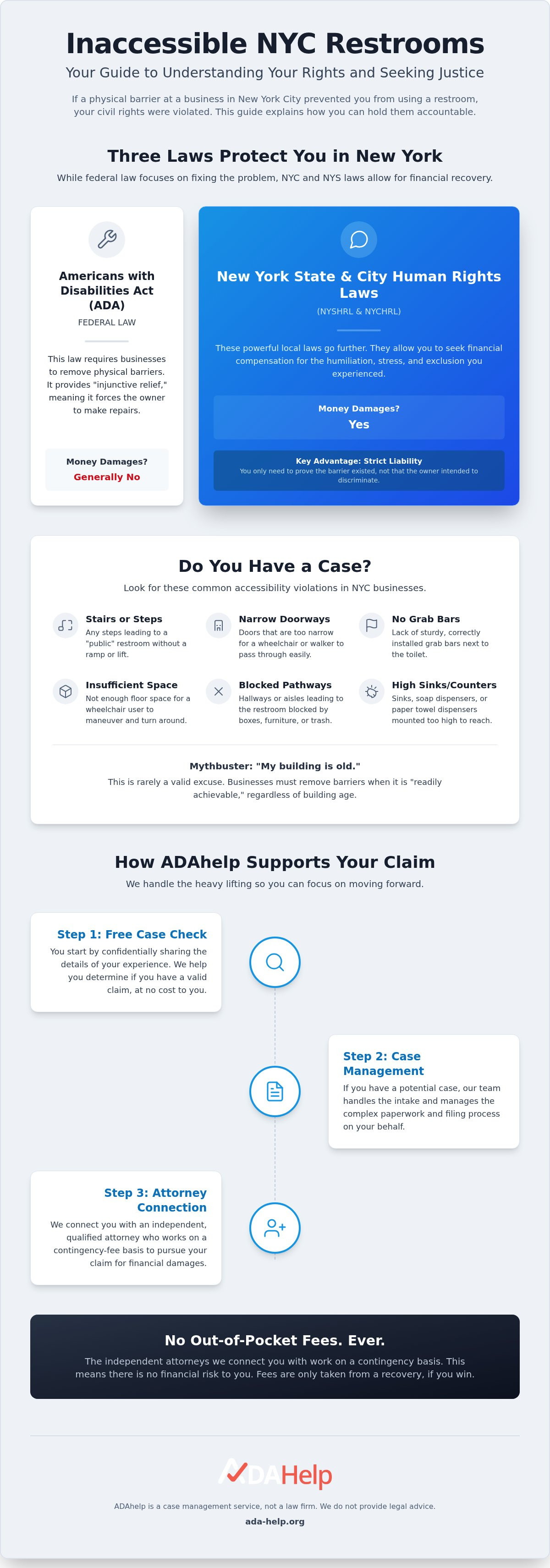
Violations are often hidden in plain sight. You might encounter a "public" restroom that requires you to climb three steps to reach it. Or perhaps the door is too narrow for a wheelchair to pass through. Other common issues include a lack of sturdy grab bars or insufficient floor space to turn a wheelchair around. Identifying these specific barriers is the first step in filing an inaccessible public restroom complaint NYC.
Your Right to Financial Recovery
Most people think a lawsuit only forces a business to fix the sink or widen the door. While the federal ADA provides this type of relief, New York laws go much further. The New York City Human Rights Law (NYCHRL) and the New York State Human Rights Law (NYSHRL) allow you to seek money damages for the humiliation and exclusion you suffered. This financial recovery holds the business accountable for its failure to provide equal access.
At ADA Help - NY disability discrimination claims, we help you determine if your situation qualifies for a claim. We are not a law firm and do not provide legal advice. Instead, we manage the intake process and connect you with independent attorneys who work on a contingency basis. This means you pay nothing out-of-pocket while pursuing an inaccessible public restroom complaint NYC. Fees are only taken from a recovery, so there is no financial risk to you. We handle the heavy lifting so you can focus on moving forward.
Understanding Your Rights Under NYC and State Disability Laws
New York laws give you power that federal laws do not. While the federal government sets the baseline for access, New York City and State laws provide the path to financial recovery. If you are preparing an inaccessible public restroom complaint NYC, you should know that you are protected by the New York City Human Rights Law (NYCHRL) and the New York State Human Rights Law (NYSHRL). These local statutes are designed to do more than just fix a broken system; they aim to compensate you for the harm you endured.
One of the most important aspects of these local laws is that they are strict liability in many cases. This means you do not need to prove the business owner intended to discriminate against you. You only need to show that the barrier existed and that it prevented you from using the facility. This lower burden of proof makes it much easier for real New Yorkers to hold businesses accountable for their lack of access.
The NYC Human Rights Law (NYCHRL)
The NYCHRL is often called one of the most protective civil rights laws in the nation. It applies to nearly every business open to the public in the five boroughs. This includes restaurants, theaters, retail stores, and private office buildings. Under this law, you can seek compensatory damages. This is a legal term for money paid to you for the humiliation, stress, and emotional pain caused by the discrimination. Because NYC recognizes that being excluded from a public space is a serious injury, these damages can be significant depending on the circumstances of your case.
NY State Human Rights Law vs. Federal ADA
Understanding the difference between these laws is vital for your recovery. Understanding Your Rights Under the ADA is a good starting point to see how federal law focuses on removing physical barriers. The ADA provides injunctive relief; which means a court orders the business to fix the problem so it doesn't happen again. However, the ADA does not typically provide money damages for individuals in public access cases.
This is where New York State law steps in. The NYSHRL protects you across the entire state and allows for financial recovery. Combining these laws strengthens your position. You can ensure the business fixes the restroom for future users while receiving compensation for what you went through. Keep in mind that New York has an election of remedies rule. This means filing a complaint with the NYC Commission on Human Rights usually prevents you from filing the same claim with the State Division of Human Rights or in state court.
The legal process can feel overwhelming; but you don't have to handle it alone. If you want to see if your experience qualifies for a claim, you can start a case check with ADA Help - NY disability discrimination claims today.
Common Accessibility Violations in NYC Businesses
You might walk into a trendy West Village bistro only to find the "accessible" restroom is actually a storage closet for beer crates and cleaning supplies. This is a common scene in New York City. When a business blocks the clear floor space needed for a wheelchair, they are violating the law. These physical hurdles are often the basis for an inaccessible public restroom complaint NYC. You shouldn't have to wait for staff to move boxes just to use a facility that should have been clear in the first place. These same blocked-path and reach-range problems show up well beyond restrooms, including in a gym accessibility complaint in New York.
Structural issues are not always about blocked paths. Many violations involve the height of fixtures. If a sink is mounted too high or a mirror is angled in a way that you cannot see yourself from a seated position, the facility is not truly accessible. Hand dryers and soap dispensers must also be within reach. If you have to struggle to reach the toilet paper because the dispenser is mounted too far forward or too high, the business is failing its legal obligations. Even the force required to open the door matters. If a restroom door requires significant muscle to pull open, it effectively locks out many New Yorkers with mobility impairments.
Barriers in Older NYC Buildings
You may hear business owners claim they are exempt from these rules because their building was constructed decades ago. This is a myth that often prevents people from seeking justice. While older buildings have some flexibility, the law requires businesses to remove barriers when it is "readily achievable." This means if a fix is relatively easy and inexpensive, the business must do it regardless of the building's age. Small businesses often think these rules don't apply to them, but civil rights protections cover almost every public space in the five boroughs. You have the right to File an Accessibility Complaint if a shop or restaurant fails to meet these standards. The same age excuse comes up for barriers beyond restrooms; see our guide on disabled access to public buildings in NYC for more on how that plays out.
Service and Policy Violations
Discrimination isn't always about the height of a sink; sometimes it's about the attitude of the staff. You might encounter an employee who refuses to let you use the restroom because you aren't "buying anything," even though the facility is physically inaccessible to you anyway. Other times, staff might claim the "key is lost" for the accessible stall while allowing other patrons inside. These are policy violations that are just as serious as physical barriers. Understanding public access discrimination New York helps you spot these illegal practices. If you've faced these hurdles, you can start an inaccessible public restroom complaint NYC to seek accountability and recovery.
How to Document and File Your Accessibility Complaint
You shouldn't let a bad experience go unchallenged. If you've been excluded from a facility, your next steps are critical for a successful inaccessible public restroom complaint NYC. Strong evidence turns a frustrating story into a solid legal claim. You need to prove that the barrier existed and that you were actually at the business when the discrimination happened. Collecting this information while you are still on-site or shortly after is the best way to protect your rights.
Step 1: Gather Your Evidence
Start by using your phone to capture the physical environment. Clear photos are often the most persuasive evidence you can provide. Don't just take one picture; capture the scene from multiple angles to show the full scale of the problem. Your documentation should include:
- Photos of the specific barrier, such as a narrow doorway, high sink, or missing grab bars.
- A picture of the entrance to the business and its signage to confirm the location.
- A photo of any signs that claim a restroom is "out of order" or "employees only" if you suspect it is actually an access issue.
- Your itemized receipt to prove you were a patron of the establishment.
Write down the date and time of the incident immediately. If you spoke with a manager or an employee, record their names and exactly what they said to you. It is also helpful to write a short impact statement while the memory is fresh. Describe how the lack of access made you feel and how it disrupted your plans. This detail is vital because New York City and State laws allow you to recover money for emotional distress and humiliation. These personal accounts help illustrate the harm caused by the business's failure to comply with the law.
Step 2: Start a Professional Case Review
Many New Yorkers think they should just file a generic report with a city agency. While reporting is helpful for public records, these forms often don't lead to a financial recovery for the individual. If you want to hold the business accountable and seek damages, you need a more focused approach. Filing an inaccessible public restroom complaint NYC requires navigating complex local laws that a standard 311 form might overlook.
ADAhelp is here to handle the heavy lifting for you. We are not a law firm, but we specialize in public access discrimination case management. We evaluate the strength of your claim and connect you with independent attorneys who work on a contingency basis. You never have to worry about out-of-pocket costs or hourly fees. If there is no recovery, you pay nothing. You can complete a free three-minute case check right now to see if your situation qualifies for a claim. Let us help you turn a barrier into a path toward justice.
Where to File: Agencies & Deadlines
Once you have documented the barrier, you can pursue your inaccessible public restroom complaint NYC through more than one agency, and each one runs on its own clock.
- NYC Commission on Human Rights (CCHR): Covers public accommodations across the five boroughs, including restaurants and bars. You generally have one year from the incident to file a complaint with the NYC CCHR.
- New York State Division of Human Rights (DHR): Covers the same conduct statewide. You typically have three years for acts occurring after February 2024 to file a complaint with the NY State Division of Human Rights.
- U.S. Department of Justice (DOJ): Handles federal ADA Title III public accommodation violations. You can file an ADA complaint with the DOJ, though it generally cannot award you money damages directly.
- U.S. Equal Employment Opportunity Commission (EEOC): The EEOC only handles workplace discrimination, so it does not cover a restroom barrier at a restaurant or store. If your access issue was with an employer rather than a public accommodation, the EEOC is the correct starting point instead.
New York's election of remedies rule means filing with the NYC CCHR usually forecloses filing the identical claim with the State Division of Human Rights or in state court, so it pays to choose carefully. For the broader reporting process beyond restrooms, see our guide to reporting ADA non-compliance in NYC.
Start Your Free Case Check with ADAhelp
You've dealt with the frustration of an inaccessible restroom. Now you want to know if you have a case and what it is worth. Filing an inaccessible public restroom complaint NYC doesn't have to be a lonely struggle. ADAhelp provides a clear path to resolution without the stress of handling complex paperwork on your own. We are not a law firm and do not provide legal advice. Instead, we act as your proactive partner to manage your claim from the initial check to the final filing.
Our process is simple. We handle the information gathering and make sure your claim reaches the correct authorities. We then connect you with independent attorneys who work on a contingency basis. This means you never pay out-of-pocket fees for our case management services. If you don't recover money, you don't owe anything. The burden of financial risk lies with the service provider, not with you.
Why Choose Case Management?
The rules for disability access in New York are complicated. You have to understand how the ADA, NYSHRL, and NYCHRL work together to protect your rights. We take the burden off your shoulders. Our team knows exactly which laws apply to your specific barrier. We ensure your documentation is strong and that every deadline is met. This allows you to focus on your life while we handle the heavy lifting of your inaccessible public restroom complaint NYC. We turn a sense of frustration into a stress-free path toward fairness.
Typical Recovery and Outcomes
What can you expect from a successful claim? Resolutions often include two main parts. First, the business is forced to fix the physical barrier so other New Yorkers don't face the same exclusion. Second, you receive money damages for the discrimination you experienced. Typical recovery amounts vary based on the specifics of each case. Factors like the severity of the barrier and the emotional impact on you play a role in the final amount. We never guarantee a specific payout; every situation is different.
To understand more about how we protect your access, read our guide on ADA Title III case management New York. We are committed to making the system work for you with minimal friction. You deserve a city that is open to everyone. Let us help you hold businesses accountable for the barriers they create.
Secure Your Right to Access Today
You shouldn't have to accept being excluded from public life. If you've faced a barrier, you now know that New York City and State laws provide a clear path to hold businesses accountable. Filing an inaccessible public restroom complaint NYC can lead to physical changes and financial recovery for the humiliation you suffered. Remember that while federal law focuses on fixing the structure, local laws allow you to seek money damages for the stress of the experience.
You don't have to handle the filing or the legal complexities alone. We provide specialized NYC case management to guide you through every step. Our initial evaluation is completely free; and we operate on a contingency model. This means there is no recovery and no fee for our services. You have nothing to lose by checking your case strength today.
Start your free three-minute case check now to see if you qualify for a claim. Take the first step toward justice and help make New York a city that truly welcomes everyone.
Frequently Asked Questions
How do I report a restroom ADA violation in a NYC restaurant?
You can report a violation by documenting the physical barrier and starting a professional case review. Start by taking clear photos of the narrow door or high sink and saving your receipt to prove you were a patron. While you can file a generic city report; using a case management service ensures your claim is handled correctly for potential recovery. We manage the filing process for an inaccessible public restroom complaint NYC so you don't have to deal with the paperwork.
Can I get money for being denied access to a restroom in New York?
Yes, you can recover financial damages for the humiliation and stress caused by the exclusion. While the federal ADA typically only requires the business to fix the barrier; the New York City and State Human Rights Laws allow for compensatory money damages. These payouts are designed to hold the business accountable for the harm you suffered. Every case is unique; so the typical recovery amount depends on the specific details of your experience and the severity of the discrimination.
Does it cost money to file a disability discrimination claim with ADAhelp?
It costs you nothing out-of-pocket to start your claim with us. We provide a free three-minute case check to evaluate the strength of your situation. Our service operates on a contingency model; which means fees are only taken from a successful recovery. If you don't win your case; you don't owe us anything. This ensures that every New Yorker has a low-risk path toward seeking justice for discrimination without the fear of high legal fees for a simple access issue.
How long do I have to file a complaint after an incident in NYC?
You generally have one year to file a complaint with the NYC Commission on Human Rights. If you are filing with the New York State Division of Human Rights; the limit is typically three years for acts occurring after February 2024. For federal claims; the deadline is often much shorter at 300 days. Because these deadlines vary and are strictly enforced; it is best to start your inaccessible public restroom complaint NYC as soon as the incident happens.
What if the business says their building is too old to be accessible?
Building age is rarely a valid excuse for ignoring accessibility laws. Federal and local laws require businesses to remove barriers when the fix is readily achievable. This means if a restaurant can easily widen a door or add grab bars; they are legally required to do so. Small shops and older buildings are still subject to New York human rights laws. You have a right to equal access regardless of when the building was originally constructed.
Do I need a lawyer to file an inaccessible restroom complaint?
You don't need to find or hire an expensive lawyer on your own. ADAhelp is not a law firm; but we manage the entire intake process and evaluate your case for free. If you have a valid claim; we connect you with independent attorneys who work on a contingency basis. This means you get professional representation without paying any hourly fees. We handle the heavy lifting and filing with authorities so you can focus on your life without the stress.

Article by
ADA Help
Written by the ADAhelp editorial team and reviewed for accuracy before publishing. ADAhelp helps New Yorkers find out if they have a disability discrimination claim and manages the process end to end, working with independent attorneys who handle the legal work. We are not a law firm and do not provide legal advice.
Disclaimer
This article is general information about New York law, not legal advice, and reading it does not create an attorney-client relationship. ADAhelp is a case-management and intake service, not a law firm; legal representation is provided by independent attorneys. Recovery amounts and timelines vary by case, and past outcomes do not guarantee future results. For advice about your specific situation, speak with a qualified attorney or start the free case check.
Tags
Discriminated against in New York because of a disability?
A free three-minute check tells you if you can pursue a claim.
Check my case →New York onlyNo upfront costIndependent NY attorneysFree 3-minute check