
How to Respond to Denial of Reasonable Accommodation
Reviewed for accuracy by the ADAhelp team before publishing. ADAhelp is not a law firm; legal work is handled by independent New York attorneys.

Denied an accommodation in NY? Learn how to respond to denial of reasonable accommodation and see if you can claim financial damages. Free 3-minute case check.
What if your employer's refusal to provide a simple workplace change isn't just a "no," but actually the evidence you need to recover financial damages? You likely feel frustrated and stressed about how you will keep working without the support you need. It is normal to fear retaliation for speaking up or feel confused by the complex rules surrounding disability rights. Knowing how to respond to denial of reasonable accommodation is the first step toward protecting your livelihood and your peace of mind.
This guide shows you the exact steps to take after a denial and how New York laws can help you recover money damages. While the federal ADA focuses on fixing the problem, the New York State and City Human Rights Laws allow you to seek payment for the harm you have suffered. ADA Help - NY disability discrimination claims is not a law firm; we are a dedicated partner here to help you determine if you have a claim through a free three minute case check. We will explain how to challenge a rejection and connect you with independent attorneys who work on a contingency basis. You will gain a clear path to resolve your situation without the burden of upfront legal fees.
Key Takeaways
- A denial of your request often triggers your right to file a discrimination claim under New York laws.
- Discover how to respond to denial of reasonable accommodation by reviewing the specific reasons given and gathering your original medical support.
- New York State and City laws provide broader protections than the federal ADA; they allow you to seek money damages for the harm you experienced.
- Employers are legally required to engage in an interactive process. A flat refusal without discussion is often a violation of your rights.
- You can evaluate your situation with a free three-minute case check. ADAhelp is not a law firm but connects you with independent attorneys who work on a contingency basis.

What does a denial of reasonable accommodation mean for you?
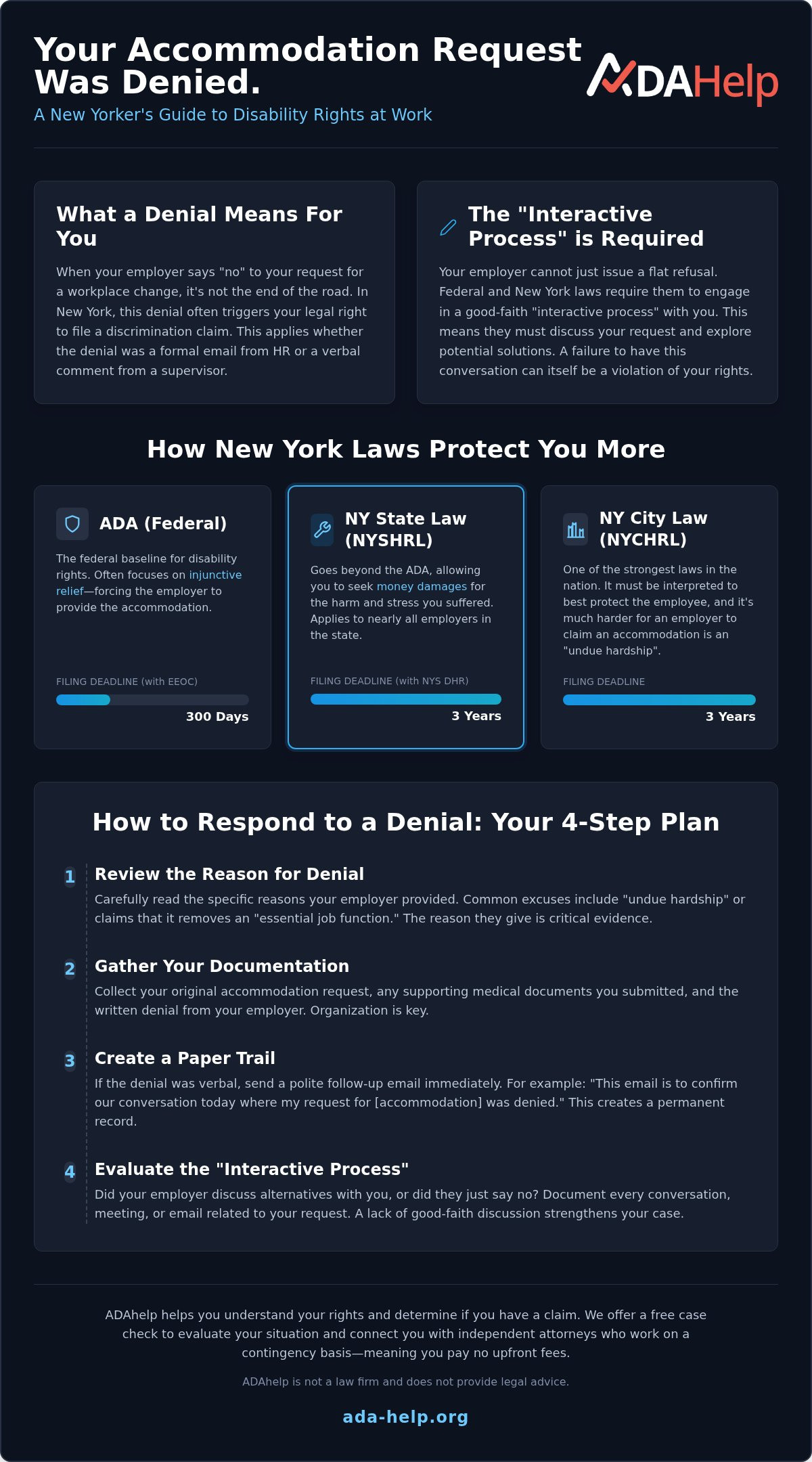
A denial is a formal or informal "no" to your request for a workplace or housing change. It might arrive as a cold email from HR or a quick comment from your supervisor during a meeting. For many New Yorkers, this refusal feels like a dead end. In reality, a denial often triggers your right to file a discrimination claim under the New York State Human Rights Law (NYSHRL) or the New York City Human Rights Law (NYCHRL). These laws protect you when an employer fails to provide the support you need to do your job. Understanding What is Reasonable Accommodation? is the first step in realizing that your request was likely a protected right, not a favor.
It's vital to distinguish between a valid denial and a discriminatory one. An employer cannot simply say "no" because they don't want to deal with the request. Federal and state laws require them to engage in an "interactive process." This means they must talk to you in good faith to find a solution that works. If they shut down the conversation immediately, they may have already violated the law. Learning how to respond to denial of reasonable accommodation starts with recognizing that the burden of proof often rests on the employer, especially in New York City.
Common reasons employers give for a denial
Employers frequently use "undue hardship" as an excuse. This term means the accommodation would cause significant difficulty or expense. However, under the NYCHRL, the employer must prove the hardship is truly significant. They might also claim your request removes an "essential job function," which is a core task of your role. Another common hurdle is missing medical documentation. In February 2026, the EEOC clarified that if you successfully worked remotely before, that history is strong evidence that telework is a feasible accommodation, even if the company has a return to office policy.
Why a written denial is better than a verbal one
A written denial provides a clear paper trail for your case. It prevents the employer from changing their story later. While verbal denials are still actionable, they are harder to prove without witnesses. If your employer only told you "no" in person, you should act quickly to document it. Send a polite follow up email stating, "I'm writing to confirm our conversation today where my request for [accommodation] was denied for [reason]." This simple step turns a fleeting conversation into a permanent record. ADA Help - NY disability discrimination claims can help you review these documents through a free three minute case check to see if you are entitled to money damages. We aren't a law firm, but we handle the heavy lifting of organizing your claim for independent attorneys.
Your rights under New York State and City laws
Most people think the Americans with Disabilities Act (ADA) is their only protection. It isn't. While the ADA provides a vital federal baseline, New Yorkers have access to some of the strongest civil rights protections in the country. The ADA often limits you to injunctive relief. This means a court can tell your boss to fix the problem or provide the accommodation, but it might not pay you for the stress you endured. If you are filing a federal charge with the EEOC, you must do so within 300 days of the denial. This is a tight window that requires quick action.
The New York State Human Rights Law (NYSHRL) offers a broader safety net. It applies to nearly every employer in the state, regardless of their size. As of February 15, 2024, the statute of limitations to file a complaint with the New York State Division of Human Rights is three years from the date of the denial. This law is powerful because it allows you to seek money damages that the federal ADA does not always provide. Knowing how to respond to denial of reasonable accommodation requires understanding which of these specific laws applies to your office, job site, or apartment building.
The power of the NYCHRL for NYC workers
If you work within the five boroughs, the New York City Human Rights Law (NYCHRL) is your best tool for justice. This city law is unique because it is designed to be "remedial." This means New York courts must interpret the law in the way that best protects the employee. You do not have to prove your disability is "permanent" or "severe" as you might under federal rules. The burden of proof is also lower. In New York City, the employer must prove that an accommodation would cause "significant expense or difficulty," which is a harder standard for them to meet than the federal "undue hardship" rule. ADA Help - NY disability discrimination claims provides case management services to help you determine if your city rights were violated. Read our full guide to failure-to-accommodate rights in New York for more detail.
Money damages vs. injunctive relief
What is your case actually worth? Federal claims usually focus on injunctive relief. This forces the employer to change their policy or provide the specific tool you need to work. However, New York laws go much further by allowing money damages. These payments compensate you for emotional distress and lost wages if the denial made it impossible to continue working. Appealing a Denial in New York through the state court system can lead to these financial recoveries. Typical amounts vary case by case based on your specific facts and the severity of the discrimination. If you are facing financial stress from being unable to work, a free three minute case check from ADA Help - NY disability discrimination claims can help you understand your potential for recovery.
How to Respond to a Denial Letter: Step-by-Step Guide
Receiving a denial letter can feel like a punch to the gut. You need to act quickly but calmly. Your first step is to read the letter line by line. Why did they say no? Was it a claim of "undue hardship"? Did they say you didn't provide enough medical proof? Pinpointing their exact excuse is vital for your next move. Understanding how to respond to denial of reasonable accommodation begins with identifying these specific weaknesses in their argument.
Next, gather every piece of paper related to your request. This includes your initial email; the doctor's note you submitted; and any replies from HR. Having this pile ready makes it easier to spot where the employer went wrong. You should also look at external resources like this guide on What to Do When Your Request is Denied to see if your experience matches common patterns of discrimination. Documentation is the foundation of any future claim for money damages.
Now, you must respond in writing. A verbal chat isn't enough to protect your rights. Write a professional email to clarify any points they got wrong. If they claimed a desk change was too expensive, but you know it only costs fifty dollars, state that clearly. Keep your tone factual. Avoid being aggressive. This email isn't just a message; it's evidence that you tried to work with them. If they ignore your follow up, it shows a failure to communicate in good faith.
Don't try to solve this by yourself indefinitely. Internal appeals often lead to more delays from HR without real results. Contact a case management service like ADAhelp to evaluate your situation. We provide a free three-minute case check to see if your denial is actually a violation of New York laws. We aren't a law firm, but we handle the heavy lifting of organizing your facts so you can connect with independent attorneys who work on a contingency basis.
Clarifying the interactive process
In New York, employers can't just shut the door on you. They have a legal duty to engage in an "interactive process." This means if your first request doesn't work, they must help find an alternative. Remind them of this duty in your response. Ask for a meeting to discuss other solutions. If they refuse to even talk about alternatives, they might be violating the NYCHRL or NYSHRL. This refusal to talk is often the strongest proof of a discrimination claim.
What to avoid in your response
It's tempting to vent your frustration. Don't. Never threaten to quit your job immediately; this can hurt your ability to claim lost wages later. Avoid using legal jargon you don't fully understand. Most importantly, don't apologize for needing help. An accommodation is a right, not a gift. Keep your response focused on the facts of your disability and the specific support you need to perform your job. Let the evidence carry the weight of your message while you seek professional case management support.
Documenting the failure of the interactive process
The interactive process isn't a suggestion; it's a legal requirement. When you request a change at work, your employer has a duty to sit down and talk with you. They must explore potential solutions in good faith. A flat denial without any discussion is often a clear violation of this process. It shows that the employer didn't take your rights seriously. Learning how to respond to denial of reasonable accommodation means becoming your own best record keeper. You need to prove that they failed to meet their legal obligations.
Start by saving a copy of your current job description. This document lists your essential functions, which are the core tasks you must perform. If you can do these tasks with the help of an accommodation, the law is on your side. You should also save your performance reviews from the last few years. These documents prove you are a capable and qualified worker. If your reviews were excellent before you asked for help but suddenly turned negative after your request, that change is strong evidence of retaliation. Under the NYSHRL amendment that took effect December 5, 2025, it is explicitly illegal to retaliate against you for simply asking for an accommodation.
Creating a disability discrimination timeline
You need a clear record of every interaction. Create a simple log that lists the date of your initial request and every response you received. Did your supervisor ignore your email for two weeks? Write that down. Was the meeting where they said "no" only five minutes long? Record that detail too. Note exactly who was present during verbal discussions and what was said. If a manager made a comment suggesting you are a burden or that "we don't do that here," those quotes are vital for your claim. This timeline turns your memory into a solid piece of evidence. For a full list of what to collect, see our evidence checklist for disability discrimination cases.
Gathering external evidence
Your medical records are the foundation of your request. Keep copies of every doctor's note and recommendation you provided to your employer. If you have been working without the support you need, identify witnesses who have seen the difficulties you face. Co-workers may have noticed your physical struggle or the increased time it takes to finish tasks. These observations help prove that the accommodation was necessary for you to succeed. For more information on your rights, review our guide on Employment Disability Discrimination New York to see how these facts build a case for recovery. If you're ready to see if your employer's failure entitles you to money damages, start your free three-minute case check today.
Where to File: Agencies & Deadlines
Once you have documented the denial, you can file a formal complaint with the agency that fits your situation. Each agency has its own deadline, so track these dates closely.
- U.S. Department of Justice / EEOC — for federal ADA charges, file with the EEOC within 300 days of the denial. General ADA guidance is available at ADA.gov.
- New York State Division of Human Rights (DHR) — file a NYSHRL complaint at dhr.ny.gov within three years of the denial.
- NYC Commission on Human Rights (CCHR) — if you work or live within the five boroughs, file a NYCHRL complaint with the NYC Commission on Human Rights, also within three years of the denial.
You can generally file with more than one agency, though a case management review can help you decide which path fits your facts before you start your free three-minute case check.
Get a free case check for your accommodation denial
You don't have to face an employer's refusal by yourself. Many people worry about the cost of standing up for their rights. They fear that legal help is too expensive or too complicated. At ADAhelp, we remove those barriers. We offer a free three-minute case check to help you understand if your situation qualifies for a claim. You don't need to spend hours researching how to respond to denial of reasonable accommodation when we can provide a clear path forward immediately. We turn your frustration into a structured plan for resolution.
Our service works on a contingency model. This means there are never any out-of-pocket costs for you. Fees are only taken from a successful recovery. If you don't win, you don't pay. This low-risk approach ensures that justice is accessible to every New Yorker, regardless of their financial situation. We manage the entire process; we gather your documentation and file the necessary paperwork with authorities like the EEOC or the New York State Division of Human Rights. We are the partners who handle the difficult tasks so you don't have to.
How ADAhelp supports New Yorkers
We are experts in the specific rules that protect New York workers. Our team determines if your case is best suited for a federal ADA claim, a New York State Human Rights Law (NYSHRL) claim, or a New York City Human Rights Law (NYCHRL) claim. This distinction is critical. City and state laws often allow for money damages that federal law does not. We aren't a law firm and we don't provide legal advice. Instead, we act as your guide. We connect you with independent attorneys who specialize in these specific New York statutes. We handle the administrative work so you can focus on your health and your future.
Start your claim today
Time is a major factor in any discrimination case. The clock is already ticking on legal deadlines. For example, you only have 300 days to file a charge with the EEOC for federal claims. While the NYSHRL and NYCHRL offer a longer three-year window, waiting too long makes it harder to gather evidence. A quick check can reveal if your denial is worth a legal pursuit and if you are entitled to typical recoveries for emotional distress or lost wages. Take the first step toward justice by completing a free case evaluation right now. It takes less than three minutes to see where you stand.
Take Action to Protect Your Rights in New York
You now have a clear roadmap for how to respond to denial of reasonable accommodation. Your employer has a legal duty to work with you in good faith; they cannot simply shut the door on your request. By documenting every interaction and understanding the power of the NYCHRL and NYSHRL, you turn a frustrating "no" into a potential claim for money damages. These local laws offer protections that go far beyond federal standards. They allow for financial recovery that can ease your stress and compensate you for the harm you have suffered.
You don't have to manage this complex process alone. ADAhelp provides the New York specific expertise needed to evaluate your situation without any financial risk to you. We offer a free case evaluation and operate on a contingency model; there are no out-of-pocket costs. We handle the heavy lifting of gathering evidence and connecting you with independent attorneys. Start your free three-minute case check now to see if you have a case. You deserve a workplace that respects your rights and supports your success.
Frequently Asked Questions
Can my employer fire me for asking for a reasonable accommodation?
No, your employer cannot legally fire you for requesting help. Under the New York State Human Rights Law (NYSHRL) amendment that took effect on December 5, 2025, it is an unlawful discriminatory practice to retaliate against anyone for requesting a reasonable accommodation. If you were fired or demoted shortly after making your request, you may have a strong claim for money damages. We can help you evaluate this through a free three minute case check.
What should I do if my employer ignores my accommodation request?
If your employer ignores you, they are failing the mandatory interactive process. You should send a follow up email immediately to create a paper trail. State clearly that you are still waiting for a response to your specific request. If they continue to remain silent, it is a sign that they are not acting in good faith. Knowing how to respond to denial of reasonable accommodation includes documenting these periods of silence to build your discrimination case.
Is a verbal denial of an accommodation legal in New York?
A verbal denial is still a violation of your rights, but it is much harder to prove in court. In New York City, the law is very protective of workers, but you still need evidence. If a manager tells you "no" in person, immediately send them an email to confirm the conversation. This simple step turns a fleeting verbal refusal into a permanent written record that can be used to recover financial damages later.
How long do I have to file a claim after an accommodation denial in NYC?
You have different deadlines depending on which law you use. For a federal claim with the EEOC, you must file within 300 days of the denial. However, for claims under the New York State Human Rights Law or the New York City Human Rights Law, you generally have three years to file a lawsuit. Because these windows can be tight, it is best to start your case management process as soon as you receive a final rejection.
Do I need to see a doctor to get a reasonable accommodation?
Yes, most New York employers will require medical documentation to confirm your disability and the need for a specific change. Your doctor does not need to share your entire medical history. They only need to explain how your condition limits your ability to perform job tasks and why the requested accommodation is necessary. Providing a clear note from a professional is a key part of how to respond to denial of reasonable accommodation effectively.
What counts as an 'undue hardship' for a New York employer?
Undue hardship means the accommodation would cause significant difficulty or expense for the business. In New York City, the burden is much higher for the employer than under federal law. They cannot just say it is too expensive; they must prove that it would cause "significant" financial or operational strain. Most simple requests, like remote work or a desk change, rarely meet this high legal bar for a valid denial in the five boroughs.

Article by
ADA Help
Written by the ADAhelp editorial team and reviewed for accuracy before publishing. ADAhelp helps New Yorkers find out if they have a disability discrimination claim and manages the process end to end, working with independent attorneys who handle the legal work. We are not a law firm and do not provide legal advice.
Disclaimer
This article is general information about New York law, not legal advice, and reading it does not create an attorney-client relationship. ADAhelp is a case-management and intake service, not a law firm; legal representation is provided by independent attorneys. Recovery amounts and timelines vary by case, and past outcomes do not guarantee future results. For advice about your specific situation, speak with a qualified attorney or start the free case check.
Tags
Discriminated against in New York because of a disability?
A free three-minute check tells you if you can pursue a claim.
Check my case →New York onlyNo upfront costIndependent NY attorneysFree 3-minute check