Is Anxiety a Disability Under the ADA? Your NY Rights
Reviewed for accuracy by the ADAhelp team before publishing. ADAhelp is not a law firm; legal work is handled by independent New York attorneys.

Is anxiety a disability under the ADA? Usually yes. See how the test works, what accommodations New York employers owe you, and your filing deadlines.
If you have an anxiety disorder and your job has become harder because of it, you are probably asking a very practical question: does the law actually protect me? In New York, the answer is usually yes — but the protection comes from a specific legal test, not from a diagnosis alone. Understanding that test is what separates a complaint that goes nowhere from a claim worth pursuing.
The short answer
Yes, anxiety can be a disability under the Americans with Disabilities Act. The ADA does not list qualifying conditions by name. Instead, it asks whether a physical or mental impairment substantially limits a major life activity — and concentrating, thinking, sleeping, communicating and interacting with others all count. Under New York State and New York City law the definition is broader still, so an anxiety disorder that might be argued over under federal law is frequently covered outright in New York.
Importantly, "disability" under the ADA is not the same thing as "disability" for Social Security benefits. You do not have to be unable to work. You only have to show a real impairment and a real limitation.
How the ADA decides whether your anxiety counts
Since the ADA Amendments Act of 2008, the definition of disability is meant to be construed broadly, and the analysis should not demand extensive proof. Three rules in that amendment matter enormously for anxiety:
- Mitigating measures are ignored. Your employer cannot argue that you are not disabled because medication or therapy helps. The question is what your anxiety does without treatment.
- Episodic conditions count. An impairment that comes and goes, or that is in remission, is still a disability if it would substantially limit a major life activity when active. Panic attacks that happen twice a month still qualify.
- "Substantially limits" is not a high bar. You do not need to be unable to perform the activity. You need to be limited compared with most people in the general population.
There is also a second route to protection. The ADA covers you if your employer regarded you as having an impairment, even if you are not in fact limited. If a manager decided you were "too anxious to handle clients" and moved you off the account, the law may protect you regardless of how your condition is diagnosed.
Generalized anxiety, social anxiety, panic disorder, PTSD
All of these can qualify. The label on the diagnosis is far less important than the effect. A person with social anxiety disorder who cannot participate in large meetings without significant distress is limited in interacting with others. A person with panic disorder whose sleep is disrupted several nights a week is limited in sleeping. Both are the kind of limitation the ADA was written to reach.
Ordinary work stress, by contrast, is generally not a disability. A difficult stretch at a demanding job, without a diagnosed impairment and a genuine limitation, will not carry a claim. This is the line that employer-side law firms write about most often, and it is worth being honest about.
Why New York law protects you more than the ADA does
Three separate laws can apply to a New Yorker with anxiety, and they are not equivalent.
- The ADA (federal). Title I covers employers with 15 or more employees. Compensatory and punitive damages are capped by employer size, from $50,000 for employers with 15–100 employees up to $300,000 for employers with more than 500.
- The New York State Human Rights Law (NYSHRL). Since February 2020 it applies to employers of every size — including one with a single employee. It uses a broader definition of disability than the ADA and places no statutory cap on compensatory damages.
- The New York City Human Rights Law (NYCHRL). The most protective of the three for people working in the five boroughs. It requires employers to engage in a written cooperative dialogue about an accommodation request and to give you a final written determination.
The practical consequence: if you work for a 9-person firm in Queens, the ADA does not cover your employer, but the NYSHRL does. Many people stop at the federal question and wrongly conclude they have no case.
Accommodations for anxiety that employers actually grant
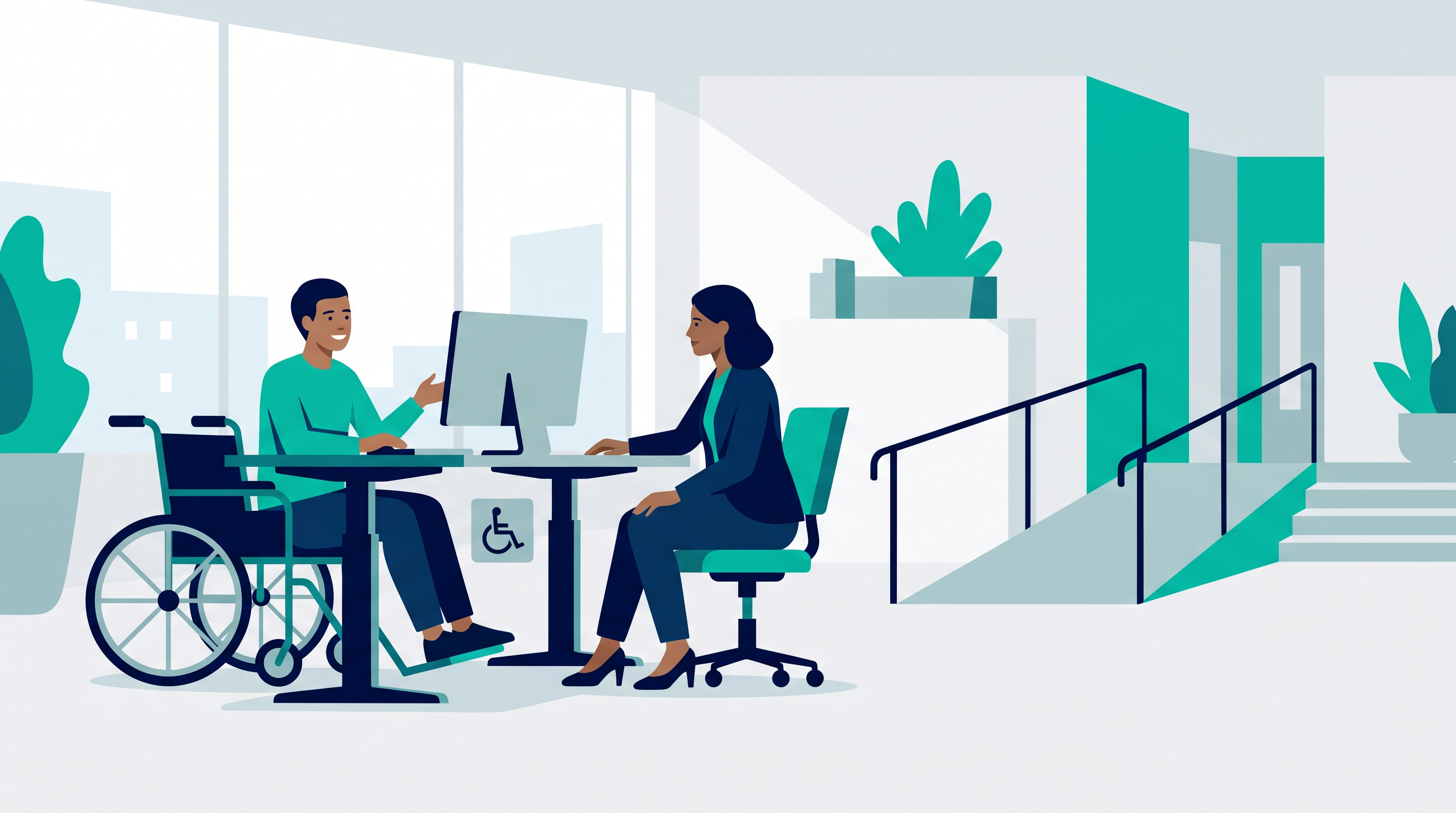
A reasonable accommodation is a change to how, when or where work gets done. For anxiety, the most common requests include:
- A modified or predictable schedule, or a later start after a medication change
- Written instructions and agendas instead of verbal-only direction
- Permission to take short breaks when symptoms spike
- A quieter workspace, noise-cancelling headphones, or a desk away from high foot traffic
- Time off for therapy appointments
- Checking in by email rather than unannounced in-person meetings
- Remote or hybrid work
Is working from home a reasonable accommodation for anxiety?
Sometimes, and it is one of the most contested requests there is. Remote work can be a reasonable accommodation when physical presence is not an essential function of the job. If your employer let the whole team work remotely for a year without issue, it becomes much harder for them to claim that in-office attendance is essential now. If your role genuinely requires you to be on site — a lab, a loading dock, a front desk — the employer may lawfully offer a different accommodation instead. They are entitled to choose among effective options; they are not entitled to offer nothing.
Your employer can refuse only if the accommodation would cause an undue hardship, meaning significant difficulty or expense measured against the size and resources of the business. "We don't do that here" is not undue hardship. Neither is a manager's preference.
What disability discrimination based on anxiety looks like
The discrimination is rarely announced. In the claims we see, it usually looks like one of these patterns:
- You disclose an anxiety disorder or request an accommodation, and within weeks you receive your first negative review in years.
- Your request is met with silence — no meeting, no response, no written determination.
- You are told to "just take medical leave" instead of receiving the adjustment you asked for.
- You are pulled off client-facing work, demoted or reassigned after a panic attack at work.
- Your manager repeatedly questions whether you are "really" anxious, or shares your condition with co-workers.
- You are placed on a performance improvement plan immediately after disclosing.
The timing is usually the most important fact in the file. If a negative action lands shortly after you disclose or request, note the dates precisely — that sequence is evidence.
Deadlines you cannot afford to miss
New York gives you more than one door, and each has its own clock:
- EEOC charge (ADA): 300 days from the discriminatory act in New York. After the EEOC issues a right-to-sue letter, you have 90 days to file in federal court.
- NYS Division of Human Rights complaint: three years from the discriminatory act. Filing here generally means you cannot also bring the same claim in court, so the choice matters.
- NYC Commission on Human Rights complaint: one year from the discriminatory act for most claims.
- NYCHRL lawsuit in court: three years.
These are the outside limits, not targets. Evidence disappears, witnesses leave, and memories fade long before a deadline runs.
What to do next
Start by writing down what happened and when, in order, while it is fresh. Save the accommodation request and any reply, keep copies outside your work email, and get a short note from your treating provider describing your limitations — not your full clinical history.
Then find out whether the facts add up to a claim. ADA Help runs a free 3-minute case check for New Yorkers. You answer a few questions about what happened, and we tell you whether there is something worth pursuing and which agency and deadline apply to you. If there is a case, we manage the whole claim — the paperwork, the filing, the agency correspondence — and if we win, our fee comes from the recovery. No recovery, no fee.
For related reading, see our guides on whether depression is a disability in New York, how to get a mental health accommodation, what the interactive process requires of your employer, and what to do when an accommodation is denied.
Frequently asked questions
Is anxiety a disability under the ADA?
It can be. The ADA protects any mental impairment that substantially limits a major life activity such as concentrating, sleeping, communicating or interacting with others. Because the ADA Amendments Act requires a broad reading and ignores the effect of medication, most diagnosed anxiety disorders that meaningfully affect daily functioning will meet the standard.
Does anxiety count as a disability at work?
Yes, when it limits a major life activity or when your employer treats you as though it does. In New York you may also be covered by the State and City Human Rights Laws, which use a broader definition than the ADA and apply to employers of every size.
Is social anxiety a disability?
Social anxiety disorder can qualify. Interacting with others and communicating are recognised major life activities, so a person whose social anxiety substantially limits those activities is covered — even if the person performs well in other parts of the job.
Is generalized anxiety disorder a disability?
Generalized anxiety disorder frequently qualifies. The analysis does not turn on the diagnostic label but on the limitation: disrupted sleep, difficulty concentrating, or difficulty interacting with others are all enough to bring GAD within the definition.
Can you get disability benefits for anxiety?
That is a separate system. Social Security disability benefits require you to show you cannot engage in substantial gainful activity, which is a much harder standard than the ADA's. ADA Help does not handle Social Security claims — we handle discrimination claims, which are about being treated unfairly at work, in housing or in a place of business because of a disability.
Is working from home a reasonable accommodation for anxiety?
It can be, if in-person attendance is not an essential function of your job. Employers may propose an equally effective alternative instead, but they must engage with the request. In New York City, the employer is required to conduct a cooperative dialogue and give you a written final determination.
ADA Help is a case management service, not a law firm. Legal work is performed by independent New York attorneys. This article is general information, not legal advice.
Tags
Discriminated against in New York because of a disability?
A free three-minute check tells you if you can pursue a claim.
Check my case →New York onlyNo upfront costIndependent NY attorneysFree 3-minute check