
Reasonable Accommodation for Mental Health NY: Your Rights
Reviewed for accuracy by the ADAhelp team before publishing. ADAhelp is not a law firm; legal work is handled by independent New York attorneys.

Need a reasonable accommodation for mental health in NY? Learn your rights, how to ask, and what to do if denied. NY laws may entitle you to money damages.
You woke up today feeling the weight of your anxiety; however, you are more afraid of your boss than your symptoms. If your employer refused to help you or treated you poorly after you asked for support, you likely have a legal claim for discrimination in New York. Your case could be worth significant money damages for emotional distress and lost wages because New York City and State laws provide broader financial recovery than federal law. Requesting a reasonable accommodation for mental health NY is a protected right that ensures you can stay employed while managing your well-being.
It is exhausting to manage a mental health condition while worrying about workplace retaliation. We promise to show you exactly how to request changes and what to do if your employer says no. While we are not a law firm and do not provide legal advice, ADA Help - NY disability discrimination claims offers a free three-minute case check to see if you qualify for a claim. This guide breaks down the formal cooperative dialogue process and explains how to hold your employer accountable without any out-of-pocket costs. You deserve to work in an environment that supports you without the fear of losing your paycheck.
Key Takeaways
- New York laws protect you if you have conditions like depression or anxiety. These qualify as disabilities that entitle you to workplace changes.
- Learn exactly how to request a reasonable accommodation for mental health NY using a formal written process that protects your rights.
- Find out how to challenge an employer who denies your request or claims the change is too difficult or expensive for the business.
- Discover how New York City and State laws provide paths to money damages; whereas federal law often only focuses on fixing the workplace issue.
- Start a free three-minute case check with ADAhelp to see if you have a claim. We are not a law firm; instead, we connect you with attorneys who only get paid if you win.

What is a reasonable accommodation for mental health in New York?
If you are struggling with a mental health condition, you might feel like your job is slipping away; however, New York laws provide a safety net. You have the right to ask for a What is a reasonable accommodation. This is a change to your work environment or how you perform your job duties. It is designed to remove barriers that prevent you from succeeding at work because of your disability.
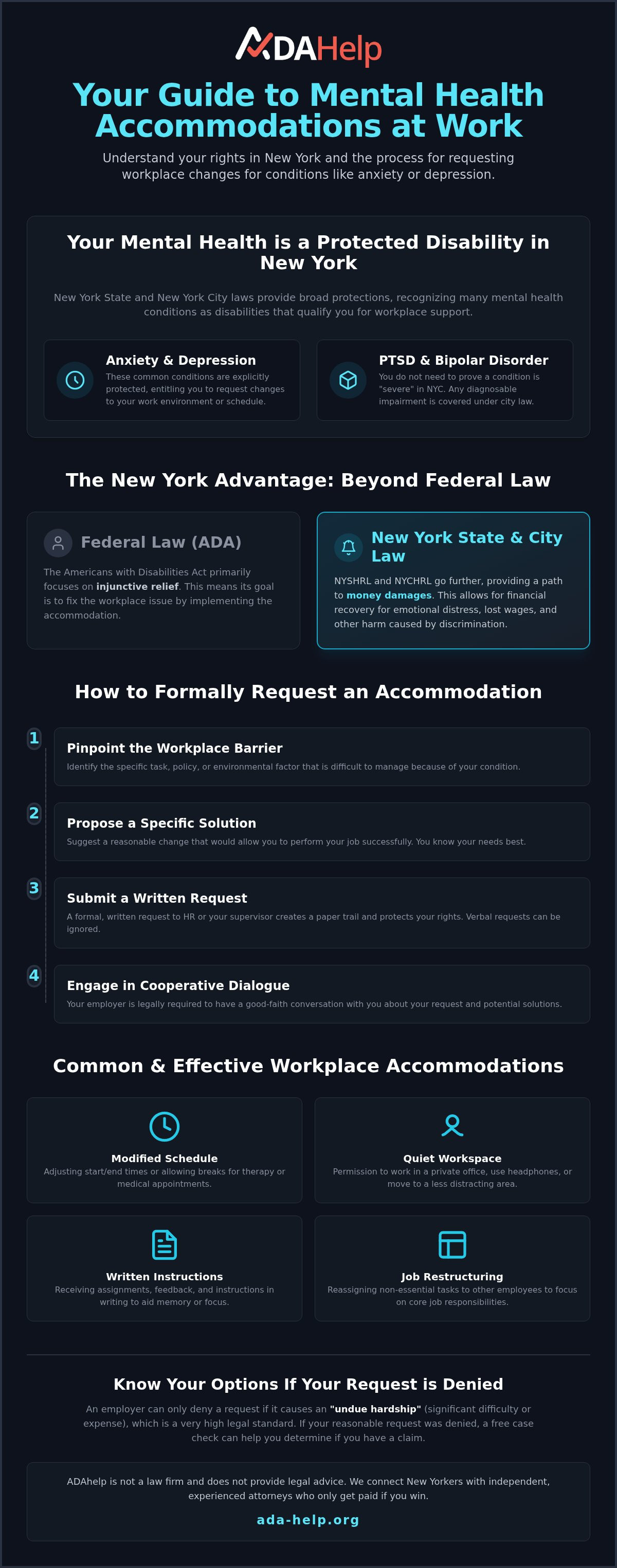
Under New York law, conditions like depression, PTSD, bipolar disorder, and anxiety qualify as disabilities. Seeking a reasonable accommodation for mental health NY is a protected right for most employees in New York City and across the state. These protections ensure you can stay employed while managing your health. If you are facing broader mistreatment at work because of your condition, learn more in our guide to mental health discrimination at work in New York.
To better understand this concept, watch this helpful video:
Your employer is required to provide these changes unless they can prove an "undue hardship." This means the request would cause significant difficulty or expense for the business. Because many mental health accommodations involve simple schedule changes or policy tweaks, they rarely meet the high bar of being an undue hardship.
Common examples for New York employees
Real-world changes often focus on flexibility and environment. You might request a modified schedule to attend therapy sessions during the day. Other employees ask for a quiet workspace or permission to wear noise-canceling headphones to manage anxiety. You could also request job restructuring, such as moving non-essential tasks to a different time, or a modified supervision style that provides clearer, written instructions. For more sample requests, see our reasonable accommodation examples for New York employees.
The legal definition of disability in NY
New York provides stronger protections than federal law. The New York State Human Rights Law (NYSHRL) defines disability broadly to include any mental impairment. If you work in the five boroughs, the New York City Human Rights Law (NYCHRL) offers even more coverage. In NYC, any diagnosable impairment is a disability. You don't have to prove your condition is "severe" to qualify for help.
While the federal ADA mostly focuses on fixing the problem, New York laws allow you to seek money damages for the harm you suffered. You will typically need a diagnosis from a doctor to request a reasonable accommodation for mental health NY, but you don't have to share your full medical record. At ADAhelp, we help you understand if your situation qualifies for a claim and connect you with attorneys who can help. We are not a law firm, but we manage the process to make it stress-free for you.
How to request a mental health accommodation at work
Requesting a reasonable accommodation for mental health NY is a formal process; however, it does not have to be intimidating. You should start by identifying the specific barrier you face at work. Is it the noise in the office? Is it an early start time that conflicts with your medication? Once you know the problem, you can propose a solution. You are the expert on your own needs. Identifying the barrier first makes the conversation with your employer much more productive.
Drafting a formal written request is the next step. While you can ask for help verbally, a written record is your best protection. You should send this request to your supervisor or the human resources department. This ensures that your request is officially on the record and cannot be easily ignored or forgotten later.
Writing your request letter
A written request is your most powerful tool. It creates a paper trail that protects you if things go wrong. In your letter, state clearly that you have a disability and need a change to do your job. You do not need to share your entire medical history or a specific diagnosis in the initial letter. Focus on your functional limitations instead. For instance, if you have trouble concentrating in an open-plan office, suggest a quiet workspace or noise-canceling headphones as a fix. You can learn more about Your Legal Rights on the EEOC website. Keeping your request focused on the job helps your employer understand how to help you succeed.
The interactive process in New York
Once you submit your request, your employer must engage in a good-faith discussion. This is known as the interactive process. In New York City, the law calls this a "cooperative dialogue." A cooperative dialogue is a formal, good-faith conversation where both parties discuss the employee's needs and possible solutions. Your employer cannot simply ignore your request; doing so is a direct violation of the NYCHRL. They have a duty to talk to you and explore potential solutions. They might suggest an alternative accommodation that is different from what you asked for. If that alternative is effective, the law allows them to choose it. In NYC, your employer must also provide you with a final written decision at the end of this process.
Always keep copies of every email, letter, and medical note you provide. If your boss speaks to you in person, send a follow-up email summarizing the conversation. This ensures there is no confusion about what was said or agreed upon. If you feel like your employer is stalling or being uncooperative, you might have a legal claim. You can check your case eligibility in just three minutes to see if you are entitled to money damages for a failure to accommodate your needs.
What to do if your accommodation request is denied
If your employer says no to your request, do not panic; however, you must act quickly to protect your rights. Start by asking for the denial in writing. You need to know the specific reason they refused to help. If your supervisor refuses to provide a written statement, send a follow-up email summarizing the conversation. This ensures you have a record of the refusal for any future legal claim regarding a reasonable accommodation for mental health NY. For a full breakdown of your options, see our guide on responding to an accommodation denial in New York.
Check if your employer claimed "undue hardship." This is a legal term that means the requested change would cause significant difficulty or expense for the business. In New York, the bar for proving undue hardship is very high. Large companies can rarely argue that a simple schedule change or a quiet workspace is too expensive. If the reason seems vague or unfair, the New York State Division of Human Rights may be able to step in to investigate.
Recognizing workplace retaliation
Retaliation is any negative action your employer takes because you exercised your legal rights. It is strictly illegal under both state and city law. You might notice your boss treating you differently after you ask for help. Sudden bad performance reviews or unexpected changes to your work schedule are common red flags. Sometimes retaliation is obvious, such as a demotion or being fired; other times, it is a series of small, hostile comments that make your job unbearable. Retaliation is often easier to prove than the original discrimination because the timing of the negative action is so closely linked to your request. If you feel like you are being punished for asking for help, document every interaction immediately.
When to seek professional case management
You should seek a case evaluation if your employer stops the interactive process or ignores your request entirely. You do not have to handle this stressful situation alone. At ADAhelp, we provide a free three-minute case check to help you understand if your rights were violated. We are not a law firm and do not provide legal advice; instead, we manage your claim and connect you with independent attorneys who specialize in New York employment law. These attorneys work on a contingency basis, which means you never pay anything out of pocket. Fees are only taken from a final recovery. This low-risk approach ensures that every New Yorker has access to justice regardless of their bank account balance. If your employer has failed you, we are here to help you find a clear path toward resolution.
Understanding your rights to money damages in New York
If you have been denied a reasonable accommodation for mental health NY, you might feel like your career is over. It is not just about getting the workplace change you originally asked for; it is about being made whole for the stress and financial loss you suffered. Many employees do not realize that New York laws provide a path to financial recovery that federal laws often do not. You have the right to seek compensation for the harm your employer caused by ignoring your needs.
Most people think of the federal Americans with Disabilities Act (ADA) first. However, the ADA is limited in what it can provide. It often only offers injunctive relief. This is a legal term for a court order that forces an employer to fix a policy or change a physical barrier. While this fixes the workplace for the future, it does not pay you for the anxiety or depression that worsened because of their refusal. In New York, we look toward state and city laws to find real financial justice.
The New York State Human Rights Law (NYSHRL) and the New York City Human Rights Law (NYCHRL) allow you to seek compensatory money damages. These are payments designed to cover your actual losses. This includes lost wages if you were fired, demoted, or forced to quit because your employer refused to help. It also includes emotional distress damages. Emotional distress refers to the mental pain, suffering, and loss of enjoyment of life caused by discrimination. New York City laws are among the strongest in the country for protecting these rights.
ADA vs. New York City Human Rights Law
If you work in the five boroughs, the NYCHRL is usually the preferred path for seeking justice. The ADA usually only applies to companies with 15 or more employees. In contrast, the NYCHRL covers almost every employer with four or more people. This means local laws protect you even if you work for a small business that the federal government might miss. While the ADA focuses on fixing the problem, the NYCHRL focuses on the victim's recovery.
What is your case worth?
You probably want to know the value of your claim. Recovery amounts vary significantly based on the specific facts of your case. Typical recovery ranges depend on your salary, how long you were out of work, and the impact on your mental health. While amounts vary case by case, settlements are never guaranteed. In cases of extreme misconduct, punitive damages may also be available. Punitive damages are extra payments meant to punish an employer for especially harmful or intentional discrimination. At ADAhelp, we are not a law firm and do not provide legal advice; however, we can help you determine if your situation qualifies for a claim. You can start a free three-minute case check today to see if you are entitled to money damages for your employer's failure to provide a reasonable accommodation for mental health NY.
How do I start my free three-minute case check?
You have already learned about your rights; however, knowing the law is only the first step toward justice. If you were denied a reasonable accommodation for mental health NY, you need a clear plan to move forward. Our case check is a simple process that takes less than three minutes to complete. You provide the basic facts about your situation and how your employer responded to your request. We evaluate this information to see if you have a valid claim under city or state laws. It is a low-pressure way to understand your options without any financial risk.
It is vital to remember that ADAhelp is not a law firm and does not provide legal advice. Instead, we provide comprehensive case management for disability discrimination in New York. We handle the heavy lifting so the process feels simple and stress-free for you. We focus on results and move fast to get you the clarity you deserve. You don't need to guess if you have a case when you can get a professional evaluation for free.
How does the case management process work?
We act as your proactive partner from start to finish. First, we gather your information and evaluate the strength of your claim based on the broad protections in New York. If we find a strong case, we file with the proper authorities like the EEOC or the New York State Division of Human Rights. Then, we connect you with independent attorneys who specialize in New York employment law. These attorneys work on a contingency model. This means fees are only taken from a recovery. You never pay anything out of pocket to start your search for justice. This approach ensures that every New Yorker has access to quality legal support regardless of their income.
How long do I have to take action?
Time is a critical factor because New York has strict deadlines for filing claims. You generally have 300 calendar days from the date of the discrimination to file a charge with the EEOC. For incidents occurring on or after February 15, 2024, you have three years to file with the New York State Division of Human Rights. Waiting too long can cause you to lose your right to money damages entirely. Take action now to protect your career and your future. You deserve a workplace that respects your rights and compensates you for any harm you have suffered. Visit ada-help.org to complete your free three-minute case check today.
Where to File: Agencies & Deadlines
Once you have documented your employer's refusal, you have several agencies that can enforce your right to a reasonable accommodation for mental health NY. Choosing the right one, and moving before the deadline closes, protects your claim.
Your filing options
- New York State Division of Human Rights (DHR): Handles complaints under the NYSHRL. You generally have three years to file for conduct occurring on or after February 15, 2024. Learn more at the New York State Division of Human Rights.
- New York City Commission on Human Rights (CCHR): Enforces the NYCHRL for employees working in the five boroughs, including the cooperative dialogue requirement. Most administrative complaints must be filed within one year. Details are available from the NYC Commission on Human Rights.
- U.S. Equal Employment Opportunity Commission (EEOC): Handles federal ADA charges. Because New York has its own anti-discrimination law, the filing window is extended to 300 calendar days from the discriminatory act.
- U.S. Department of Justice (DOJ): Primarily oversees Title II and Title III public accommodation complaints rather than workplace claims, but it is worth knowing if your situation also involves an inaccessible facility.
You can also skip the guesswork about which agency and deadline apply to you: start a free three-minute case check and let us help you map out the right path.
How can I protect my workplace rights in New York?
You have learned that your mental health needs are protected by powerful state and city laws. You now know that a reasonable accommodation for mental health NY is a right that ensures you can stay in the workforce while managing your health. If your employer has ignored your request or treated you unfairly, you have a clear path toward resolution. You understand that money damages are available to compensate you for emotional distress and lost wages. You are no longer alone in this process.
ADAhelp acts as your proactive partner to handle the heavy lifting of your claim. We are not a law firm; instead, we provide the New York-specific expertise needed to evaluate your case for free. Because our partners work on a contingency model, there is no recovery and no fee. This means you face zero financial risk while seeking the justice you deserve. Start your free three-minute case check now. You deserve a workplace that respects your health and your legal rights.
Frequently Asked Questions
Is depression considered a disability in New York?
Yes, depression is a disability under New York law. Both the NYSHRL and NYCHRL define disability broadly to include any mental impairment. You qualify for a reasonable accommodation for mental health NY if your condition is diagnosable. Unlike federal law, New York City law does not require your condition to substantially limit a major life activity. This makes it easier for New Yorkers to get the support they need at work.
Can my employer fire me for asking for a mental health accommodation?
No, your employer cannot legally fire you for requesting help. This is called retaliation. Requesting a reasonable accommodation for mental health NY is a protected activity. If your boss fires you, demotes you, or treats you poorly because you asked for a change, you may have a strong legal claim. Retaliation is often easier to prove in court than the original discrimination because the timing of the firing is usually suspicious.
Do I need a formal diagnosis to request an accommodation in NY?
Yes, you typically need a diagnosis from a medical professional to trigger your legal rights. However, you do not have to share your entire medical history or every private detail of your symptoms. A letter from your doctor stating that you have a mental health condition and need specific changes is usually enough. Focus on the functional limitations that affect your job performance rather than sharing your full medical record with HR.
What is the New York City Human Rights Law?
The New York City Human Rights Law (NYCHRL) is one of the strongest anti-discrimination laws in the country. It protects employees working within the five boroughs of NYC. It covers smaller employers that the federal ADA might ignore. Most importantly, the NYCHRL allows you to seek money damages for emotional distress and lost wages. These financial recoveries are often much harder to get under federal law alone.
How much does it cost to file a disability discrimination claim with ADAhelp?
It costs nothing out of pocket to start your claim with ADAhelp. We provide a free three-minute case check to evaluate your situation. We are not a law firm and do not provide legal advice; instead, we manage your claim and connect you with independent attorneys. These attorneys work on a contingency model. This means you only pay a fee if they successfully recover money for you. No recovery means no fee.
What happens if my employer says the accommodation is too expensive?
Your employer can only deny a request if it causes an undue hardship. This means the change must cause significant difficulty or expense. In New York, the bar for proving this is very high. Large companies can rarely argue that a quiet workspace or a schedule change is too expensive for the business. If they deny you without a valid reason, they may be violating your rights under city and state law.

Article by
ADA Help
Written by the ADAhelp editorial team and reviewed for accuracy before publishing. ADAhelp helps New Yorkers find out if they have a disability discrimination claim and manages the process end to end, working with independent attorneys who handle the legal work. We are not a law firm and do not provide legal advice.
Disclaimer
This article is general information about New York law, not legal advice, and reading it does not create an attorney-client relationship. ADAhelp is a case-management and intake service, not a law firm; legal representation is provided by independent attorneys. Recovery amounts and timelines vary by case, and past outcomes do not guarantee future results. For advice about your specific situation, speak with a qualified attorney or start the free case check.
Tags
Discriminated against in New York because of a disability?
A free three-minute check tells you if you can pursue a claim.
Check my case →New York onlyNo upfront costIndependent NY attorneysFree 3-minute check