
Service Animal vs Emotional Support Animal: NY Rules
Reviewed for accuracy by the ADAhelp team before publishing. ADAhelp is not a law firm; legal work is handled by independent New York attorneys.
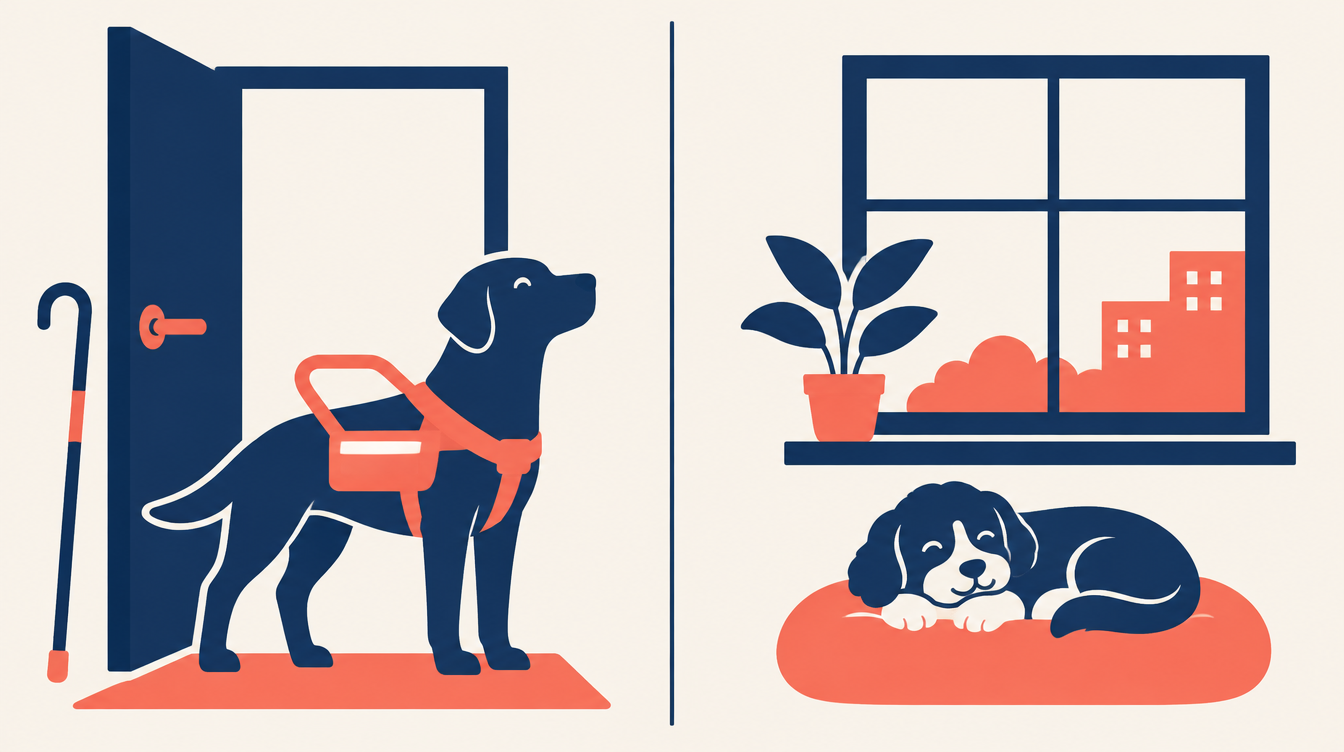
Service animal vs emotional support animal: what the ADA covers, the two questions staff may ask, and why housing rules in New York are different.
The question comes at a restaurant door, a pharmacy counter, or a lease signing, always at the worst moment: is that a service animal? For a lot of New Yorkers the honest answer is "not exactly" — and the law treats those two words very differently depending on where you are standing.
A service animal and an emotional support animal are not the same legal category. They are not covered by the same statutes, they do not carry the same access rights, and the questions a business, an employer, or a landlord may lawfully ask are different for each. Getting the distinction right is what keeps a conversation at a door from turning into a denial you have no answer for.
The Short Answer
Under the Americans with Disabilities Act, a service animal is a dog that has been individually trained to do work or perform tasks for a person with a disability — guiding, alerting, retrieving, interrupting a behavior, responding to a medical event. An emotional support animal provides comfort by its presence without being trained to perform a specific task, and is not a service animal under the ADA. That means an ESA has no automatic right of entry to stores, restaurants, or other places of public accommodation. In housing, the rule flips: under the Fair Housing Act and New York law, both are treated as assistance animals, and a landlord generally must allow one as a reasonable accommodation, without a pet fee.
Key Takeaways
- The dividing line is trained task work, not species, size, temperament, or how much the animal helps you emotionally.
- Service animals are dogs under the ADA. A separate provision covers trained miniature horses. Cats, birds, and other species are not ADA service animals, however well trained.
- Staff may ask only two questions when a disability is not obvious: is the animal required because of a disability, and what work or task has it been trained to perform. Nothing else.
- There is no official registry. No certificate, ID card, vest, or online registration is required, and none of them creates a right that does not already exist.
- Housing is the exception. An ESA that has no public-access rights can still be a protected assistance animal in your apartment, with no pet fee or deposit.
- New York adds protection. The State and City Human Rights Laws cover public accommodations, employment, and housing, and the NYCHRL is generally read more broadly than federal law.
- ADA Help is a case management service, not a law firm. The free 3-minute case check tells you whether a refusal you ran into is a claim.
What Counts as a Service Animal
The ADA definition is narrow and specific: a dog individually trained to do work or perform tasks directly related to a person's disability. The task has to be a task — something the dog does, on cue or in response to a condition, that the person could not do as well without it.
Examples that clearly qualify:
- A guide dog navigating obstacles for a person who is blind.
- A hearing dog alerting a deaf handler to a doorbell, an alarm, or their name.
- A dog that retrieves dropped items, opens doors, or provides bracing for a person with a mobility disability.
- A dog trained to detect the onset of a seizure or a blood sugar change and respond in a specific way.
- A psychiatric service dog trained to perform a task — interrupting a dissociative episode, reminding a handler to take medication, or applying deep pressure on cue.
That last one matters, because it is where the two categories come closest. A psychiatric service dog is a service animal under the ADA. A dog that helps the same person feel calmer simply by existing is not. The difference is trained, identifiable task work.
Two further points people get wrong. First, the training does not have to come from a professional program — a handler may train their own dog. Second, there is no certification requirement, so a business cannot condition entry on paperwork, and the websites selling "service dog registration" are selling nothing that the law recognizes.
What Counts as an Emotional Support Animal
An emotional support animal, sometimes called a comfort animal, helps a person with a disability through its companionship and presence. It has no trained task and can be any species. For many people with anxiety, depression, or PTSD it is genuinely therapeutic — and that therapeutic value is exactly what the ADA's public-access rules do not turn on.
So an ESA has no right to accompany you into a supermarket, a theater, a restaurant dining room, or a waiting room on the strength of being an ESA. A business may allow it, and many do. It is not required to.
Air travel works the same way now: under the U.S. Department of Transportation's current rules, airlines are not required to treat emotional support animals as service animals and may handle them as pets. Only trained service dogs carry service-animal status in the cabin.
The Two Questions, and the Ones That Are Off Limits
This is the single most useful thing to know, in either direction. When it is not obvious what service an animal provides, staff at a business may ask exactly two things:
- Is the dog required because of a disability?
- What work or task has the dog been trained to perform?
They may not ask about your disability, require medical documentation, demand a certification or ID card, insist on a vest, or ask the dog to demonstrate the task. You can answer the second question in a sentence — "she alerts me before a seizure," "he retrieves items I drop" — and that is the end of it.
What a business can lawfully do is narrower than most managers think. A service animal may be asked to leave if it is out of control and the handler does not take effective action, or if it is not housebroken. "Out of control" means actually out of control — not a dog lying under a table. Allergies and fear of dogs are not valid reasons to refuse entry, breed bans do not apply to service animals, and a business cannot route you to a separate area, seat you last, or charge a surcharge because the dog is there.
If you are denied service with a trained service dog in New York, write down the date, the location, who refused you, and their exact words. Our guide to being denied service because of a service animal in NYC covers what to do next, and service animal discrimination in NYC explains how these claims are built.
Where the Rules Change: Housing
Here the categories converge. Housing is governed by the Fair Housing Act rather than ADA Title III, and the FHA uses the broader concept of an assistance animal — a category that includes both trained service animals and emotional support animals, is not limited to dogs, and requires no training. The practical consequences are significant:
- A landlord generally must grant an assistance animal as a reasonable accommodation, including in a building with a no-pets policy.
- No pet fee, no pet deposit, no pet rent for an assistance animal. You remain responsible for actual damage the animal causes.
- Breed, weight, and size restrictions in the lease generally do not apply.
- Where the disability or the need is not obvious, a housing provider may ask for reliable documentation of the disability-related need — a step a store may never take.
New York's Human Rights Laws cover housing as well and are generally read at least as broadly. Our guides to fair housing laws and service animals in New York and emotional support animal housing rights in NYC go through the request process, what a landlord may and may not ask, and what a denial is worth.
And at Work
Employment is a third framework again. Under ADA Title I and New York law, bringing an animal to work is handled as a reasonable accommodation request rather than an access right, which means it goes through the interactive process: you ask, the employer may request supporting documentation of the disability-related need, and the two of you discuss whether it works or whether something else would.
That cuts both ways. An employer is not required to say yes automatically for a trained service dog, and is not entitled to say no automatically for an emotional support animal. It has to engage, consider the request, and have an actual reason if it refuses. A flat "we don't allow animals" is not that reason. Our guide to the ADA interactive process in New York sets out what an employer owes you once you ask.
Side by Side
- Definition. Service animal: a dog individually trained to perform a task. ESA: any animal providing comfort through presence, untrained.
- Stores, restaurants, public places. Service animal: admitted under the ADA and New York law. ESA: no automatic right of entry.
- Housing. Both are assistance animals. Both generally allowed as a reasonable accommodation, with no pet fee.
- Work. Both go through the interactive process as an accommodation request.
- Documentation. Service animal in public: none may be required. Housing: reliable documentation of the need may be requested for either.
- Air travel. Trained service dogs only; ESAs may be treated as pets.
What to Do Next
If you were turned away, charged a fee, moved to another table, evicted, or told your animal was not "real," write it down today while the details are exact: the date, the address, who spoke to you, what they said, and what you missed as a result. Keep the lease clause, the email, or the denial letter, and photograph any posted sign about animals. These records are the case later, and they are almost impossible to reconstruct from memory.
ADA Help offers a free 3-minute case check at ada-help.org. You answer a short set of questions about what happened and where, and you get a read on whether it looks like a claim under the ADA, the Fair Housing Act, or the New York State and City Human Rights Laws, and what to preserve. There is no cost and no obligation.
ADA Help is a case management service. If a claim is viable, we manage it end to end — organizing records, tracking deadlines, and working with independent New York attorneys who handle the legal work on a no recovery, no fee basis. Claims we manage have recovered up to $60,000, though every case turns on its own facts and no outcome can be promised.
Frequently Asked Questions
Are emotional support animals considered service animals?
Not under the ADA. A service animal is a dog individually trained to do work or perform tasks for a person with a disability, and an emotional support animal provides comfort through its presence without trained task work. That means an ESA does not have an automatic right to enter stores, restaurants, or other places of public accommodation. In housing it is different: under the Fair Housing Act and New York law, emotional support animals and service animals are both assistance animals, and a landlord generally must allow either as a reasonable accommodation.
Is an emotional support animal a service dog?
No. The two overlap in people's minds because both help someone with a disability, but the legal test is trained task work. A dog trained to interrupt a panic attack, apply deep pressure on cue, or remind its handler to take medication is a psychiatric service dog and counts. A dog that helps the same person simply by being nearby is an emotional support animal and does not, for public-access purposes.
Do emotional support animals count as service animals in New York?
For access to businesses and public places, no — New York follows the ADA's trained-task definition. For housing, yes in practical effect: both are assistance animals under fair housing rules and the State and City Human Rights Laws, so a landlord generally cannot refuse one or charge a pet fee for it. At work, both are handled as accommodation requests through the interactive process rather than as automatic rights.
Can you ask for proof of a service dog?
A business may ask only two questions when the need is not obvious: whether the dog is required because of a disability, and what work or task it has been trained to perform. It may not ask for certification, an ID card, a vest, medical records, or a demonstration of the task, and it may not ask about the disability itself. There is no official service dog registry in the United States, so there is no document that would satisfy such a request anyway.
What is considered a service animal under the ADA?
A dog of any breed or size that has been individually trained to do work or perform tasks directly related to a person's disability. A separate provision requires reasonable modifications for trained miniature horses in some settings. The training may be done by the handler rather than a program, and no certification is required. Animals whose only function is comfort, protection, or companionship do not meet the definition.
Can a landlord charge a pet fee for an emotional support animal?
Generally no. An assistance animal, including an emotional support animal, is a reasonable accommodation rather than a pet, so pet fees, pet deposits, and pet rent should not apply, and no-pets policies and breed or weight limits generally give way. You are still responsible for any actual damage the animal causes. If a landlord has charged you a fee or refused outright, that refusal is worth having reviewed.
Disclaimer
ADA Help is a case management service, not a law firm. Legal work is performed by independent New York attorneys. This article is general information, not legal advice.
Discriminated against in New York because of a disability?
A free three-minute check tells you if you can pursue a claim.
Check my case →New York onlyNo upfront costIndependent NY attorneysFree 3-minute check