Emotional Support Animal Housing Rights NYC: Your 2026 Guide
Reviewed for accuracy by the ADAhelp team before publishing. ADAhelp is not a law firm; legal work is handled by independent New York attorneys.

Protect your emotional support animal housing rights NYC. Learn how local laws let you keep your animal in a no-pet building and stop landlord harassment.
Imagine coming home to an eviction notice or a threatening letter from your landlord just because your dog helps you manage your anxiety. It is a terrifying reality for many tenants, similar to what happens in a broader disability eviction case; however, your landlord does not have the final word on your living situation. Understanding your emotional support animal housing rights NYC is the first step toward stopping harassment and securing your home. You shouldn't have to choose between your mental health and a roof over your head.
We know how exhausting it is to fight for your right to live in peace. This guide clarifies how you can keep your animal in your apartment even if your building has a strict no-pet policy. While federal enforcement policies shifted in May 2026, the New York City Human Rights Law still provides some of the strongest protections in the country for untrained emotional support animals. You will learn how to identify discrimination, what your rights are under local law, and how you might recover money for the stress you have endured. We handle the heavy lifting by checking your case for free and connecting you with independent attorneys who only get paid if you win. Let's look at how you can stop the harassment today.
Key Takeaways
- You have the legal right to live with your emotional support animal in New York City regardless of your lease terms or no-pet policies.
- Learn how local laws protect your emotional support animal housing rights NYC even when federal enforcement policies change.
- Understand exactly what your landlord can and cannot ask for when you request a reasonable accommodation for your disability.
- Discover how you can stop landlord harassment and potentially recover money damages for discrimination without paying anything out of pocket.
- Find out how to use a free case check to determine if you have a valid claim and connect with an independent attorney who works on a contingency basis.

Do You Have Emotional Support Animal Rights in NYC Housing?
You shouldn't feel like a criminal for needing your animal at home. In New York City, your rights are protected by a strong network of laws. Your Emotional Support Animal (ESA) is not a pet; it is an assistance animal. This distinction is the core of emotional support animal housing rights NYC. Even if your lease says "no pets," that clause generally does not apply to an ESA. You have the right to live with your animal regardless of what your landlord says about their pet policy.
The Legal Framework for New Yorkers
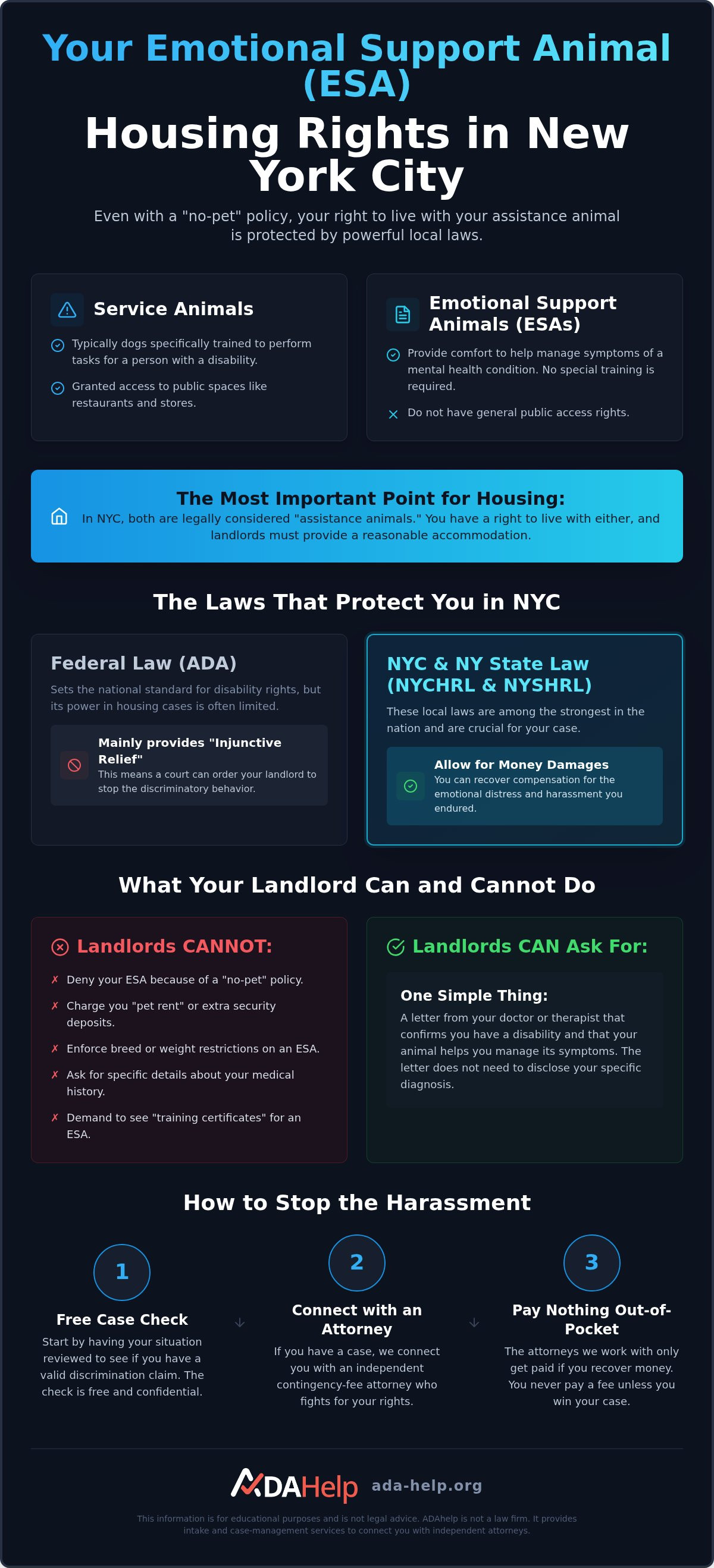
Understanding which law protects you is vital for your case. The Americans with Disabilities Act (ADA) sets the federal standard for disability access. However, the ADA mostly provides what is called injunctive relief; this means a court can order a landlord to stop a specific behavior. For real money damages, New Yorkers look to the New York State Human Rights Law (NYSHRL) and the New York City Human Rights Law (NYCHRL). The NYCHRL is one of the most powerful civil rights laws in the country. It covers buildings with as few as three units, which is a lower threshold than federal law. If a landlord discriminates against you, these local laws allow you to seek compensation for the emotional distress and harassment you faced.
Why Your Lease No-Pet Clause May Not Apply
Do you have a "no-pets" policy in your lease? For a person with a disability, that policy is not absolute. Housing providers in NYC must provide a reasonable accommodation. This is a change in rules or policies that allows a person with a disability an equal opportunity to use and enjoy their home. An ESA is a recognized reasonable accommodation for people with mental health disabilities like depression, PTSD, or chronic anxiety.
Waiving a pet fee or a no-pet rule is a standard requirement for NYC landlords. They cannot charge you extra "pet rent" or a higher security deposit for your animal. If they try to evict you or threaten you because of your animal, they are likely violating the law. At ADAhelp, we help you figure out if your situation qualifies as a valid claim. We are not a law firm; we provide case management to connect you with independent attorneys who fight for your rights on a contingency basis. This means you never pay out of pocket to get the help you need. You can check your case for free in about three minutes to see if you have a path forward.
Service Animals vs. Emotional Support Animals: NYC Rules
Many New Yorkers feel overwhelmed by the technical differences between a service dog and an emotional support animal. While the labels matter in public spaces, they carry similar weight when you are trying to stay in your apartment. A service animal is a dog specifically trained to perform tasks that help a person with a disability. An emotional support animal provides comfort that helps manage symptoms of a mental health condition. In terms of emotional support animal housing rights NYC, both are legally classified as assistance animals. This means you do not need to prove your animal has special training to qualify for housing protections.
Training Requirements and Public Access
Service dogs have the right to enter restaurants, stores, and offices with their owners. Emotional support animals do not usually have these public access rights in New York City. This distinction often leads to confusion for landlords who think they can apply "public" rules to your "private" home. The Fair Housing Act for ESAs ensures that your rights inside your residence are protected regardless of the animal's training. Both service animals and ESAs are protected from housing discrimination under the New York City Human Rights Law, though service animal discrimination in public spaces follows a different legal track than housing denials. You have the right to a reasonable accommodation as long as the animal's presence helps you manage your disability. If a landlord demands to see "training certificates" for an ESA, they are likely overstepping their legal bounds.
Species and Size Restrictions in NYC Apartments
Service animals are almost always dogs. Emotional support animals can be a wider range of species, including cats, rabbits, or birds. Many New York City apartments have strict rules about the weight or breed of animals allowed on the premises. However, these pet policies cannot be used to block a valid assistance animal. Landlords cannot deny your request because your dog is a certain breed or weighs more than thirty pounds. The NYCHRL prevents housing providers from applying these arbitrary limits to animals that provide disability-related support. If your building manager claims your animal is too large for the building, they may be violating your rights. You can take a free three-minute case check to see if your landlord is acting illegally. We help you understand if you have a claim for damages due to this type of discrimination.
What Your NYC Landlord Can Legally Ask You
Landlords in the five boroughs often try to bully tenants into sharing private medical information. You don't have to comply with these invasive demands. When you exercise your emotional support animal housing rights NYC, your landlord is legally restricted in what they can ask. If your disability is not obvious, they are only entitled to two pieces of information. First, they can ask for documentation that you have a disability. Second, they can ask for proof of a disability-related need for the animal. They cannot demand your specific diagnosis, medical records, or a meeting with your doctor.
Valid Documentation vs. Online Certificates
Many tenants are misled by websites selling "official" registrations or ID tags. These items carry no legal weight in New York. A valid request requires a letter from a licensed healthcare professional. This letter must confirm that you have a disability and explain how the animal helps manage your symptoms. According to the NYC Commission on Human Rights ESA Guidelines, your provider doesn't need to be a psychiatrist; a social worker or primary care doctor can often provide the necessary documentation. If your landlord insists on a "certified registry" number, they are likely violating city law.
The Interactive Process Requirement
Your landlord cannot simply ignore your request or give you an immediate "no." They must engage in what the law calls an interactive process. An interactive process is a good faith dialogue between you and your landlord to find a way to accommodate your needs. This means they must review your documentation and discuss potential solutions. If a building manager refuses to speak with you or stops responding once you mention an ESA, they may be committing housing discrimination.
Ignoring a request for a reasonable accommodation is a serious violation of the New York City Human Rights Law. You might be eligible for money damages for the stress and uncertainty caused by a landlord's refusal to follow these rules. At ADAhelp, we help you determine if your landlord's questions have crossed the line. You can complete a free three-minute case check to see if you have a valid claim. We are not a law firm, but we can connect you with independent attorneys who work on a contingency basis. This ensures you get the professional support you need without any out-of-pocket costs.
What to Do if Your NYC Landlord Denies Your ESA
Finding out your landlord has denied your request can feel like a punch in the gut. You might worry about where you will live or if you have to give up your companion. Stop and take a breath. A denial is often the beginning of a legal claim for discrimination. Your emotional support animal housing rights NYC are protected even if your building manager says otherwise. The most important thing you can do right now is to stay put. Do not get rid of your animal and do not move out before you understand your options.
You need to build a paper trail immediately. Keep a record of every single communication with your landlord or management company. If they called you to say no, follow up with an email summarizing that call. Save copies of your original written request for a reasonable accommodation. Note the specific dates and times of any verbal denials or threats of eviction. These details are the foundation of a successful case.
Documenting the Discrimination Incident
Discrimination often happens in quick conversations or short emails. You should act fast to preserve evidence. Follow these steps to ensure your records are ready for review:
- Write down exactly what the landlord said regarding your animal immediately after any conversation.
- Keep all emails and text messages in a safe digital folder or print them out.
- Identify any witnesses, such as neighbors or roommates, who heard the landlord make discriminatory remarks.
- Save copies of all medical documentation you provided to the building.
Clear documentation turns a simple disagreement into a factual record of harassment. This evidence is what allows an attorney to prove that your rights were violated.
Understanding Your Right to Money Damages
Many people assume that a discrimination case only forces the landlord to let the animal stay. While the federal ADA provides for changes to building policies, it rarely results in money for the tenant. However, the New York City Human Rights Law is much broader. The NYCHRL allows you to seek money damages for emotional distress and the mental toll of being harassed in your own home. If your landlord willfully ignored your documentation or used intimidation tactics, you may be entitled to a recovery.
The New York State Division of Human Rights awarded nearly $1 million in financial compensation for housing complaints in 2025. This shows that the city and state take these violations seriously. You shouldn't have to suffer in silence while a landlord breaks the law. If you've been denied, you can start your free three-minute case check right now. We help you determine if you have a valid claim and connect you with independent attorneys who handle the rest on a contingency basis. You focus on your peace of mind while we help manage the process of holding your landlord accountable.
How ADAhelp Manages Your Housing Discrimination Claim
You shouldn't have to fight a powerful landlord or management company alone. We help real New Yorkers determine if they have a valid discrimination case based on their emotional support animal housing rights NYC. Most people don't know where to start or feel intimidated by the legal process. Our free three-minute case check is the first step toward a resolution. We handle the information gathering and filing process for you so you can stay focused on your life. You never pay out of pocket for our case management services. We are not a law firm; instead, we act as your advocate to find the right path forward and hold your landlord accountable.
The Contingency Fee Model Explained
Fighting for your rights shouldn't be a financial burden. We operate on a contingency fee model. This means we only take a fee if there is a successful recovery in your case. This removes the financial risk of fighting a landlord who might have a team of corporate lawyers. We connect you with independent attorneys who work on the same basis. While the federal ADA mostly focuses on changing building rules, we focus on the NYCHRL and NYSHRL. These local laws allow for money damages to compensate you for the stress and harassment you've faced. If there is no recovery, you don't owe anything. It is a low-risk way to stand up for yourself and your animal companion without the fear of high legal bills.
Start Your Free Case Check Today
Taking the first step is simple and fast. Visit ada-help.org to begin the process. Our system is designed for speed and efficiency because we know your housing situation is urgent. You don't need to spend hours researching laws or looking for a lawyer on your own. We manage the intake and connect you with the right professionals to handle your claim. Let us handle the heavy lifting while you focus on your well-being. If you've been harassed, ignored, or threatened with eviction because of your animal, you deserve a partner who will stand up for you. We provide the support you need to turn a frustrating situation into a clear path toward a resolution. Stop the harassment and see if you have a case today.
Where to File: Agencies & Deadlines
Once you have documented your landlord's denial or harassment, you have several agencies where you can file a formal housing discrimination complaint. Each one has its own rules, deadlines, and potential remedies, so it helps to understand your options before you choose a path.
New York State Division of Human Rights (DHR)
The New York State Division of Human Rights investigates housing discrimination violations of the NYSHRL. For incidents occurring after February 15, 2024, you generally have three years from the date of the discriminatory act to file a complaint.
NYC Commission on Human Rights (CCHR)
If your building is located in one of the five boroughs, the NYC Commission on Human Rights enforces the NYCHRL, which offers some of the strongest tenant protections in the country, including for buildings with as few as three units. Most claims must be filed within one year of the last discriminatory act.
U.S. Department of Justice (DOJ) and HUD
Federal housing claims under the Americans with Disabilities Act and the Fair Housing Act can also be filed with the U.S. Department of Housing and Urban Development, which can refer serious violations to the DOJ for further action.
Because deadlines vary by agency and can be shorter than you expect, it helps to start your free case check as soon as your documentation is in order. ADAhelp is not a law firm and does not provide legal advice, but we can help you understand which filing option fits your situation before you connect with an independent attorney. For a broader look at how landlords violate tenant rights, see our guide on housing disability discrimination in New York.
Secure Your Home and Your Peace of Mind
Your living situation shouldn't be a source of constant stress. You have the legal right to live with your assistance animal regardless of what your lease says. While federal enforcement policies shifted in May 2026, the New York City Human Rights Law remains a shield for local tenants. Landlords cannot demand your private medical history or charge you extra fees for your animal. If you have been threatened with eviction or faced harassment, it is time to take action. Understanding your emotional support animal housing rights NYC is the first step toward holding your landlord accountable.
We provide the NYC-specific expertise you need to determine if you have a valid claim for money damages. Our team handles the heavy lifting of case management so you don't have to face management companies alone. There are no out-of-pocket costs for our services. We connect you with independent attorneys who work on a contingency basis; they only get paid if you win. Take your free three-minute case check now to see how we can help. You deserve to live in a home where your rights are respected and your well-being is protected.
Frequently Asked Questions
Can an NYC landlord charge a pet deposit for an emotional support animal?
No, your landlord cannot legally charge you a pet deposit, pet rent, or any additional fees for an emotional support animal. New York City and State laws treat these animals as assistance animals rather than pets. Charging extra fees for a disability accommodation is a form of housing discrimination. If your building manager demands a monthly fee or a one-time deposit for your animal, they are violating your rights. You shouldn't have to pay for your legal protections.
Do I have to tell my landlord I have an ESA before I sign the lease?
You are not required to disclose your need for an emotional support animal before signing your lease. Many tenants wait until after they have secured the apartment to request a reasonable accommodation. This approach helps prevent potential discrimination during the application process. You can submit your request and documentation at any time during your tenancy. Your landlord must review your request in good faith even if the lease has already been signed. It is your right to live in peace.
What happens if my NYC apartment building has a weight limit for dogs?
Weight limits and breed restrictions do not apply to emotional support animals in New York City. Your emotional support animal housing rights NYC ensure that your animal is exempt from standard building pet policies. A landlord cannot deny your request simply because your dog weighs more than a certain limit. As long as you provide valid documentation of your disability-related need, the animal's size is generally irrelevant to your legal protections. Don't let arbitrary building rules stop you from getting help.
Can my landlord evict me if I bring an ESA home without asking first?
Bringing an animal home without prior approval can be risky; however, it does not give your landlord an automatic right to evict you. If you have a disability and valid documentation, you can still request a reasonable accommodation after the animal arrives. It is always better to submit your request in writing as soon as possible. If your landlord starts eviction proceedings after you disclose your animal, they may be engaging in illegal retaliation. We can help you check your claim for free.
Is an ESA letter from an online therapist valid in New York City?
An ESA letter from an online therapist is valid in NYC as long as the provider is a licensed healthcare professional. The letter must confirm your disability and your need for the animal. Be careful with websites that sell certificates or ID tags without a real consultation. These items carry no legal weight. A legitimate letter from a licensed professional who has evaluated your mental health is what protects your rights under city law. Professional documentation is the key to your case.
How much can I recover in an NYC housing discrimination case?
Recovery amounts vary based on the details of your case. In 2025, the New York State Division of Human Rights awarded nearly $1 million in total compensation for housing discrimination complaints. These awards highlight the importance of emotional support animal housing rights NYC. Typical recoveries include money for emotional distress and civil penalties. While results are never guaranteed, the NYC Commission on Human Rights can impose penalties up to $250,000 for willful violations. We offer a free case check to help you start.

Article by
ADA Help
Written by the ADAhelp editorial team and reviewed for accuracy before publishing. ADAhelp helps New Yorkers find out if they have a disability discrimination claim and manages the process end to end, working with independent attorneys who handle the legal work. We are not a law firm and do not provide legal advice.
Disclaimer
This article is general information about New York law, not legal advice, and reading it does not create an attorney-client relationship. ADAhelp is a case-management and intake service, not a law firm; legal representation is provided by independent attorneys. Recovery amounts and timelines vary by case, and past outcomes do not guarantee future results. For advice about your specific situation, speak with a qualified attorney or start the free case check.
Tags
Discriminated against in New York because of a disability?
A free three-minute check tells you if you can pursue a claim.
Check my case →New York onlyNo upfront costIndependent NY attorneysFree 3-minute check