Assistance Animal Discrimination NY: Rights & Recovery
Reviewed for accuracy by the ADAhelp team before publishing. ADAhelp is not a law firm; legal work is handled by independent New York attorneys.
Facing assistance animal discrimination NY? NY laws protect you. Learn your rights, how to get a settlement, and check your case for free. No out-of-pocket f...
Have you ever been told that your support animal isn't welcome in a New York apartment or a local business? Facing assistance animal discrimination NY is more than a minor inconvenience; it is a violation of your civil rights that can lead to public humiliation or even the threat of homelessness. You are not alone in your frustration. It is exhausting to deal with landlords who ignore the law or business owners who do not understand the rules.
While federal enforcement for emotional support animals narrowed in May 2026, New York State and City laws remain some of the strongest in the country. You deserve to know that your rights are still protected here. This guide will help you identify illegal behavior and show you how to seek a settlement for the emotional distress caused by these actions. We will explore how the New York State Human Rights Law and the New York City Human Rights Law provide the financial recovery that federal law often lacks.
We will look at the specific steps to hold a business or landlord accountable. You can find out if you have a claim through a free check that takes only three minutes. Our team handles the heavy lifting by managing your case and connecting you with independent attorneys who work on a contingency basis. This means you never pay out of pocket; fees only come from the money you recover.

Key Takeaways
- Identify illegal treatment such as "no pet" policies or extra fees used against your support animal.
- Understand how New York State and City laws provide money damages for assistance animal discrimination NY while federal law typically does not.
- Learn the specific legal protections for both trained service dogs and emotional support animals in New York housing.
- Discover how to document evidence and interactions to build a strong case for accountability.
- Take a free three-minute case check to find out if you qualify for case management with no out-of-pocket costs.
What counts as assistance animal discrimination in New York?
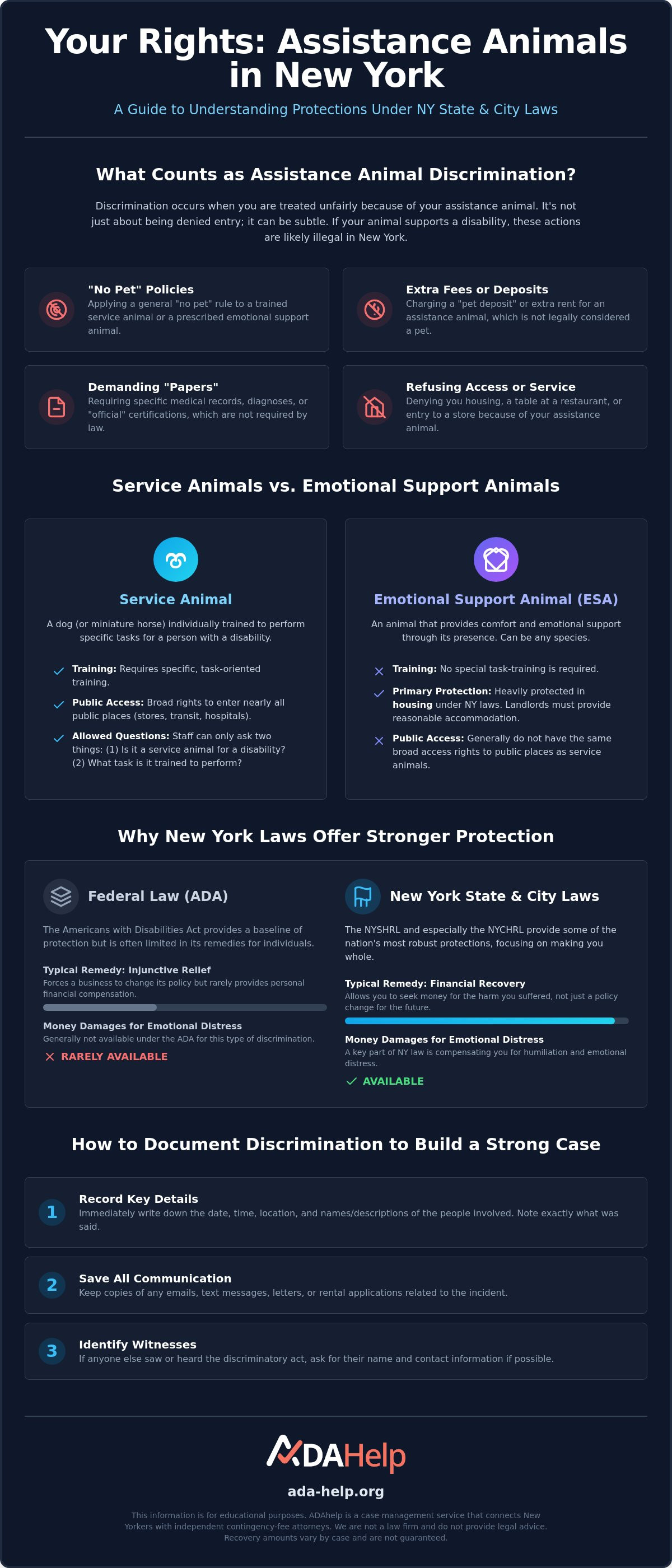
Discrimination happens the moment you are treated poorly or denied a service because of your assistance animal. You might be trying to grab a coffee or sign a new lease when someone tells you "no pets allowed." If your animal is there to help with a disability, that refusal is likely illegal. In New York, these protections are broad and cover more than just physical access; they cover your right to be treated with respect.
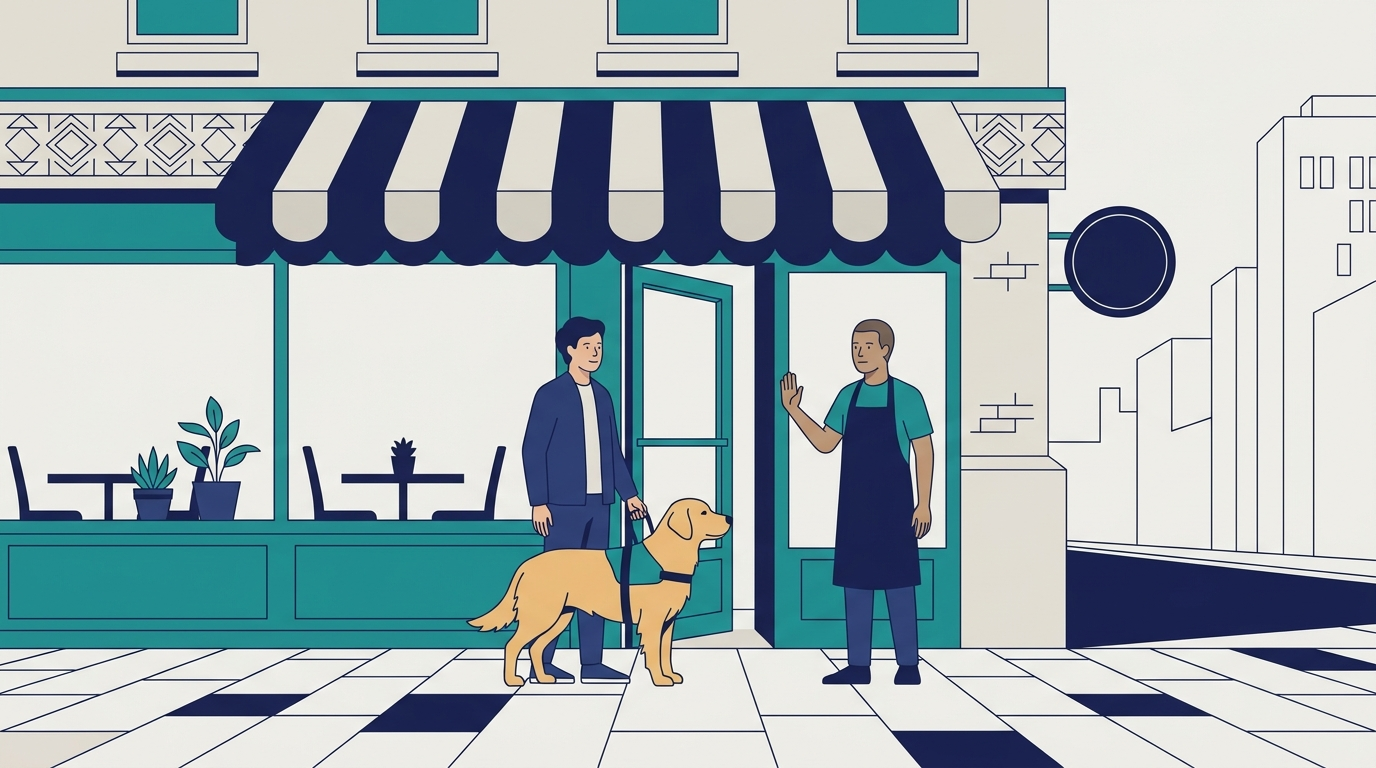
Facing assistance animal discrimination NY can take many forms. It isn't always a flat-out "no." It can be a landlord who demands a "pet deposit" for an animal that isn't a pet. It can be a store clerk who makes you wait outside while everyone else walks in freely. Understanding these boundaries is the first step toward holding these parties accountable.
To better understand how these situations play out in real estate, watch this helpful video:
Common examples of illegal 'no pet' policies
Many landlords try to use "no pet" rules to keep assistance animals out of their buildings. If a landlord tells you that your dog is too big or belongs to a "restricted breed," they are likely violating the law. Assistance animals are not pets; therefore, pet rules do not apply to them. You also have the right to privacy regarding your health. A store clerk or manager cannot demand to see your specific medical diagnosis or your medical records before letting you inside. They also cannot ask for "papers" or "official certifications" because New York law does not require them. You can find more details on Service animal definitions to see why these demands are often baseless.
Why New York laws offer better protection
Federal law, like the Americans with Disabilities Act (ADA), is often limited. It usually focuses on forcing a business to change its policy or fix a physical barrier. While this helps the community, it doesn't always help you personally. The New York State Human Rights Law (NYSHRL) and the New York City Human Rights Law (NYCHRL) go much further. These laws allow you to seek money damages for the emotional distress and humiliation you suffered. The NYCHRL is particularly powerful and is considered one of the strictest civil rights laws in the United States. If you live in the five boroughs, you have a very high level of protection. ADAhelp can help you determine if your situation qualifies for a claim under these specific laws through our case management services. We connect you with independent attorneys who understand these local nuances.
Service animals vs. emotional support animals: know your rights
Many people use the terms "service animal" and "emotional support animal" interchangeably. However, the law treats them very differently. A service animal is individually trained to do work or perform specific tasks for a person with a disability. This might include a dog that guides a person who is blind or alerts someone to a seizure. An emotional support animal (ESA) provides comfort through its presence. It does not require special training.
Understanding this distinction is vital. Failing to recognize these differences is a common way businesses commit assistance animal discrimination NY. If a store manager treats your trained service dog like a pet, they are breaking the law. If a landlord denies your ESA because it isn't a "service dog," they are also likely violating your rights under New York law.
Where service dogs are protected in New York
Service dogs have a right to enter almost any public place in the five boroughs. This includes grocery stores, hospitals, subways, and even yellow taxis. You don't need a vest or a special ID card for your dog. According to the NY State Attorney General on Service Animals, staff at these locations are limited in what they can ask you. They can only ask two things: is the dog a service animal required because of a disability, and what work or task has the dog been trained to perform? They cannot ask about your medical condition or demand to see the dog perform the task. If they push further, they may be overstepping legal boundaries.
Housing rights for emotional support animals
The rules change when you go home. In New York housing, emotional support animals are considered assistance animals. This means that even if your building has a strict "no pets" policy, your landlord must make a reasonable accommodation for you. You generally only need a letter from a healthcare provider to prove that the animal helps with your disability. The same accommodation duty applies in senior housing, where residents often face assisted living facility discrimination in New York.
While federal HUD guidance narrowed in May 2026, New York State and City laws still provide strong protections for ESAs. Landlords cannot charge you extra pet rent or security deposits for an ESA. If your landlord refused the accommodation outright, our guide on what to do when you are denied housing because of a disability in New York walks through your next steps. If you've been humiliated or threatened with eviction because of your animal, you can check your case eligibility for free to see if a settlement is possible. These local laws allow for money damages that federal law does not always provide. We handle the claim management process so you can focus on your well-being while we connect you with independent attorneys.
Recovering damages for discrimination in New York housing and businesses
Can you get a check for the humiliation you felt when you were turned away? Yes. While the federal ADA mostly forces businesses to change their rules or fix physical barriers, New York laws allow you to seek money for your emotional distress. Filing a claim for assistance animal discrimination NY under state or city law is the only way to secure a financial recovery for the personal harm you suffered.
In Fiscal Year 2024, the New York State Division of Human Rights awarded more than $8 million in compensation to victims of discrimination. This was the highest total in 13 years. These payouts are possible because the New York State Human Rights Law (NYSHRL) and the New York City Human Rights Law (NYCHRL) provide broader protections than federal law. These specific statutes recognize that being denied an apartment or kicked out of a restaurant because of your animal causes real, compensable pain.
What determines the value of your case?
Every situation is unique, so typical recoveries vary based on the facts. Several factors influence the final amount of a settlement or award:
- The frequency of the events: Were you turned away once, or has a landlord harassed you for months about your animal?
- The impact on your life: Did the discrimination lead to a mental health crisis, or did it cause you to lose your housing stability?
- The behavior of the offender: Did the business or landlord act with "willful" disregard for your rights?
If a business owner was informed of the law and still refused you entry, the penalties can be much higher. The NYC Commission on Human Rights can impose civil penalties of up to $250,000 for willful violations of the city's Human Rights Law. We focus on these details to help build a strong argument for your recovery.
How ADAhelp manages your claim for recovery
You don't have to handle the stress of a legal battle alone. We provide case management services to help you determine if you have a valid claim without any financial risk. We start with a free three-minute case check to evaluate your situation. If you qualify, we handle the heavy lifting by gathering evidence and filing the necessary paperwork with the correct authorities.
We are not a law firm and do not provide legal advice. Instead, we act as your guide and connect you with independent attorneys who work on a contingency fee basis. You never pay anything out of pocket. Fees are only taken from a recovery, so we only win if you win. This model ensures that every New Yorker has a fair path to justice regardless of their bank account balance.
How to document and report assistance animal discrimination
Take a breath and reach for your phone. The moments immediately following an act of assistance animal discrimination NY are the most critical for your case. While you might feel humiliated or angry, focusing on the facts will help you hold the business or landlord accountable. Success in a discrimination claim depends on the evidence you collect while the details are fresh.
You must also be mindful of the clock. For any act of discrimination that occurred on or after February 15, 2024, you have three years to file a complaint with the New York State Division of Human Rights. However, if the incident happened within the five boroughs, the New York City Commission on Human Rights requires you to file within one year. Waiting too long can disqualify even the strongest case, so start your documentation today.
Step 1: Record the details of the incident
Digital evidence is often the hardest for a landlord or business owner to dispute. If you are dealing with a housing issue, keep every piece of paper. If you are at a place of business, use your phone to create a digital trail. Follow these steps:
- Log the basics: Write down the exact date, the time of day, and the full address of the location.
- Identify the people: Ask for the name and title of the person who turned you away. If they refuse to give it, write down a detailed physical description.
- Save the trail: Do not delete any text messages, emails, or voicemails. If a landlord sends a letter regarding a "no pet" policy, keep the original envelope with the postmark.
Step 2: Identify witnesses and physical evidence
Discrimination rarely happens in a vacuum. Other people likely saw or heard what happened, and their testimony can be the deciding factor in your recovery. Physical signs and your own immediate reactions also serve as powerful proof.
- Find bystanders: If a store clerk yelled at you in front of other customers, ask those customers for their contact information. A quick name and phone number can be invaluable later.
- Capture the environment: Take photos of any "no dogs allowed" signs. If the business has a policy posted on a wall or a window, snap a clear picture of it.
- Record your impact: Write a few sentences describing how you felt. Were you embarrassed? Did you feel unsafe? These notes help demonstrate the emotional distress required for a settlement.
Once you have gathered these facts, the next step is to see if they meet the legal requirements for a claim. You can start your free three-minute case check right now to find out if your documentation supports a recovery. We handle the heavy lifting of evaluating your evidence and connecting you with the right legal partners.
Where to file: agencies & deadlines
You can bring an assistance animal discrimination claim to more than one agency, and each has its own deadline. Missing a filing window can end even a strong case, so note the timelines that apply to where the discrimination happened. For a step-by-step walkthrough, see our guide on how to file an ADA complaint in New York.
- NY State Division of Human Rights (DHR): file at dhr.ny.gov. Deadline is 3 years for incidents on or after February 15, 2024 (1 year for earlier incidents).
- NYC Commission on Human Rights (CCHR): file at nyc.gov/site/cchr. Deadline is 1 year to file an administrative complaint, or 3 years to sue directly in court.
- U.S. DOJ (ADA): report public-accommodation and service-animal violations at ada.gov.
- EEOC (workplace): for job-related assistance animal issues, file with the EEOC within 300 days.
Get a free case check for your New York discrimination claim
Do you have a valid claim for assistance animal discrimination NY? Most New Yorkers who are turned away or harassed because of their animal have a legal right to a financial recovery. You can find out if you have a case and what it might be worth by starting a free check that takes only three minutes. You should not have to pay a professional just to find out if a landlord or business owner broke the law.
We provide case management services that take the pressure off your shoulders. Our team evaluates your situation and determines which New York laws apply to your specific incident. We handle the paperwork and the coordination so you can focus on your daily life. Our goal is to make the New York legal system work for you without the usual stress or confusion.
No cost and no risk to you
Our case check is completely free for all New Yorkers. We believe that everyone deserves a fair path to justice regardless of their financial situation. ADAhelp operates on a model where the risk stays with the service providers; not with you. We are not a law firm and we do not provide legal advice. Instead, we manage your claim and connect you with independent attorneys who work on a contingency basis.
This means you never pay any hourly fees or out-of-pocket costs. These attorneys only get paid if they secure a successful recovery for you. If there is no settlement or award, you owe nothing for the legal representation. This ensures that your path to holding a business or landlord accountable is entirely low-risk.
Start your three-minute check today
You can begin the process right now from your phone or computer. You will answer a few simple questions about where the discrimination happened and how you were treated. Our experts will then review your details to determine the best next steps for your recovery. Taking this first step toward justice is simple and fast. Click the link below to start your free three-minute case check and see if you qualify for a settlement.
Take action against assistance animal discrimination
You don't have to accept being treated like a second-class citizen because of your animal. Whether you were turned away from a storefront or a landlord tried to charge you an illegal pet fee, these actions have real legal consequences. You now know that New York State and City laws provide a path to financial recovery for emotional distress that federal law does not. By documenting the incident and acting before the filing deadlines, you can hold these parties accountable.
ADAhelp is here to handle the heavy lifting for you. We provide the New York specific expertise needed to manage your claim from start to finish. Our process is designed to be stress-free and entirely low-risk. You can find out if you qualify for a settlement without spending a dime. Our case evaluation is free, and we only get paid if you win; there are never any out-of-pocket costs for our services.
Don't let your rights be ignored any longer. You have the power to stop assistance animal discrimination NY and secure the recovery you deserve. Your road to justice begins with a few simple questions. We are ready to help you move forward with confidence.
Start your free three-minute case check now. Let us help you turn your frustration into a clear path toward resolution.
Frequently Asked Questions
Can a New York landlord charge a pet deposit for a service animal?
No, a New York landlord cannot legally charge a pet deposit or any extra fees for an assistance animal. These animals are not pets under the New York State Human Rights Law. Charging "pet rent" or a "pet security deposit" for a service dog or emotional support animal is a form of illegal discrimination. You are entitled to have your animal in your home without paying more than any other tenant.
Do I need a vest or ID card for my service dog in NYC?
You do not need a vest, ID card, or any official "papers" to use your service dog in NYC. Many businesses wrongly believe these items are required by law. Under both city and state rules, your dog is allowed in public spaces as long as it is trained to perform a task related to your disability. You are not required to provide any physical proof or certification to exercise your rights.
What should I do if a restaurant refuses to seat me with my service dog?
You should immediately document the interaction and identify the staff members involved. Ask for the manager's name and write down the exact time of the refusal. This evidence is vital if you decide to pursue a claim for assistance animal discrimination NY. You should also look for bystanders who witnessed the event and ask for their contact information while the details are fresh.
Can a landlord deny my emotional support animal because of its breed?
No, a landlord cannot use breed or size restrictions to deny your emotional support animal. New York housing laws require landlords to make reasonable accommodations for your animal regardless of its breed. They cannot claim your dog is a "restricted breed" to avoid following the law. If your animal provides the support you need for a disability, it must be allowed regardless of its appearance.
How long do I have to file a discrimination claim in New York?
The deadline depends on where you file your complaint. For incidents in the five boroughs, you generally have one year to file with the NYC Commission on Human Rights. For incidents anywhere in the state occurring on or after February 15, 2024, the New York State Division of Human Rights allows you up to three years to file. Acting quickly ensures your evidence remains fresh and your claim stays valid.
Is an emotional support animal protected in New York workplaces?
Yes, emotional support animals can be protected in New York workplaces as a reasonable accommodation. While the federal ADA mostly covers trained service dogs at work, the New York City Human Rights Law is broader. Your employer must engage in an interactive process with you to see if your animal can be accommodated. This conversation should focus on your needs rather than a flat "no pets" policy.

Article by
ADA Help
Written by the ADAhelp editorial team and reviewed for accuracy before publishing. ADAhelp helps New Yorkers find out if they have a disability discrimination claim and manages the process end to end, working with independent attorneys who handle the legal work. We are not a law firm and do not provide legal advice.
Disclaimer
This article is general information about New York law, not legal advice, and reading it does not create an attorney-client relationship. ADAhelp is a case-management and intake service, not a law firm; legal representation is provided by independent attorneys. Recovery amounts and timelines vary by case, and past outcomes do not guarantee future results. For advice about your specific situation, speak with a qualified attorney or start the free case check.
Tags
Discriminated against in New York because of a disability?
A free three-minute check tells you if you can pursue a claim.
Check my case →New York onlyNo upfront costIndependent NY attorneysFree 3-minute check