
Performance Improvement Plan After Disclosing Disability
Reviewed for accuracy by the ADAhelp team before publishing. ADAhelp is not a law firm; legal work is handled by independent New York attorneys.

Got a performance improvement plan after disclosing disability in NY? This may be illegal retaliation. Learn your rights and see if you have a case for damages.
Did your employer suddenly hand you a performance improvement plan after disclosing disability? It feels like a punch in the gut when honesty about your health leads to a threat against your job. You shared your situation in good faith, perhaps even asking for a reasonable accommodation. Now, you are facing a document that claims your work is suddenly failing. This timing is often more than a coincidence, it can be a sign of discrimination or retaliation under New York laws.
It is natural to feel targeted when the rules seem to change the moment you ask for help. You deserve to know where you stand and what protections you have as a New Yorker. This guide explains your rights under the Americans with Disabilities Act and the even stronger, uncapped protections of the New York State and City Human Rights Laws. We will show you how to respond to a PIP, what the interactive process should look like, and how to tell if you have a case for money damages. You can protect your career by knowing the facts and acting quickly.
Key Takeaways
- Identify why receiving a performance improvement plan after disclosing disability could be a form of illegal retaliation.
- Learn how New York State and City laws provide stronger protections and money damages than federal law alone.
- Master the steps to document your work history and any failures by your employer to provide reasonable accommodations.
- Find out how a free three-minute case check can help you determine if you have a claim without any out-of-pocket costs.

What is a Performance Improvement Plan and Why Might You Face One?
A performance improvement plan is a formal document your employer uses to point out areas where they believe you aren't meeting expectations. What is a Performance Improvement Plan? It is meant to be a structured path toward success; however, in many New York offices, it is often the first step toward termination. If you receive a performance improvement plan after disclosing disability, the timing can feel suspicious and alarming. You shared your medical information in good faith, and now your job security feels threatened.
New York workplaces are governed by strict rules regarding how these plans are used. Whether you work in a high-rise in Manhattan or a small business in Albany, your employer cannot use a PIP as a tool for discrimination. If you feel like you're being pushed out, you can visit ada-help.org to see if your situation qualifies for a case check. Understanding why these plans are issued is the first step in defending your rights.
Understanding the Purpose of a PIP
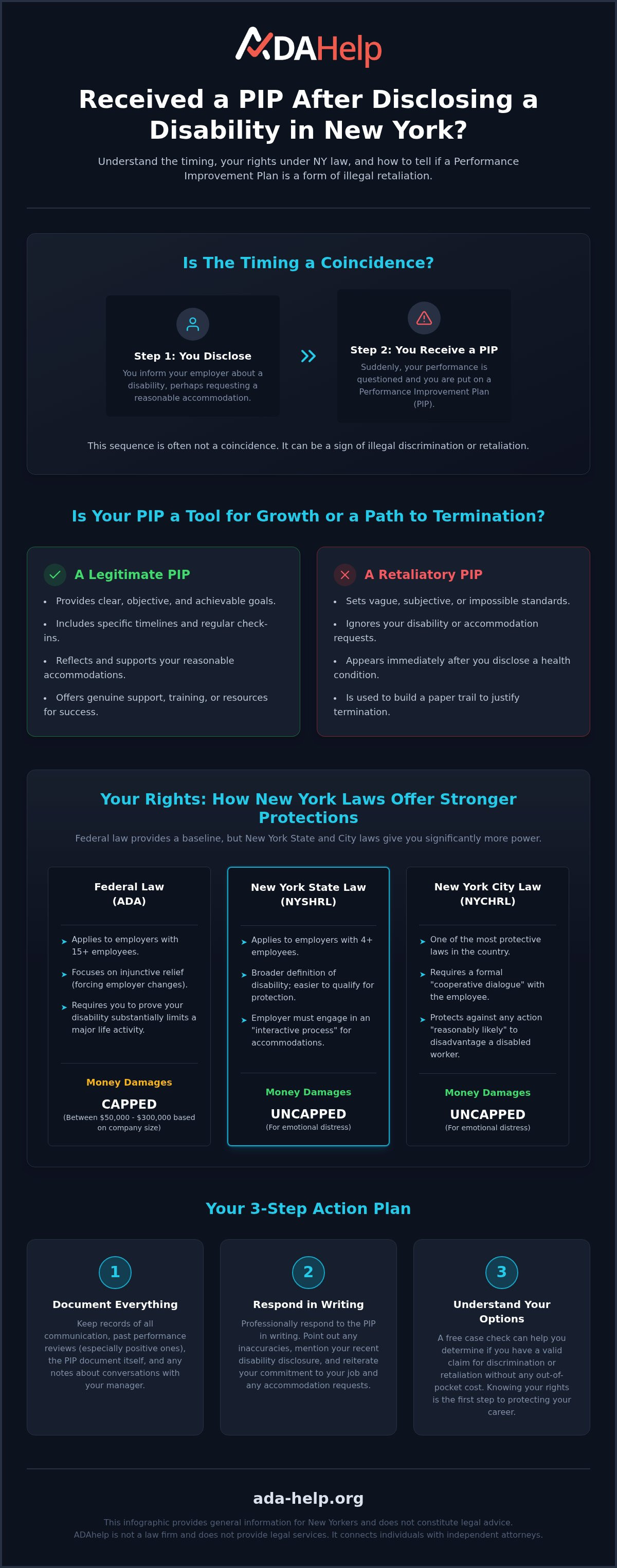
The stated goal of a PIP is to clarify what your manager wants to see from you. It should include clear metrics, specific timelines, and regular check-ins to monitor your progress. For a worker with a disability, this document should also reflect any reasonable accommodations already in place. If the plan ignores your disability or sets impossible goals, it might not be a tool for growth. It might be a way to build a paper trail to justify firing you. A legitimate plan provides an opportunity for support, while a retaliatory one often sets you up to fail.
Common Triggers for PIPs
Why do these plans often appear right after you speak up about a health condition? There are several common reasons this happens in New York companies:
- Employer Misunderstandings: A manager might wrongly assume your disability makes you less capable of doing your job.
- Pre-existing Issues: Sometimes an employer has concerns they didn't voice until you disclosed your condition, using the disclosure as an excuse to act.
- Retaliation: In some cases, a PIP is a direct, illegal response to a request for a reasonable accommodation.
- Role Changes: If your job duties changed recently, your employer might use a PIP instead of providing the training or tools you need.
In New York City and across the state, employers must engage in an interactive process. This means they must talk to you about how to help you do your job. If they skip this step and go straight to a performance improvement plan after disclosing disability, they may be violating the New York State Human Rights Law. You should keep copies of all emails, past performance reviews, and the PIP itself. This evidence is crucial if you later need to show that the plan was unfair.
Your Rights Under the ADA and New York Laws
Receiving a performance improvement plan after disclosing disability doesn't mean you have lost your rights. In fact, it often triggers specific legal obligations for your employer. You are protected by a combination of federal, state, and city laws that work together to ensure you are treated fairly. Understanding these laws helps you see if your employer is following the rules or if they are setting you up for an illegal termination.
Federal Protections: The ADA
The Americans with Disabilities Act (ADA) is the federal baseline for your protection. It prohibits employers with 15 or more employees from discriminating against qualified individuals with disabilities. Your Rights Under the ADA include the right to reasonable accommodations that help you perform your job duties. The U.S. Equal Employment Opportunity Commission (EEOC) enforces these rules. While the ADA is powerful, it often focuses on injunctive relief, this means making the employer change their behavior or policies. It also has strict caps on money damages based on the size of the company. For example, combined compensatory and punitive damages are capped according to employer size: up to $50,000 for employers with 15 to 100 employees, up to $100,000 for 101 to 200, up to $200,000 for 201 to 500, and up to $300,000 for more than 500. These federal caps do not apply to claims brought under the NYSHRL or the NYCHRL.
State and Local Protections: NYSHRL and NYCHRL
New Yorkers have even stronger shields. The New York State Human Rights Law (NYSHRL) and the New York City Human Rights Law (NYCHRL) offer broader protections than federal law. One major difference is that these laws often apply to much smaller employers. Most importantly, they do not have the same caps on money damages for emotional distress as the ADA. If you face a performance improvement plan after disclosing disability in NYC, your employer must engage in a cooperative dialogue. This is a formal requirement to talk to you about what you need to succeed. If you feel your employer skipped this step, you can use a free three-minute case check to see if you have a claim (this same interactive-process duty applies to a reasonable accommodation for mental health).
Local enforcement agencies like the New York City Commission on Human Rights or the New York State Division of Human Rights handle these complaints. They look for evidence that your employer failed to provide reasonable accommodations during your PIP. Your right to these accommodations does not disappear just because you are on a performance plan. In many cases, the accommodation is exactly what is needed to meet the goals of the plan. If your employer refuses to provide it, the PIP itself could be evidence of discrimination or retaliation.
How to Respond to a Performance Improvement Plan
Don't panic if you receive a PIP. While it feels like a threat, it is also a chance to build your own record of facts. You should never sign a PIP immediately without reviewing it for errors. How to Respond to a PIP involves being proactive rather than reactive. If you face a performance improvement plan after disclosing disability, your response should focus on how your employer can help you succeed through accommodations.
In New York, documentation is your best defense. If your manager claims you missed deadlines, check your sent folder to prove otherwise. If they say your quality has dropped, find emails from clients praising your work. Every discrepancy you find is a piece of evidence that the PIP might be unfair. You can always reach out to ada-help.org to see how these documents fit into a potential discrimination claim.
Step-by-Step Response to Your PIP
Start by gathering all your performance data. This includes past reviews, commendations, and a timeline of your disability disclosure. Write a formal rebuttal to the PIP that addresses each point of criticism with facts. If a performance dip was caused by a lack of accommodation, state that clearly. Request a meeting with your supervisor and HR to discuss your response. This meeting is part of the interactive process required by New York law. It forces the employer to acknowledge your disability and your needs.
Communicating Your Needs Effectively
Be crystal clear about what you need to meet the goals in the plan. Vague requests like "I need more time" are less effective than "I need a 30-minute break at 2:00 PM to manage my symptoms." Use specific examples of how an accommodation will solve the performance issue your manager raised. Keep the conversation professional and focused on the work. If you stay calm and solution-oriented, it becomes much harder for an employer to claim you are the problem. If they refuse to provide the tools you need, make sure you have a written record of that refusal (read more on responding to accommodation denials).
Resources for Support and Guidance
Dealing with a performance improvement plan after disclosing disability is a heavy burden. You are likely worried about your paycheck and your future. Fortunately, New York offers some of the strongest protections in the country. You can find help through government agencies, local non-profits, and specialized case management services. You don't have to face this situation alone or guess about your legal standing.
ADA Help - NY disability discrimination claims
Our team at ADA Help - NY disability discrimination claims focuses on helping New Yorkers understand if they have been victims of discrimination. We provide a free three-minute case check to help you identify if your employer has crossed a legal line. If you have a claim, we can connect you with independent contingency-fee attorneys. This means you never pay out-of-pocket fees. The attorneys only get paid if you win a recovery. We handle the intake and case management so you can focus on your health and your life. We help you gather the right documents and prepare your story for a legal review. Start your free three-minute case check today to get the support you need.
Local Advocacy and Support Groups
New York has several agencies dedicated to protecting your rights. The New York State Division of Human Rights (NYSDHR) and the New York City Commission on Human Rights (NYCHRL) are primary resources. These agencies investigate claims of discrimination in the workplace. For acts occurring on or after February 15, 2024, you have three years to file a complaint with the NYSDHR. If you are in the five boroughs, the NYCHRL provides an additional layer of protection. You can also look for community-based organizations like the New York Association on Independent Living, or review the steps for how to file an ADA complaint against your employer. These groups offer peer support and can help you find local resources for daily living and employment assistance. Connecting with others who have faced a performance improvement plan after disclosing disability can provide emotional relief and practical tips.
The U.S. Equal Employment Opportunity Commission (EEOC) is the federal authority for ADA claims. In New York, you must file a charge with the EEOC within 300 calendar days of the discriminatory act. This preserves your federal rights while you pursue state and city remedies. Finding a legal professional who knows the specific New York legal environment is vital. You want someone who understands how the ADA interacts with local laws. This expertise ensures you aren't just filing a complaint but building a case for the full recovery you deserve. Typical recoveries vary by case, but having an advocate who understands the system makes the process much simpler.
Take Action: Get Started with Your Case
Do you feel like your back is against the wall? Receiving a performance improvement plan after disclosing disability is a stressful experience that no New Yorker should face alone. You have rights under the law; however, those rights only work if you use them. Acting now can change the outcome of your situation from a job loss to a fair resolution.
Why Choose ADAhelp?
We are your proactive partner in this process. ADAhelp isn't a law firm, we don't give legal advice. Instead, we provide expert case management and intake services to help you determine if you have a claim. We take the heavy lifting off your shoulders by reviewing your situation and connecting you with independent contingency-fee attorneys. This means you don't have to worry about hourly legal fees or out-of-pocket costs. You only pay if there is a successful recovery. We understand the specific regional rules of New York employment law. We know how the NYSHRL and NYCHRL provide the money damages you need while the ADA provides federal oversight. Our goal is to make the path forward feel simple and stress-free.
Next Steps to Protect Your Rights
Your first step is to gather every piece of paper related to your job. This includes your original offer letter, past performance reviews, and any emails where you mentioned your disability. If your manager gave you a performance improvement plan after disclosing disability, keep a copy of that plan and any rebuttals you wrote. These records are the foundation of your case.
Once you have your documents, you should prepare to speak with a case manager. Think about the timeline of events. When did you disclose your disability? When did the performance complaints start? Having these dates ready makes your intake process much faster. You should also stay informed about the deadlines for filing. You have 300 days for the EEOC and up to three years for the New York State Division of Human Rights for recent acts. Don't wait for your employer to take the next step. You can take control of your future right now. Reach out for support from local advocacy groups or start your intake process with us. Your job security and your dignity are worth protecting. The best way to start is with a free three-minute case check.
Secure Your Future and Protect Your Rights
Receiving a performance improvement plan after disclosing disability is a serious challenge; however, it is one you can meet with the right information. You now know that New York City and State laws provide some of the strongest protections in the country. These local laws often allow for money damages that federal law limits. You also understand the importance of documenting every interaction and requesting specific accommodations to help you succeed.
Don't let the fear of losing your job stop you from seeking justice. Whether you are in Buffalo or Brooklyn, the system is designed to protect you from unfair treatment. We handle the heavy lifting by managing your case and connecting you with independent attorneys who work on a contingency basis. You don't have to face your employer alone. Get your free three-minute case check now!
You have the strength to stand up for yourself. We are here to help you turn a stressful situation into a clear path toward fairness and resolution.
Frequently Asked Questions
What is a performance improvement plan?
A PIP is a formal document from your employer that lists specific areas where they believe you aren't meeting work standards. It typically includes goals, timelines, and regular check-ins. While intended for growth, many New Yorkers see them as the start of a termination process. If you receive a performance improvement plan after disclosing disability, the timing suggests your employer might be acting on bias rather than actual work quality.
What are my rights if I’m placed on a PIP after disclosing my disability?
You have the right to be free from retaliation and discrimination under the ADA, NYSHRL, and NYCHRL. In New York, your employer must engage in a cooperative dialogue to find reasonable accommodations that help you succeed. Receiving a performance improvement plan after disclosing disability does not strip you of these protections. If the PIP sets impossible goals or ignores your medical needs, it may be evidence of a legal claim for uncapped money damages.
How should I respond to a performance improvement plan?
You should respond by reviewing every claim for accuracy and gathering your own evidence. Write a formal rebuttal that points out any errors in their assessment. If your performance was impacted by a lack of support, state that clearly in writing. Keep copies of all emails and meeting notes. You can also use a free three-minute case check to see if your employer's actions violate New York labor and human rights laws.
Can I request accommodations during a performance improvement plan?
Yes, you can and should request reasonable accommodations at any time, including during a PIP. Your employer is legally required to discuss these requests with you. An accommodation might be exactly what you need to meet the goals listed in the plan. If an employer refuses to provide a necessary tool or schedule change while holding you to a PIP, they may be setting you up for an illegal termination under New York law.
What resources are available for support in New York?
New Yorkers can access the State Division of Human Rights or the City Commission on Human Rights for investigations. For acts after February 15, 2024, the state filing deadline is three years. ADAhelp provides specialized case management to help you determine if you have a claim. We connect you with independent attorneys who work on a contingency basis. You never pay out-of-pocket fees. Our intake process helps you organize your evidence for a potential recovery.

Article by
ADA Help
Written by the ADAhelp editorial team and reviewed for accuracy before publishing. ADAhelp helps New Yorkers find out if they have a disability discrimination claim and manages the process end to end, working with independent attorneys who handle the legal work. We are not a law firm and do not provide legal advice.
Disclaimer
This article is general information about New York law, not legal advice, and reading it does not create an attorney-client relationship. ADAhelp is a case-management and intake service, not a law firm; legal representation is provided by independent attorneys. Recovery amounts and timelines vary by case, and past outcomes do not guarantee future results. For advice about your specific situation, speak with a qualified attorney or start the free case check.
Tags
Discriminated against in New York because of a disability?
A free three-minute check tells you if you can pursue a claim.
Check my case →New York onlyNo upfront costIndependent NY attorneysFree 3-minute check