Blind Discrimination Case New York: Your Rights (2026)
Reviewed for accuracy by the ADAhelp team before publishing. ADAhelp is not a law firm; legal work is handled by independent New York attorneys.
Learn your rights in a blind discrimination case New York. See if you can get financial recovery under local laws. Free case check connects you to attorneys.
Do you have a valid blind discrimination case New York and what is it worth? Yes — if a New York business, landlord, or public place denied you equal access because you are blind or have low vision, you almost certainly have a claim. Under the New York State and City Human Rights Laws that claim can be worth money damages for emotional distress, not just a promise to fix the barrier, and you have three years to file with the state. If a business or public space has denied you access, you likely have a claim that could result in financial recovery under local laws. You shouldn't have to pay out of pocket to fight for your rights. We help New Yorkers determine their case validity for free and connect them with attorneys who work on a contingency basis; this means you only pay if you receive a settlement.
It is exhausting to face barriers at work or on the street. You might feel overwhelmed by the differences between federal ADA rules and the New York City Human Rights Law. This guide simplifies the process by explaining how New York laws allow for money damages, which is financial compensation for the discrimination you faced. We will cover the three year statute of limitations, or the legal deadline to file a claim, and show you how to start a no-risk check. ADAhelp is not a law firm; instead, we act as your advocate to handle the heavy lifting and find the professional help you need.
Key Takeaways
- Learn how to identify a valid blind discrimination case New York when businesses deny access or refuse service animals.
- Understand why local New York City and State laws allow you to seek money damages while federal laws often do not.
- Discover the specific steps to document an incident so you can prove what happened and who was involved.
- Find out how our free three-minute case check connects you with independent attorneys on a contingency fee basis.
What Qualifies as a Blind Discrimination Case in New York?
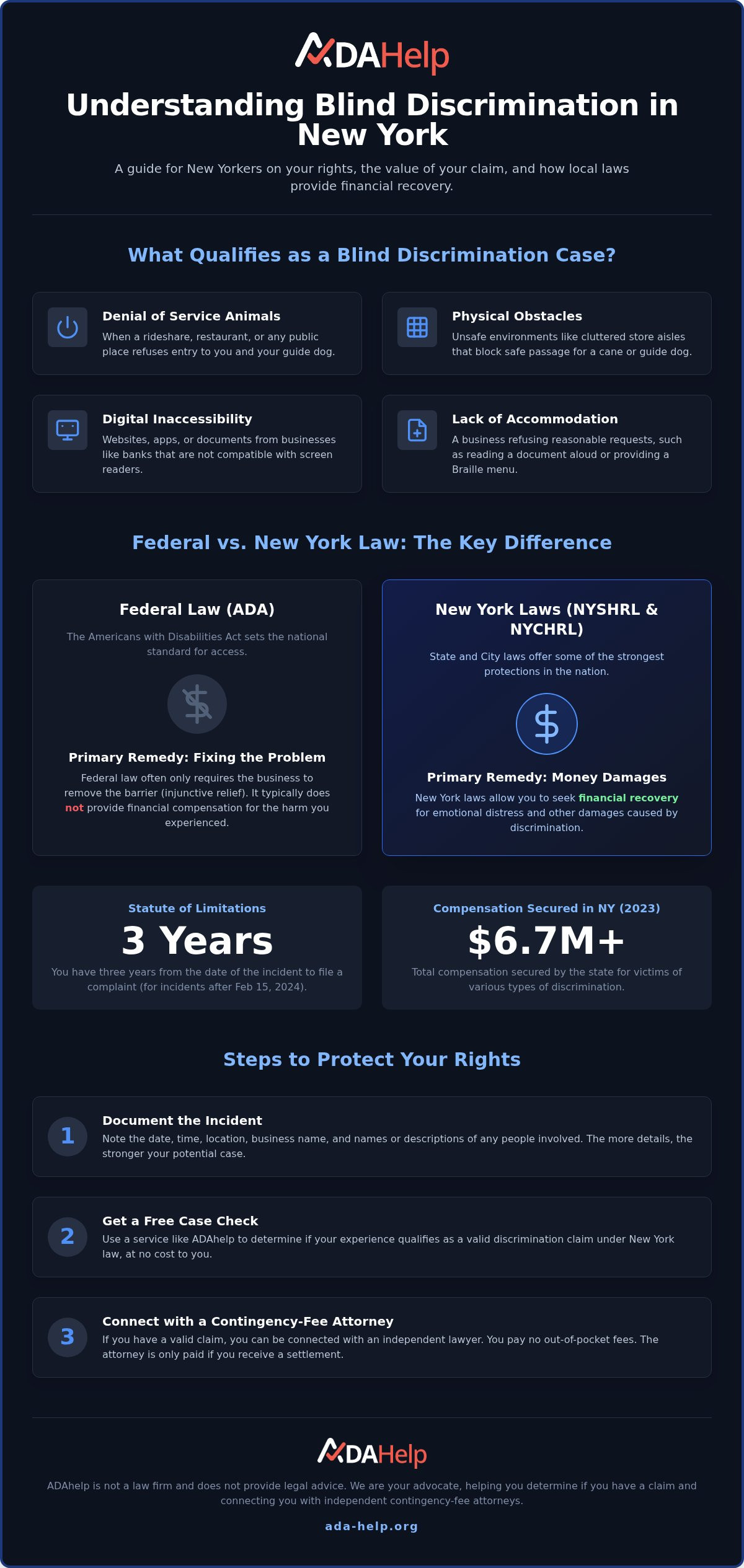
A blind discrimination case New York occurs when a business or public entity fails to provide you with equal access. This is not about intent or whether a manager meant to be helpful. It happens when the environment itself prevents you from using a service in the same way a sighted person would. For example, if a retail store layout is impossible to walk through safely or if a restaurant website does not work with your screen reader, that is a violation of your rights. You have the right to experience the city without constant barriers.
In New York, this includes physical obstacles like blocked aisles, the denial of service animals in Ubers or restaurants, and digital inaccessibility. You're entitled to reasonable accommodations; these are simple changes to rules or spaces that allow you to participate fully. If a business refuses to read a document to you or forces you to leave because of your guide dog, they've failed their legal duty. You don't need to prove they were being malicious. The fact that you were excluded is often enough to start a case. We handle the heavy lifting of determining if your experience meets these legal standards.
To better understand how these rights are defended in our state, watch this report on a recent legal challenge regarding jury service access:
The Role of the Americans with Disabilities Act (ADA)
The Americans with Disabilities Act (ADA) is the federal foundation for your rights. Title III of this law specifically covers public accommodations. This includes almost every private business you visit, such as grocery stores, doctors' offices, and movie theaters. Under the ADA, these businesses must remove physical and communication barriers. However, federal law is often limited. It usually only requires the business to fix the problem rather than paying you for the harm caused. This is why local New York laws are so important for your recovery.
New York State and City Protections
The New York State Human Rights Law (NYSHRL) and the New York City Human Rights Law (NYCHRL) provide the strongest protections in the country. For incidents occurring on or after February 15, 2024, you now have three years to file a complaint with the New York State Division of Human Rights. This is a major extension from the old one year limit. These local laws are vital because they allow for money damages. You can seek financial recovery for the emotional distress and frustration you faced. In 2023, the state secured over $6.7 million in compensation for discrimination victims. ADAhelp focuses on these specific New York claims to ensure you get more than just a promise of future change. We connect you with independent attorneys who understand how to use these local laws to secure a settlement.
Common Examples of Blind Discrimination in New York City
You might think discrimination only happens in high-profile lawsuits. In reality, it's the daily friction of living in the city while blind. A blind discrimination case New York often stems from simple, everyday interactions where a business fails to accommodate you. This isn't just a minor inconvenience; it's a violation of your civil rights under both city and state law. When a business treats your access as an afterthought, they're responsible for the harm that follows.
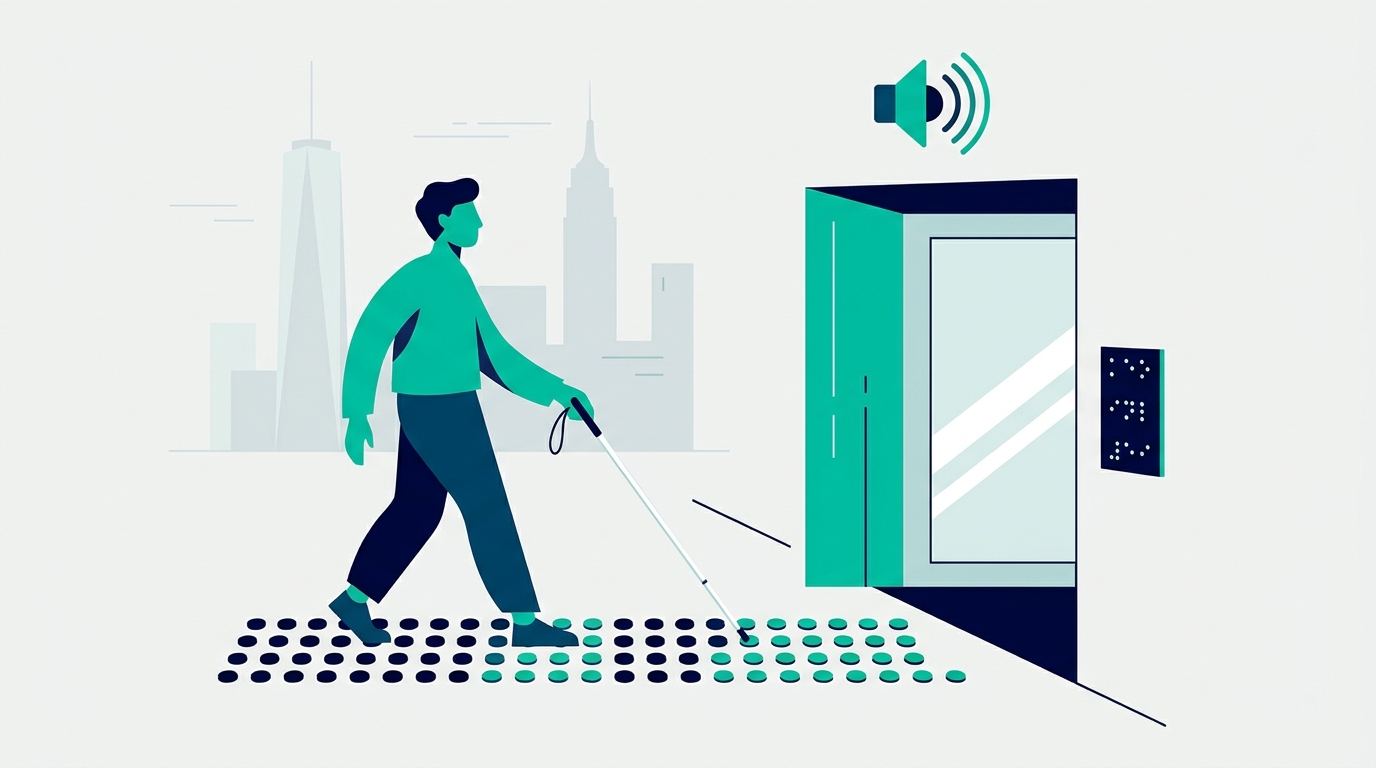
Service animal denials are some of the most frequent violations we see. Whether it's a yellow cab, a ride-share app, or a small coffee shop in Brooklyn, you have the right to bring your guide dog inside. Staff cannot ask for "papers" or demand that you leave. If they do, they are breaking the law. Similarly, retail stores must ensure you can move through their aisles without hitting obstacles. If a shop is so cluttered that you can't move safely with a cane or dog, they've denied you equal access. The New York State Division of Human Rights tracks these complaints to hold businesses accountable and protect your right to use public spaces.
Another common issue is the lack of alternative formats. Businesses must provide information in a way you can actually use it. This might mean Braille menus at a restaurant or digital files that are compatible with screen readers for a bank statement. If a business refuses to provide these or ignores your request for help, you may have a valid claim. You don't have to accept being ignored or excluded from basic services. If you've faced any of these barriers, you can check your eligibility with a free three-minute case check to see if you're entitled to recovery.
Public Accommodations and Physical Access
Restaurants must allow guide dogs without questioning your disability or asking for proof. Retailers cannot refuse to help you or block the paths you need to move through the store. Hotels also have a duty to ensure their check-in counters and room features are usable. If you're denied entry or service because of your visual impairment, it's a clear violation of the New York City Human Rights Law.
Digital and Website Accessibility
Your rights don't stop at the physical front door. In 2026, websites are essential for everything from grocery shopping to paying rent. New York courts have consistently ruled that websites are public accommodations. If a screen reader cannot identify buttons, read product descriptions, or complete a checkout, that business is excluding you. This is a clear website accessibility violation New York claim. You have the right to a digital experience that works for you, and we can help you hold companies accountable when their technology fails to be inclusive.
Determining the Value of a New York Blind Discrimination Claim
The first question many New Yorkers ask is: "What is my case worth?" While the federal ADA mostly forces a business to fix a barrier, New York's local laws allow you to seek financial recovery. A blind discrimination case New York can result in significant settlements because our state and city laws prioritize the victim's experience. In the fiscal year 2023, the New York State Division of Human Rights secured over $6.7 million in compensation for discrimination victims. This shows that the system can and does work for individuals who take action.
Typical recoveries include compensation for emotional distress. This covers the frustration, humiliation, and stress you felt during the incident. Under the New York City Human Rights Law (NYCHRL), you may also be eligible for statutory damages and civil penalties. These penalties are designed to hold businesses in the five boroughs to a higher standard and can increase the total settlement. If a business has a long history of ignoring accessibility rules or if the manager was intentionally hostile, punitive damages might be awarded to punish the business. Every case is different. Amounts vary based on the specific facts of your situation, and no result is ever guaranteed.
Factors That Influence Your Recovery
Several details can change the potential value of your claim. First, we look at the frequency of the violation. Were you denied access once, or has this happened every time you visit? Second, we check the business's history. Companies that have ignored past complaints often face higher penalties. Finally, we consider the direct impact on your life. If the discrimination prevented you from attending a job interview or receiving medical care, the recovery might be higher. Documenting these details is essential for building a strong blind discrimination case New York.
The Contingency Fee Model
You should never have to pay out-of-pocket to hold a business accountable. ADAhelp is not a law firm, but we connect you with independent attorneys who work on a contingency fee basis. This means they only take a fee if they win your case. If there is no recovery, you owe nothing. This model ensures that justice is accessible to every New Yorker, regardless of their bank account balance. You can start with a free three-minute case check to see if you have a valid claim without any financial risk. We handle the initial intake and information gathering so you can focus on moving forward.
How to Document and Report Discrimination in New York
If you've just been turned away from a business or ignored by a service provider, your first instinct might be to leave and forget the frustration. However, the actions you take in the minutes following the incident are vital. Your success in a blind discrimination case New York relies on clear, factual evidence. Businesses often try to claim that an incident never happened or that you misunderstood the situation. Solid documentation makes it much harder for them to avoid responsibility.
Start by recording the basics immediately. Use your phone to note the exact date, time, and the specific address of the location. If you were using a ride-share app, take a screenshot of the driver's name and vehicle details. At a physical store or restaurant, ask for the names and job titles of the employees who spoke to you. If they refuse to give their names, write down a physical description. You should also save every piece of physical evidence. This includes receipts, emails confirming an appointment, or text messages from a delivery service. If the issue is a physical barrier, such as a blocked aisle or a non-working accessible entrance, take a photo or video of the scene if possible.
Collecting these details might feel like a lot of work while you are upset, but it protects your future claim. We can help you organize this information and determine if it meets the requirements for a legal filing. You can start your free case check today to see how your evidence translates into a potential recovery.
Gathering Witness Information
Did another customer see the manager refuse your guide dog? Did a bystander hear the staff make a discriminatory comment? If so, ask for their name and contact information. Witness statements are incredibly powerful in "he-said, she-said" scenarios. A neutral third party who has no personal connection to you carries a lot of weight during case management. Their account can confirm the facts of the incident and help prove that the business was at fault.
Filing with the Proper Authorities
Once you have your evidence, the next step is reporting the violation to the right agency. In our state, cases are typically filed with the New York State Division of Human Rights. If the incident happened within the five boroughs, the NYC Commission on Human Rights also has the power to investigate. These agencies handle the official complaints that can lead to civil penalties and settlements. ADAhelp is not a law firm, but we manage this entire filing process for you. We handle the paperwork and coordination so you don't have to deal with government bureaucracy alone.
Where to File: Agencies & Deadlines
Four bodies can take a blind discrimination case New York, and each has its own clock:
- New York State Division of Human Rights (DHR) — statewide complaints under the NYSHRL. Three years to file for incidents on or after February 15, 2024 (one year for incidents before that date).
- NYC Commission on Human Rights (CCHR) — incidents in the five boroughs under the NYCHRL, the broadest law of the four. One year to file an administrative complaint (three years for gender-based harassment).
- U.S. Department of Justice (DOJ) — ADA Title II and Title III complaints about public entities and businesses. 180 days is the usual guideline, and the DOJ selects which complaints it investigates.
- U.S. Equal Employment Opportunity Commission (EEOC) — only for workplace discrimination. 300 days in New York because the state has its own fair-employment agency.
Filing with DHR generally forecloses filing the same claim in state court, and a CCHR complaint has the same election-of-remedies effect, so the order matters. That is one of the reasons we connect you with an independent attorney before anything is filed.
Start Your Free Three-Minute Case Check
Starting a blind discrimination case New York doesn't have to be intimidating or expensive. You've already dealt with the frustration of being excluded from a business or service. You shouldn't have to deal with a confusing legal process on your own. ADAhelp offers a fast, free way to see if your experience qualifies for a claim. We focus on the results so you can focus on moving forward with your life.
We are not a law firm and we do not provide legal advice. Instead, we act as your proactive partner to handle the heavy lifting of the intake process. Our team manages the information gathering and documentation needed to build a strong foundation for your case. Once we determine you have a valid claim, we connect you with independent attorneys who understand the specific requirements of the New York City Human Rights Law. This process removes the stress of visiting a cold, professional law office while ensuring your rights are protected by experts who know the local system intimately.
Our goal is to hold New York businesses accountable for the barriers they create. Whether it was a restaurant that refused your guide dog or a website that wouldn't work with your screen reader, these entities have a legal duty to provide equal access. When they fail, you deserve a clear path toward resolution and financial recovery. We move quickly to turn your hesitation into a straightforward plan for justice.
Why Choose ADAhelp for Your Case?
We focus specifically on New York disability rights. Many firms handle general cases across the country, but we prioritize the unique interplay between the ADA and our powerful local laws. This specialization is vital because money damages for emotional distress often come from the NYCHRL and NYSHRL rather than federal law. Our process is built for speed and clarity for real New Yorkers. Most importantly, you pay nothing out-of-pocket. We operate on a contingency model; this means fees are only taken from a recovery, and you owe nothing if your case is not successfully resolved.
Take Action Today
Discrimination does not go away if it is ignored. When a business gets away with excluding one person, they continue to maintain barriers for everyone else. Your case could help prevent other blind or low-vision New Yorkers from facing the same obstacles in the future. Remember that for incidents occurring on or after February 15, 2024, you have three years to take action — see our full guide to the ADA discrimination claim statute of limitations in New York. Don't let the clock run out on your right to recovery. Start your free case check now and let us help you hold the responsible parties accountable.
Secure Your Rights and Your Recovery
You have the right to move through New York without being ignored or excluded. Whether you were denied entry with a guide dog or faced a digital barrier, these incidents shouldn't be your burden to carry alone. Local laws like the NYCHRL are designed to provide you with money damages for the emotional distress you've faced. Documentation is your strongest tool, but you don't have to handle the filing process by yourself.
Starting a blind discrimination case New York is a powerful way to hold businesses accountable and protect others in your community. We provide a free case evaluation for all New Yorkers to determine if you have a valid claim. Our expert case management for ADA and NYCHRL claims ensures you have a tireless advocate on your side. We operate on a no recovery, no fee model; this means you never pay out of pocket for our help.
Take the first step toward a stress-free resolution today. You can start your free three-minute case check to see what your claim might be worth. You deserve a city that is fully accessible, and we are ready to help you fight for it.
Frequently Asked Questions
How much does it cost to start a blind discrimination case in New York?
It costs nothing out of pocket to start your case check. We offer a free evaluation for every blind discrimination case New York. If your claim moves forward, the independent attorneys we connect you with work on a contingency fee basis. This means they only get paid if you receive a settlement. You never have to worry about hourly legal fees or upfront costs while seeking justice.
Do I need a lawyer to report an ADA violation in NYC?
You don't legally need a lawyer to file a complaint with a government agency like the New York State Division of Human Rights. However, the legal system is complex and businesses often have their own legal teams. Most New Yorkers find that professional representation helps secure a fair settlement for emotional distress. We handle the initial intake and connect you with experts who can manage the filing process for you.
Can I sue a restaurant for refusing my guide dog in New York?
Yes, you can seek money damages if a restaurant denies entry to your guide dog. This is a clear violation of the New York State Human Rights Law and the New York City Human Rights Law. While the federal ADA focuses on making the business change its policy, our local city and state laws are what allow you to recover financial compensation for the harm you experienced.
What is the statute of limitations for disability discrimination in NY?
For acts of discrimination occurring on or after February 15, 2024, you have three years to file a complaint with the New York State Division of Human Rights. This is an extension from the previous one year deadline. If the incident happened before that date, the one year limit still applies. Federal complaints with the EEOC must be filed within 300 days, so it's important to take action quickly.
Is a website required to be accessible for the blind in New York?
Yes, websites are considered public accommodations under New York law. If a business offers services to the public, their digital presence must be accessible to screen readers. If you cannot complete a purchase or navigate a site because of a digital barrier, the business is in violation of your rights. This applies to retailers, banks, and service providers across the state.
What is the difference between ADAhelp and a law firm?
ADAhelp is a case management service and not a law firm. We don't provide direct legal advice or hourly representation. Instead, we act as your advocate to determine if you have a valid claim and gather all necessary evidence. If your case is valid, we connect you with independent contingency-fee attorneys who handle the legal negotiations and litigation for you.
How long does a typical blind discrimination settlement take?
The timeline for a settlement varies case by case and there is no guaranteed duration. Some cases are resolved in a few months through mediation, while others may take a year or more if the business contests the claim. The speed of your recovery depends on the complexity of the violation and the responsiveness of the entity involved. We aim to make the process as fast and stress-free as possible.

Article by
ADA Help
Written by the ADAhelp editorial team and reviewed for accuracy before publishing. ADAhelp helps New Yorkers find out if they have a disability discrimination claim and manages the process end to end, working with independent attorneys who handle the legal work. We are not a law firm and do not provide legal advice.
Disclaimer
This article is general information about New York law, not legal advice, and reading it does not create an attorney-client relationship. ADAhelp is a case-management and intake service, not a law firm; legal representation is provided by independent attorneys. Recovery amounts and timelines vary by case, and past outcomes do not guarantee future results. For advice about your specific situation, speak with a qualified attorney or start the free case check.
Tags
Discriminated against in New York because of a disability?
A free three-minute check tells you if you can pursue a claim.
Check my case →New York onlyNo upfront costIndependent NY attorneysFree 3-minute check