Assisted Living Facility Discrimination New York (2026)
Reviewed for accuracy by the ADAhelp team before publishing. ADAhelp is not a law firm; legal work is handled by independent New York attorneys.
Facing assisted living facility discrimination New York? Learn how NY laws protect you from illegal denials and help you secure money damages. Free case check.
Can an assisted living facility in New York legally reject you just because you use a wheelchair or have a mobility impairment? Many facilities use safety myths to hide illegal assisted living facility discrimination New York. You might feel rejected and helpless when a facility says they cannot meet your needs; but these blanket bans often violate state and city laws.
We understand the anxiety of fighting a large facility while trying to find a safe place to live. You deserve to know if you have a valid case without worrying about out-of-pocket costs. This guide explains how New York laws protect you and how money damages are often secured through the state and city human rights laws. ADA Help - NY disability discrimination claims manages the entire process by connecting you with independent contingency-fee attorneys.
Learn how to identify red flags and start a risk-free case check today. We will show you how to protect your rights and find a clear path toward resolution. You don't have to handle the burden of a claim alone or navigate complex legal systems without a partner.
Key Takeaways
- Identify if you have a valid claim for assisted living facility discrimination New York by recognizing common red flags like illegal admission denials.
- Understand how the New York State and City Human Rights Laws provide broader protections and paths to money damages than federal law alone.
- Learn why facilities cannot legally reject you for using a wheelchair or charge you higher fees because of your disability.
- Discover the specific steps to document your interactions and preserve evidence for a successful claim.
- Find out how to access a free three-minute case check and connect with independent attorneys who work on a contingency basis.
Assisted Living Facility Discrimination in New York: Do You Have a Claim?
If a facility treats you differently because of a disability, it is not just frustrating; it is a violation of your civil rights. While the federal Americans with Disabilities Act (ADA) requires businesses to remove physical barriers, assisted living facility discrimination New York is often more subtle. You have a right to equal treatment under the New York State Human Rights Law (NYSHRL), which covers many housing providers that the federal law might miss. The New York State Division of Human Rights enforces these protections so you are entitled to the same housing opportunities as any other New Yorker. If a landlord or building has turned you away, see our guide on what to do when you are denied housing because of a disability in New York.
To see how these issues affect real families, watch this report on facility challenges:
What counts as an assisted living facility in New York?
In New York, these are officially classified as Adult Care Facilities (ACF). This includes assisted living residences and enriched housing programs that provide long-term care and 24-hour supervision. They are not nursing homes, but they are still public accommodations that must be accessible. If a residence offers housing to the public, they cannot exclude you based on a physical or mental impairment. ADA Help - NY disability discrimination claims specializes in managing these types of housing claims to ensure your rights are protected.
Recognizing the signs of illegal rejection
Signs of discrimination often appear during the first tour or phone call. You might hear staff say they are "not equipped" for your specific level of care, even if your needs are manageable. Other red flags include intrusive medical questions that seem more like a screening tool than a care assessment. Sometimes, a facility will suddenly claim a room is no longer available only after they see you use a mobility aid. These are classic examples of assisted living facility discrimination New York that warrant a professional review.
Common Ways New York Facilities Discriminate Against Residents
Have you been told a room isn't available only after the staff saw your walker? Assisted living facility discrimination New York often starts at the front door. Facilities may try to screen out people with certain disabilities to keep their costs down or avoid making changes to their building. This is illegal. You have the right to live in a facility that meets your needs without being treated like a burden.
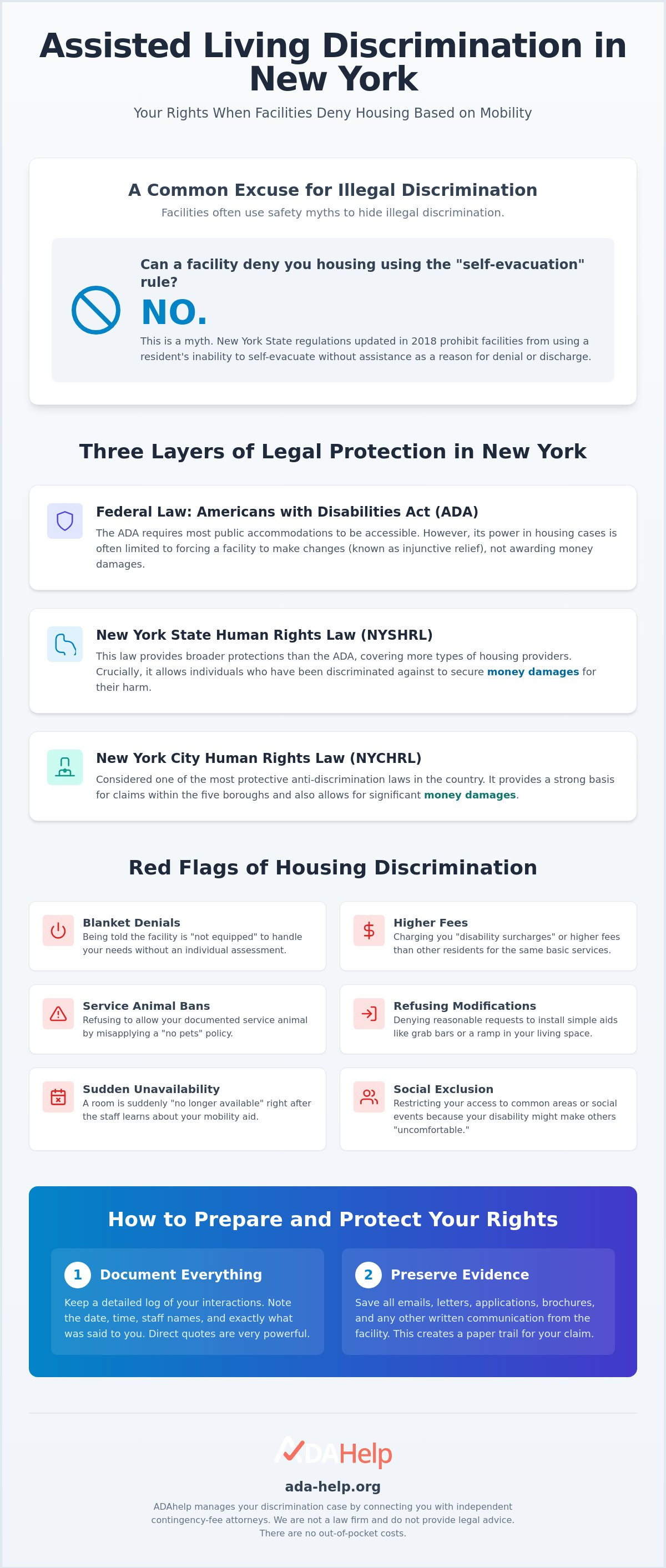
Charging higher fees is another frequent violation. Some facilities add "disability surcharges" or hidden costs for residents who need more help with daily tasks. While they can charge for specific care services, they cannot charge you more just because you have a physical or mental impairment. This practice is a direct violation of the New York State Human Rights Law. If your bill seems unfairly high due to your medical status, it is time to look closer at their practices.
Many New Yorkers also face trouble with service animals. A facility might have a strict "no pets" policy and try to apply it to your guide dog or service animal. Under Disability Rights in New York, these animals are considered medical tools; not pets. Denying you a place to live because of a service animal is a clear sign of assisted living facility discrimination New York. You shouldn't have to choose between your animal and your home. Learn more about your protections in our guide to assistance animal discrimination in New York.
Common discriminatory practices include:
- Refusing to install grab bars or ramps in your living space.
- Telling you that you must move out because your condition has worsened, even if you still meet the facility's care level.
- Ignoring requests for dietary accommodations related to a medical condition.
- Restricting your access to social events because your disability "makes other residents uncomfortable."
The self-evacuation myth in New York
Facilities often claim that every resident must be able to "self-evacuate" during an emergency. They use this to say that if you cannot walk down a flight of stairs without help, you cannot live there. This is a myth. New York state regulations since 2018 prohibit facilities from using this as an excuse to deny housing. Every facility must have a comprehensive emergency plan that accounts for residents with all levels of mobility. If they tell you that your wheelchair makes you a safety risk, they are likely breaking the law.
Inaccessible common areas and rooms
Discrimination also happens when a facility fails to maintain its building. This includes narrow doorways that won't fit a standard wheelchair or social rooms that lack ramp access. When you are blocked from the dining hall or the garden, you are being denied the services you pay for. Facilities must provide reasonable accommodations to ensure you have full access to the property. Tenants in regular buildings face the same barriers; our apartment building accessibility checklist for NYC shows what to document. If you feel isolated because of physical barriers, you can start a free case check to see if you have a claim for damages.
Understanding Your Rights Under New York Law and the ADA
Do you have a case? What is it worth? These are the first questions most New Yorkers ask after facing assisted living facility discrimination New York. The law provides two different paths for residents. One path fixes the facility; the other path compensates you for your losses. ADA Help - NY disability discrimination claims manages your case by evaluating these laws and connecting you with independent contingency-fee attorneys.
You have the right to live in a facility that respects your dignity and follows the law. Federal and local statutes work together to protect you. While the federal government sets a baseline for access; New York provides the tools to seek justice for the emotional harm you have suffered. We help you use these laws to turn a frustrating experience into a clear path toward a resolution.
ADA Title III and injunctive relief
Title III is a federal law that applies to public places like assisted living residences. It focuses on access. If a facility has a step where there should be a ramp; the ADA allows you to seek injunctive relief. This means a court orders the business to fix the physical barrier. It is a powerful tool for community change; but it rarely provides money damages to an individual. It fixes the building; not your bank account.
NYSHRL and NYCHRL: Seeking money damages
For financial compensation; we look to the New York State Human Rights Law and the New York City Human Rights Law. These laws are much broader than the ADA. They allow you to recover money for emotional distress; mental anguish; and out-of-pocket expenses. If you live in the five boroughs; the NYCHRL is especially protective. These damages are the primary way to hold a facility accountable for the pain they've caused. ADA Help - NY disability discrimination claims ensures your case is organized to pursue these specific state and city remedies.
How to Document Discrimination and Prepare Your Case
Proving assisted living facility discrimination New York requires more than just your word. It requires a paper trail. Facilities often hide behind oral excuses; but these excuses vanish when you have physical proof. You should start by saving every piece of paper or digital message you receive from the facility. This includes admission brochures, rejection letters, and even simple emails about room availability. These documents serve as the foundation of your claim.
Keep a detailed log of every conversation you have with staff. Write down the name of the person you spoke with, the date, and exactly what they said. If an admissions officer tells you that "residents must be able to walk independently," note it immediately. Don't sign any documents or waivers that limit your right to take legal action without speaking to a professional first. These papers are often designed to protect the facility; not you. Taking photos of physical barriers is also vital. If a "public" dining hall is only accessible by stairs; or if a hallway is too narrow for a standard wheelchair; snap a photo of it.
Recording verbal statements and excuses
When a facility denies you a room; they might give a verbal reason like "safety concerns" or "staffing levels." Ask them to put this policy in writing. If they refuse; make a note of that refusal. You should also look around the facility during your visit. Do you see other residents using walkers or wheelchairs? If the facility allows some people to use mobility aids but denies you; it's a strong sign of bias. You can learn more about how to document disability discrimination to help you build a solid foundation for your claim.
Gathering witness information
You don't have to be your only witness. If a family member or friend was present during a tour where discrimination occurred; get their contact information. Their testimony can confirm your account of the events. You might also talk to other residents or their families. If they have faced similar barriers or heard the same excuses; their stories can prove a pattern of behavior. Gathering this information now makes the legal process much smoother later.
Managing a claim while looking for housing is a lot of work. ADAhelp handles the case management for you so you can focus on your life. If you have evidence of unfair treatment; get a free case check today to see if your documentation supports a claim for money damages.
How ADAhelp Manages Your New York Discrimination Case
Do you feel overwhelmed by the thought of fighting a large facility? You shouldn't have to face assisted living facility discrimination New York alone. ADAhelp provides end-to-end case management for New Yorkers who have been treated unfairly. We understand the stress of being rejected from a home. Our team handles the heavy lifting of organizing your claim so you can focus on your health and housing. We serve as your proactive partner throughout the entire process.
It is vital to understand that ADAhelp is not a law firm and we do not provide legal advice. Instead; we act as your advocate and guide through a confusing administrative system. We gather your documents, log your evidence, and prepare the necessary information for filing with agencies like the New York State Division of Human Rights. Once your case is organized, we connect you with independent attorneys who specialize in New York disability law. This ensures your claim is handled by experts who know how to win under the NYCHRL and NYSHRL.
No upfront costs or hourly fees
One of the biggest fears for many New Yorkers is the cost of a lawyer. You might worry that fighting a large facility will cost more than you can afford. Our model removes that financial barrier. You never pay out-of-pocket for our case management services. There are no hourly fees or hidden charges to worry about. We work on a contingency basis; which means fees are only taken if you receive a financial recovery. If you don't win money, you don't owe anything. This model allows every New Yorker to seek justice regardless of their bank account balance.
Start your risk-free case check
Taking the first step is simple and fast. We offer a free three-minute case check to help you understand if you have a valid claim. You can visit our homepage to begin the intake process immediately. Our team will review the details of your situation to see if it meets the criteria for ADA Title III case management New York. We look for clear signs of bias; such as illegal wheelchair bans, service animal rejections, or inaccessible common areas.
Don't let a facility's illegal behavior go unpunished. Whether you want to secure a place to live or receive financial compensation for emotional distress, we are here to help. Our process is designed to be stress-free and efficient. You have rights under the NYSHRL and NYCHRL. We are here to make sure those rights are respected. Start your case check today and let us help you move toward a resolution with minimal friction.
Where to File: Agencies & Deadlines
If you have faced assisted living facility discrimination New York, you can file with a government agency in addition to pursuing money damages. Deadlines are strict, so act quickly:
- New York State Division of Human Rights (DHR) — handles NYSHRL housing and public-accommodation complaints. For discrimination occurring on or after February 15, 2024, you have three years to file; earlier incidents generally have a one-year deadline.
- NYC Commission on Human Rights (CCHR) — enforces the broader NYCHRL if the facility is in the five boroughs. You generally have one year to file an administrative complaint (up to three years to sue in court).
- U.S. Department of Justice (ADA) — accepts ADA Title III complaints about physical access barriers at public accommodations like adult care facilities.
- U.S. EEOC — for related employment disability claims (for example, if you also work at the facility), file within 300 days.
Not sure which path fits your situation? A free three-minute case check can point you to the right agency and confirm whether you may be owed damages.
Take Action Against Assisted Living Discrimination
You have the power to challenge illegal rejections and unfair treatment in senior housing. New York state and city laws are some of the strongest in the country. They offer you a path to financial compensation that federal law often misses. By keeping detailed records of every conversation and photo evidence of barriers; you are already building a foundation for your recovery. You don't have to accept a facility's excuses as the final word.
Facing assisted living facility discrimination New York is exhausting; but our team handles the heavy lifting for you. ADAhelp provides the New York specific expertise required to manage your claim from start to finish. We offer a completely free case evaluation to help you understand your options. Because we work on a contingency basis; you never pay a fee unless you win a recovery. There are no out-of-pocket costs and no financial risks to your family.
Start your free three-minute case check today and take the first step toward the justice you deserve. You have rights; and we are here to make sure they are respected. Let's work together to hold these facilities accountable and secure your future.
Frequently Asked Questions
Can an assisted living facility in New York refuse me if I use a wheelchair?
No; they cannot legally reject you for using a mobility device. New York state regulations updated in 2023 explicitly prohibit assisted living facilities from denying admission based on wheelchair use. Facilities are required to provide reasonable accommodations to ensure you can live there safely. If a staff member tells you they are "not equipped" for your wheelchair; they are likely violating your rights.
What is the "self-evacuation" rule in New York senior living?
The "self-evacuation" rule is an outdated excuse used to exclude residents who cannot walk down stairs independently. New York regulations have prohibited this practice since 2018. Every facility is required to have a comprehensive emergency plan that accounts for all residents; regardless of their mobility level. A facility cannot use your inability to walk down stairs as a reason to deny you housing or force you to move out.
How much does it cost to file a discrimination claim with ADAhelp?
It costs nothing out-of-pocket to begin your case. We provide a free three-minute case check to help you determine if you have a valid claim for assisted living facility discrimination New York. Our contingency model means you only pay if you receive a financial recovery. If your case does not result in a settlement or award; you will not owe any fees for our case management or the work of the independent attorneys.
What kind of money damages can I get for housing discrimination in NYC?
You can recover financial compensation for emotional distress; mental anguish; and any out-of-pocket costs you faced. The New York City Human Rights Law is one of the strongest in the country and allows for these money damages. This compensation is separate from federal ADA requirements; which usually only focus on fixing physical barriers. Typical recovery amounts vary case by case based on the severity of the discrimination you experienced.
Do I need a lawyer to report an ADA violation in New York?
You don't need a lawyer to file a report; but a professional advocate is essential if you want to recover money damages. ADAhelp handles the entire intake and case management process for you. We organize your evidence and then connect you with independent contingency-fee attorneys who specialize in New York disability law. This ensures your claim is handled correctly without the stress of managing complex legal filings on your own.
How long do I have to file a discrimination claim against a facility?
For discrimination occurring on or after February 15; 2024; you have three years to file a complaint with the New York State Division of Human Rights. If the incident happened before that date; the deadline is typically one year. Federal claims with the EEOC must be filed within 300 days. Because these deadlines are strict; you should start your risk-free case check as soon as possible to protect your right to a recovery.

Article by
ADA Help
Written by the ADAhelp editorial team and reviewed for accuracy before publishing. ADAhelp helps New Yorkers find out if they have a disability discrimination claim and manages the process end to end, working with independent attorneys who handle the legal work. We are not a law firm and do not provide legal advice.
Disclaimer
This article is general information about New York law, not legal advice, and reading it does not create an attorney-client relationship. ADAhelp is a case-management and intake service, not a law firm; legal representation is provided by independent attorneys. Recovery amounts and timelines vary by case, and past outcomes do not guarantee future results. For advice about your specific situation, speak with a qualified attorney or start the free case check.
Tags
Discriminated against in New York because of a disability?
A free three-minute check tells you if you can pursue a claim.
Check my case →New York onlyNo upfront costIndependent NY attorneysFree 3-minute check