Concert Venue Accessibility Complaint NYC: Your Rights
Reviewed for accuracy by the ADAhelp team before publishing. ADAhelp is not a law firm; legal work is handled by independent New York attorneys.
Faced a barrier at a show? File a concert venue accessibility complaint in NYC. You may be owed money damages. Get a free case check to see if you have a claim.
If you were unable to see the stage or access a restroom at a show, you likely have a valid legal claim and could be entitled to money damages. We provide a free three-minute case check to help you determine your eligibility without any out-of-pocket costs. Filing a concert venue accessibility complaint NYC under local laws is the best way to hold a business accountable and secure a recovery.
You spent months waiting for the show; but when you arrived, the accessible section was blocked or the staff was dismissive. It is frustrating to be treated like an afterthought when you paid for a ticket like everyone else. Unlike federal law which only requires a physical fix; New York City and State laws allow you to seek compensation for the discrimination you suffered. We act as your case manager to guide you through the process and connect you with independent contingency-fee attorneys who only get paid if you win.
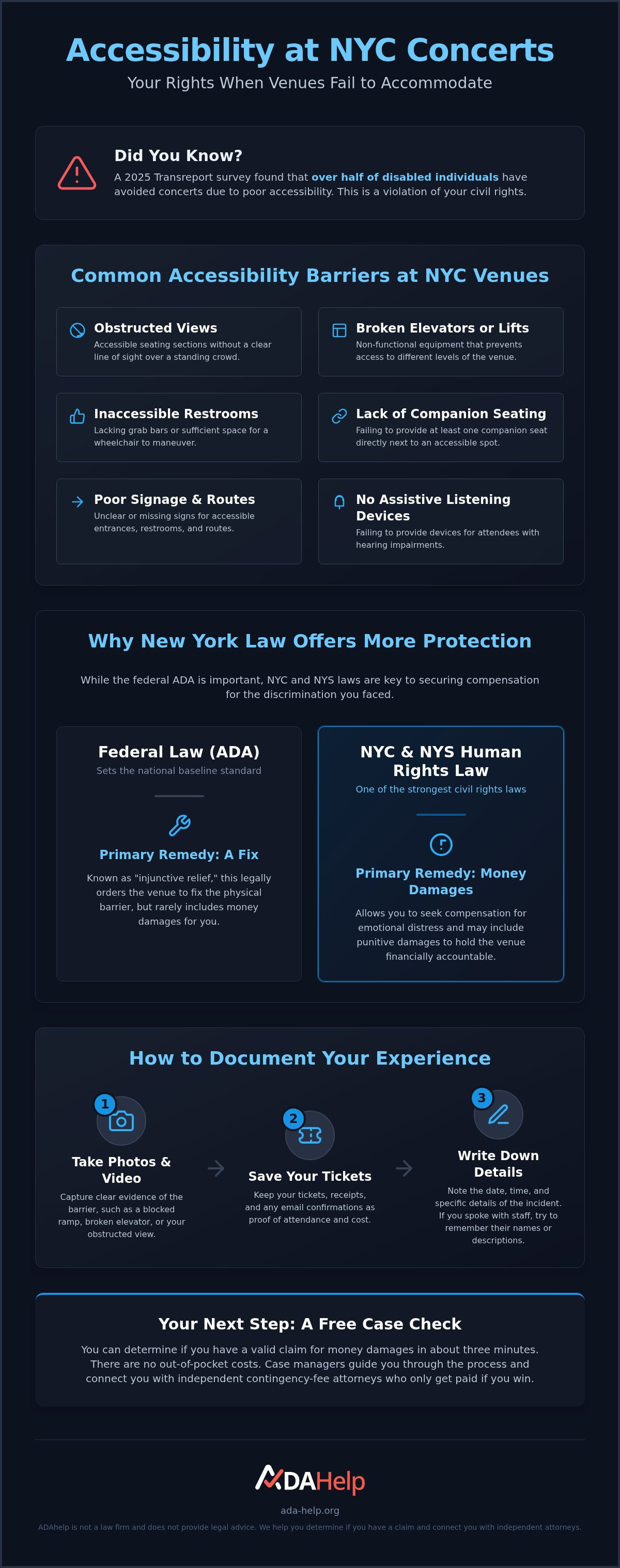
A 2025 survey by Transreport found that over half of disabled individuals avoided concerts due to poor accessibility. This guide will show you how to document your experience, understand the typical recovery ranges for public access claims, and ensure the venue makes the necessary changes for others.
Key Takeaways
- Identify common barriers like blocked views and broken elevators that violate your rights under local laws.
- Start your concert venue accessibility complaint NYC by taking photos of the barrier and saving your event tickets as proof.
- Learn why the New York City Human Rights Law allows you to seek money damages that federal laws do not provide.
- Discover how to report violations to NYC 311 or the New York State Division of Human Rights to ensure the venue fixes the problem.
- Get a free three-minute case check to determine if you have a claim without paying any out-of-pocket fees.
Common ADA Violations at NYC Concert Venues
You bought tickets to see your favorite band at a legendary NYC venue, but the experience was anything but inclusive. Many historic theaters and modern arenas across the five boroughs fail to meet basic standards. Identifying these failures is the first step in starting a concert venue accessibility complaint NYC. Knowing exactly what went wrong helps you determine if you have a valid claim for damages under city and state laws.
The Americans with Disabilities Act (ADA) sets the baseline for what every public space must provide. In New York City, the requirements are often even stricter to ensure everyone can enjoy live entertainment. When a venue ignores these rules, it isn't just an inconvenience; it is a violation of your civil rights.
To better understand your rights in these spaces, watch this helpful video:
Common violations we see at New York venues include:
- Broken elevators or lifts that leave fans stranded on the ground floor.
- Restrooms that lack grab bars or don't have enough room to turn a wheelchair.
- Security or front-of-house staff who refuse entry to service animals.
- A total lack of assistive listening devices for attendees with hearing impairments.
- Steep ramps that are dangerous to use without help.
Seating and Sightline Requirements
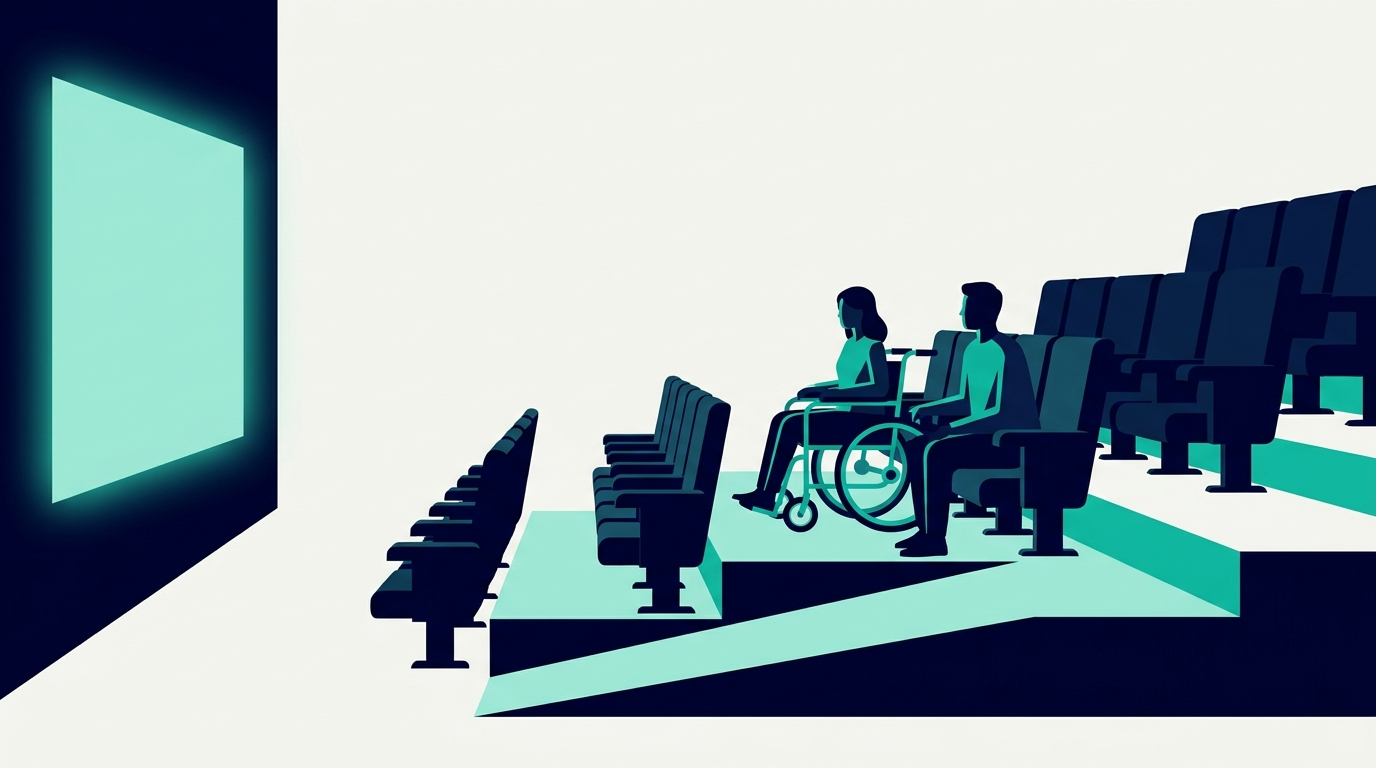
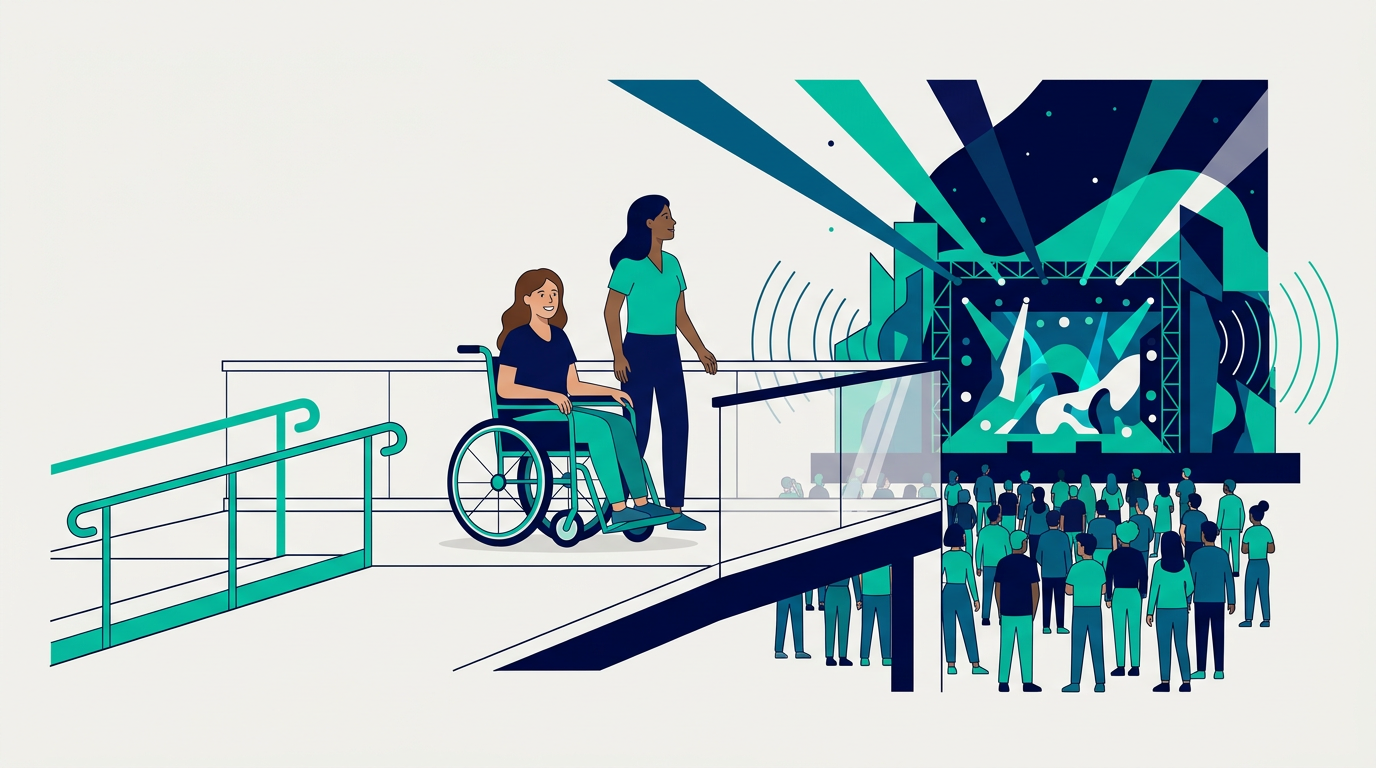
Venues can't just stick all accessible seating in the back corner. They must offer seats at different price points and in various locations throughout the house. A major issue in NYC is the "standing crowd" problem. If the crowd stands up and you are in an accessible section, you still have a right to see the stage. If the venue hasn't raised the platform to provide a clear line of sight over standing fans, they are likely in violation. You also have the right to sit next to your guests. Venues must provide at least one companion seat immediately next to each designated accessible spot.
Barriers to Entry and Movement
Getting into the venue shouldn't be a struggle. The path from the New York City sidewalk to your seat must be level or ramped correctly. Steps without a working lift are a clear violation. Once inside, you should have the same access to amenities as everyone else. This means concession stands and bars need lowered counters so you can order food or drinks comfortably. Signage is another frequent failure. Venues must use clear signs to point out accessible routes and restrooms. If you had to hunt for an entrance because there was no sign, that is a barrier to your experience. Documenting these specific issues is the key to a successful concert venue accessibility complaint NYC.
New York Laws and Your Right to Recovery
When you experience a barrier at a venue, you have rights under three layers of protection. The federal Americans with Disabilities Act (ADA) sets national standards; but the New York State Human Rights Law (NYSHRL) and the New York City Human Rights Law (NYCHRL) offer broader protections. These local laws are the primary tools for securing a recovery after filing a concert venue accessibility complaint NYC. If you aren't sure which laws apply to your specific situation, you can check your case for free.
The federal law focuses on building compliance; but city and state laws allow for financial penalties that hold businesses accountable to the individual. Understanding the difference between these laws is the foundation of a successful claim. While one law might fix the building; the other compensates you for the discrimination you suffered.
ADA Title III vs. NYC Local Laws
ADA Title III applies to private businesses that serve the public; including stadiums and theaters. If you File an ADA Complaint with the Department of Justice, the result is usually injunctive relief. This means the court orders the venue to fix the physical problem. However, federal law rarely grants money damages to the individual. This is where NYC local laws offer additional remedies. The NYCHRL is one of the most powerful civil rights laws in the country. It allows you to seek compensation for emotional distress and punitive damages; which are designed to penalize the venue for its actions.
Why Money Damages Matter
Money damages hold venues financially accountable for ignoring accessibility. In New York City; you do not need to prove a physical injury to seek a recovery. The humiliation and loss of enjoyment you felt because of a barrier are enough to form a claim. While typical recovery amounts vary case by case; these financial penalties are often the only way to motivate a venue to repair a broken lift or clear a blocked sightline. Filing under local laws ensures that the burden of the violation stays with the venue; not with you.
ADA Help - NY disability discrimination claims is not a law firm and does not provide legal advice. We act as your case manager to help you determine if your experience qualifies for a claim. If it does; we connect you with independent contingency-fee attorneys. You never pay anything out-of-pocket because fees are only taken from a successful recovery. We manage the paperwork and the process from start to finish so you can focus on your life.
How to Document a Venue Accessibility Incident
You are at the show and realize the accessible section has no view of the stage. This is the moment to start your documentation. Evidence is the only way to prove what happened after the event ends and the crowd leaves. To file a successful concert venue accessibility complaint NYC, you must act while you are still on-site. Your phone and your memory are the most important tools you have to secure justice.
Save your digital or physical ticket as proof of attendance. Write down a quick timeline of the evening while the details are fresh. What time did you arrive? When did you first ask for help? What exactly did the staff say to you? Recording these details immediately ensures the facts stay accurate. If you decide to File an ADA complaint later, this evidence will be your primary support. Detailed notes prevent the venue from claiming your experience was different than what actually occurred.
Capturing Useful Photographic Evidence
Use your phone camera to record physical violations. Take photos of the barrier from several different angles. If a ramp looks too steep or a doorway seems too narrow, place a common object like a water bottle next to it. This helps show the scale of the problem to anyone reviewing the case. Capture the lack of signage or any out of order signs on elevators. If the accessible section is blocked by standing fans, take a photo from your seated eye level. Clear photos are very difficult for a venue to dispute. Ensure your flash is on if the venue is dark; as blurry images are less effective for your claim. Digital photos also provide timestamps that prove exactly when the violation occurred during the show.
Gathering Witness Information
Ask your companions to write down what they saw and heard. Their account can support your story if the venue tries to deny your claim. If you see other fans struggling with the same barriers, ask for their contact information. A pattern of discrimination is much harder for a business to ignore. Pay close attention to what the staff says during the event. If a manager admits the elevator has been broken for weeks or says they ran out of assistive devices, write that name down. These admissions are powerful pieces of evidence for your concert venue accessibility complaint NYC. If you are unsure if your photos show a clear violation, you can visit ada-help.org for a free three-minute case check. We help you organize this evidence to determine if you have a valid path to a recovery.
Filing Your Concert Venue Accessibility Complaint
You have your photos and your timeline. Now you need to decide how to use them. Many New Yorkers feel a sense of urgency to report the issue immediately. While speed is important; choosing the wrong path can limit your ability to get a recovery. There are several ways to file a concert venue accessibility complaint NYC, and each serves a different purpose. You must understand these options before you submit any paperwork or sign any documents provided by the venue.
The most common route is reporting to NYC 311. This alerts the city to building code violations; like a broken elevator or a blocked exit. However; 311 is a government service request system. It might result in a fine for the venue, but it will not result in money damages for you. For a more formal legal step, you can file with the New York State Division of Human Rights. This starts a government investigation into the discrimination you faced. While these paths help the public; a private claim managed by experts is often the most effective way to secure personal justice and accountability.
311 Reporting vs. Private Claims
Think of 311 as a way to fix the building for the next person. It is an essential tool for public safety. If you encountered a steep ramp or an inaccessible restroom, a 311 report can trigger an inspection by the Department of Buildings. Private claims are different. They focus on the harm done to you. Under the New York City Human Rights Law; you are entitled to seek compensation for the emotional distress and frustration caused by the venue's negligence. You can do both; but a private claim requires specific evidence that links the barrier to your personal experience. If you want to know if your situation qualifies for a private claim, start your free case check today.
Avoiding Common Filing Mistakes
One of the biggest mistakes is waiting too long. In New York, strict statutes of limitations apply. For example; if the concert was in an NYC Park, you may only have 60 days to file certain types of complaints. Another common error is naming the wrong business. You might have been at a specific club, but that club is often owned by a large parent company. You must identify the correct legal entity to ensure your claim is valid, a step covered in our guide to building a wheelchair access discrimination case. Finally; be incredibly specific about the impact. Don't just say the seat was "bad." Explain that the standing crowd blocked your view entirely and the staff refused to relocate you to a higher platform.
Be very careful if the venue reaches out to you after the show. They may offer a small refund or a few free tickets to "make things right." Often; these offers come with fine print. If you sign a waiver or accept a small payment; you might accidentally give up your right to a much larger recovery. At ADAhelp, we handle the paperwork and manage the process from start to finish. We are not a law firm, but we connect you with independent attorneys who work on a contingency basis. This means you never pay out-of-pocket to hold these venues accountable for their actions.
Where to File: Agencies & Deadlines
Once you have documented the barrier, you have several places to formally file a concert venue accessibility complaint NYC. The New York State Division of Human Rights (DHR) accepts complaints from venues anywhere in the state, and if the show was in one of the five boroughs, the NYC Commission on Human Rights (CCHR) is also available. You can file a Title III complaint with the U.S. Department of Justice (DOJ), though the DOJ generally pursues injunctive relief rather than money damages. The Equal Employment Opportunity Commission (EEOC) only handles workplace disability claims, not public accommodation cases like a concert venue visit, so it does not apply here.
Deadlines matter. Following a 2024 change in New York law, both the DHR and the NYCHRL generally give you three years from the incident to file an administrative complaint, as long as the incident happened on or after February 15, 2024. Filing with an agency is not required before pursuing money damages through an independent attorney, and many claims move through the business discrimination filing process without ever needing a courtroom. If you want to see how these damages compare at other entertainment venues, review our cinema accessibility rights guide.
Get a Free NYC Accessibility Case Check
You shouldn't have to spend hours researching complex statutes just to get justice for a bad night at a theater or stadium. If you were ignored, dismissed, or physically blocked, filing a concert venue accessibility complaint NYC should be the start of your resolution; not another source of stress. ADAhelp is here to handle the heavy lifting so you don't have to. We are not a law firm and we do not provide legal advice. Instead; we act as your case management partner to determine if you have a valid claim for damages under the New York City Human Rights Law.
Our goal is to make the process as simple as possible. Many New Yorkers hesitate to take action because they think it will be expensive or time-consuming. We have removed those barriers. We help you understand if your experience qualifies for a recovery and connect you with independent attorneys who specialize in public access discrimination. This ensures you are using the strongest local laws to secure your rights.
Our Three-Minute Evaluation Process
Starting your claim is fast. You will answer a few simple questions about what happened at the venue. Did the staff refuse to help? Was the elevator broken? Could you see the stage from the designated section? Once you provide these details; our team reviews your experience to find the best path forward. We handle the initial information gathering and manage the filing process for you. This ensures your concert venue accessibility complaint NYC is accurate and names the correct parent company responsible for the venue's operations.
No Upfront Risk for New Yorkers
You never have to worry about the cost of seeking justice. ADAhelp operates on a model that puts the financial risk on the service provider; not on you. We connect you with independent contingency-fee attorneys. This means their fees are only taken if there is a successful recovery. You never pay any out-of-pocket fees for our case management or for the legal representation we help you secure. We manage the entire process from start to finish so you can focus on your life while we work on your case.
Start your free case check now at ADAhelp. It takes less than three minutes to find out if you have a case and what it might be worth. Typical recovery amounts vary based on the specific facts of your situation; but you won't know your options until you check. Don't let a venue's negligence go unanswered when you have the legal right to hold them accountable under New York law.
Protect Your Rights at New York Concerts
You deserve to enjoy live music without facing physical barriers or dismissive staff. By documenting the incident and understanding the power of the New York City Human Rights Law; you can turn a night of frustration into a path for accountability. Remember that local laws allow you to seek money damages for emotional distress; which federal regulations often miss. Acting quickly is vital because strict deadlines apply to these claims across the five boroughs. Whether you were blocked by a standing crowd or denied entry with a service animal; your experience matters.
When you are ready to move forward with your concert venue accessibility complaint NYC; let us handle the heavy lifting. Our team provides NYC-specific case management to help you determine if you have a valid claim. We connect you with independent contingency-fee attorneys; so you never have to worry about out-of-pocket costs. You only pay if you receive a recovery. Don't let a venue's negligence go unchallenged when the system is built to protect you.
Take your free three-minute case check today and start the process of securing the justice you deserve.
Frequently Asked Questions
Can I sue a concert venue for not being wheelchair accessible in NYC?
Yes, you can file a claim against a venue that fails to provide wheelchair access. In New York City; the NYCHRL protects your right to full and equal enjoyment of public spaces. This means the venue must provide accessible seating; restrooms; and entrances. If they don't; you can seek money damages for the discrimination you faced under city and state laws.
How much is an ADA accessibility claim worth in New York?
Typical recovery ranges for a concert venue accessibility complaint NYC vary based on the specific facts of your case. While the federal ADA usually only forces the venue to fix the physical barrier; the New York City Human Rights Law allows for compensation for emotional distress. Amounts are determined case by case; but these damages are meant to hold the venue accountable for the harm caused to you.
Do I need a lawyer to file an accessibility complaint against a venue?
You don't need to hire a lawyer out-of-pocket to start your claim. ADAhelp acts as your case manager to determine if you have a valid claim and then connects you with independent contingency-fee attorneys. These lawyers only get paid if you win a recovery; meaning there is no financial risk to you. We handle the paperwork and the intake process from start to finish.
What if the venue is an old building and says they are 'grandfathered' in?
There is no "grandfather clause" that exempts old buildings from the ADA or NYC accessibility laws. Private businesses must remove physical barriers if doing so is "readily achievable." In New York City; the standards are high and historic status is rarely a valid excuse for leaving a venue inaccessible to fans with disabilities. If a venue claims they are exempt; they are likely incorrect.
What should I do if a venue staff member was rude about my disability?
Rude or dismissive behavior from staff is a form of discrimination and should be documented immediately. Write down the staff member's name; their physical description; and exactly what they said or did. This behavior often proves that the venue lacks proper training and failed to provide a reasonable accommodation. This evidence is vital for your concert venue accessibility complaint NYC and helps prove the impact on your experience.
How long do I have to file a discrimination claim in New York City?
Your deadline depends on where the incident happened. If the venue is located within an NYC Park; you must file a written complaint within 60 calendar days. For other private venues; you generally have more time under the NYCHRL; but it is always best to start your case check immediately. Acting fast ensures your evidence is preserved and your memories of the event stay fresh.

Article by
ADA Help
Written by the ADAhelp editorial team and reviewed for accuracy before publishing. ADAhelp helps New Yorkers find out if they have a disability discrimination claim and manages the process end to end, working with independent attorneys who handle the legal work. We are not a law firm and do not provide legal advice.
Disclaimer
This article is general information about New York law, not legal advice, and reading it does not create an attorney-client relationship. ADAhelp is a case-management and intake service, not a law firm; legal representation is provided by independent attorneys. Recovery amounts and timelines vary by case, and past outcomes do not guarantee future results. For advice about your specific situation, speak with a qualified attorney or start the free case check.
Tags
Discriminated against in New York because of a disability?
A free three-minute check tells you if you can pursue a claim.
Check my case →New York onlyNo upfront costIndependent NY attorneysFree 3-minute check