Fired Because of Disability in New York: Your Rights
Reviewed for accuracy by the ADAhelp team before publishing. ADAhelp is not a law firm; legal work is handled by independent New York attorneys.
Fired because of disability in New York? Don't sign anything. Our guide explains your rights under state law and how to recover money damages. Free help.
Did your employer let you go shortly after you requested a medical accommodation or disclosed a health condition? You might think that New York's at-will employment rules mean you have no recourse. That is a common mistake. Being fired because of disability New York is a serious violation of your civil rights. While the federal ADA provides basic protections, the New York State Human Rights Law and the New York City Human Rights Law offer even broader paths to recover money damages for your lost wages and emotional distress.
We understand the weight of losing your health insurance and the anxiety that comes with a sudden loss of income. It is frustrating to feel like the system is rigged against the individual. This guide will show you exactly how to identify discrimination and the specific steps you must take to file a claim. You will learn how the latest legal updates, including the three-year statute of limitations for state claims, affect your situation. We provide a clear plan to help you move from confusion to a resolution without any out-of-pocket costs or financial risk to you.
Key Takeaways
- New York is an at-will state; however, being fired because of disability New York is a major legal exception that protects your job.
- Discover how the New York State and City Human Rights Laws provide broader protections and allow you to seek money damages for your loss.
- Learn to spot the warning signs of discrimination, such as sudden negative reviews after you disclose a medical condition or request an accommodation.
- Get a clear plan for what to do after a wrongful termination, including why you should avoid signing severance waivers immediately.
- Find out how to start a free three-minute case check to determine if your rights were violated without any out-of-pocket costs.
Is it Illegal to be Fired Because of a Disability in New York?
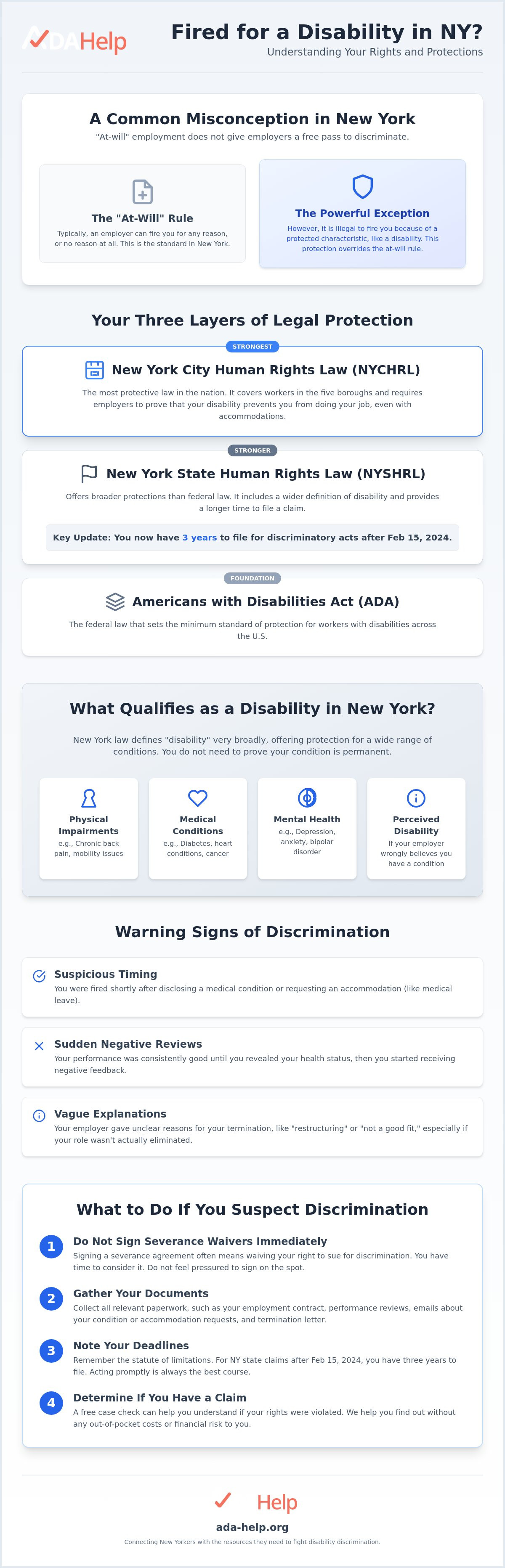
Yes, it is illegal to terminate an employee because of a medical condition or impairment. New York is an at-will employment state. This means an employer can usually fire you for any reason, or no reason at all. However, state and federal laws create a powerful shield for workers that overrides this rule. You cannot be fired because of disability New York. This protection is not just a suggestion; it is a legal requirement. The Americans with Disabilities Act (ADA) sets the federal standard for workplace rights, but New York laws often go much further to protect you.
These protections apply from the very first interaction you have with a company. If a business refuses to hire you because of a disability, they are breaking the law. If they fire you after you disclose a diagnosis or a need for treatment, they are also violating your rights. You are even protected if your employer wrongly believes you have a condition. This is known as a perceived disability. If their mistaken belief leads to your termination, you may have a valid claim for money damages.
To better understand how these protections work in our state, watch this helpful video:
The Definition of Disability in New York
New York provides some of the strongest disability protections in the country. The New York State Human Rights Law (NYSHRL) defines disability very broadly. It includes physical, medical, or mental impairments that prevent the exercise of a normal bodily function. It also covers conditions that are demonstrable by medically accepted clinical or laboratory diagnostic techniques. This means things like chronic back pain, diabetes, or heart conditions are covered. Mental health is treated with the same seriousness. Conditions like clinical depression, bipolar disorder, or severe anxiety qualify for protection. You do not need to prove your condition is permanent to be protected under New York law.
At-Will Employment vs. Disability Rights
Employers often use the at-will excuse to hide discriminatory motives. They might tell you that the company is moving in a different direction or that your role was eliminated. If your disability was a motivating factor in that decision, the at-will rule does not apply. Discrimination overrides the employer's right to fire you at will. Under the NYSHRL, you now have three years to file a complaint for discriminatory acts that happened on or after February 15, 2024. This gives you time to gather evidence and seek a resolution. If you were recently let go and suspect your health played a role, you can start a free case check. We help you determine if your rights were violated and connect you with professionals who can help you recover money for your losses.
Understanding Your Rights Under New York Law
If you were fired because of disability New York, you aren't just protected by one law. You're protected by three layers of defense. The federal Americans with Disabilities Act (ADA) acts as a baseline for the entire country. However, New York workers have access to much stronger tools. The New York State Human Rights Law (NYSHRL) and the New York City Human Rights Law (NYCHRL) offer protections that go far beyond what federal law provides. These local laws make it easier to prove your case and often lead to higher financial recoveries.
The New York State Division of Human Rights enforces state laws that apply to every employer in the state. Recent updates have made these protections even more robust. As of December 19, 2025, the NYSHRL explicitly includes "disparate impact" liability. This means a company policy can be illegal if it unfairly affects disabled workers, even if the employer didn't intend to discriminate. Additionally, state law now gives you a full three years to file a complaint for any discriminatory act occurring after February 15, 2024. This extended timeline is vital for building a strong case after a sudden job loss.
Why New York City Laws Matter for Your Recovery
The New York City Human Rights Law (NYCHRL) is the most powerful tool available to workers in the five boroughs. It uses a lower burden of proof than federal law. You don't have to prove that your disability was the only reason you were fired. You only need to show that you were treated "less well" than other employees because of your condition. This law is designed to be broadly interpreted in favor of the victim. In Fiscal Year 2025, the NYC Commission on Human Rights resolved 374 cases and secured over $17 million in damages and penalties. This highlights how effective city-level claims can be for those seeking justice.
Injunctive Relief vs. Money Damages
Federal law often focuses on "injunctive relief." This is a legal term that means the court orders your employer to fix a problem. It might mean getting your job back or forcing the company to change its handbook. While this sounds helpful, most people don't want to return to a workplace where they were mistreated. You likely need money to cover your bills and the stress of the situation.
New York state and city laws focus heavily on "money damages." This includes several types of compensation:
- Back Pay: The wages and benefits you lost from the day you were fired until the date of a settlement or trial.
- Front Pay: Compensation for future lost wages if you can't find a comparable job.
- Emotional Distress: Money for the mental pain and anxiety caused by the discrimination.
- Punitive Damages: Extra money awarded to punish the employer for especially bad behavior.
In FY 2024, the state agency awarded more than $8 million to complainants. Most successful claims in New York combine all three levels of law to maximize the recovery. You can find out which laws apply to your specific situation with a free three-minute case check.
How to Identify Disability Discrimination at Work
How do you know if you were fired because of disability New York or if it was truly a business decision? Discrimination is rarely a loud or obvious event. It is usually a series of subtle shifts in how your employer treats you. You might notice a sudden change in the "vibe" of the office after you disclose a diagnosis. Your supervisor might stop inviting you to strategy meetings. They might stop giving you high-priority assignments or client leads. These actions are often the first signs that your job is at risk. Spotting these signs early is the first step toward proving you were fired because of disability New York.
- Sudden Negative Reviews: You have years of positive feedback. Suddenly, your manager finds "performance issues" right after you mention a health condition or a scheduled surgery.
- Exclusion: You are suddenly left out of emails or meetings that are vital to your role.
- Hostile Comments: A boss makes "jokes" about your medical appointments or suggests you aren't "reliable" anymore because of your health.
- Timing: You are let go within days or weeks of requesting a change to your workspace, a modified schedule, or a leave of absence.
Pretextual Firing Scenarios
Employers often hide behind a "pretext." This is a fake reason used to cover up the real, illegal reason for your termination. They might tell you that your role is being eliminated due to a company-wide reorganization. If you see your job posted online under a different title a week later, that excuse was a pretext. They might also claim you were fired for a minor policy violation, like being five minutes late once. If other employees are late and face no discipline, you are being singled out. For example, if a company claims they are "downsizing" to save money but they keep three junior employees with less experience than you, their logic fails. Comparing how your boss treats you versus your non-disabled coworkers is the best way to spot this bias.
Denial of Reasonable Accommodations
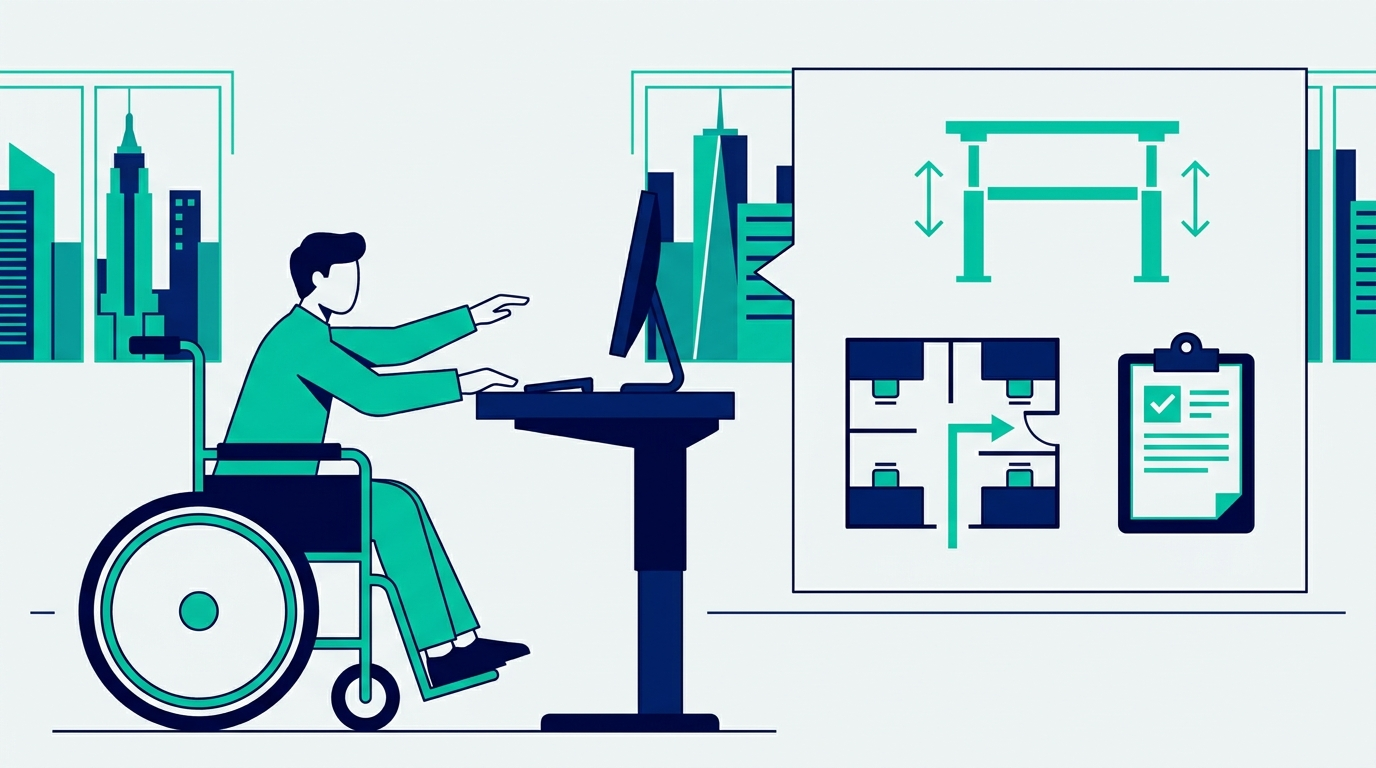
A reasonable accommodation is a change to your job or environment that helps you work with your disability. This could be a modified schedule, a specific chair, or remote work options. New York law requires employers to engage in an "interactive process." This is a formal, good-faith conversation to find a solution that works for both sides. The interactive process isn't just a suggestion; it's a legal requirement. Your employer must sit down with you and explore options. They can't just say "no" and walk away. If they shut down the conversation without a valid reason and fire you instead, they are breaking the law. Effective December 5, 2025, the New York State Human Rights Law makes it strictly illegal to retaliate against you for requesting an accommodation. You shouldn't lose your income just because you asked for the tools to do your job.
What to Do if You Were Fired Because of a Disability
You just lost your job. It's a shock. But you need to act fast. Your employer might push a severance agreement across the table during your termination meeting. Stop. Don't sign it. These documents often include waivers that strip away your right to sue for being fired because of disability New York. You usually have a period of time to review these offers. Use that time to think clearly. Signing away your rights for a few weeks of pay could cost you thousands in potential damages later.
Request a written reason for your termination from HR immediately. In New York, you have a right to know the official reason you were let go. If they refuse or give a vague answer, write down exactly what was said and who said it. Start a detailed timeline of events. Note every meeting, every comment about your health, and every request for help you made. Memories fade quickly under the stress of a job loss. A written record is your best tool for proving the truth.
How to Document Your Case
You need proof to win. Save copies of your performance reviews and any emails praising your work. If you have medical notes or records of your accommodation requests, keep them in a safe place outside of your office. Gather all your evidence before you lose access to your company email, Slack account, or internal portals. If you aren't sure where to start, use our step-by-step checklist for New Yorkers. This guide helps you organize your facts so you can present a clear story to a professional.
Filing a Claim in New York
You have two main paths for seeking justice. You can file with the federal Equal Employment Opportunity Commission (EEOC) or the New York State Division of Human Rights. State law is often the better choice for New Yorkers. It covers almost all employers and allows for higher money damages for emotional distress. You must also watch the deadlines. For state claims occurring on or after February 15, 2024, you have three years to file. Federal claims usually have a much shorter window of only 300 days. Missing these dates can end your case permanently. For a full walkthrough of the process, see our guide on how to report an ADA violation and file a claim in New York.
Don't try to handle the complicated paperwork and filing rules on your own. We can help you organize your claim and connect you with the right professionals to handle the heavy lifting. Start your free three-minute case check today to see if you have a claim.
Where to File: Agencies and Deadlines
If a New York employer fired you or denied you a reasonable accommodation because of your disability, you can file a complaint with the agency that fits your situation. Each has its own process and deadline, so act promptly:
- NYS Division of Human Rights (DHR) — statewide claims under the NYSHRL, generally within three years for incidents on or after February 15, 2024. File at dhr.ny.gov.
- NYC Commission on Human Rights (CCHR) — workplace disability discrimination within the five boroughs, with the strong money-damages remedies of the NYCHRL. Report at nyc.gov/cchr.
- EEOC — federal workplace disability claims under the ADA, generally within 300 days of the incident. File at eeoc.gov.
- U.S. Department of Justice (ADA) — federal ADA rights and standards for public accommodations and government services. Learn more at ada.gov.
Not sure which fits? Start a free case check and we'll help you find the right path.
Related guides: Employment Disability Discrimination New York · How to Document Workplace Discrimination in NY · Do I Have an ADA Case in New York?.
How ADA Help - NY disability discrimination claims Manages Your New York Disability Claim
If you were fired because of disability New York, you shouldn't have to face the legal system alone. The process of filing a claim and finding the right representation is often overwhelming. You are likely dealing with the sudden loss of your income and health insurance. ADA Help - NY disability discrimination claims was created to remove the stress and financial risk from this journey. We aren't a law firm and we don't provide legal advice. Instead, we act as your proactive partner and guide. We handle the heavy lifting of case management so you can focus on your recovery. Our team understands the local environment and the specific hurdles New Yorkers face after a wrongful termination.
Our goal is to turn your frustration into a clear path toward a resolution. You don't need to spend hours researching statutes or trying to find an attorney who will take your call. We streamline the entire experience. By focusing on the specific details of your termination, ADA Help - NY disability discrimination claims helps build a narrative that shows exactly how your rights were violated. This organized approach makes it much easier for you to move forward with confidence. You can start this process right now with a free three-minute case check on our website.
The Case Management Process
Our work begins the moment you complete your initial check. We evaluate your situation against the high standards set by the NYSHRL and NYCHRL. If your case has merit, our team moves into action. We help you organize your evidence, from performance reviews to medical notes. ADA Help - NY disability discrimination claims manages the paperwork and the intake flow to ensure your claim is as strong as possible. Once your file is ready, we connect you with independent contingency-fee attorneys who specialize in New York disability law. This low-risk path ensures real New Yorkers get the justice they deserve without the burden of managing a complex system by themselves. We stay with you throughout the intake process to ensure every detail is handled correctly.
No Upfront Costs or Risks
Many people hesitate to seek help because they worry about the cost of hiring a professional. Some referral services in the city even charge a fee just to speak with someone. ADA Help - NY disability discrimination claims does things differently. There are no upfront costs and no hourly fees. We only get paid if you recover money. This contingency model means the financial risk stays with the service provider; not with you. We manage the entire claim flow from start to finish. If you want to learn more about your broader protections, read our guide on Employment Disability Discrimination New York. Our goal is to make the path to resolution simple and stress-free. Start your free case check today to take the first step toward getting the money damages you are owed.
Take the First Step Toward Justice
You now know that New York provides some of the strongest workplace protections in the country. Even if you were an at-will employee, you cannot be fired because of disability New York. We have covered how to spot pretextual firing and the importance of documenting every interaction before you lose access to your work accounts. Whether it is a denied accommodation or a sudden negative review, these actions have consequences for employers. Stop the cycle of frustration and start looking toward your recovery.
ADA Help - NY disability discrimination claims is ready to act as your advocate. We handle the complex intake and organization of your case so you don't have to face the system alone. Our process is designed to be entirely risk-free. We operate on a no recovery, no fee model; meaning we only get paid if you win. You can get a free case evaluation in minutes through our portal. Start your free three-minute case check now to protect your future and hold your employer accountable. You deserve a fair path toward a resolution and the money damages necessary to move forward with your life.
Frequently Asked Questions
Can I be fired while on short-term disability leave in New York?
Yes, you can be fired while on leave, but your employer cannot fire you because of your disability or the fact that you took leave. New York laws protect you from being targeted for using medical benefits or requesting a leave of absence as an accommodation. If your employer fires you while you are away, they must prove the decision was based on legitimate business reasons that have nothing to do with your health condition. Firing an employee to avoid providing a reasonable accommodation is a violation of the NYSHRL.
What is the typical settlement for disability discrimination in NYC?
Typical settlements vary case by case because they are based on your specific lost wages and emotional distress. However, New York City laws allow for significant recoveries. In Fiscal Year 2025, the New York City Commission on Human Rights resolved 374 cases and secured over $17 million in total damages and penalties. This demonstrates that city-level claims can result in substantial money damages for victims of workplace bias. Your recovery depends on factors like your previous salary and how long it takes you to find a new job.
How long do I have to file a claim after being fired in NY?
You have three years to file a complaint with the New York State Division of Human Rights for discriminatory acts that occurred on or after February 15, 2024. If the incident happened before that date, the limit was only one year. For federal claims with the EEOC, you must act much faster as the deadline is generally 300 days. It is vital to begin your case check as soon as possible to ensure you don't miss these strict legal windows.
Do I need a lawyer to file a disability discrimination complaint?
You aren't required to have a lawyer, but the filing process is complex and involves strict deadlines. Many individuals find the paperwork and evidence gathering to be overwhelming while they are also looking for a new job. ADAhelp manages the entire intake process for you and connects you with independent contingency-fee attorneys. This means you get professional help without having to pay any hourly fees or upfront costs.
What counts as a reasonable accommodation in a New York office?
A reasonable accommodation is any change to your work environment or schedule that helps you do your job. Common examples in New York offices include modified work hours for medical appointments, specialized office furniture, or software that assists with visual or hearing impairments. Employers must participate in a good-faith conversation called the interactive process to find a solution. If they refuse to discuss these options and fire you instead, you may have a claim for being fired because of disability New York.
Can I still file a claim if I was an at-will employee?
Yes, you can still file a claim. At-will employment means your boss can fire you for many reasons, but they can never fire you for an illegal reason. Discrimination is a major exception to the at-will rule. If your disability was a motivating factor in your termination, your employer has violated the law. You are protected by the NYSHRL and NYCHRL regardless of your at-will status.

Article by
ADA Help
Written by the ADAhelp editorial team and reviewed for accuracy before publishing. ADAhelp helps New Yorkers find out if they have a disability discrimination claim and manages the process end to end, working with independent attorneys who handle the legal work. We are not a law firm and do not provide legal advice.
Disclaimer
This article is general information about New York law, not legal advice, and reading it does not create an attorney-client relationship. ADAhelp is a case-management and intake service, not a law firm; legal representation is provided by independent attorneys. Recovery amounts and timelines vary by case, and past outcomes do not guarantee future results. For advice about your specific situation, speak with a qualified attorney or start the free case check.
Tags
Discriminated against in New York because of a disability?
A free three-minute check tells you if you can pursue a claim.
Check my case →New York onlyNo upfront costIndependent NY attorneysFree 3-minute check