Disability Discrimination in Private Schools New York
Reviewed for accuracy by the ADAhelp team before publishing. ADAhelp is not a law firm; legal work is handled by independent New York attorneys.
Facing disability discrimination in private schools New York? Learn your rights, how to get accommodations, and recover tuition costs. Free case check.
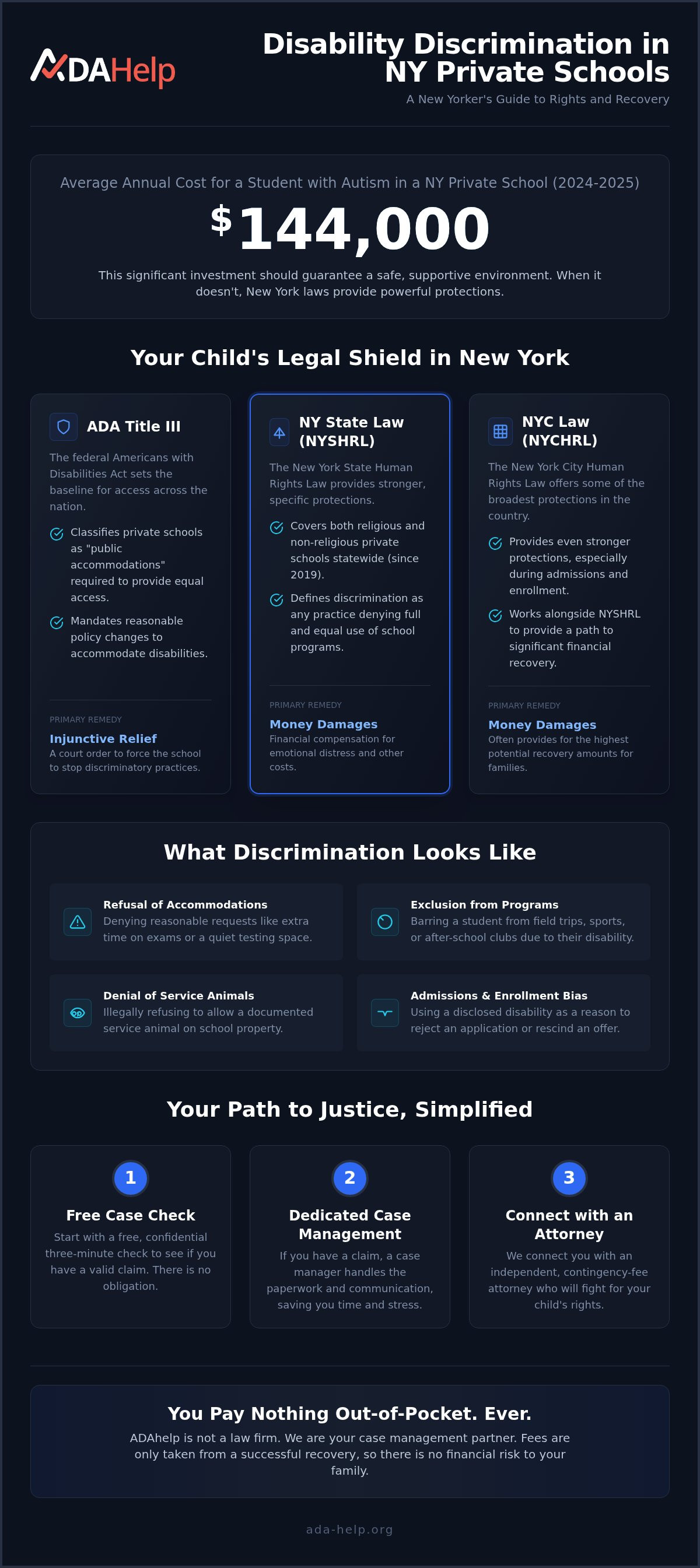
Did you know that the average cost for a student with autism in a New York private school reached approximately $144,000 per year in 2024-2025? You expect that kind of investment to buy a safe and supportive environment; yet many families still face exclusion or harassment. It's common to feel ignored by school administrations or to worry that the high cost of legal action makes justice impossible. You might even wonder if the ADA truly applies to these private institutions.
This guide explains your rights regarding disability discrimination in private schools New York and how to secure reasonable accommodations. You'll learn how to obtain financial recovery for emotional distress or forced tuition costs under state and city laws. ADA Help - NY disability discrimination claims is not a law firm; instead, we act as your proactive case management partner. We offer a free three-minute case check to determine if you have a valid claim and connect you with independent contingency-fee attorneys. You pay nothing out-of-pocket because fees are only taken if there is a successful recovery.
Key Takeaways
- Know that New York laws protect your child's rights in both religious and non-religious private institutions.
- Identify common signs of disability discrimination in private schools New York, such as refusing service animals or denying extra time for exams.
- Learn how the NYSHRL and NYCHRL allow you to seek money damages for emotional distress and tuition costs.
- Start your case with a free three-minute check and pay nothing out-of-pocket unless your case is successful.
- See how a dedicated case manager handles the paperwork and connects you with an independent attorney to fight for your child.
What counts as disability discrimination in NY private schools?
Disability discrimination in private schools New York occurs when a student faces unfair treatment due to a physical or mental impairment. This behavior isn't limited to physical access like ramps or elevators. It includes any policy or action that prevents your child from participating in school life on equal terms with their peers. Whether it's a learning disability or a medical condition; the law requires these institutions to provide a level playing field for every student.
Under the 2019 amendment to the New York State Human Rights Law; disability discrimination is defined as any practice that denies a student full and equal use of a private school's facilities or programs. This law covers both religious and non-religious private schools across the state. Before this change; many religious institutions claimed they were exempt from state oversight. Today; those excuses no longer hold up in the face of New York's strict anti-discrimination standards.
To better understand how these laws apply to different types of schools; watch this helpful video:
Exclusion from school programs
Does the school leave your child behind during field trips? Schools cannot bar a student from educational travel just because they have a disability. This protection extends to after-school clubs; music programs; and sports teams. If the school claims they can't manage your child's needs during a trip to a museum or a local park; they might be violating the law. Private institutions must provide the same opportunities for social interaction that every other student receives. Access to daily activities is a right; not a privilege that the school can grant or deny at will.
Admissions and enrollment bias
Addressing disability discrimination in private schools New York often requires looking at how admissions officers handle medical disclosures. It is generally illegal for a school to use a disability as a reason to screen out applicants. Schools shouldn't ask questions designed to identify medical conditions for the purpose of rejection. If a school offers your child a spot and then tries to rescind that offer after learning about a diagnosis; you likely have a claim. New York City laws provide even stronger protections for families during the enrollment phase. If you suspect an application was rejected due to a disability; ADA Help - NY disability discrimination claims can help you start a free case check. Our process is simple and low-risk; we connect you with independent attorneys so you never pay out-of-pocket.
How New York laws protect your child
Your child's rights don't come from a single source. Instead, a combination of federal, state, and city rules creates a safety net. This multi-layered approach is vital when fighting disability discrimination in private schools New York. While federal law sets the baseline for access, New York's specific laws often provide the actual financial recovery families need to move forward. Access is a right. These laws ensure your child can learn in an environment free from exclusion or harassment.
Understanding how these laws interact helps you build a stronger case. The federal government ensures basic access; however, New York lawmakers have gone much further. They've created a system where schools face real penalties for failing their students. This structure provides a clear path toward resolution if a school refuses to follow the rules. It turns a sense of frustration into a focused plan for justice.
The role of ADA Title III
The Americans with Disabilities Act (ADA) classifies private schools as "public accommodations." This legal term means these schools must provide equal access to their services. Title III requires schools to make reasonable changes to their policies to accommodate a student's disability. For example, a school might need to adjust its testing schedule or allow a service animal in the classroom. The primary goal of the ADA is injunctive relief. This is a legal term for a court order that forces a school to stop its discriminatory practices. It is excellent for fixing physical barriers or changing unfair rules.
State and City Human Rights Laws
If you seek financial recovery, you must look to the New York State Human Rights Law (NYSHRL) and the New York City Human Rights Law (NYCHRL). These laws are the "teeth" of the system for Real New Yorkers. The NYSHRL protects students from harassment and bullying across the entire state. You can file a formal complaint with the New York State Division of Human Rights. For any acts occurring on or after February 15, 2024, you have three years to file your claim. This is a significant increase from the previous one-year deadline.
For schools located within the five boroughs, the NYCHRL offers even broader protections. It is widely considered one of the most powerful civil rights laws in the nation. While federal law might force a school to build a ramp, these local laws are where money damages for emotional distress or tuition recovery usually come from. They ensure that disability discrimination in private schools New York has actual financial consequences for the institution. If you believe your child has been treated unfairly, you can start a free case check today to see which laws protect your family.
Common examples of private school ADA violations
Identifying disability discrimination in private schools New York isn't always straightforward. It often hides behind school policies that seem fair on the surface but exclude students with specific needs. For example, a school might have a strict "no animals" rule. If they apply this to a trained service dog needed for a student's safety, they are likely violating federal and state laws. These violations can happen in the classroom, the cafeteria, or even on the school's website.
School safety also includes protection from harassment. Effective in the 2026-2027 academic year, amendments to the Dignity for All Students Act (DASA) will require private schools to use enhanced digital reporting systems for bullying. If an administration ignores reports of students targeting your child's medical condition, they are failing their legal duty. Schools must take proactive steps to stop harassment once they are aware of it. Ignoring the problem is a form of discrimination that can lead to significant money damages for your family.
Physical and digital barriers
Many private schools in New York operate out of historic buildings with narrow hallways and steep stairs. While these buildings have character, they cannot serve as an excuse for exclusion. Schools must remove physical barriers where it's easy to do so. This includes providing accessible bathrooms and ensuring students can reach their classrooms without help. Digital access is just as important. In our modern learning environment, a school's online portal for homework must work with screen readers. If a student with a visual impairment cannot access their assignments, the school is creating a digital barrier to their education.
Failure to provide reasonable accommodations
A reasonable accommodation is a change in rules or practices that allows a student to succeed. Schools often fail this test by refusing to be flexible. Common violations include:
- Testing environments: Denying a student a quiet space or extra time for exams when their disability requires it.
- Medical policies: Refusing to modify a "no food in class" policy for a student with diabetes who needs to manage their blood sugar.
- Learning materials: Declining to provide textbooks in large print or braille for students with vision loss.
These patterns aren't unique to schools; the same fights over reasonable accommodation denied in New York come up in workplaces and public spaces too, and the legal standards for what counts as "reasonable" are closely related.
These failures prevent your child from receiving the education you pay for. If you've seen these signs, don't wait for the school to fix it themselves. You can start a free three-minute case check with ADAhelp to see if you have a valid claim. We help you understand your rights and connect you with independent attorneys who work on a contingency basis.
What can you recover from a discrimination claim?
You likely want to know what a successful claim means for your family's future. While every situation is different; families often secure money damages for emotional distress. This compensation addresses the pain, anxiety, and social isolation your child suffered due to unfair treatment. If the disability discrimination in private schools New York was so severe that you had to enroll your child in a different institution; you might also recover the cost of tuition. These financial outcomes hold schools accountable for the harm they cause and provide the resources needed for your child's transition to a better environment.
Typical recovery amounts vary based on the specific facts of your case and the severity of the incident. For a broader sense of what similar cases have settled for, see our guide to disability discrimination settlement amounts in New York. There is no guaranteed payout; however; New York laws are designed to make your family whole again. It is vital to understand that while the federal ADA provides injunctive relief to change school policies; the NYCHRL is the law that typically provides actual money damages in the city. Using these laws together gives you the strongest path toward a fair resolution and financial recovery. The New York State Division of Human Rights also processes claims that can lead to settlements for families throughout the state.
Injunctive relief vs. money damages
Injunctive relief is a legal tool that forces a school to change its illegal policies immediately. It might require them to install a ramp; provide a quiet testing room; or allow a service animal in the cafeteria. This stops the discrimination from continuing for your child and others. Money damages are different. They focus on the harm already done to your child's well-being and your family's finances. These payments compensate you for the stress and the financial burden the school's failure created. In many New York cases; you can secure both a change in school policy and a financial settlement to ensure the school fixes its behavior permanently.
The cost of filing a claim
Many parents hesitate to act because they fear high legal bills or confusing paperwork. You don't need to worry about those barriers here. Starting your case check with ADA Help - NY disability discrimination claims is free for all New Yorkers. We act as your capable guide to determine if you have a valid claim. We then connect you with independent attorneys who work on a contingency basis. This means you pay nothing out-of-pocket to start your case or keep it moving. Fees are only taken if there is a successful recovery in your case. If you don't win; you don't owe any legal fees. You can start your free three-minute case check today to begin the process of securing the accommodations and recovery your child deserves.
How ADAhelp manages your New York school case
Dealing with a private school administration can feel like shouting into a void. They often have layers of bureaucracy designed to protect the institution rather than your student. ADAhelp changes that dynamic. We act as your proactive partner, handling the heavy lifting so you can focus on your child's well-being. Our process is built for speed and results. We specialize in Government and School Discrimination Case Management in New York to ensure your family's rights are protected under the NYSHRL and NYCHRL.
The ADAhelp three-minute check
Most parents don't know where to start or if they even have a valid claim. Our three-minute check solves this problem immediately. You answer a few simple questions about the incident at the private school. This process is entirely confidential and tailored specifically for Real New Yorkers. You don't have to wait weeks for a legal appointment or pay expensive consultation fees. Instead, you get an immediate sense of whether disability discrimination in private schools New York has occurred. It's a stress-free way to identify your next steps.
End-to-end case management
Once we identify a potential claim, our team assists you with the information gathering process. Building a strong case requires clear documentation of the incident and the school's response. We know exactly which authorities need to receive your claim. For acts of discrimination occurring on or after February 15, 2024, our team ensures your filing meets the updated three-year statute of limitations. Our expertise in ADA Title III case management New York ensures that no detail is missed during the filing process.
The biggest worry for many families is the cost of legal action. We remove that barrier. ADAhelp connects you with independent attorneys who work on a contingency-fee basis. This means you pay nothing out-of-pocket to start your case or keep it moving. Fees are only taken if there is a successful financial recovery. If there is no recovery, you owe nothing. This low-risk approach gives you the ability to seek justice without financial fear. Start your free three-minute case check now to see how we can help your family secure the recovery you deserve.
Where to File: Agencies & Deadlines
If you believe your family has experienced disability discrimination in private schools New York, several agencies can take a formal complaint. Deadlines differ by agency, so it helps to know your options before you act.
- New York State Division of Human Rights (DHR): Handles NYSHRL complaints against private schools statewide. For acts occurring on or after February 15, 2024, you have three years to file. Learn more at dhr.ny.gov.
- NYC Commission on Human Rights (CCHR): If the school is located within the five boroughs, you can file under the NYCHRL, which generally also allows three years to bring a claim. Details are available from the NYC CCHR.
- U.S. Department of Justice (ADA Title III): The DOJ enforces Title III against private schools as public accommodations. There is no strict filing deadline, but complaints are best submitted promptly through ada.gov.
- U.S. Equal Employment Opportunity Commission (EEOC): If the discrimination involves a school employee rather than a student, that claim typically goes to the EEOC instead, which has its own, shorter filing deadlines.
Because these windows can overlap with the state's three-year NYSHRL deadline, it's best to start your case check as soon as possible so nothing is missed.
Take Action for Your Child's Future
Your child's education should be a source of growth; not a source of exclusion. You now know that New York laws protect students in all private institutions. These laws ensure that schools provide reasonable accommodations and a safe learning environment. While federal law stops the unfair treatment; the NYSHRL and NYCHRL allow you to seek money damages for the harm and stress caused.
As your case management partner; ADAhelp specializes in New York State and City Human Rights Laws to help you secure justice. Fighting disability discrimination in private schools New York doesn't have to be a financial burden. We offer a free initial case evaluation to determine if you have a valid claim. Our contingency-fee model means there is no recovery; no fee. You pay nothing out-of-pocket while we connect you with independent attorneys who fight for your rights.
Take the first step toward a resolution today. You can start your free three-minute case check now. We are here to help you turn frustration into a clear, stress-free path forward.
Frequently Asked Questions
Do New York private schools have to follow the ADA?
Yes, the ADA classifies private schools as public accommodations under Title III. This means they must provide equal access and remove physical or policy barriers for all students. While religious schools may have certain exemptions from specific federal requirements; New York's state and city laws often close those gaps. These local rules ensure that your child is protected regardless of the school's religious affiliation.
What is the difference between the ADA and the New York State Human Rights Law?
The ADA focuses primarily on stopping current discrimination or fixing physical barriers; it rarely provides money damages in private school cases. The New York State Human Rights Law goes further by allowing families to seek financial recovery for emotional distress and harassment. While both laws prohibit unfair treatment; the state law is often your primary path for securing a settlement and holding the school accountable.
Can a private school expel a student for having a disability?
No, a private school cannot legally expel or exclude a student simply because of a medical condition or impairment. If a school claims they can no longer "meet the needs" of your child without exploring reasonable changes; they may be violating the law. This type of exclusion often qualifies as disability discrimination in private schools New York and can lead to a valid claim for damages.
How much does it cost to file a disability discrimination claim in New York?
It costs nothing out-of-pocket to start your case check with ADAhelp. We offer a free initial evaluation to see if you have a valid claim. If your case moves forward; we connect you with independent attorneys who work on a contingency-fee basis. This means fees are only taken from a successful recovery. If you don't receive a settlement; you don't owe any legal fees.
How long do I have to report discrimination in a New York school?
Filing a claim for disability discrimination in private schools New York follows specific timelines. For acts occurring on or after February 15, 2024; you have three years to file a complaint with the New York State Division of Human Rights. This is a significant increase from the old one-year deadline. It is best to act quickly while evidence is fresh. Our team helps you document the facts to meet these state deadlines.
What counts as a reasonable accommodation in a private school setting?
A reasonable accommodation is any practical change to a policy or practice that allows a student with a disability to participate fully. Examples include allowing a service animal; providing extra time for exams; or modifying a medical policy to allow snacks in class. Schools must provide these adjustments unless they can prove the change would cause an "undue burden" or fundamentally alter their program.
Article by
ADA Help
Written by the ADAhelp editorial team and reviewed for accuracy before publishing. ADAhelp helps New Yorkers find out if they have a disability discrimination claim and manages the process end to end, working with independent attorneys who handle the legal work. We are not a law firm and do not provide legal advice.
Disclaimer
This article is general information about New York law, not legal advice, and reading it does not create an attorney-client relationship. ADAhelp is a case-management and intake service, not a law firm; legal representation is provided by independent attorneys. Recovery amounts and timelines vary by case, and past outcomes do not guarantee future results. For advice about your specific situation, speak with a qualified attorney or start the free case check.
Tags
Discriminated against in New York because of a disability?
A free three-minute check tells you if you can pursue a claim.
Check my case →New York onlyNo upfront costIndependent NY attorneysFree 3-minute check