Disabled Access to Public Buildings NYC: Rights Guide
Reviewed for accuracy by the ADAhelp team before publishing. ADAhelp is not a law firm; legal work is handled by independent New York attorneys.
Denied disabled access to public buildings NYC? Learn your rights under city law to seek money damages for discrimination. Get a free case check with our adv...
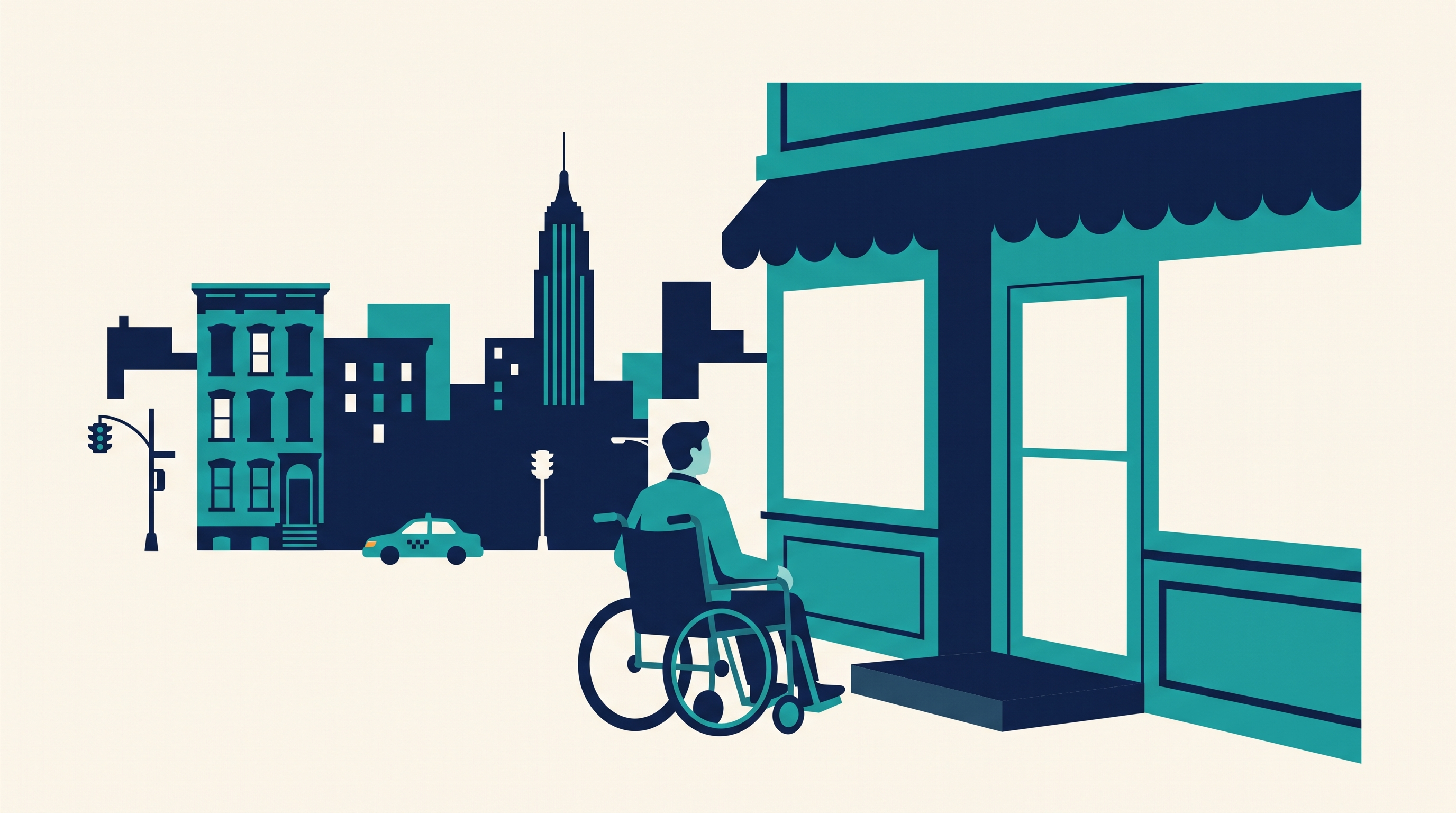
You planned a dinner in Manhattan, but when you arrived, a single step at the entrance stopped you. Perhaps the door was too heavy to move, or the restroom was blocked by storage boxes. It's frustrating to be turned away because of a lack of disabled access to public buildings NYC. We understand the stress of facing a narrow door or a missing ramp when you just want to go about your day. You deserve to move through your city without these barriers.
This guide explains your rights and how you can seek a recovery for discrimination. While the federal ADA focuses on fixing the physical building, the New York City Human Rights Law allows you to seek money damages for the exclusion you faced. ADA Help - NY disability discrimination claims is not a law firm and does not provide legal advice. Instead, we act as your advocate to help you determine if you have a claim and handle the paperwork for you.
We'll show you how to hold businesses accountable and ensure they make their spaces accessible for everyone. You'll learn how our case management process connects you with independent attorneys who only get paid if you receive a settlement. It starts with understanding the local laws that put the power back in your hands and ensure fairness in every borough.
Key Takeaways
- Learn which NYC businesses like restaurants and medical offices must provide full accessibility under local and federal laws.
- Identify common barriers such as heavy doors and missing ramps that prevent disabled access to public buildings NYC.
- Understand how the New York City Human Rights Law provides a path to money damages for the discrimination you faced.
- Discover the specific steps to document an inaccessible space to build a strong foundation for your claim.
- Find out how our free case management helps you start your claim. We are not a law firm, but we handle the heavy lifting for you.
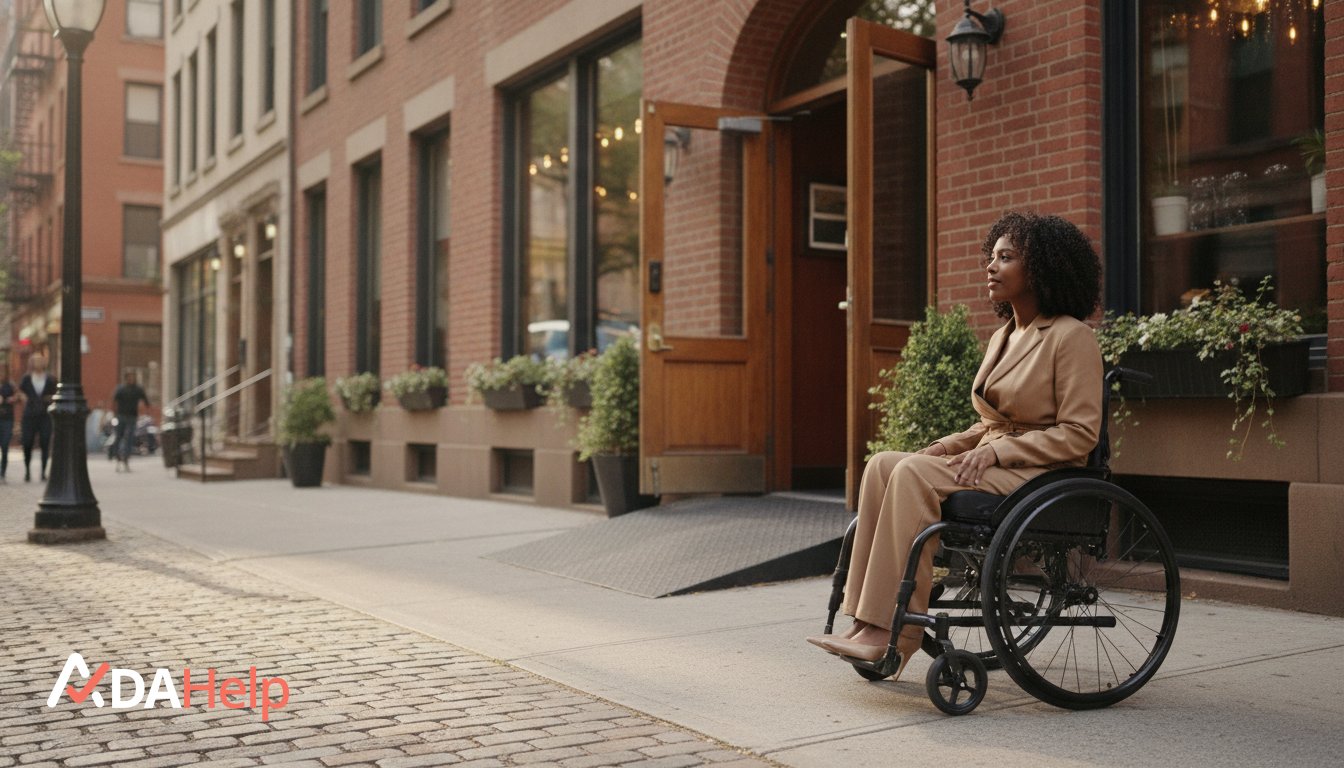
What Counts as Disabled Access to Public Buildings in NYC?
Disabled access to public buildings NYC means that every person can use a public space regardless of their physical ability. It is more than just a courtesy; it is a fundamental civil right. These protections began with the Americans with Disabilities Act of 1990, which established the federal floor for accessibility. However, the New York City Human Rights Law (NYCHRL) often provides even stronger protections for local residents. ADA Help - NY disability discrimination claims is not a law firm, but we specialize in identifying these violations to help you seek a recovery. We focus on the specific standards that New York businesses must meet to stay compliant with both city and federal rules.
To better understand this concept, watch this helpful video:
Places Covered by NYC Public Access Laws
NYC laws cover a wide range of locations. If a business invites the public inside, they must provide access. This includes retail stores and shopping centers across all five boroughs. It also covers restaurants, bars, and cafes, including the permanent outdoor dining setups that have become common on city streets. Professional offices such as doctors, lawyers, and accountants are also required to be accessible. If you have been blocked from entering any of these places, you may have a case for discrimination. You can check your eligibility at ada-help.org in just three minutes.
The Role of Reasonable Accommodations
A reasonable accommodation is a change to a building or a policy that creates access for you. NYC businesses have a duty to remove barriers when it is "readily achievable." This means the fix is relatively simple and does not cause an undue burden. For example, a store might need to move a display rack to widen an aisle or install a permanent ramp over a single step. Historic NYC buildings often try to claim they don't have to follow these rules. That is usually false. While some structural changes might be limited, owners must still provide the best access possible. They cannot simply ignore your needs because the building is old. When they fail to make these changes, ADA Help - NY disability discrimination claims helps you hold them accountable. We handle the paperwork so you don't have to face the system alone.
Common Accessibility Violations in New York Businesses
Barriers to disabled access to public buildings NYC are often hiding in plain sight. They aren't just quirks of a crowded city; they are illegal obstacles that prevent you from living your life. Many business owners ignore these issues for years until someone speaks up. Spotting these barriers is the essential first step in your claim for justice and recovery.
Management often fails to maintain the accessible features they already have. A ramp might be blocked by trash cans or delivery boxes. An automatic door button might be broken for months without repair. These failures show a lack of respect for your rights. Under the NYC Disability Protections, businesses must keep these features in working order at all times. ADA Help - NY disability discrimination claims is not a law firm, but we specialize in identifying these failures to help you seek a recovery.
Entrance and Doorway Barriers
Your struggle often starts before you even get inside. A single step can be an insurmountable wall for a wheelchair user. If a business doesn't have a permanent ramp, they may be required to provide a portable one upon request. Accessibility is not a suggestion; it's a requirement for any place that serves the public.
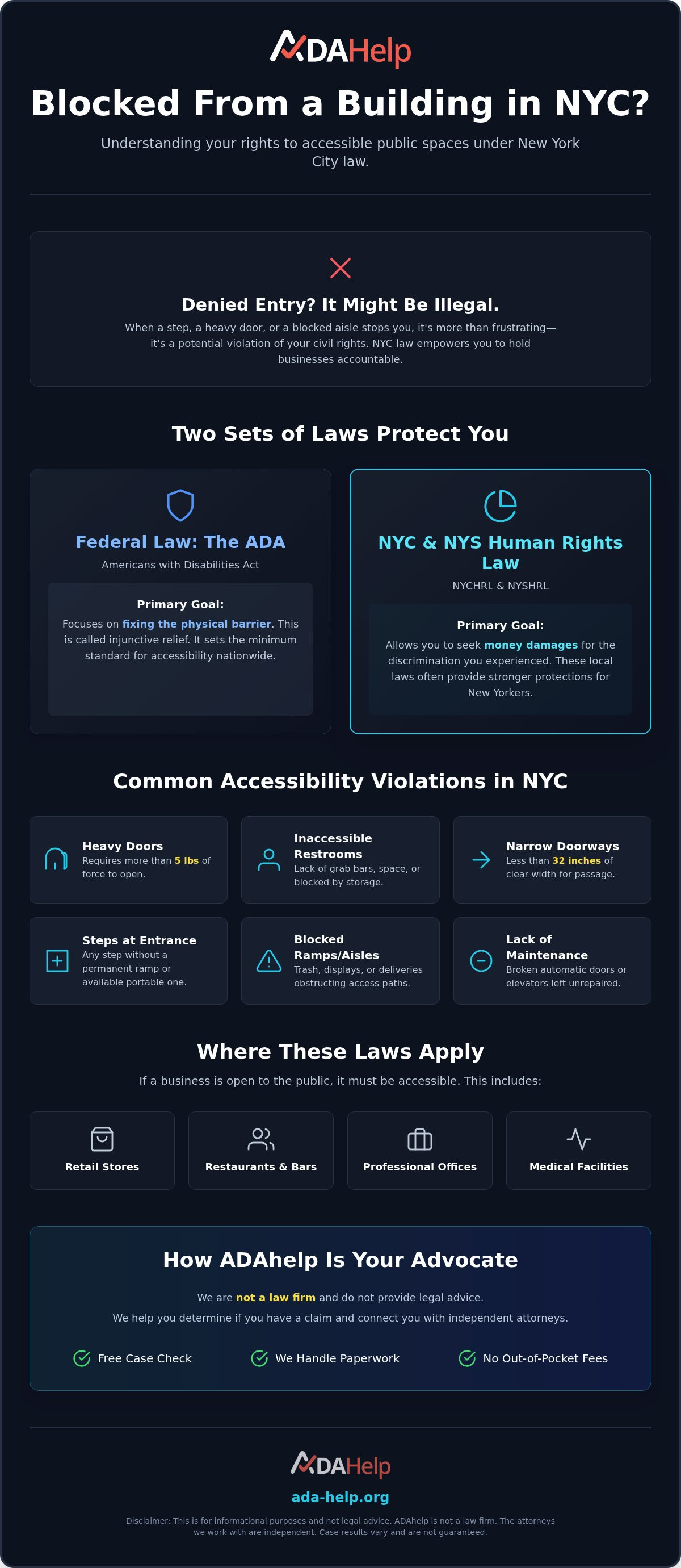
- Heavy doors: If a door requires more than 5 pounds of force to open, it's a violation.
- Narrow entries: Doorways must provide at least 32 inches of clear width for a wheelchair to pass safely.
- Lack of signage: Accessible entrances must be clearly marked if the main entrance is not the one you must use.
These physical barriers are a form of discrimination that the New York City Human Rights Law (NYCHRL) recognizes. While federal law might force a store to fix the door, the NYCHRL allows you to seek money damages for the exclusion you felt. You deserve to be treated with dignity every time you leave your home.
Interior Access Issues
Once you're inside, the challenges often continue. Retail stores frequently prioritize floor space for products over your ability to move. You shouldn't have to get through a maze of boxes or clothing racks just to reach the back of a store. Clear paths are a basic right.
- Blocked aisles: Paths must remain clear and wide enough for a wheelchair or walker.
- Inaccessible restrooms: This includes narrow stalls, sinks that are too high, or missing grab bars.
- Checkout counters: If a counter is too high, the business must provide a lower section or a folding shelf for your use.
These violations are often visible to everyone, yet management chooses to look the other way. This is especially common in restaurants and cafes; see our guide on restaurant ADA violations in New York for more examples. If you've encountered these issues, you don't have to accept it. You can check your case online to see if you qualify for a recovery. ADA Help - NY disability discrimination claims handles the heavy lifting by connecting you with independent attorneys who work on a contingency basis.
ADA vs. New York City Law: Understanding Your Recovery
When you encounter poor disabled access to public buildings NYC, you have several legal paths to choose from. Most people have heard of the federal Americans with Disabilities Act. While this law is important, it often surprises New Yorkers to learn that it does not provide money to the victim. Understanding the difference between federal and local law is the key to getting the recovery you deserve.
You don't have to choose just one law to protect your rights. A strong case often uses federal, state, and city laws at the same time. This ensures that the business fixes the problem while also paying you for the discrimination you faced. ADAhelp is not a law firm and does not provide legal advice; instead, we help you understand how these laws work together to support your claim.
Why the ADA Alone May Not Be Enough
The federal ADA focuses on the physical building. Under ADA Title III, a private individual can only seek injunctive relief. This is a legal term meaning the court orders the business to fix the barrier. For example, the court might force a store to install a ramp or widen a doorway. While this helps the community, it does nothing to address the personal impact on you.
The ADA does not pay you for your emotional distress or the humiliation of being turned away. It does not provide money damages for the time you lost or the frustration you felt. If you only file a claim under the federal ADA, you could spend months in court and end up with nothing but a fixed door at a store you no longer want to visit.
Getting Money Damages Under NYC and NYS Laws
This is why New York laws are so important. The New York City Human Rights Law (NYCHRL) and the New York State Human Rights Law (NYSHRL) are among the strongest in the country. These laws allow you to seek compensatory damages. This is money meant to pay you back for the harm caused by discrimination. While you can File an Accessibility Complaint through the city to start an official inspection, a private claim focuses on your personal recovery.
Typical recoveries in these cases vary significantly based on the details of your incident. Factors like how many times you were denied access or how the business treated you will influence the final amount. Every case is different. By focusing on city and state laws, you can hold the business accountable and receive a recovery for the discrimination you faced. For a deeper look at how these damages are calculated across all types of public spaces, see our guide to public access discrimination and money damages in New York. We handle the paperwork and connect you with independent attorneys who work on a contingency basis. You pay nothing out of pocket.
How to Document an Inaccessible Public Space in NYC
Evidence is the foundation of any successful disability discrimination claim. When you encounter a lack of disabled access to public buildings NYC, your phone is your most valuable tool. You should document the barrier at the moment you encounter it. Clear records help independent attorneys evaluate your case faster and with more accuracy. ADAhelp is not a law firm; we provide the case management you need to organize these facts before connecting you with legal experts.
Don't wait until you get home to write down what happened. Details fade quickly in the rush of a busy day. Businesses may also fix a barrier or move an obstruction once they realize it is a problem. Capturing the violation exactly as it exists during your visit is vital. Keep your documentation organized and factual. Avoid exaggerating the situation; the facts of the barrier are often enough to carry the weight of your claim.
Step-by-Step Documentation Checklist
Follow this simple checklist to ensure you have what you need for a free case check:
- Take clear photos: Capture the barrier itself to prove the lack of disabled access to public buildings NYC. Take a wide shot of the building entrance and the business name.
- Record the details: Write down the exact date and time of the incident. Note the full street address and the borough.
- Identify staff: If you spoke to anyone about the access issue, note their names or physical descriptions. Write down exactly what they told you.
Why Your Personal Account Matters
Your story is a key part of the evidence. While a photo shows a physical step, your account shows the human impact of that barrier. Describe how the lack of access made you feel. Were you frustrated? Did you feel humiliated being turned away while others walked right in? These feelings are central to claims under the New York City Human Rights Law, which provides for money damages based on the discrimination you faced.
Mention if you had to leave the premises or if you were denied service entirely. If a restaurant host told you they couldn't accommodate your wheelchair, that is a specific act of discrimination. Your personal experience provides the context that turns a building code violation into a civil rights claim. If you have documented an inaccessible space, you can start your free three-minute case check right now to see if you qualify for a recovery.
Where to File: Agencies & Deadlines
Once you've documented the barrier, you have several agencies where you can formally report the problem. Filing with the right agency, before the deadline passes, protects your ability to seek a recovery for the discrimination you faced.
- NYC Commission on Human Rights (CCHR): Handles complaints under the New York City Human Rights Law. You generally have up to three years from the date of the incident to file.
- NYS Division of Human Rights (DHR): Investigates claims under the New York State Human Rights Law. Learn more about the process at dhr.ny.gov. The filing window is typically three years as well, though it can be shorter for certain claims.
- U.S. Department of Justice (DOJ): Accepts complaints under Title III of the federal ADA for public accommodations; there is no fixed statutory filing deadline, but earlier is always better for gathering evidence.
- U.S. Equal Employment Opportunity Commission (EEOC): Applies to workplace discrimination rather than public buildings, but is worth knowing if your barrier also affected you as an employee. Charges generally must be filed within 300 days.
Missing a deadline can permanently close the door on a recovery, so don't wait to get help. If you're unsure which agency fits your situation -- for example, after filing a complaint in Queens or elsewhere in the city -- our case management team can help you figure out the right path and the applicable deadline before you lose your chance at compensation.
Start Your Free Three-Minute NYC ADA Case Check
You shouldn't have to struggle against a system that was built to protect you. If you've been turned away from a business because of a step or a narrow door, you have already faced enough frustration. Now it's time to take the next step toward a resolution. ADAhelp provides a fast and simple way to see if you have a valid claim for disabled access to public buildings NYC. We are not a law firm and we don't provide legal advice. Our role is to act as your capable guide and handle the heavy lifting for you.
The first step is our case check. It takes just three minutes of your time. We ask a few direct questions about the barrier you encountered and where it happened. Once we have these details, we help determine if you have a claim under New York's strong civil rights laws. We then connect you with independent attorneys who know the local court system and work on your behalf to secure a recovery.
No Upfront Costs or Risks
Starting a claim often feels like a financial burden, but we've removed that risk for you. The initial case check is completely free for everyone. You never pay out of pocket to start your claim or work with our case management team. We believe in fairness and justice for all New Yorkers regardless of their bank account balance.
We use a contingency-based model. This means that fees for the attorneys we connect you with are only taken from a recovery if your case is successful. If you don't receive a settlement, you don't owe any legal fees. This approach puts the financial risk on the service providers rather than on you. It ensures that your path to accountability is entirely stress free.
How Our Case Management Works
We act as your proactive partner throughout the entire process. First, we gather your information and evaluate the specific details of the incident. We look at your photos, your notes, and the location of the business. Then, we handle the filing process with the appropriate authorities to make sure your claim is taken seriously from day one. Our specialized ADA Title III case management New York service is designed to move your case forward quickly.
Our goal is to make the process as streamlined as possible. We want to ensure that buildings are made accessible for everyone while you receive the compensation you deserve for the discrimination you faced. You don't have to be a legal expert to stand up for your rights. Stop wondering if you have a case and let us handle the paperwork. Start your free case check today and see how simple it is to hold a business accountable.
Take Control of Your Access Rights Today
You shouldn't have to live in a city that ignores your needs. We've shown you that disabled access to public buildings NYC is a right, not a privilege. By documenting barriers and understanding the power of the New York City Human Rights Law, you can move from frustration to resolution. Remember that while federal law fixes the building, local laws are designed to compensate you for the discrimination you faced.
ADAhelp is here to handle the heavy lifting. We are not a law firm and do not provide legal advice; instead, we are NYC discrimination specialists who understand the system. Our goal is to connect you with independent attorneys who work on a contingency basis. This means you benefit from a no recovery, no fee model that keeps your path to justice low-risk.
Don't let another day go by feeling excluded from your community. You have the power to hold businesses accountable and ensure a more accessible future for everyone. Start your free three-minute case check today and let us help you secure the recovery you deserve. You've faced the barrier; now let's find the solution together.
Frequently Asked Questions
Do I need a lawyer to file an ADA complaint in NYC?
You don't need a lawyer to file a basic administrative complaint with government agencies like the NYC Commission on Human Rights. However, if you want to seek money damages for the discrimination you faced, working with a case manager is a smart move. ADAhelp is not a law firm and does not provide legal advice. We help you organize your evidence and connect you with independent attorneys who work on a contingency basis.
How much money can I get from a public access discrimination claim?
Typical recoveries vary based on the specific facts of your case and the severity of the discrimination. Under the New York City Human Rights Law, you can seek compensatory damages for the emotional distress and humiliation caused by the barrier. While we cannot guarantee a specific result, settlements in the NYC metro area frequently exceed $100,000 for certain cases. Every case is unique. The final amount depends on factors like the business's history of violations.
Does a business have to install a ramp if they have steps?
Yes, businesses must provide disabled access to public buildings NYC by removing physical barriers like steps if the change is readily achievable. This means the fix is simple and doesn't cause an undue financial burden. If a permanent ramp isn't possible, the store might need to provide a portable ramp and a way for you to signal for help. Ignoring a single step at a main entrance is a common violation.
What if the building is old and historic?
Old or historic status does not give a business a free pass to ignore accessibility laws. While some structural changes might be restricted to protect the building's character, owners must still provide the best access possible. This could include using alternative entrances or installing removable ramps. If a business uses "historic status" as an excuse to deny you service, they are likely violating the New York State Human Rights Law. We can help you check your claim.
How long does the NYC disability discrimination claim process take?
The timeline for an NYC disability discrimination claim varies depending on the complexity of the case and the business's willingness to settle. Some cases resolve in a few months through negotiation, while others may take longer if they go to court. Our case management team works to keep your claim moving quickly by handling the paperwork and organizing your evidence from the start. We aim to make the process as streamlined as possible for you.
Will I have to pay anything if we do not win the case?
No, you will not pay any out-of-pocket fees if your case is not successful. ADAhelp provides a free case check, and the independent attorneys we connect you with work on a contingency-fee model. This means their fees are only taken as a percentage of your final recovery. If there is no recovery, you owe nothing. This ensures that the financial risk stays with the service providers, allowing you to seek justice without any personal cost.
Can I file a claim for a website that is not accessible?
Yes, you can file a claim if a business's website is not accessible to you. Modern laws treat websites as places of public accommodation. This means they must follow the same rules as physical stores. If a site doesn't work with screen readers or has other digital barriers, it violates your rights. We provide website accessibility case management in New York to help you hold these companies accountable and ensure their digital spaces are open to everyone.

Article by
ADA Help
Written by the ADAhelp editorial team and reviewed for accuracy before publishing. ADAhelp helps New Yorkers find out if they have a disability discrimination claim and manages the process end to end, working with independent attorneys who handle the legal work. We are not a law firm and do not provide legal advice.
Disclaimer
This article is general information about New York law, not legal advice, and reading it does not create an attorney-client relationship. ADAhelp is a case-management and intake service, not a law firm; legal representation is provided by independent attorneys. Recovery amounts and timelines vary by case, and past outcomes do not guarantee future results. For advice about your specific situation, speak with a qualified attorney or start the free case check.
Tags
Discriminated against in New York because of a disability?
A free three-minute check tells you if you can pursue a claim.
Check my case →New York onlyNo upfront costIndependent NY attorneysFree 3-minute check