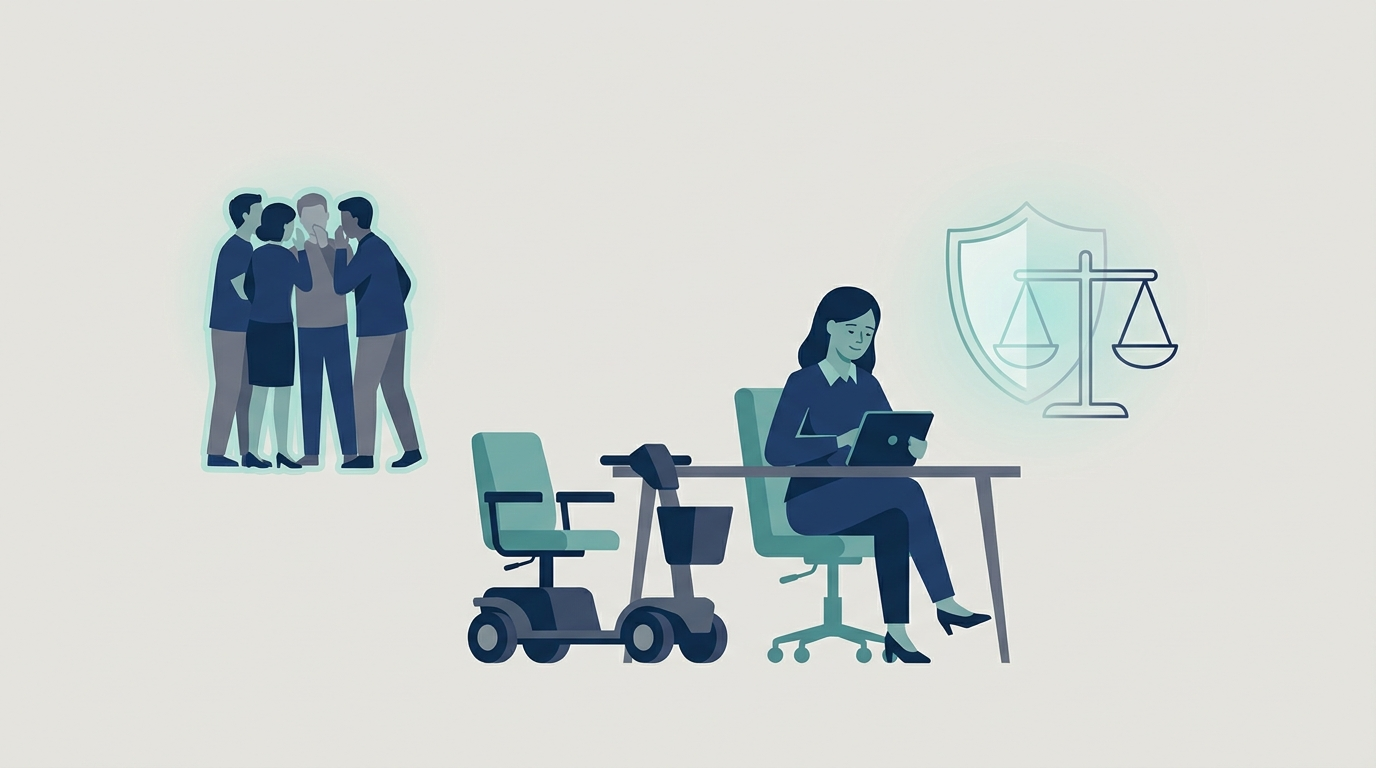
Emotional Cost of Workplace Discrimination: Your NY Rights
Reviewed for accuracy by the ADAhelp team before publishing. ADAhelp is not a law firm; legal work is handled by independent New York attorneys.

The emotional cost of workplace discrimination is real. New York law protects you. Learn how to get uncapped damages for your suffering. Free case check.
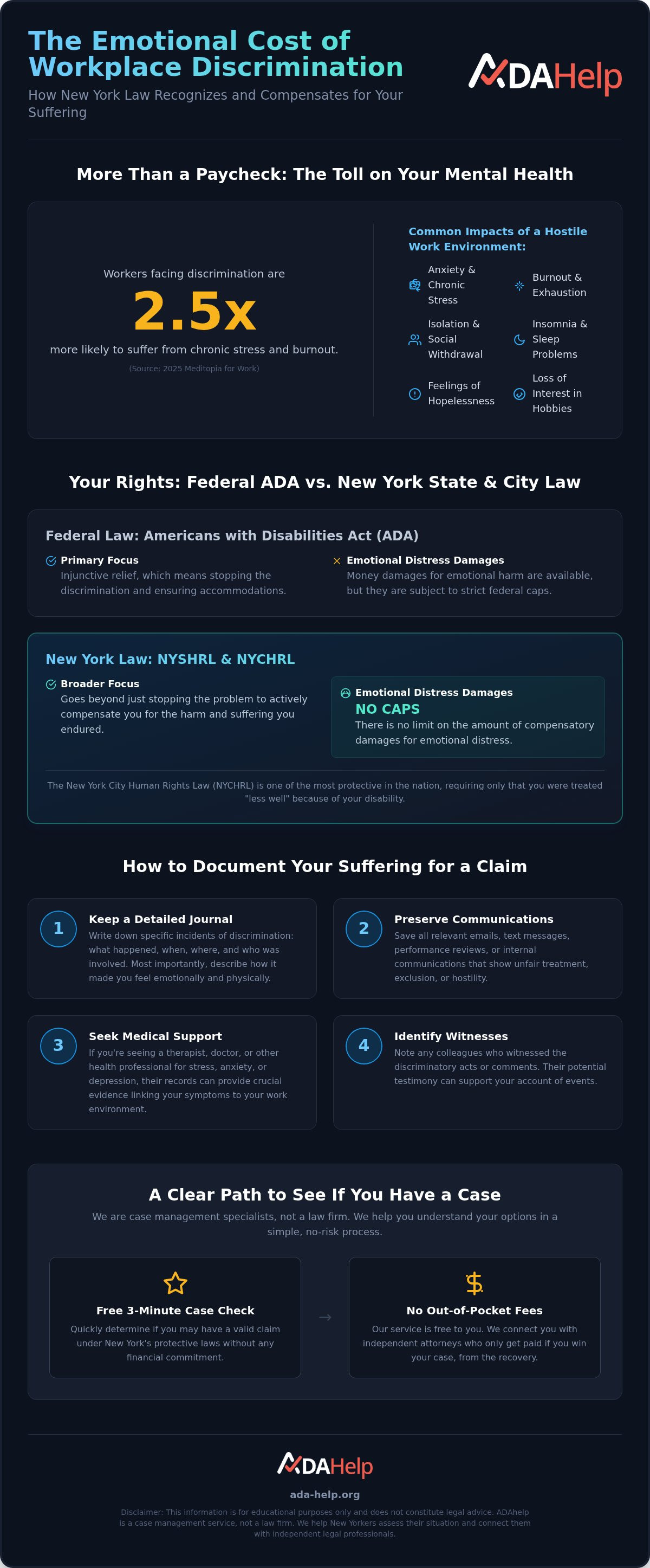
You log in at 9:00 AM and see another meeting invite that excludes you while your heart starts to race. You aren't just tired; you're dreading the subtle slights and unfair comments that have become your daily reality in the office. The emotional cost of workplace discrimination is often heavier than the lost wages themselves. It leaves you feeling isolated and dehumanized. This anxiety starts to bleed into your personal life and affects your health. You aren't alone; workers who face discrimination are 2.5 times more likely to suffer from chronic stress and burnout according to 2025 research from Meditopia for Work.
It's exhausting to feel like a target in a professional environment. Your mental health matters, and New York laws agree. This article explains how the New York State and City Human Rights Laws provide protections that go beyond federal standards. You will understand how to recover damages for emotional suffering and why New York doesn't cap these payouts like the ADA does. We are case management specialists, not a law firm; we provide a simple way to see if you have a case with a free three-minute check. This process is low-risk because fees are only taken from a recovery. We help you find the right path so you can focus on your well-being.
Key Takeaways
- Understand how New York law recognizes the psychological burden of being treated differently because of a disability.
- Learn why New York City and State laws allow for money damages that the federal ADA does not typically provide.
- Discover the specific ways to document your suffering to support a claim for emotional distress.
- See why there are no caps on compensatory damages for the emotional cost of workplace discrimination under local New York statutes.
- Get a clear path to a free three-minute case check to determine if you have a valid claim without any financial risk.

What is the emotional cost of workplace discrimination?
When you think about a legal claim, you might only focus on your paycheck. You think about the promotion you missed or the hours you lost. However, Employment discrimination causes damage that a bank statement cannot show. The emotional cost of workplace discrimination is the heavy psychological burden you carry when an employer treats you differently because of your disability. This isn't just about feeling "upset." In New York, emotional distress is a recognized legal injury that entitles you to financial compensation. While the federal ADA focuses on fixing the physical problem, the New York State Human Rights Law (NYSHRL) and New York City Human Rights Law (NYCHRL) allow you to recover money for the pain you've endured.
Discrimination creates a hostile environment that wears you down day after day. It triggers a constant stress response that can lead to long term mental health struggles. If you feel isolated or dehumanized at work, your mind is reacting to an illegal situation. Understanding this cost is the first step toward holding your employer accountable. At ADAhelp, we help you identify these damages so you can seek the recovery you deserve. We aren't a law firm, but we specialize in helping New Yorkers see if they have a valid claim through a free three-minute case check.
The invisible weight of daily exclusion
Discrimination isn't always a loud argument or a firing. Often, it is a series of small acts that exclude you from the team. These microaggressions add up. You might feel like you have to hide your disability just to survive the workday. This "masking" is exhausting. You spend your energy trying to appear "normal" instead of doing your job. Fighting for reasonable accommodations every day is another drain on your mental resources. This constant friction makes the office feel like a battlefield rather than a workplace. Over time, the emotional cost of workplace discrimination becomes a barrier to your professional success and personal happiness. If the daily exclusion has escalated into open hostility, see our Disability Harassment at Work in New York: Your Action Guide for next steps.
Why New Yorkers often ignore early warning signs
New York City has a high pressure culture. You are told to be "tough" and "grind it out." Because of this, many New Yorkers ignore the early signs of emotional distress. You might dismiss your insomnia, social withdrawal, or sudden anxiety as just part of the job. You shouldn't have to "tough out" illegal treatment. According to the 2025 Meditopia for Work report, workers facing discrimination are 2.5 times more likely to suffer from burnout. If you are logging in with a sense of dread, it's likely a direct result of your employer's actions. Recognizing that your suffering is real and valid is not a sign of weakness. It's the foundation of your legal rights under the New York State Human Rights Law.
How discrimination impacts your mental health
Discrimination does not just stay at the office. It triggers your body's stress response system constantly. When you face unfair treatment, your brain stays in a state of "fight or flight." This chronic stress causes real physical and mental damage over time. You might find that the emotional cost of workplace discrimination begins to spill over into your home life. You are less present with your family. Your sleep suffers. You lose interest in hobbies that used to bring you joy. These mental health impacts are not just personal struggles; they are valid grounds for a legal claim in New York.
The U.S. Equal Employment Opportunity Commission (EEOC) provides clear guidance on your legal rights for mental health conditions. Under the New York City Human Rights Law (NYCHRL), the standard for proving a hostile work environment is often lower than under federal law. You only need to show you were treated "less well" than others because of your protected status. If the stress is making you sick, you should check your case eligibility to see how New York laws can protect you.
The link between workplace hostility and depression
Persistent unfair treatment often leads to a sense of hopelessness. You might feel like no matter how hard you work, you will never be treated fairly. This can cause you to lose interest in a career you once loved. Depression makes everything harder; it even affects the task of documenting the discrimination you are facing. You might struggle to keep a log of incidents or save emails when you are fighting just to get through the day. This is why having a support system and professional case management is vital. We help handle the heavy lifting so you don't have to manage the paperwork alone while you are suffering.
Anxiety and the fear of returning to work
For many New Yorkers, the "Sunday Scaries" turn into physical illness. You might experience panic attacks triggered by a specific colleague's voice or the sound of a new email notification. This anxiety often leads to hypervigilance. You are always waiting for the next discriminatory incident to happen. This state of constant alert is exhausting. It prevents you from performing your best and damages your self-esteem. New York law recognizes that this fear is a direct result of an employer's failure to provide a safe, non-discriminatory environment. The emotional cost of workplace discrimination is a measurable injury, and you have the right to seek compensation for the anxiety that keeps you from working peacefully.
Can you recover money for emotional distress in New York?
You can recover significant money for your suffering. While the federal Americans with Disabilities Act (ADA) often focuses on stopping discriminatory behavior or forcing an employer to change their policies, it is limited in terms of financial payouts. Money damages for the emotional cost of workplace discrimination typically come from broader state and city laws. In New York, you can seek compensation for "pain and suffering" even if you have no physical injuries. These laws recognize that the mental anguish of being dehumanized is a real harm that requires a financial remedy.
Typical recovery amounts vary case by case. They depend on the severity of the treatment and the specific impact the discrimination has had on your daily life. Because New York laws are designed to be more protective than federal ones, your potential for a recovery is often much higher here. We help you determine the strength of your claim through our free case check. We then connect you with independent contingency-fee attorneys who handle the heavy lifting while you focus on your health.
Why the New York City Human Rights Law is unique
The New York City Human Rights Law (NYCHRL) is one of the most protective civil rights statutes in the country. It is designed to be interpreted broadly to protect workers. This law requires a lower burden of proof for emotional distress than federal law. You do not always need a formal medical diagnosis or expensive expert testimony to prove your harm; your own credible testimony about your suffering can be enough. Courts in New York City often award higher damages for mental anguish because they understand the unique pressures of working in the five boroughs. If you work in NYC, you have access to these powerful protections that go far beyond what the ADA offers.
ADA vs. NYSHRL: Understanding your recovery options
The New York State Human Rights Law (NYSHRL) applies to employers across the entire state. For discriminatory acts occurring on or after February 15, 2024, you have up to three years to file a complaint. This is a vital advantage over the 300 day deadline for federal EEOC charges. Unlike the ADA, which has federal damage caps ranging from $50,000 to $300,000 based on employer size, the NYSHRL has no caps on compensatory damages for emotional distress. This means your recovery is based on the actual harm you suffered. You can learn more about Disability Discrimination Settlement Amounts New York: Guide to see how these state and city laws work together to protect your mental health.
How to document your emotional suffering for a case
Documenting an "invisible" injury like emotional distress is different from taking photos of a car accident. Evidence is the foundation of any successful claim. Your personal testimony is powerful. However, it is much stronger when supported by outside records. You need to show the court or a commission exactly how the emotional cost of workplace discrimination has changed your life. New York City and State laws allow for significant recoveries; but you must prove the harm occurred through consistent record-keeping.
Learn more about How to Document Disability Harassment at Work in New York to see how documentation impacts your potential payout. At ADAhelp, we handle the gathering of information so you can focus on your mental health. We aren't a law firm, but we help you organize your evidence before connecting you with an independent attorney.
Keeping a detailed personal journal
Write down how each discriminatory incident made you feel at the time. Don't just list what happened. Describe the pit in your stomach or the way your hands shook after a meeting. Note changes in your sleep patterns; appetite; or social life. Be specific about the dates and times you felt the most distress. If you stopped attending family events because of work-related anxiety, write that down. This journal becomes a "day-in-the-life" record of your suffering. It turns vague feelings into concrete facts for your case.
The role of medical professionals and therapy
Seek professional help from a therapist or doctor if you are struggling. Your health is the priority. Medical records also serve as objective proof of your emotional injuries. A doctor's note about your stress-induced insomnia or a therapist's record of your depression provides a vital third-party perspective. In many cases, therapy costs can be recovered as part of your economic damages. New York courts value this documentation because it shows you took steps to treat your injury. If you aren't sure where to start, we can help. Start your free three-minute case check today to see if your documentation supports a claim for the emotional cost of workplace discrimination.
Where to File: Agencies & Deadlines
Once you've documented the emotional cost of workplace discrimination, the next step is filing with the right agency before your deadline passes. New York gives you several overlapping options, each with its own timeline.
- New York State Division of Human Rights (DHR): Covers employers statewide. You generally have three years to file for acts occurring on or after February 15, 2024. Learn more at dhr.ny.gov.
- NYC Commission on Human Rights (CCHR): Covers the five boroughs and typically requires filing within one year. Details are available at nyc.gov/cchr.
- U.S. Department of Justice (DOJ): Handles ADA enforcement for broader civil rights violations. See ada.gov for guidance.
- U.S. Equal Employment Opportunity Commission (EEOC): Handles federal workplace discrimination charges, generally within 300 days of the incident. Visit eeoc.gov to learn more.
You can file with more than one agency, but deadlines don't wait for you to decide. A free case check helps you confirm which agency fits your situation before time runs out.
Get a free case check for your workplace discrimination claim
You have already endured the isolation and anxiety that comes with being targeted at work. The emotional cost of workplace discrimination is a heavy burden to carry alone. You shouldn't have to spend your remaining energy trying to decipher complex legal codes or filing deadlines while you are struggling to maintain your mental health. ADAhelp offers a streamlined, supportive path toward resolution. We are a specialized case management service for New Yorkers; not a law firm. This means we focus on the intake process and organizing your story so it is ready for legal action. We take over the administrative stress so you can focus on your therapy and recovery. Our service is free to use; and we only receive a fee if you successfully recover money for your damages.
How our three-minute case check works
Our process begins with a simple, digital case check that takes less than three minutes to complete. You will answer a few direct questions about your job; your disability; and how you were treated by your supervisors or colleagues. We use this information to evaluate your situation under the federal ADA; the New York State Human Rights Law (NYSHRL); and the New York City Human Rights Law (NYCHRL). We look for specific triggers like a failure to provide reasonable accommodations or a sudden change in your duties after disclosing a health condition. You get a clear, factual answer about your options without any high-pressure sales pitches or intimidating office visits. This is a low-risk way for you to validate that your suffering is a serious legal matter.
Connecting with contingency-fee attorneys in New York
When our evaluation confirms you have a strong claim; we connect you with independent attorneys who specialize in Employment Discrimination Case Management in New York. These professionals understand the local court systems in the five boroughs and across the state. They operate on a contingency-fee model. This ensures that your financial status never prevents you from seeking justice. You pay nothing out-of-pocket and no hourly rates. The attorneys only take a fee if they win a recovery for you. This structure puts the financial risk on the service providers; not on the person who has already suffered. We are committed to making the legal system work for the individual with minimal friction. Start your recovery from the emotional cost of workplace discrimination by letting us handle the heavy lifting today.
Take control of your path to recovery
You have already carried the psychological burden of being treated differently because of your disability. The emotional cost of workplace discrimination isn't just a personal struggle; it is a recognized legal injury in New York. While the federal ADA focuses on policy changes, the New York State and City Human Rights Laws allow you to seek money damages for the mental anguish you've endured. You don't have to manage this complex system alone while you are trying to heal. ADAhelp provides specialized New York case management to help you determine if you have a claim. We connect you with independent contingency-fee attorneys who handle the legal work with no out-of-pocket costs. You only pay if you win a recovery. It's time to stop wondering if your feelings are valid and start protecting your future. Start your free three-minute case check now and take the first step toward the justice you deserve. Your mental health is worth the effort.
Frequently Asked Questions
Is emotional distress considered a disability in New York?
No; emotional distress is typically the injury you suffer rather than the disability itself. However; the underlying mental health conditions like clinical depression or PTSD that cause this distress are recognized as disabilities. The New York City Human Rights Law (NYCHRL) protects you if you have any physical; medical; mental; or psychological impairment. If your employer treats you poorly because of these conditions; they are violating your rights.
Can I sue my employer for emotional distress without being fired?
Yes; you can seek damages for emotional distress while you are still employed. You do not have to wait to be fired to hold an employer accountable for a hostile work environment or a failure to provide reasonable accommodations. If the emotional cost of workplace discrimination is making it impossible to do your job; you have the right to take action. New York laws protect you from retaliation if you file a claim while still on the payroll.
How much is a typical settlement for emotional distress in NYC?
Typical recovery amounts vary significantly based on the specific facts of your case. Because the New York City Human Rights Law has no caps on compensatory damages; payouts can be higher than federal awards. Factors include the duration of the discrimination and the severity of your mental health symptoms. While no one can guarantee a result; New York courts frequently award damages that reflect the actual pain and suffering you have experienced. Every case is unique.
Do I need to see a therapist to prove emotional damages?
You do not strictly need a formal medical diagnosis to prove emotional damages in New York City. The NYCHRL allows a jury to award damages based on your credible testimony alone. However; seeing a therapist or doctor provides objective evidence that strengthens your claim. Medical records turn your personal feelings into documented facts. This documentation helps prove the emotional cost of workplace discrimination was severe enough to require professional intervention and support.
What is the difference between the ADA and the New York City Human Rights Law?
The primary difference is the level of protection and the potential for money damages. The federal ADA often focuses on stopping discrimination through injunctive relief; such as forcing an employer to install a ramp. The New York City Human Rights Law is much broader and specifically allows for uncapped money damages for emotional distress. It also covers smaller employers with four or more employees; whereas the ADA generally applies to businesses with 15 or more workers.
How long do I have to file a discrimination claim in New York?
Your deadline depends on where you file. For the EEOC; you generally have 300 days from the discriminatory act. Under the New York State Human Rights Law; you have three years to file a complaint for acts occurring on or after February 15; 2024. The New York City Commission on Human Rights typically requires filing within one year. Because of these varying timelines; it's vital to start your case check as soon as possible to avoid missing your window.

Article by
ADA Help
Written by the ADAhelp editorial team and reviewed for accuracy before publishing. ADAhelp helps New Yorkers find out if they have a disability discrimination claim and manages the process end to end, working with independent attorneys who handle the legal work. We are not a law firm and do not provide legal advice.
Disclaimer
This article is general information about New York law, not legal advice, and reading it does not create an attorney-client relationship. ADAhelp is a case-management and intake service, not a law firm; legal representation is provided by independent attorneys. Recovery amounts and timelines vary by case, and past outcomes do not guarantee future results. For advice about your specific situation, speak with a qualified attorney or start the free case check.
Tags
Discriminated against in New York because of a disability?
A free three-minute check tells you if you can pursue a claim.
Check my case →New York onlyNo upfront costIndependent NY attorneysFree 3-minute check