Handicap Parking Permit NYC: How to Apply in 2026
Reviewed for accuracy by the ADAhelp team before publishing. ADAhelp is not a law firm; legal work is handled by independent New York attorneys.
Handicap parking permit NYC: who qualifies, how to apply to NYC DOT or your town clerk, how to renew or replace one, and your accessible parking rights.
If you or someone in your household has trouble walking any distance, a disability parking permit can be the difference between leaving the house and staying home. New York runs this program at the local level, which is why the answer you find online is so often wrong for your borough or town. This guide covers who qualifies, where to apply inside and outside New York City, how to renew or replace a permit, and what to do when a business, landlord or garage blocks the accessible parking you are entitled to use.
The short answer
In New York, a disability parking permit is issued by your local government, not by the state DMV. If you live in New York City, you apply to the NYC Department of Transportation for a Parking Permit for People with Disabilities (PPPD); anywhere else in the state, you apply to the clerk or issuing agent of the city, town or village where you live, using the New York State application form with a medical certification. The permit itself is not an ADA matter, but being denied the use of accessible parking once you have one often is.
Key takeaways
- Permits are local. New York State sets the rules; your city, town or village (or NYC DOT) actually issues the permit.
- A medical certification is required. A licensed medical provider must certify that your condition seriously limits your ability to walk, or that you meet one of the other qualifying criteria the state recognizes.
- Temporary permits exist. A condition that will improve, such as a recovery from surgery, can still qualify for a time-limited permit.
- Lost, stolen or expired permits are replaced by the same office that issued them — not by the DMV and not online through a third party.
- Holding a permit does not guarantee a space. When a business, parking garage, landlord or employer blocks accessible parking, that can be disability discrimination under federal, New York State and New York City law.
Two different permits: state rules, local issuers
Most of the confusion around a handicap parking permit in NYC comes from one fact: New York State writes the eligibility rules, but local government hands out the permits. That creates two separate paths. Inside the five boroughs, the New York City Department of Transportation administers the Parking Permit for People with Disabilities. Outside the city, the clerk's office or designated issuing agent in your city, town or village handles applications. Both rely on the same state standard and both require a medical certification — but the forms, the processing times and the places you can legally park are not identical.
So the most useful thing you can do before applying is identify your issuing agent. A Westchester village clerk cannot process a Brooklyn application, and NYC DOT cannot issue a permit for a Buffalo resident.
What the permit actually is
New York permits are usually hanging placards displayed from the rearview mirror when the vehicle is parked. The permit belongs to the person with the disability, not to a car: you may use it in any vehicle you are travelling in, but only when you are the driver or a passenger. Lending a placard to someone driving without you is misuse, and enforcement agencies across the state treat it seriously.
Who qualifies for a handicap parking permit in New York
New York does not publish a list of diagnoses that automatically qualify. Eligibility turns on functional limitation: how your condition affects your ability to get from a parking space to where you are going. A licensed medical provider makes that assessment and certifies it on the application. Limitations that commonly support a certification include:
- Significant limitation in walking because of an arthritic, neurological, orthopedic or muscular condition
- Inability to walk without the use of a brace, cane, crutch, walker, wheelchair, prosthetic device or the assistance of another person
- Cardiac or respiratory conditions that are substantially limited by exertion
- Severe visual impairment
- Conditions that require portable oxygen
Two points matter here. You do not need a permanent condition — temporary permits exist for recoveries and treatment periods. And invisible or episodic conditions qualify: a cardiac, respiratory or neurological condition that flares looks like nothing from the outside, and it is still a legitimate basis for certification if your provider documents the functional limitation.
How to apply in New York City
If you live in one of the five boroughs, your application goes to NYC DOT, which administers the PPPD program. The process has four practical steps.
- Get the application package. NYC DOT publishes the PPPD application: one section you complete, one your provider completes.
- Have a licensed medical provider complete the medical certification. This is where applications most often stall. Ask your provider to be specific about functional limitation — how far you can walk, what assistance you need, what makes it worse — rather than listing a diagnosis alone.
- Submit the application to NYC DOT with proof that you live in New York City and the identification the program requires.
- Wait for the city's medical review. If the reviewer asks for more information, respond quickly and in writing; an unanswered request is a common reason an application stalls.
If your application is denied, read the denial carefully. Often the problem is a vague medical section rather than a finding that you are ineligible, and a more detailed certification resolves it.
How to apply outside New York City
Everywhere else in New York State, you apply to the issuing agent where you live — usually the clerk of your city, town or village. The state application form has an applicant's section and a medical certification section; your local office tells you how to submit it.
Because issuing agents are local offices, the details vary: some accept mail, some require an in-person visit, some process in days and some in weeks. Call the clerk's office first and ask three questions — what form they want, what identification and proof of residence they require, and how long review takes.
Renewals, temporary permits and replacing a lost permit
Renewing
Permits carry an expiration date, and renewal runs through the same office that issued the permit. Do not wait until the week it expires: some issuing agents require a fresh medical certification, which means an appointment with your provider on top of the office's processing time.
Temporary permits
If your condition is expected to improve — after surgery, during treatment, or while an injury heals — your provider can certify a temporary limitation and the issuing agent can grant a permit for a limited period. If recovery takes longer, you generally apply again rather than extend the old permit.
Replacing a lost or stolen permit
If you lost your handicap parking permit, contact the office that issued it — NYC DOT in the five boroughs, your municipal clerk elsewhere. Do not buy a replacement from an online seller. Permits sold by third parties are not valid in New York, and using one exposes you to penalties far worse than the inconvenience of a replacement. If your permit was stolen, report the theft; several issuing agents ask for a police report number before they will reissue.
When a parking problem becomes a disability claim
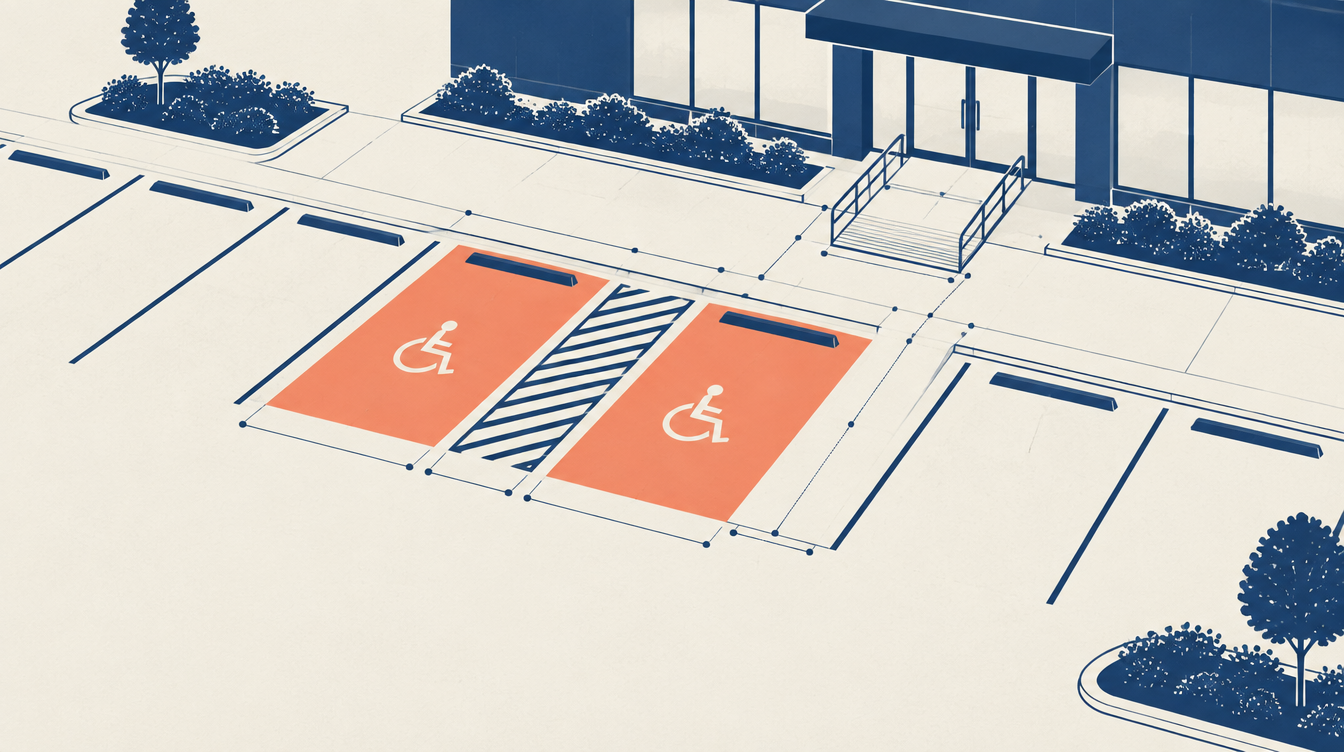
Getting the permit is a municipal process. What happens afterward is often a civil rights question, and that is a different body of law entirely. A valid permit does not help if the accessible spaces at your pharmacy are permanently occupied by delivery vans, if a garage attendant turns you away, if the striped access aisle beside the only accessible space is used as a parking spot so you cannot deploy a ramp, or if your building refuses to assign you an accessible space. Those are access problems, and federal, New York State and New York City law all address them:
- Businesses open to the public — stores, restaurants, medical offices, gyms, parking facilities — have obligations under Title III of the Americans with Disabilities Act, the New York State Human Rights Law and, in the five boroughs, the New York City Human Rights Law. Our guide to an ADA public accommodation violation in NYC explains what those duties look like in practice.
- Physical barriers that keep you out of a business entirely are covered too. See no wheelchair access to a business in NYC.
- Housing is governed by the Fair Housing Act along with state and city law. A landlord's refusal to grant a reserved accessible space can be a refusal of a reasonable accommodation or modification — see a landlord refusing a reasonable modification in NYC.
- Repeated, targeted denial of access based on a mobility disability is discrimination in its own right. Our guide to mobility impairment discrimination in NYC covers how those claims are built.
Deadlines are real and they are shorter than people expect. A complaint to the New York State Division of Human Rights must generally be filed within three years. A complaint to the New York City Commission on Human Rights generally must be filed within one year for most claims. Waiting is the single most common way a strong claim is lost.
What to do next
If your goal is the permit itself, start with your issuing agent — NYC DOT if you live in the five boroughs, your municipal clerk if you do not — and give your medical provider time to complete a detailed certification. ADA Help does not issue, renew or replace parking permits, and no private service can.
If the problem is that your access is being denied — blocked spaces, a garage that turns you away, a landlord who refuses an accessible space, a lot with no accessible parking at all — that is where we can help. Write down what happened: the date, the location, who you spoke to, what they said, and photographs of the space or barrier if you can take them safely. Keep every email and letter.
Then take the free 3-minute case check at ada-help.org. It asks a short series of questions about what happened and where, and tells you whether your situation looks like a claim worth pursuing. There is no cost and no obligation, and ADA Help works on a no recovery, no fee basis. Claims brought under New York State and City law can include compensatory damages — some matters resolve for up to $60,000 — but every case turns on its own facts, and no one can tell you in advance what yours is worth.
Frequently asked questions
How do I get a handicap parking permit in New York?
Apply to your local issuing agent, not the DMV. In New York City, that is the Department of Transportation's Parking Permit for People with Disabilities program. Outside the city, it is the clerk or issuing agent of the city, town or village where you live. In both cases a licensed medical provider must complete a certification describing how your condition limits your mobility, and you must show proof of residence.
What disabilities qualify for handicap parking?
New York looks at function, not diagnosis. Qualifying limitations commonly include inability to walk without a brace, cane, crutch, walker, wheelchair, prosthetic device or another person's help; serious limitation in walking from an arthritic, neurological, orthopedic or muscular condition; cardiac or respiratory conditions substantially limited by exertion; severe visual impairment; and conditions requiring portable oxygen.
What do I do if I lost my handicap parking permit?
Contact the office that issued it and ask for its replacement process — NYC DOT in the five boroughs, your municipal clerk elsewhere. If it was stolen rather than lost, report the theft, because some issuing agents ask for a police report before reissuing. Never buy a replacement permit from an online seller; permits sold by third parties are not valid in New York.
How do I renew a handicap parking permit?
Renew through the same office that issued it, and start well before the expiration date. Some issuing agents require an updated medical certification, so allow time for a provider appointment as well as the office's processing.
How do I get a temporary handicap parking pass?
The same application covers temporary permits. Your provider certifies that the limitation is expected to last a defined period — after surgery, during treatment, or while an injury heals — and the issuing agent grants a permit valid for that period. If you still need it afterward, you generally apply again.
How much is a handicap parking ticket in New York?
Penalties for parking in an accessible space without a valid permit, and for misusing someone else's permit, are set and enforced locally, so the amount depends on the municipality and on what happened. They are substantially higher than an ordinary parking ticket, and misuse of a permit can also mean the permit is revoked. Your issuing agent or local enforcement agency can tell you the current amounts where you live.
Does a permit guarantee me a parking space?
No. A permit establishes your right to use spaces reserved for people with disabilities; it does not create a space or reserve one for you personally. If accessible spaces at a business are missing, blocked, misused or inaccessible, that is a separate issue — and under federal, state and city law it may be a disability access violation you can act on.
ADA Help is a case management service, not a law firm. Legal work is performed by independent New York attorneys. This article is general information, not legal advice.
Tags
Discriminated against in New York because of a disability?
A free three-minute check tells you if you can pursue a claim.
Check my case →New York onlyNo upfront costIndependent NY attorneysFree 3-minute check