ADA Parking Requirements: Your Access Rights in New York
Reviewed for accuracy by the ADAhelp team before publishing. ADAhelp is not a law firm; legal work is handled by independent New York attorneys.
ADA parking requirements explained: how many accessible spaces a business needs, access aisle and van rules, and how to report a violation in New York.
You drive to a pharmacy, a diner or a medical office in New York and the accessible spaces are gone — taken by a delivery van, blocked by a shopping-cart corral, or simply never painted in the first place. Sometimes the space exists but the striped area beside it is occupied, so there is no room to get a wheelchair or walker out of the car. This guide explains what the law actually requires of parking that serves a business open to the public, how to tell a genuine violation from an inconvenience, and what you can do about it in New York.
The short answer
Under the Americans with Disabilities Act, businesses open to the public must provide a minimum number of accessible parking spaces based on the size of the lot, place them on the shortest accessible route to the entrance, mark an access aisle beside each one, and make at least one in every six van accessible. They may not charge extra for accessible parking. In New York, the same failures can also violate the State Human Rights Law and, in the five boroughs, the New York City Human Rights Law — which, unlike federal Title III, allow you to seek money damages.
Key takeaways
- Accessible parking is a legal requirement, not a courtesy. The 2010 ADA Standards for Accessible Design set the minimums.
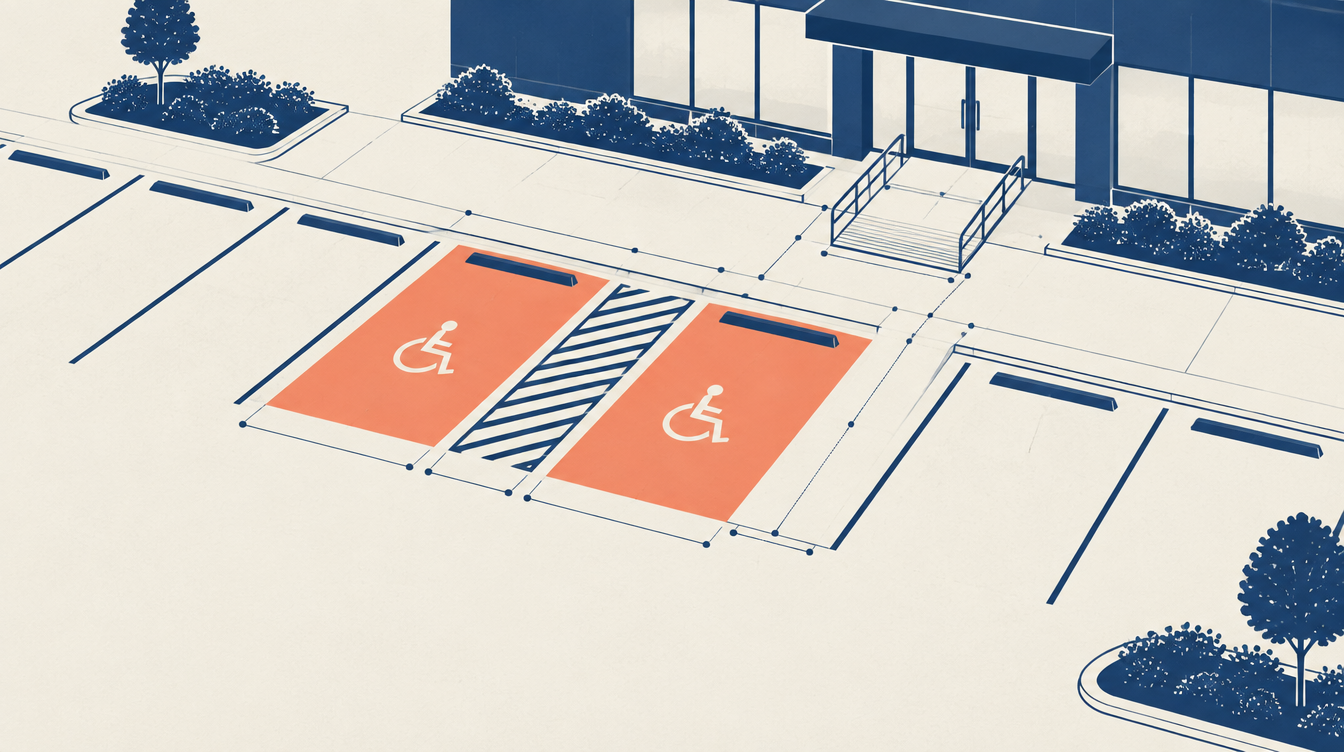
- The access aisle is part of the space. The striped area beside an accessible space is not a parking spot and not optional — it is what makes the space usable.
- Location matters as much as count. Accessible spaces must sit on the shortest accessible route to the accessible entrance.
- A business cannot charge you more for accessible parking than it charges anyone else.
- Federal law gets the barrier fixed; New York law can get you compensated. That is why where you file matters.
How many accessible parking spaces are required
The number scales with the size of the parking facility. For smaller lots, the 2010 ADA Standards for Accessible Design require:
- 1 to 25 total spaces — at least 1 accessible space
- 26 to 50 total spaces — at least 2
- 51 to 75 total spaces — at least 3
- 76 to 100 total spaces — at least 4
The requirement keeps climbing for larger facilities, and for very large lots the minimum is calculated as a percentage of the total rather than from a fixed table. The practical point for most people is simple: even the smallest lot serving a business open to the public is expected to have at least one accessible space. A five-space lot outside a Queens dental office is not exempt because it is small.
Note that this is a floor, not a target. Where demand is obviously higher — a medical practice, a dialysis center, a rehabilitation facility — the Standards call for more, and a lot that technically meets the minimum but is always full may still be failing the people it serves.
Van accessible spaces and the access aisle
Two features separate a real accessible space from a painted symbol.
The access aisle
Every accessible space must have a marked access aisle immediately beside it. That striped area is not decoration and it is not a space for compact cars, shopping carts, snow piles or delivery pallets. It is the clear ground someone needs to deploy a ramp, swing a door fully open, transfer to a wheelchair or stand up with a walker. A space whose access aisle is blocked is, for practical purposes, not an accessible space at all — and that is one of the most common and most easily documented violations in New York.
Van accessible spaces
At least one of every six accessible spaces (and always at least one) must be van accessible. Vans with side-entry ramps need a wider access aisle and greater vertical clearance than a sedan, so a lot full of standard accessible spaces with no van accessible space fails the requirement even if the total count looks right. Low overhead clearance in a garage — a pipe, a low ceiling, a height bar at the entrance — can defeat a van accessible space entirely.
Where the spaces have to be
Accessible spaces must be located on the shortest accessible route to the accessible entrance. "Accessible route" is the operative phrase: a space thirty feet from the door is not compliant if reaching the door from it means crossing a curb with no curb ramp, a gravel strip or a flight of steps.
This is where a lot of New York lots fall down. The spaces are present and correctly marked, but the path from them to the entrance is interrupted — a broken curb cut, a permanently propped-open gate, a delivery zone that traffic has to detour around. If you cannot get from the space to the door without encountering a barrier, the parking is not doing its job, whatever the paint says.
Older buildings and the "readily achievable" standard
A frequent response from businesses is that the building is old and therefore exempt. That is not how the ADA works. There is no blanket exemption for older buildings.
What the law actually distinguishes is new construction and alterations, which must meet the Standards, from existing facilities, where Title III requires the removal of architectural barriers when doing so is readily achievable — meaning easily accomplishable without much difficulty or expense, judged against the resources of the business. Restriping a lot to create an accessible space and an access aisle, moving a shopping-cart corral, or adding proper signage is frequently readily achievable. A business that has done none of it rarely has a good answer for why.
Our checklist on building code accessibility violations in NYC goes further into how these obligations interact with local requirements.
Common violations you can document today
If you are trying to work out whether what you saw is actionable, these are the patterns that come up repeatedly:
- No accessible spaces at all in a lot serving a business open to the public.
- An access aisle in use as a parking space, or routinely blocked by carts, bins, pallets or snow.
- No van accessible space, or a van space defeated by low overhead clearance.
- Faded or missing markings and signage, so spaces are not identifiable or respected.
- A broken accessible route — no curb ramp, a damaged curb cut, or an obstructed path from the space to the entrance.
- Accessible spaces placed far from the entrance while general parking sits closer.
- A surcharge or a separate fee for using accessible parking, or for valet service someone with a disability is forced into.
- Staff refusing to act when you report a blocked space, or telling you to park elsewhere and walk.
Document what you can, safely: dated photographs showing the whole lot and the specific problem, the business name and address, the time of day, and the name of anyone you spoke to and what they said. Keep any email or written response. Contemporaneous notes carry real weight, and a photograph taken the day it happened is worth far more than a recollection months later. For more on evidence-gathering, see our guide to reporting ADA non-compliance in NYC.
Your rights under New York State and City law
This is the part most national articles leave out, and it is the part that matters most if you are in New York.
Title III of the ADA lets a private individual seek an order requiring the barrier to be fixed, plus attorney's fees — but not money damages. New York law goes further. The New York State Human Rights Law covers places of public accommodation across the state, and the New York City Human Rights Law, which applies in the five boroughs, is broader still and is interpreted liberally in favor of the person bringing the claim. Both allow compensatory damages, including for the humiliation and emotional harm of being shut out.
Deadlines differ by forum, and they are not generous:
- New York State Division of Human Rights — a complaint must generally be filed within three years.
- New York City Commission on Human Rights — generally within one year for most claims.
- Court — claims under the State and City Human Rights Laws are generally subject to a three-year limitations period.
Filing with an agency and filing in court are different routes with different consequences, and choosing one can foreclose the other. That choice is worth making deliberately rather than by accident. If you want the broader picture of how these claims work, start with our guide to an ADA public accommodation violation in NYC, or, if you were kept out of the building entirely, no wheelchair access to a business in NYC.
What to do next
Three steps, in order.
- Document it now. Photographs, date, address, names. Do this before you do anything else, because lots get restriped and carts get moved.
- Report it to the business in writing if it is safe and sensible to do so. An email creates a record and a date, and a business that ignores a clear written notice has a harder time arguing it did not know.
- Find out whether you have a claim. Take the free 3-minute case check at ada-help.org. It asks a short set of questions about what happened and where, and tells you whether your situation looks like something worth pursuing.
ADA Help is a case management service, not a law firm — we organise the claim, handle the paperwork and the deadlines, and work with independent New York attorneys who handle the legal work. The case check is free, there is no obligation, and we work on a no recovery, no fee basis. Some New York disability access claims resolve for up to $60,000, but the figure depends entirely on the facts, and no one can promise an outcome in advance.
Frequently asked questions
What is ADA parking?
"ADA parking" is the everyday term for parking spaces that meet the Americans with Disabilities Act's requirements for people with disabilities: a space of the required size, marked with the international symbol of accessibility, with a marked access aisle beside it, located on the shortest accessible route to the accessible entrance. Using one requires a valid disability parking permit or plate.
How many ADA parking spaces are required?
It depends on the size of the lot. Under the 2010 ADA Standards, a lot with 1 to 25 spaces needs at least 1 accessible space; 26 to 50 needs 2; 51 to 75 needs 3; and 76 to 100 needs 4. Requirements continue to scale upward for larger facilities, and at least one in every six accessible spaces must be van accessible.
Is ADA parking the same as handicap parking?
In ordinary use, yes — people mean the same thing. The distinction worth knowing is between the space and the permit. "ADA parking" describes what the business must provide; the permit or plate that entitles you to use it is issued separately by state and local government, not by the business.
Can a business charge extra for ADA parking?
No. A business may charge the same parking rate it charges everyone else, but it may not impose a surcharge for accessible parking or for accommodations connected to it. Charging more for an accessible space, or requiring a paid valet service that other customers can avoid, is a recognised form of discrimination.
Does the striped area next to an accessible space have to stay clear?
Yes. The access aisle is a required part of the accessible space, not a bonus. Parking in it, or allowing it to be filled with carts, bins, deliveries or plowed snow, makes the space unusable for anyone who needs room to deploy a ramp or transfer to a wheelchair — and it is one of the clearest violations to photograph and report.
How do I report an ADA violation in New York?
You have several routes: a complaint to the business itself, a complaint to the New York State Division of Human Rights (generally within three years), a complaint to the New York City Commission on Human Rights if the business is in the five boroughs (generally within one year for most claims), or a civil action. Each has different deadlines and different remedies, so it is worth understanding the options before you file. The free case check at ada-help.org is a short way to see where your situation fits.
ADA Help is a case management service, not a law firm. Legal work is performed by independent New York attorneys. This article is general information, not legal advice.
Tags
Discriminated against in New York because of a disability?
A free three-minute check tells you if you can pursue a claim.
Check my case →New York onlyNo upfront costIndependent NY attorneysFree 3-minute check