No Wheelchair Access to Business NYC: Rights & Recovery
Reviewed for accuracy by the ADAhelp team before publishing. ADAhelp is not a law firm; legal work is handled by independent New York attorneys.
No wheelchair access to a business in NYC? Learn your rights under the ADA and NYC Human Rights Law, what proof to gather, and how to start a free case check.
Why should you be the one stuck on the sidewalk while everyone else goes inside? If you ran into no wheelchair access to business NYC locations, you may have a valid claim under city, state, and federal accessibility law. This guide is our main starting point for public access rights in New York: it explains what counts as a barrier, what your claim could be worth, how to document the violation, and where to go next depending on the type of place that turned you away.
You do not need to pay anything up front to find out where you stand. Our case check is free and takes about three minutes. The independent attorneys we work with handle these matters on a contingency basis, so there is no fee unless you win.
Key takeaways
- A single step, a heavy door, or a high threshold can be enough to support a public accommodation claim in New York City.
- The ADA (Title III) can force a business to fix the barrier; the New York City and State Human Rights Laws are what open the door to money damages.
- Photos, video, receipts, dates, and staff names taken at the scene are the backbone of a strong claim.
- Filing deadlines differ by agency, so it is worth checking your dates early.
- Our free three-minute case check is the fastest way to see whether your documentation supports a claim, with no out-of-pocket cost to you.
In this guide
- Do I have a case for no wheelchair access in NYC?
- What is my NYC accessibility case worth?
- Which NYC businesses must provide wheelchair access?
- How to report a business for no wheelchair access
- How ADA Help manages your claim
Do I have a case for no wheelchair access in NYC?
You may well have a claim if a physical barrier stopped you from entering a place that is open to the public. Under the ADA's Title III, restaurants, retail stores, gyms, theaters, hotels, professional offices, and other private businesses that serve the public are called places of public accommodation, and they are required to remove architectural barriers when doing so is readily achievable — meaning easily accomplishable without much difficulty or expense. New York State and New York City human rights laws cover the same kinds of places and are often read more broadly than federal law.
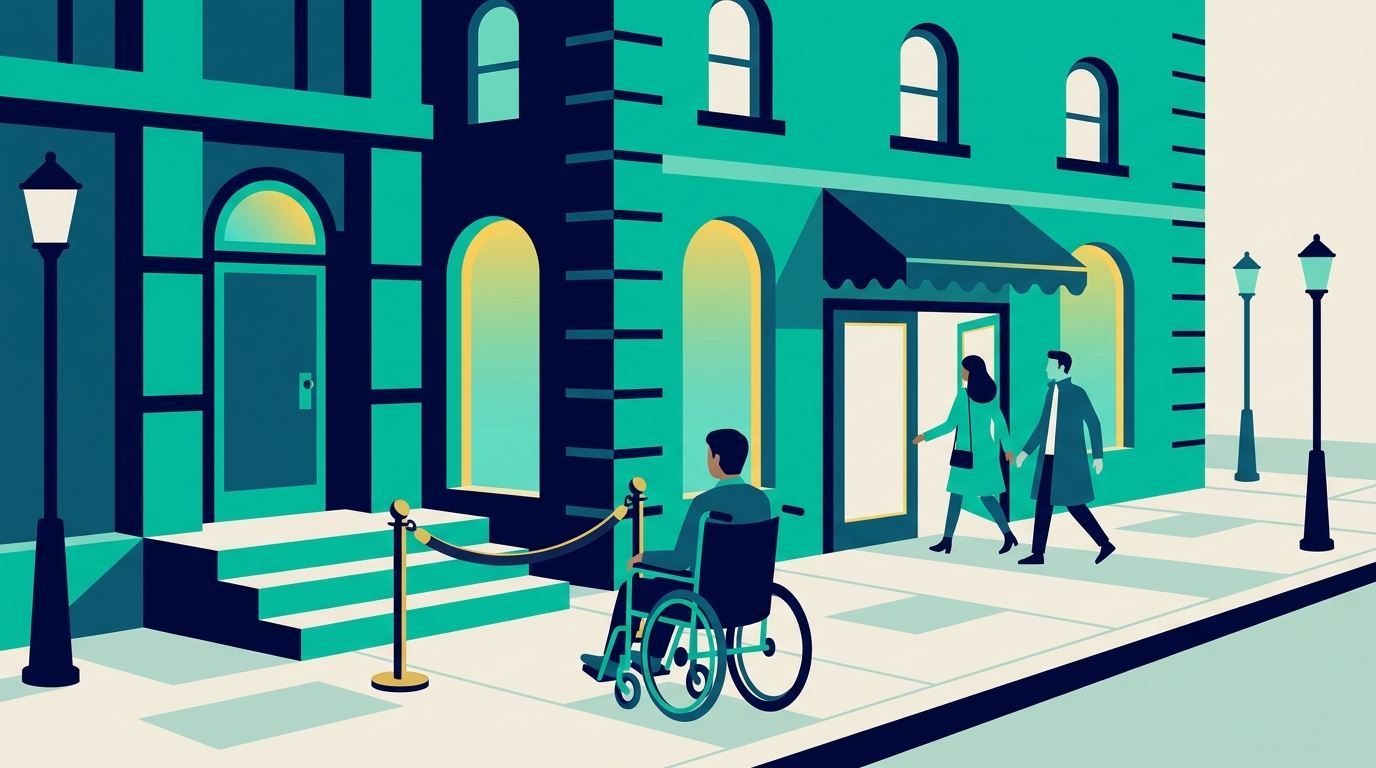
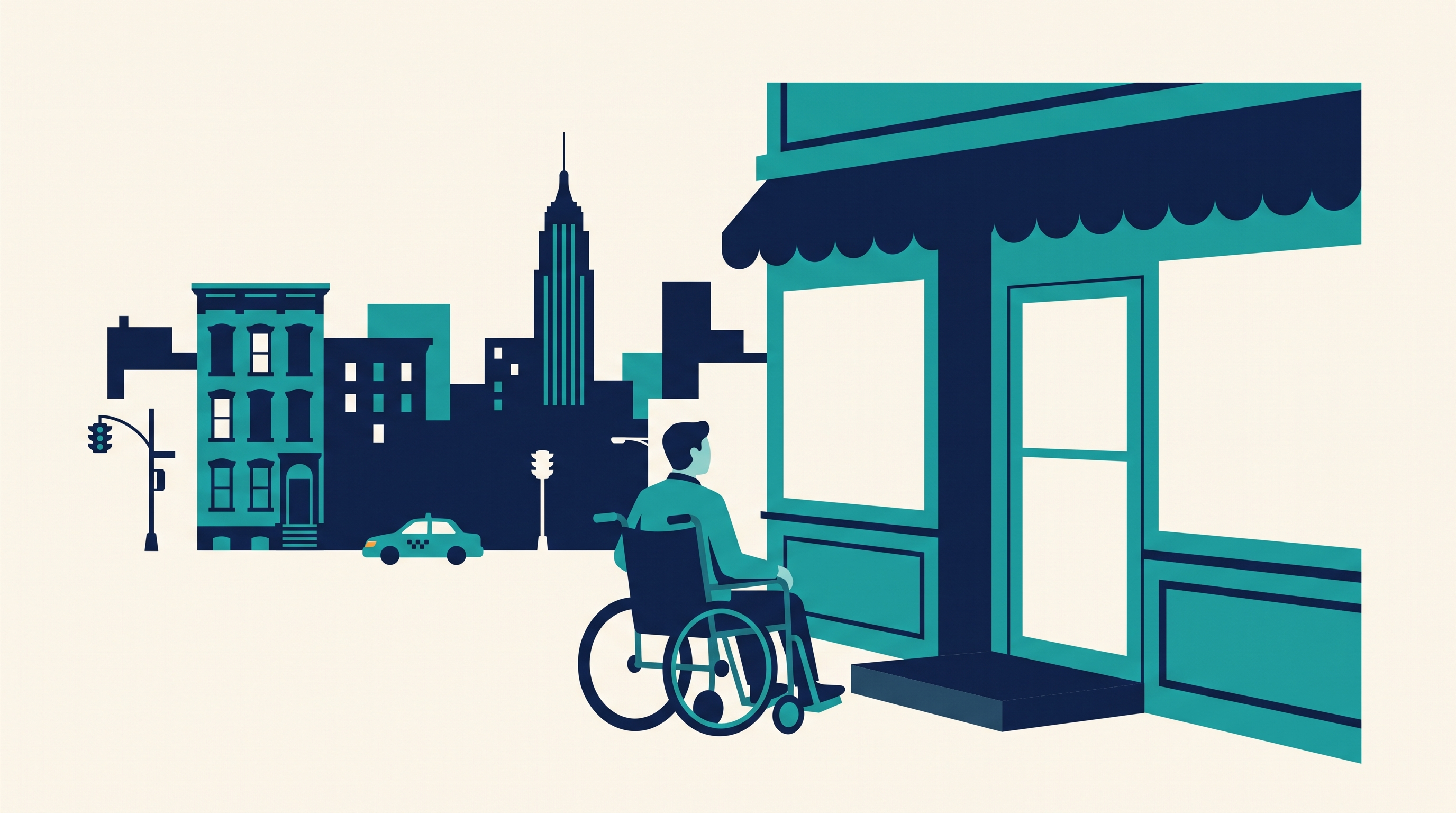
Many owners assume one small step is not a problem. It can be. If a two-inch rise, a locked side entrance, or a blocked aisle is what kept you out, that is the same kind of exclusion at the center of most mobility impairment discrimination claims in NYC and of cases where someone is barred from entry because of a disability.
Common wheelchair access violations in New York City
- Entrance barriers: no permanent or portable ramp at the main door.
- Door hardware: doors too heavy to open without help, or knobs you cannot grip.
- Vestibule issues: two sets of doors too close together, trapping a wheelchair between them.
- High thresholds: a bump at the doorway higher than half an inch.
- Interior barriers: narrow or cluttered aisles, high-only counters, inaccessible restrooms, or no accessible seating.
- Sidewalk sheds and outdoor dining: structures that block the accessible path or create seating you cannot reach.
If the barrier involves construction, renovation, or a newly built space, the city's own accessibility rules may also apply — our NYC building code accessibility violations checklist walks through what to look for.
Does the age of the building matter?
You may hear that an old building is "grandfathered in." That is a common misunderstanding. Existing buildings are not exempt from the ADA's ongoing duty to remove readily achievable barriers, and buildings that are newly constructed or altered face stricter design standards. Age can affect what fix is reasonable, but it rarely erases the obligation entirely. If you are not sure whether a specific entrance is unlawful, we can review the details with you at no cost.
What is my NYC accessibility case worth?
Value depends on which law carries your claim. The ADA gives a court power to order the business to fix the barrier — install a ramp, widen a door, rearrange shelving — and can allow recovery of attorney's fees, but it does not provide money damages to the individual who was turned away.
That is why most New Yorkers pursue public access claims under the New York City Human Rights Law (NYCHRL) or the New York State Human Rights Law (NYSHRL). Both allow compensatory damages, including damages for the humiliation and emotional harm of being excluded, and the NYC Commission on Human Rights can also impose civil penalties on a business it finds liable.
Outcomes vary a great deal. Some matters resolve early through a demand letter for up to $25,000, while claims involving repeat exclusion, a refusal to fix the barrier, or serious emotional harm have resolved for up to $60,000. No one can promise a number for your situation — the facts, the evidence, and the business's conduct drive the result. For a fuller breakdown of ranges and what moves them, see our guide to disability discrimination settlement amounts in New York.
No upfront costs for your claim
You should not have to gamble money to enforce a civil right. Our case check is free, and the independent attorneys we connect you with work on contingency: no recovery, no fee. We manage the intake and case file so the paperwork is not sitting on your shoulders. When you are ready, start your free three-minute case check.
Which NYC businesses must provide wheelchair access?
Almost every place open to the public is covered. Below are the venue types we see most often, with a deeper guide for each.
Restaurants, bars, and hotels
Dining rooms, bars, and restrooms all have to be usable, and high-top-only seating is not an accessible seating plan. If you were seated by the kitchen door, sent to a side entrance, or could not reach the restroom, start with our restaurant accessibility complaint guide for NYC. For overnight stays, accessible rooms, roll-in showers, and reservation policies are covered in our guide to hotel disability discrimination in New York.
Retail stores and small shops
Aisles must be wide enough to move through, and at least part of a service counter should be reachable from a seated position. Small size alone is not an exemption; a boutique open to the public is open to you. Our walkthrough of an inaccessible retail store complaint in Brooklyn shows how these claims come together.
Gyms, museums, cinemas, and venues
Fitness clubs, cultural institutions, and entertainment spaces are all public accommodations. That includes accessible equipment routes and locker rooms — see our gym accessibility complaint guide — as well as galleries, elevators, and programs, covered in our guide to filing a museum accessibility complaint in Manhattan. For theaters, wheelchair spaces and companion seating cannot be the worst seats in the house; our guide to cinema accessibility for wheelchair users in NYC and our concert venue accessibility complaint guide explain what to document.
Transit, government buildings, ATMs, and restrooms
Public transportation and government facilities fall under ADA Title II rather than Title III, but the barrier feels the same when a lift is broken or an elevator is out. Start with inaccessible public transportation in NYC or our guide to a government building accessibility complaint in New York. Banking machines and public facilities matter too: see our ATM accessibility complaint guide and our guide to an inaccessible public restroom complaint in NYC.
Medical and professional offices
Doctors, dentists, lawyers, and accountants run public accommodations too. An office without a ramp, an accessible exam room, or a height-adjustable table can deny you basic care — our guide to doctor's office wheelchair accessibility in NY covers how to report it.
How to report a business for no wheelchair access
Reporting is really about building a record. Businesses sometimes make quick cosmetic changes once they sense a complaint is coming, so capture what you saw while you are there.
Steps to take at the scene
- Photograph the entrance from several angles, including the step or threshold and the business name and address.
- Record a short video panning the doorway so the absence of a ramp is obvious.
- Note whether there is a doorbell, buzzer, or sign offering assistance — and note it if there is none.
- Save receipts, order confirmations, or texts that show the date and time you were there.
- Write down what staff said, who said it, and the names of anyone who witnessed it.
Our New York evidence checklist covers this in more detail, and our guide to reporting ADA non-compliance in NYC explains what happens after a report is filed.
Where public access claims get filed
Public accommodation claims in New York are usually brought before the New York City Commission on Human Rights (CCHR) or the New York State Division of Human Rights (NYSDHR), or in court. Deadlines differ: a complaint with the CCHR generally must be filed within one year of the discriminatory act, while a complaint with the NYSDHR generally must be filed within three years. (The EEOC handles employment discrimination, not public access, so it is not the right door for this type of claim.) Our step-by-step look at the NYC Commission on Human Rights complaint process shows how an administrative case unfolds, and our overview of the ADA claim statute of limitations in New York helps you check your dates before they pass.
How ADA Help manages your NYC access claim
ADA Help is a case-management and intake service, not a law firm, and we do not give legal advice. What we do is take the administrative weight off you: we review the barrier you encountered, organize your photos, video, and notes into a clear file, flag your filing deadlines, and connect you with independent attorneys who handle New York accessibility matters. Our broader overview of ADA Title III case management in New York explains the process end to end.
You get plain-English updates at each milestone instead of legal jargon, and the attorneys work on contingency — no recovery, no fee. Not sure yet whether what happened to you counts? Check your case in about three minutes and we will tell you what we see.
Take action for an accessible New York
You have the right to walk — or roll — into the same shops, restaurants, gyms, theaters, and offices as anyone else. When a step or a locked door blocks that, the exclusion is not just inconvenient; it may be unlawful. Your photos and notes are what turn a bad afternoon into a documented claim, and the sooner you capture them, the stronger your position.
Start with a free three-minute case check, and use the venue guides above to understand the specific rules for the place that turned you away.
Frequently asked questions
Is a business required to have a ramp in NYC?
A covered business must make its entrance accessible when doing so is readily achievable. If a permanent ramp is not feasible because of sidewalk width or structure, the owner is expected to look at alternatives such as a portable ramp, a lift, or another usable entrance with clear signage. Simply leaving a step in place and doing nothing is what creates exposure under the ADA and the NYC Human Rights Law.
Can I get money if a business is not wheelchair accessible?
Money damages generally come from the state and city human rights laws rather than the ADA. The NYCHRL and NYSHRL allow compensatory damages, including for emotional harm, and the CCHR can also impose civil penalties. Amounts depend entirely on the facts; some matters resolve for up to $25,000 and stronger claims have resolved for up to $60,000.
Do small NYC shops have to follow accessibility rules?
Public accommodation rules do not have an employee-count threshold the way some employment laws do. A small gift shop, pharmacy, or gallery that serves the public is covered. Size can affect what fix is considered readily achievable, but it does not remove the obligation to consider access at all.
What if the business says it has a portable ramp?
A portable ramp can be an acceptable solution where a permanent one is not feasible, but it has to actually work in practice. That means it is available whenever the business is open, staff know where it is and how to deploy it, and there is a way for you to request it from the sidewalk, such as a bell with clear signage. A ramp locked in a basement is not access.
How long do I have to file?
Deadlines depend on where you file. A complaint with the NYC Commission on Human Rights generally must be filed within one year of the discriminatory act; a complaint with the NYS Division of Human Rights generally must be filed within three years. Because the clock starts at the incident, it is worth confirming your dates early.
Can I file if I was not physically injured?
A physical injury is not required. The harm in a public access claim is the denial of equal access and the indignity of being turned away. New York law recognizes that being shut out of a place open to the public is a real injury to your civil rights.
Disclaimer
This article is general information about New York law, not legal advice, and reading it does not create an attorney-client relationship. ADAhelp is a case-management and intake service, not a law firm; legal representation is provided by independent attorneys. Recovery amounts and timelines vary by case, and past outcomes do not guarantee future results. For advice about your specific situation, speak with a qualified attorney or start the free case check.
Tags
Discriminated against in New York because of a disability?
A free three-minute check tells you if you can pursue a claim.
Check my case →New York onlyNo upfront costIndependent NY attorneysFree 3-minute check