Mental Health Discrimination at Work New York: Your Rights
Reviewed for accuracy by the ADAhelp team before publishing. ADAhelp is not a law firm; legal work is handled by independent New York attorneys.

Sidelined for anxiety or depression? Learn about mental health discrimination at work in New York and your right to recover damages. Free case check.
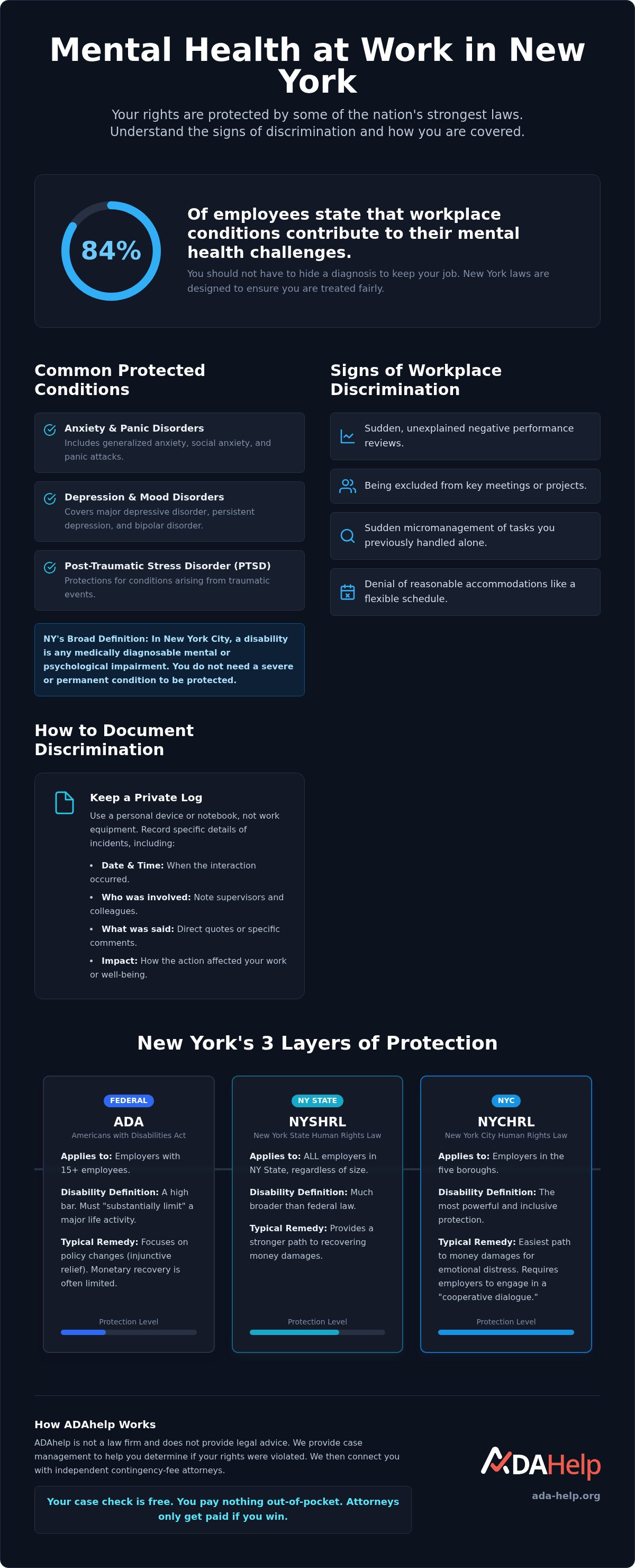
84% of employees state that workplace conditions contribute to their mental health challenges. You shouldn't have to hide a diagnosis like anxiety or depression just to keep your paycheck. It's common to feel a sense of dread about disclosing your needs; especially when you fear being fired or sidelined. If you have faced mental health discrimination at work New York laws provide some of the strongest protections in the country to ensure you are treated fairly.
You deserve a professional environment that respects your health. This article explains how to tell if your employer failed to provide a reasonable accommodation or engaged in illegal retaliation. We will clarify the differences between federal law and the New York City Human Rights Law; which often allows for higher financial recoveries. You will learn how to determine if you have a case and how to start the process without any financial risk.
ADAhelp is not a law firm. We provide case management to help you identify if your rights were violated. We connect you with independent contingency-fee attorneys who only get paid if you win. You can seek justice and financial stability without paying anything out of pocket.
Key Takeaways
- Identify how New York laws protect common conditions like anxiety; depression; and PTSD from unfair treatment in the workplace.
- Understand that while federal law often focuses on policy changes; New York state and city human rights laws are the primary tools for recovering money damages.
- Learn how to document mental health discrimination at work New York by keeping a private log of interactions and supervisor comments.
- Discover your right to a cooperative dialogue; a legal requirement for New York City employers to discuss your specific accommodation needs.
- Access intake and case management services through ADAhelp; which is not a law firm; to determine if you have a claim and connect with a contingency-fee attorney.

Mental Health Discrimination at Work in New York: The Basics
Mental health discrimination at work New York occurs when your employer treats you poorly because of a psychological condition. This treatment isn't always an immediate firing; it can include being passed over for a promotion or having your duties stripped away. Real New Yorkers are protected by three distinct layers of law that work together to provide a safety net. These laws protect employees living with several conditions; including:
- Depression and persistent depressive disorders.
- Anxiety disorders and panic attacks.
- Post-Traumatic Stress Disorder (PTSD).
- Bipolar disorder and other mood-related conditions.
Many of these conditions can be triggered or made worse by psychosocial hazards in the workplace; such as chronic overwork or a hostile environment. Under the New York City Human Rights Law; disability discrimination is defined as any medically diagnosable mental or psychological impairment; regardless of whether it limits a major life activity.
To better understand the legal framework surrounding these issues; watch this helpful video:
Is your mental health condition a disability?
The Americans with Disabilities Act (ADA) defines a disability as a physical or mental impairment that substantially limits one or more major life activities. This is a high bar to clear in federal court. Fortunately; New York State and City laws use a much broader definition. You don't need a permanent or severe condition to qualify for local protections. Even temporary conditions like situational depression can be covered if a doctor can provide a diagnosis. If your employer knows about your condition and treats you differently because of it; you may have a claim under the New York State Human Rights Law (NYSHRL).
Federal vs. New York City protections
The ADA is a federal law that applies to employers with 15 or more employees. While it offers a baseline; it often limits what you can recover in terms of money. The NYSHRL is stronger because it applies to all employers in the state regardless of their size. If you work within the five boroughs; the New York City Human Rights Law (NYCHRL) provides the most powerful protections available. It requires employers to engage in a formal cooperative dialogue to find solutions for your needs. This local law also makes it easier to recover money damages for emotional distress; whereas federal law often focuses on making the employer change their policies.
Common Signs of Workplace Mental Health Discrimination
You might notice your manager's tone change after you mention your therapy appointments. Mental health discrimination at work New York often begins with subtle shifts in your daily routine rather than a sudden firing. Perhaps you are no longer invited to key meetings; or your supervisor starts micromanaging tasks you previously handled alone. These changes can feel isolating; but they are often the first indicators that your employer is reacting to your health status rather than your job performance.
One common tactic involves using your mental health as a pretext for poor performance reviews. If your work quality hasn't changed but your ratings suddenly drop after you disclose a condition; this is a red flag. Employers sometimes build a paper trail of "performance issues" to justify a termination that is actually based on bias. It's vital to understand your legal rights under the ADA; as these federal standards provide a foundation for the even stronger protections found in New York state and city laws. See our related guide on medical discrimination at work for more on how these claims start.
Denial of reasonable accommodations
A reasonable accommodation is any change to your work environment or schedule that helps you do your job despite your condition. In New York; this could mean a flexible start time to manage morning medication side effects or a quiet workspace to reduce sensory overload. Your employer can't simply say "no" without a valid reason. They are legally required to engage in an interactive process. This means they must talk to you to find a solution that works for both parties. If they refuse to even discuss these options; they may be violating the law.
Hostile work environments and harassment
Harassment isn't just about physical threats. It includes offensive comments; "jokes;" or insults about your mental health that make it difficult to do your job. Under the New York City Human Rights Law; the standard for proving harassment is lower than federal law. You don't have to prove the behavior was "severe or pervasive." Instead; you only need to show you were treated "less well" than others because of your disability. The behavior must be more than a petty slight or trivial inconvenience; but persistent bullying or management ignoring your complaints often crosses the legal line.
If you feel like you're being pushed out or treated unfairly; you don't have to figure this out alone. You can check your case eligibility in just a few minutes to see if your experience matches the criteria for a legal claim.
Calculating Your Recovery Under New York Human Rights Laws
You might wonder if filing a claim is worth the emotional effort. While Federal Disability Discrimination Laws like the ADA focus on making your employer change their behavior; New York laws focus on your financial recovery. The ADA primarily provides injunctive relief. This means a court might order your boss to stop the discrimination or change a policy. However; if you are looking for money to cover your losses; the New York State Human Rights Law (NYSHRL) and the New York City Human Rights Law (NYCHRL) are your strongest tools. These local statutes are designed to make you whole again after facing mental health discrimination at work New York.
When your rights are violated; you can seek several types of financial recovery through the state and city systems. These include:
- Back pay: This covers the wages; bonuses; and benefits you lost from the time you were fired or demoted until your case is resolved.
- Front pay: This compensates you for future lost earnings if you cannot return to your previous position or find comparable work.
- Compensatory damages: These payments address your emotional distress; pain; and suffering.
- Punitive damages: In cases of egregious or malicious behavior; a court may order these to punish the employer and prevent future violations.
What is your case worth?
Typical recovery amounts vary based on your specific lost wages and the severity of the treatment you endured. Emotional distress damages are particularly important for mental health claims. They compensate you for the anxiety; depression; or trauma caused by the discrimination itself. Because these impacts are personal; the recovery amount often reflects the depth of the harm done to your well-being. It is important to remember that settlement amounts vary case by case and are never guaranteed.
The power of the NYCHRL
If you work in the five boroughs; the NYCHRL is one of the most employee-friendly laws in the United States. It has a much lower burden of proof than federal law. You do not have to prove the discrimination was the only reason for your firing; only that it was a motivating factor. This law is designed to be liberally construed in favor of the employee to ensure justice is served. Additionally; the NYCHRL allows for the recovery of attorney fees from the employer. This means the cost of legal help does not have to be a barrier to seeking justice. ADAhelp is not a law firm; but we can help you determine if you meet these criteria and connect you with a contingency-fee attorney who handles the heavy lifting.
How to Document Discrimination for Your Claim
Documentation is the foundation of any successful claim, and our evidence checklist for disability discrimination cases covers this in more depth. If you've faced mental health discrimination at work New York laws require evidence to prove your employer's actions were illegal. Start by keeping a private log. Record every date; time; and specific comment made by your supervisors or coworkers. If a manager makes a remark about your "stability" or "mood;" write it down immediately. These details often fade from memory; but they are vital for building a clear timeline of events. When keeping your private log; include:
- The names of everyone present during the interaction.
- Exact quotes whenever possible.
- How the interaction affected your ability to perform your job.
- The date you submitted any medical notes or accommodation requests.
Save every email and text message that relates to your disability or your job performance. If you receive a sudden negative review after disclosing a condition; that document is essential. Your medical records are private; and you don't have to share your entire history. However; these records prove your condition exists and that you are entitled to legal protection. A diagnosis from a licensed professional is often the key to turning a workplace grievance into a valid legal case.
Creating a paper trail
Verbal conversations are difficult to prove. You can fix this by sending follow-up emails after every meeting. Write a brief summary of what was discussed and send it to your supervisor. This creates a permanent record of their statements. Always use your personal email to store copies of these documents. Do not rely on your work computer or company server. If you are fired or suspended; you will likely lose access to your work account within minutes. Having a backup on your personal device ensures you keep control of your evidence and protects your history of the events.
Managing medical documentation
You don't need a thick file of hospital records to start the process. A simple note from your doctor is often enough to trigger your right to a reasonable accommodation. This note should state that you have a condition and list the specific changes you need at work. You have the right to keep the specific details of your diagnosis private from your boss. Keep a record of every request you made and how your employer responded. If they ignored your request or denied it without a discussion; they may have violated the New York City requirement for a cooperative dialogue. This failure to talk is often a major factor in winning a discrimination claim.
If you are unsure if your documentation is sufficient; take a moment to start your free three-minute case check. We can help you organize your information and determine if your situation meets the legal criteria for a claim.
Start Your Case with ADAhelp Case Management
Starting a claim for mental health discrimination at work New York can feel like a second job. You are already dealing with the weight of your condition and the stress of a hostile workplace. ADAhelp is here to handle the heavy lifting. We are not a law firm; we are a case-management service that simplifies the path to justice. Our goal is to turn your frustration into a clear plan for resolution.
You don't have to spend hours researching statutes or cold-calling law offices. Instead; you can start with a free three-minute case check. This process is designed for real New Yorkers who need answers fast. It removes the intimidation of talking to an attorney before you are ready. You can learn more about the broader context in our guide on Employment Disability Discrimination New York: Your Rights and Recovery.
How our three-minute check works
The process is fast and simple. You start by answering a few questions about your workplace situation. We ask about your diagnosis; the treatment you received; and whether you work in the five boroughs. We then evaluate this information against the specific standards of the ADA; the NYSHRL; and the NYCHRL. If your situation shows a likely violation; we handle the information gathering. We organize your evidence and prepare it for filing.
Connecting with contingency-fee attorneys
Once your information is ready; we connect you with independent attorneys who specialize in New York discrimination cases. These professionals understand the local court system and how to seek the best possible recovery for you. They work on a contingency basis; which means they only get paid if you win. You will never pay a dime out of pocket for their representation. This model ensures that every New Yorker has access to justice; regardless of their financial situation.
By focusing on state and city laws; these attorneys target the money damages you deserve for emotional distress and lost wages. We act as your proactive partner throughout this intake process. We ensure your case is handled efficiently and that you are matched with an advocate who will fight for your rights. Justice shouldn't be a luxury. It should be an accessible path for anyone facing unfair treatment.
Take the Next Step Toward Workplace Fairness
You don't have to carry the burden of a hostile workplace alone. New York laws are designed to protect you from bias and ensure you receive the accommodations you need to succeed. By understanding the strength of local protections; you can move from a place of anxiety to a clear path for financial recovery.
Dealing with mental health discrimination at work New York requires a proactive approach to documentation and filing. Remember that state and city laws often provide broader damages than federal standards. You can seek justice for emotional distress and lost wages without the fear of upfront legal fees.
ADAhelp is ready to act as your partner in this process. We are not a law firm; but we handle the critical first steps of intake and case management. We provide a free case evaluation and connect you with independent contingency-fee attorneys. This means you pay no out-of-pocket costs to seek the justice you deserve. Start your free three-minute case check today and begin your journey toward a fair resolution. You deserve a workplace that values your health and your contributions.
Where to File: Agencies & Deadlines
If you believe you have experienced mental health discrimination at work New York offers several agencies where you can file a formal complaint, each with its own deadline. Filing promptly protects your right to pursue a claim and preserves your evidence while it is still fresh.
- New York State Division of Human Rights (DHR): Handles claims under the NYSHRL for employers of any size statewide. You generally have three years from the discriminatory act to file. Learn more at dhr.ny.gov.
- NYC Commission on Human Rights (CCHR): Enforces the NYCHRL for conduct within the five boroughs and offers the broadest protections. Complaints must generally be filed within one year of the discriminatory act. Details are available at nyc.gov/cchr.
- U.S. Equal Employment Opportunity Commission (EEOC): Enforces the ADA for employers with 15 or more employees. You typically have 300 days from the discriminatory act to file a charge.
- U.S. Department of Justice (DOJ): Oversees broader ADA compliance and enforcement. You can review federal standards and complaint procedures directly at ada.gov.
Filing with the wrong agency, or missing a deadline, can permanently bar you from recovering damages. ADAhelp's free case check helps confirm which agency and deadline apply to your situation before you file.
Frequently Asked Questions
Is depression considered a disability in New York?
Depression is absolutely a protected disability under New York laws. While federal standards require a condition to limit a major life activity; the New York City Human Rights Law covers any medically diagnosable impairment. This means you are protected even if your symptoms are temporary or managed with medication. If you face mental health discrimination at work New York laws ensure you have a right to a fair workplace regardless of your specific diagnosis.
Can I be fired for taking time off for mental health treatment?
You cannot be fired solely for requesting or taking time off as a reasonable accommodation for treatment. New York employers must engage in a formal cooperative dialogue to discuss your needs. If your boss terminates you shortly after you disclose your condition or request leave; it may constitute illegal retaliation. These protections apply to all employers in the state regardless of their size. It's vital to document these requests to prove your legal rights were violated.
What should I do if my boss denies my request for an accommodation?
Start by documenting the specific date and reason given for the denial. New York City law requires employers to discuss potential solutions in good faith before claiming an accommodation is impossible. If they refuse to talk or provide a valid reason; you should gather your medical notes and records of the interaction. You don't have to handle the filing process alone. We can help you determine if the denial constitutes a violation of your rights.
How much does it cost to file a discrimination claim with ADAhelp?
Filing a claim through our case management services costs you nothing out of pocket. We offer a free three-minute case check to evaluate your situation. ADAhelp is not a law firm; so we focus on intake and connecting you with independent attorneys. These professionals work on a contingency fee basis; meaning they only get paid if you win your case. You never have to worry about hourly rates or upfront legal fees while seeking justice.
What is the difference between the ADA and the New York City Human Rights Law?
The ADA is a federal law that often limits money damages and applies only to companies with 15 or more employees. The New York City Human Rights Law provides much stronger protections for local workers. It has no caps on the damages you can recover for emotional distress or punitive measures. The NYC law also uses a broader definition of disability; making it easier for employees to prove they were treated unfairly compared to federal standards.
How long do I have to report mental health discrimination in NYC?
Your deadline depends on where you file your claim. For federal claims with the EEOC; you generally have 300 days from the discriminatory act. In New York City; you have one year to file with the City Commission on Human Rights. If you choose to file a lawsuit in state court; the statute of limitations is typically three years. It is important to act quickly to ensure your evidence is fresh and your filing remains legally valid.

Article by
ADA Help
Written by the ADAhelp editorial team and reviewed for accuracy before publishing. ADAhelp helps New Yorkers find out if they have a disability discrimination claim and manages the process end to end, working with independent attorneys who handle the legal work. We are not a law firm and do not provide legal advice.
Disclaimer
This article is general information about New York law, not legal advice, and reading it does not create an attorney-client relationship. ADAhelp is a case-management and intake service, not a law firm; legal representation is provided by independent attorneys. Recovery amounts and timelines vary by case, and past outcomes do not guarantee future results. For advice about your specific situation, speak with a qualified attorney or start the free case check.
Tags
Discriminated against in New York because of a disability?
A free three-minute check tells you if you can pursue a claim.
Check my case →New York onlyNo upfront costIndependent NY attorneysFree 3-minute check