Restaurant Accessibility Complaint NYC: Rights & Recovery
Reviewed for accuracy by the ADAhelp team before publishing. ADAhelp is not a law firm; legal work is handled by independent New York attorneys.
Faced a barrier at a restaurant? File a restaurant accessibility complaint NYC. Learn how local laws can get you a cash settlement with no out-of-pocket costs.
Did you know that a single step at a restaurant entrance could entitle you to financial compensation in New York City? It's frustrating when a night out ends before it starts because of a physical barrier. You might feel ignored when a manager brushes off your concerns. Filing a 311 report might eventually get a building inspector to show up; however, it won't compensate you for the discrimination you experienced. To get justice and a payout, you need to file a formal restaurant accessibility complaint NYC under local civil rights laws.
We understand how exhausting it is to fight for basic access. This guide explains how the Americans with Disabilities Act (ADA) works alongside the New York State and City Human Rights Laws. While federal law focuses on fixing the building, New York's specific laws allow for money damages. ADAhelp is not a law firm and does not provide legal advice. We are a case management service that helps you determine if you have a claim. We connect you with independent attorneys who work on a contingency basis. This means you never pay out of pocket. You only pay if you win a recovery. We will show you how to identify violations and start your path toward a stress-free resolution today.
Key Takeaways
- Identify physical barriers like steep entrance steps and narrow aisles that violate your rights.
- Understand how New York City laws provide financial recovery for the indignity of discrimination.
- Filing a restaurant accessibility complaint NYC can lead to a settlement without any out-of-pocket costs.
- Learn why saving your receipt and taking photos are critical for building a strong case.
- ADAhelp is not a law firm, we provide case management to connect you with independent contingency-fee attorneys.
Common Restaurant ADA Violations in New York City
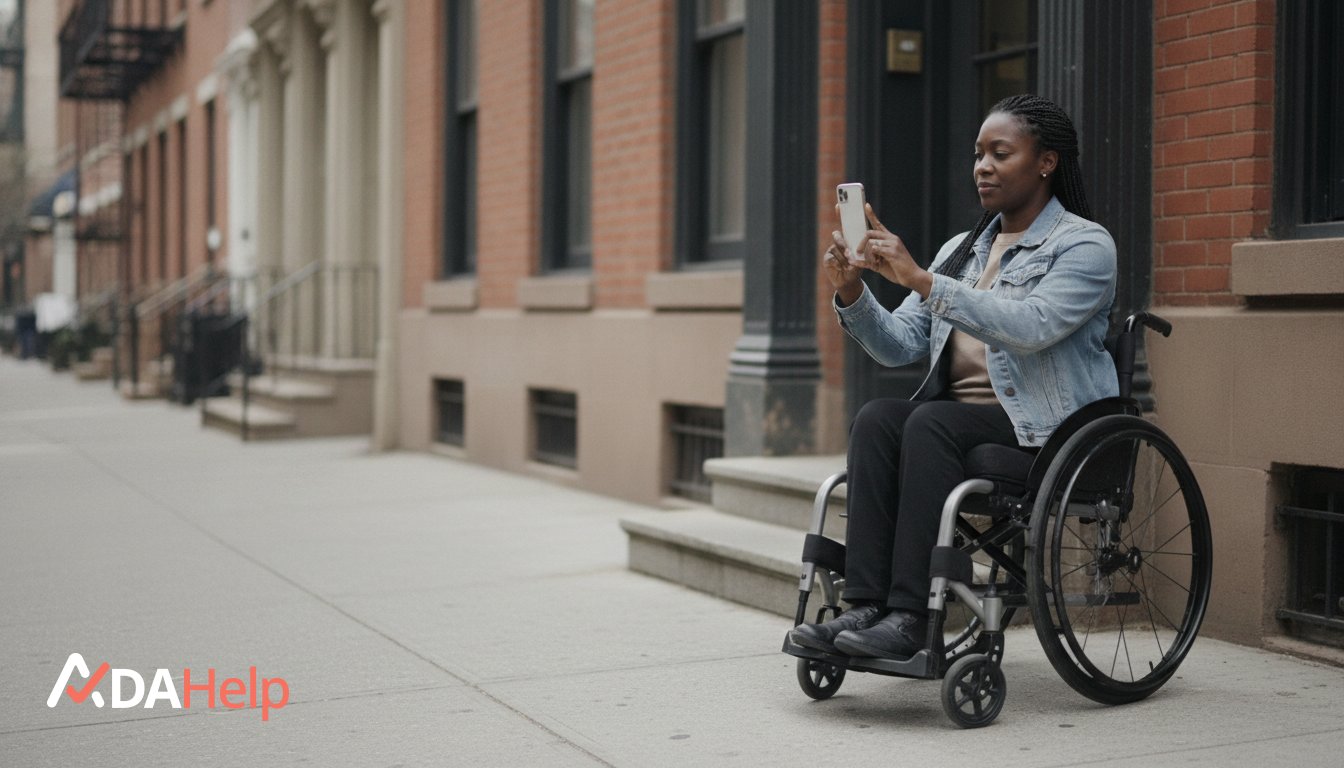
Many New York City eateries operate in older buildings with narrow layouts. Federal and local laws require these businesses to remove barriers that prevent you from enjoying a meal. When a restaurant fails to provide equal access, it isn't just an inconvenience. It is a violation of your civil rights. Identifying these issues is the first step toward starting a restaurant accessibility complaint NYC. You deserve the same experience as any other diner, from the moment you reach the front door to the time you leave the table. These same access standards apply broadly across public buildings across NYC, not just restaurants.
Entrance and Exterior Barrier Checklist
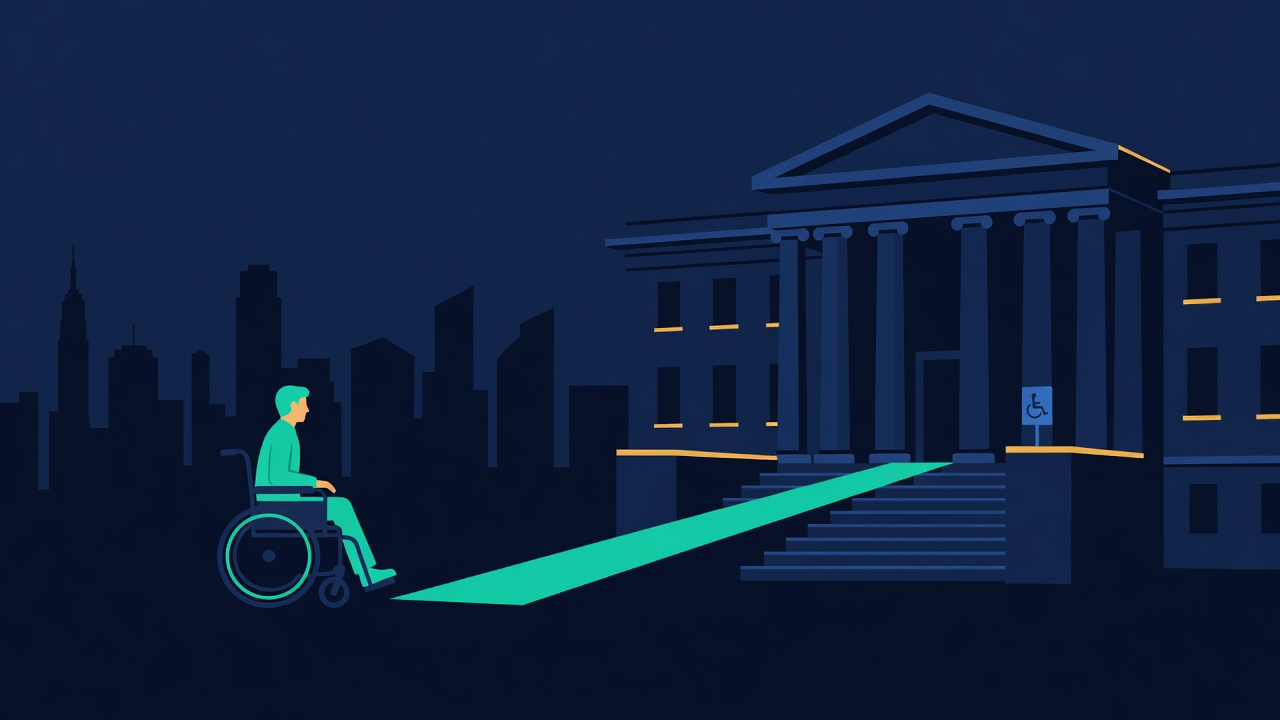
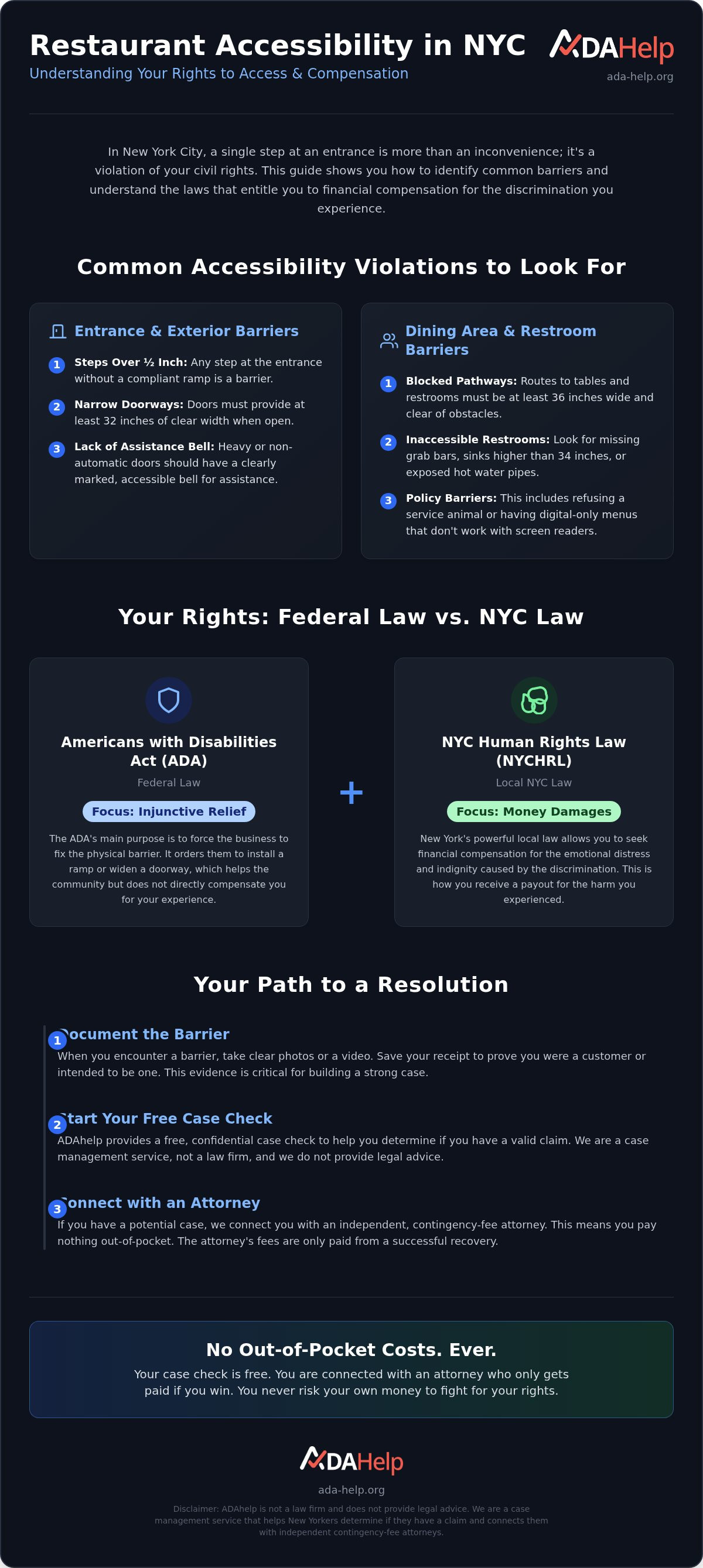
The entrance is the most common place where discrimination occurs. You should look for specific physical obstacles that make entry difficult or impossible. Check if there are steps higher than half an inch without a proper ramp. Even a single small step can stop a wheelchair. Measure the door to see if it is at least 32 inches wide when open. If the door is heavy or not automatic, look for a doorbell for assistance. This bell must be at an accessible height and clearly marked for use by people with disabilities.
Dining Area and Restroom Access
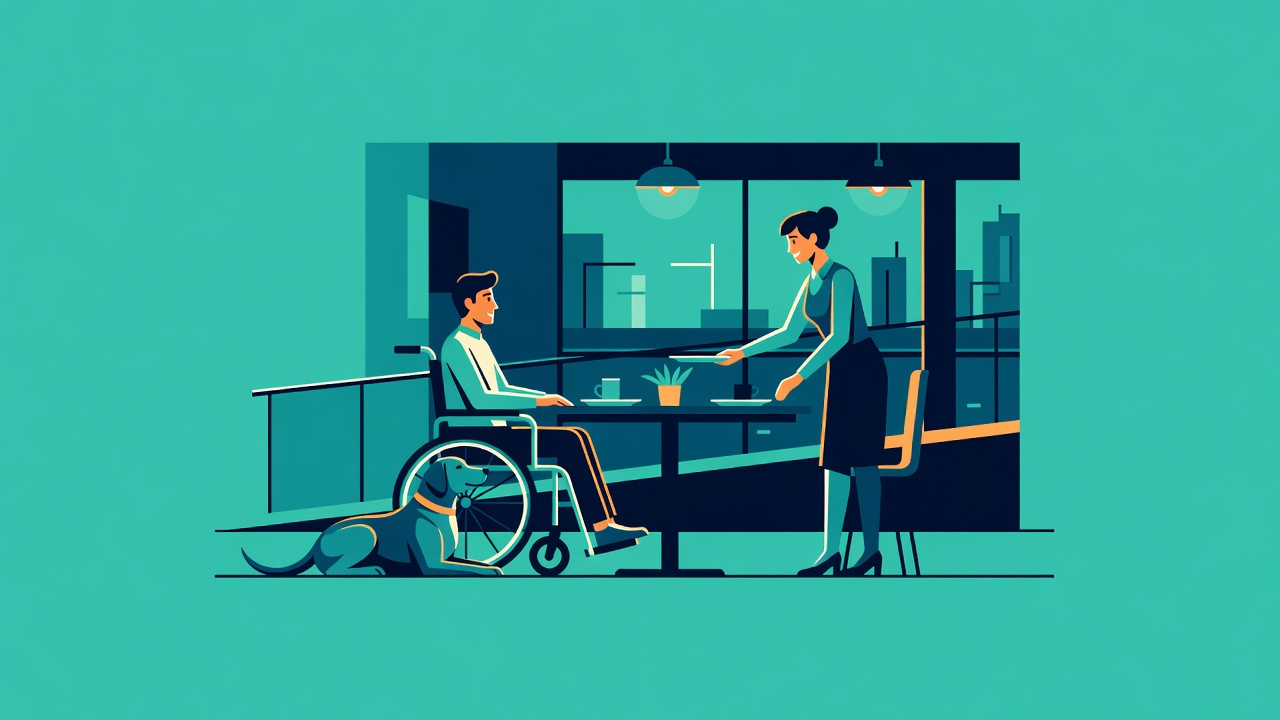
Accessibility must continue throughout the entire establishment. You have the right to sit where you choose and use the facilities without help. Verify if accessible tables are distributed throughout the dining room rather than tucked away in a corner. These tables must have enough knee clearance for a wheelchair user. Check restrooms for grab bars installed at the correct heights, usually between 33 and 36 inches. Sinks should be no higher than 34 inches from the floor with insulated pipes. Ensure the path to the bathroom is at least 36 inches wide. It should not be blocked by stored chairs, delivery boxes, or cleaning supplies.
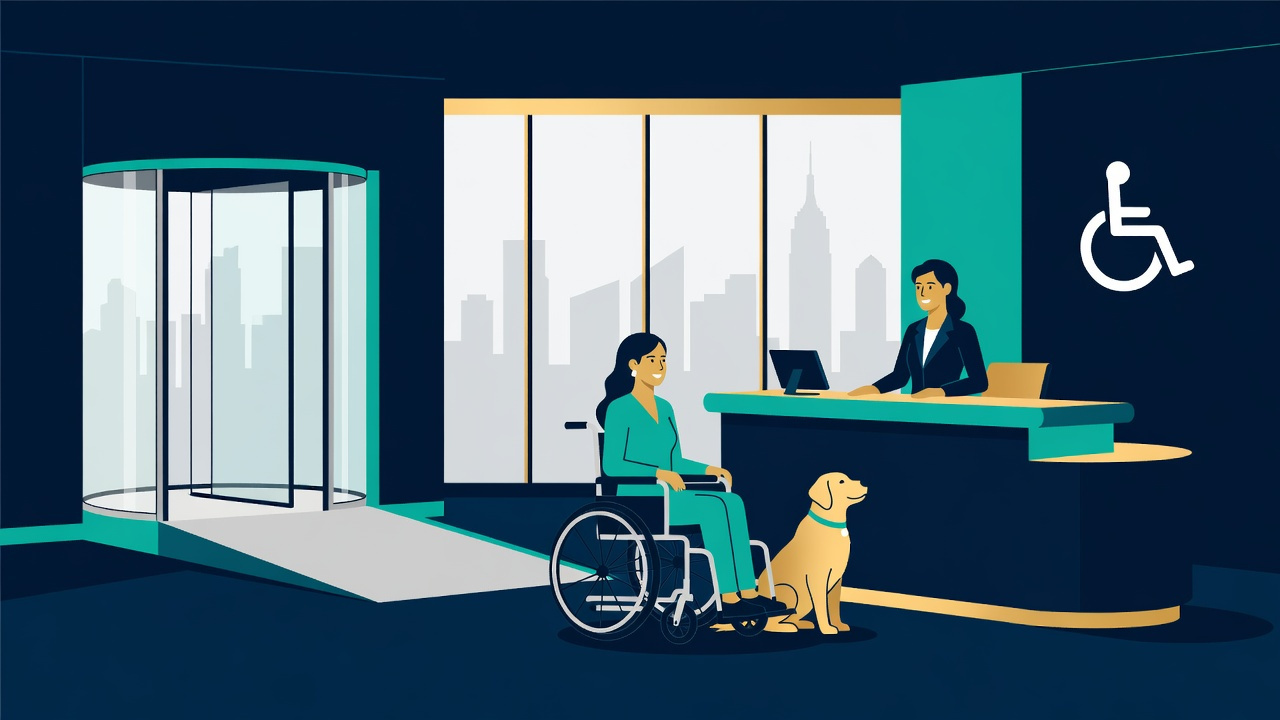
You might also face policy barriers. This includes staff refusing your service animal or digital menus that are not compatible with screen readers. These issues fall under the ADA and the New York City Human Rights Law. While the federal ADA focuses on fixing the physical building, the NYCHRL provides a path to financial recovery for the frustration you experienced. ADAhelp is not a law firm and does not provide legal advice. We act as your case manager to help you identify these violations. We connect you with independent attorneys who work on a contingency basis. This means you face no financial risk and pay nothing out of pocket. Fees are only taken if you receive a recovery. Typical amounts vary based on the specific details of your case.
Understanding Your Rights Under New York Law
You have more power than you think. When you encounter a barrier at a local eatery, you aren't just looking at a building code issue, you're looking at a civil rights violation. In New York, three specific laws protect your right to dine out without obstacles. These include the federal Americans with Disabilities Act (ADA), the New York State Human Rights Law (NYSHRL), and the New York City Human Rights Law (NYCHRL). Each serves a different purpose in your fight for fairness.
ADA vs. New York City Human Rights Law
The ADA is a federal law that focuses on "injunctive relief." This means the court orders the restaurant to fix the physical problem, such as installing a ramp or widening a door. While fixing the barrier helps the community, it doesn't compensate you for the humiliation of being turned away. That's where the NYCHRL comes in. This local law allows you to seek money damages for emotional distress and indignity. Under all three laws, restaurants are considered "public accommodations." This means they are legally required to be accessible to everyone. If they aren't, you have the right to file a restaurant accessibility complaint NYC to hold them accountable.
Why New York Protections Are Unique
New York City has some of the strongest civil rights protections in the country. Unlike federal laws that sometimes have exemptions for very small businesses, the NYCHRL applies to almost all businesses regardless of their size. You don't need to prove the owner acted with malice or intended to discriminate. The mere existence of a barrier is often enough to establish a claim. These protections aren't just for locals, they cover anyone visiting the five boroughs. Whether you live in Brooklyn or are just visiting for dinner, the law protects your access.
Starting this process might feel overwhelming, but you don't have to handle it alone. Instead, we act as a proactive partner to manage your claim. We help you determine if you have a case and connect you with independent contingency-fee attorneys. You won't pay anything out of pocket. Fees are only deducted if your attorney wins a recovery for you. If you're ready to see if you qualify, you can check your case online in just a few minutes. We handle the heavy lifting so you can focus on moving forward.
How Much Is a Restaurant Accessibility Case Worth?
One of the first questions you likely have is about the potential value of your claim. Recovery amounts vary significantly based on the specific facts of your situation. Unlike a simple 311 report that only seeks to fix a building code violation, a formal restaurant accessibility complaint NYC focuses on the discrimination you personally experienced. Typical recovery ranges depend on the severity of the barrier and the impact it had on your experience. In New York City, financial damages are designed to compensate you for the emotional distress and indignity of being denied equal access. Every public accommodation carries the same legal duty, whether it is a restaurant or a gym accessibility complaint New York case, but the value of your claim always depends on your specific facts.
It is important to remember that while the federal ADA requires the restaurant to remove the physical barrier, it does not provide you with money. Your financial recovery typically comes from the broader protections of the New York State and City Human Rights Laws. These local statutes recognize that being turned away from a restaurant is a serious harm. Every case is unique. There are no guaranteed payouts, and results vary from case to case based on the evidence available.
Factors That Influence Your Recovery
Several specific details help determine the strength and value of your claim. First, consider the number of times you encountered the barrier at the restaurant. While a single visit is enough to start a claim, multiple encounters can show a pattern of neglect by the business owner. Second, was the restaurant previously notified of the violation? If a business was already aware of the problem and chose to ignore it, your claim may be viewed differently. Finally, the impact on your daily life or mobility is a major factor. If you were forced to wait outside in bad weather or had to cancel a special event because of an inaccessible entrance, these facts strengthen your case for emotional distress damages.
No Out-of-Pocket Costs for New Yorkers
You should never have to pay to protect your civil rights. We believe the path to justice should be stress-free and financially safe. That is why the initial case check is free for everyone. If we determine you have a valid claim, we connect you with independent attorneys who operate on a contingency model. This means they only earn a fee if they successfully secure a recovery for you. There are no hourly rates, no upfront retainers, and no hidden charges. Fees are only taken from the final settlement or award.
We are your dedicated case management partner. We handle the intake process and manage the details so you don't have to deal with the heavy lifting. This approach ensures there is no financial risk to you when starting your claim. You can focus on your life while we help move your case toward a resolution. If you are ready to find out what your case might be worth, our free three-minute case check is the best place to start.
How to Document Your Experience for a Strong Claim
Evidence is the foundation of any successful claim. When you face a barrier, your first instinct might be to leave and never look back. However, taking a few minutes to gather proof can make all the difference for your restaurant accessibility complaint NYC. You need to show that the discrimination happened and that you were there to experience it. Clear documentation helps independent attorneys understand the strength of your case immediately. It bridges the gap between a frustrating afternoon and a successful legal resolution.
Visual Evidence and Measurements
Photos are your most powerful tool. Take pictures of the entrance from multiple angles to show exactly why it's inaccessible. If there's a step with no ramp, place a common object like a phone or a water bottle next to it. This provides a sense of scale for the court. Don't forget to capture images of discriminatory signs, such as those stating "no service animals allowed." If the issue is inside, photograph the narrow path to the bathroom or the lack of grab bars. Visual proof makes it harder for a business owner to deny the barrier exists.
Recording the Details of the Encounter
The way staff treated you matters just as much as the physical building. Note the specific tone and words used by employees if they refused you entry or ignored your request for assistance. Write down the names of anyone you spoke with, including managers or hosts. If you can, identify witnesses who saw what happened. This could be a friend you were with or even another diner. Describe how you felt in that moment. Were you embarrassed in front of your family? Did you feel excluded from a social gathering? Keeping a log of these feelings and any follow-up emails with the restaurant adds weight to your claim for emotional distress damages.
Always save your receipt or a bank statement showing the transaction. This proves you were a patron or attempted to be one at that specific location. Write down the exact date and time of your visit while the memory is fresh. This level of detail turns a vague story into a factual record. For a complete rundown of what to gather, see our evidence checklist for disability discrimination cases. Providing these details is essential when filing a restaurant accessibility complaint NYC. We use this information to manage your intake and connect you with the right legal partner. If you have your evidence ready, you can start your free case check right now to see if you qualify for a recovery. We handle the process so you don't have to face the business alone.
Where to File: Agencies & Deadlines
A restaurant accessibility complaint NYC can be filed in more than one place, and knowing which agency handles what helps you avoid missing a deadline. You do not have to figure out the right path alone, our team helps you sort this out when you start your free case check.
Key Agencies for Your Complaint
- NYC Commission on Human Rights (CCHR): The NYC Commission on Human Rights enforces the NYCHRL and can investigate discrimination at restaurants and other public accommodations within the five boroughs.
- New York State Division of Human Rights (DHR): The NYS Division of Human Rights handles complaints under the NYSHRL and covers incidents anywhere in the state, not just New York City.
- U.S. Department of Justice (DOJ): The DOJ enforces Title III of the Americans with Disabilities Act, the federal law requiring restaurants to remove physical barriers, though it does not award you personal money damages directly.
- U.S. Equal Employment Opportunity Commission (EEOC): The EEOC only handles workplace discrimination, not restaurant access, so it will not apply to most restaurant accessibility complaint NYC cases unless a separate employment issue is also involved.
Deadlines You Should Know
Under the NYCHRL and NYSHRL, you generally have up to three years from the date of the incident to bring a claim directly in court. Administrative deadlines are shorter: a public accommodation complaint with the CCHR or the DHR is generally due within one year of the incident. Do not rely on the three-year figure when filing with an agency. You may still file a claim directly in court. Federal ADA claims for injunctive relief do not follow the same fixed clock, but waiting too long can still weaken your case and make details harder to recall. Because deadlines and procedures can change, we strongly recommend starting the process as soon as possible. Our free three-minute case check helps confirm which deadline applies to your situation before you file anywhere.
Start Your Free Three-Minute Case Check Today
You have the evidence. You know your rights. Now, you need a partner to help you cross the finish line. Filing a restaurant accessibility complaint NYC does not have to be a confusing or lonely process. While the city's 311 system might eventually send an inspector, it rarely results in personal justice or financial recovery for the victim. You deserve a path that prioritizes your experience and your time. Our case check takes only three minutes, it is the fastest way to determine if you have a valid claim for discrimination.
We act as your dedicated case management partner to streamline the intake process. We believe that no New Yorker should be priced out of justice. This is why we connect you with independent attorneys who work on a contingency basis. You face no financial risk. There are no upfront fees and no out-of-pocket costs. These attorneys only receive a fee if they successfully secure a recovery for you. You can stop waiting for the city to act and take control of your rights today.
What Happens After Your Case Check
Once you complete our brief digital check, our team begins a thorough review of your information. We examine the photos and documentation you provided to determine if a clear violation of the ADA or New York City Human Rights Law occurred. We gather the necessary records to build a strong file, including verifying the establishment's ownership and history. We handle the heavy lifting and administrative tasks so you can focus on your daily life. Our goal is to make the transition from identifying a barrier to starting a claim as smooth as possible.
Take Action Against Discrimination in NYC
Your claim does more than just seek a personal recovery. It helps make the five boroughs more accessible for every resident and visitor. When you hold a business accountable for ignoring the law, you create a powerful incentive for them to fix their physical barriers. We specialize in ADA Title III case management New York to ensure your rights are protected under federal, state, and local statutes. Every successful claim is a step toward a city where everyone can dine with dignity. Don't let a restaurant's neglect go unchallenged. Start your free three-minute case check now and let us help you move your process toward a resolution.
Take Control of Your Rights Today
Discrimination at a local eatery is more than just a minor inconvenience, it is a violation of your civil rights. You now know how to spot violations and document your experience with photos and receipts. Filing a restaurant accessibility complaint NYC under the City Human Rights Law is the most effective way to seek financial recovery for the emotional distress you experienced. While federal law focuses on fixing the physical building, New York's local laws provide the path to personal justice and fairness.
We act as your specialized guide through the intake and case management process. We connect you with independent attorneys who use a contingency model. This means there is no recovery, no fee. You face no financial risk and never pay out of pocket for a case evaluation. We handle the heavy lifting so you can focus on your life. Your claim holds businesses accountable and makes our city more inclusive for everyone. Start your free three-minute case check now and let us help you move toward a stress-free resolution. You deserve equal access every time you dine out.
Frequently Asked Questions
Do I need a lawyer to file a restaurant accessibility complaint in NYC?
You don't need a lawyer to start the process; however, having one is vital for securing a financial settlement. ADAhelp manages your intake and connects you with independent contingency-fee attorneys. These laws are complex. Legal representation ensures you handle the process correctly to maximize your recovery. We act as your proactive partner so you don't have to handle the heavy lifting of a legal claim on your own.
Can I sue a restaurant if they do not have a wheelchair ramp?
Yes, a lack of a wheelchair ramp is a clear violation of the ADA and the New York City Human Rights Law. If the barrier is easy to remove, the business must provide access. You can seek money damages for the frustration and humiliation you faced when trying to enter. We help you identify these physical barriers and connect you with legal help to hold the restaurant owner accountable.
How long does an ADA accessibility claim take in New York?
Most claims reach a resolution within several months, although the exact timeline depends on the restaurant's willingness to settle. Some cases resolve quickly after the initial filing, while others may take longer if the business owner chooses to fight the claim. ADAhelp streamlines the documentation phase to move your case forward as fast as possible. We keep you updated at every step of the process until your case concludes.
What if the restaurant claims they are in a landmarked building?
Landmark status does not exempt a restaurant from providing accessibility under the ADA or NYCHRL. While owners must follow preservation rules, they are still required to find ways to provide access. This might include using portable ramps or modifying an alternative entrance. The law requires businesses to remove barriers whenever it is achievable. We can help you determine if a landmarked eatery is ignoring its legal duty to accommodate you.
Can I file a complaint for a restaurant that only has steps at the entrance?
Yes, entrance steps without a ramp are a primary reason for a restaurant accessibility complaint NYC. Even one small step can stop a wheelchair user from entering. This is a violation of your civil rights under local and federal laws. You should document the steps with a photo and save your receipt. Our team will review your evidence for free to determine if you have a valid claim for a payout.
Will it cost me anything to report a restaurant for an ADA violation?
It costs you nothing to report a violation through our service. We offer a free three-minute case check for all New Yorkers. The independent attorneys we connect you with work on a contingency model. This means they only take a fee if they successfully secure a recovery for you. There are no hourly rates or upfront costs. You only pay a percentage of the final settlement your attorney wins.
What is the difference between a 311 report and an ADAhelp claim?
A 311 report alerts the city to a building code issue, but an ADAhelp claim seeks financial compensation for the discrimination you suffered. Filing with 311 might result in a fine for the business. It does not provide money for your emotional distress. We focus on your rights under the NYCHRL to ensure you get a personal payout. We handle the management of your claim from start to finish.
Can I still file a claim if I did not buy anything at the restaurant?
Yes, you can still file a restaurant accessibility complaint NYC if the barrier prevented you from entering or using the facility. You do not have to buy a meal to have your rights protected. The law ensures your right to equal access to the establishment itself. You only need to show that you intended to be a patron and were turned away by an inaccessible entrance or bathroom.

Article by
ADA Help
Written by the ADAhelp editorial team and reviewed for accuracy before publishing. ADAhelp helps New Yorkers find out if they have a disability discrimination claim and manages the process end to end, working with independent attorneys who handle the legal work. We are not a law firm and do not provide legal advice.
Disclaimer
This article is general information about New York law, not legal advice, and reading it does not create an attorney-client relationship. ADAhelp is a case-management and intake service, not a law firm; legal representation is provided by independent attorneys. Recovery amounts and timelines vary by case, and past outcomes do not guarantee future results. For advice about your specific situation, speak with a qualified attorney or start the free case check.
Tags
Discriminated against in New York because of a disability?
A free three-minute check tells you if you can pursue a claim.
Check my case →New York onlyNo upfront costIndependent NY attorneysFree 3-minute check