Museum Accessibility Complaint Manhattan: How to File
Reviewed for accuracy by the ADAhelp team before publishing. ADAhelp is not a law firm; legal work is handled by independent New York attorneys.
Denied access to a Manhattan museum? File a museum accessibility complaint Manhattan. Our guide shows you how to claim money damages under NYC law. No upfron...
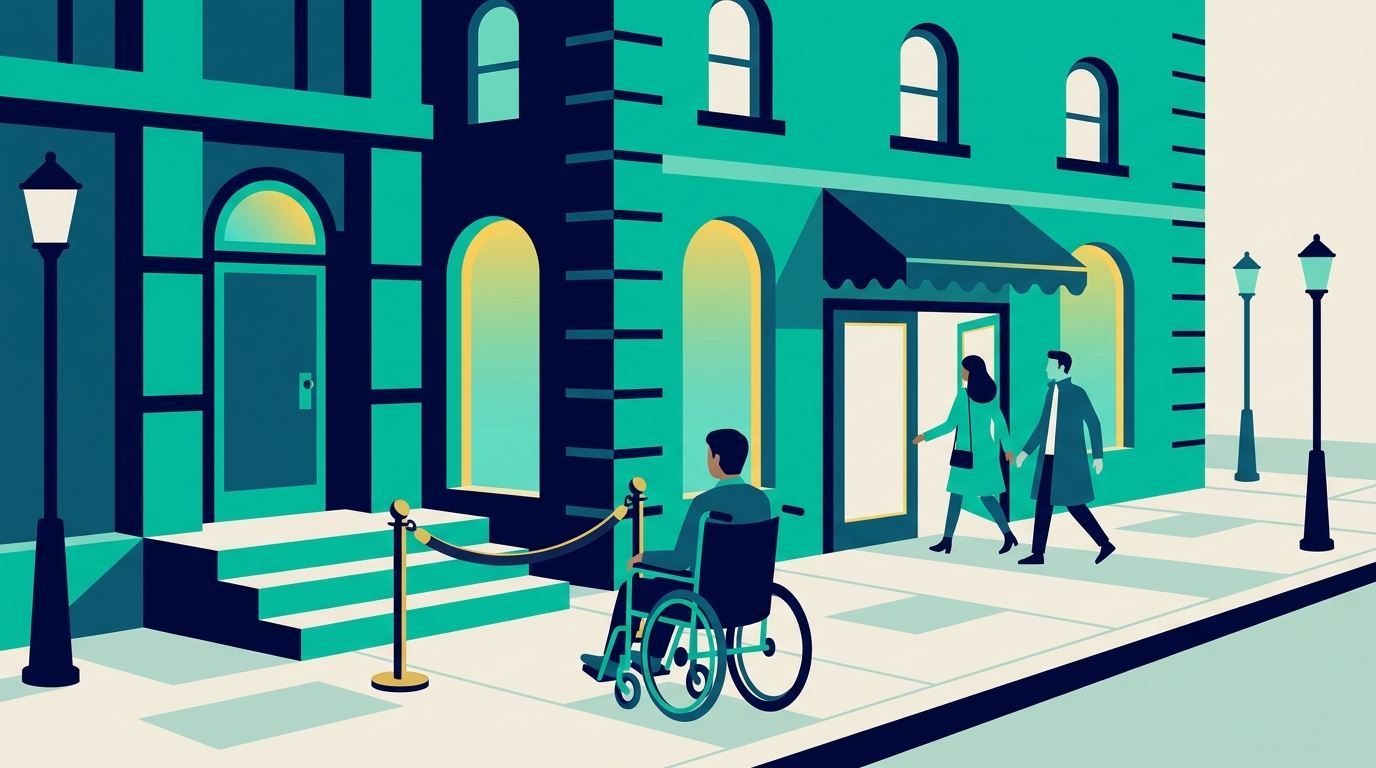
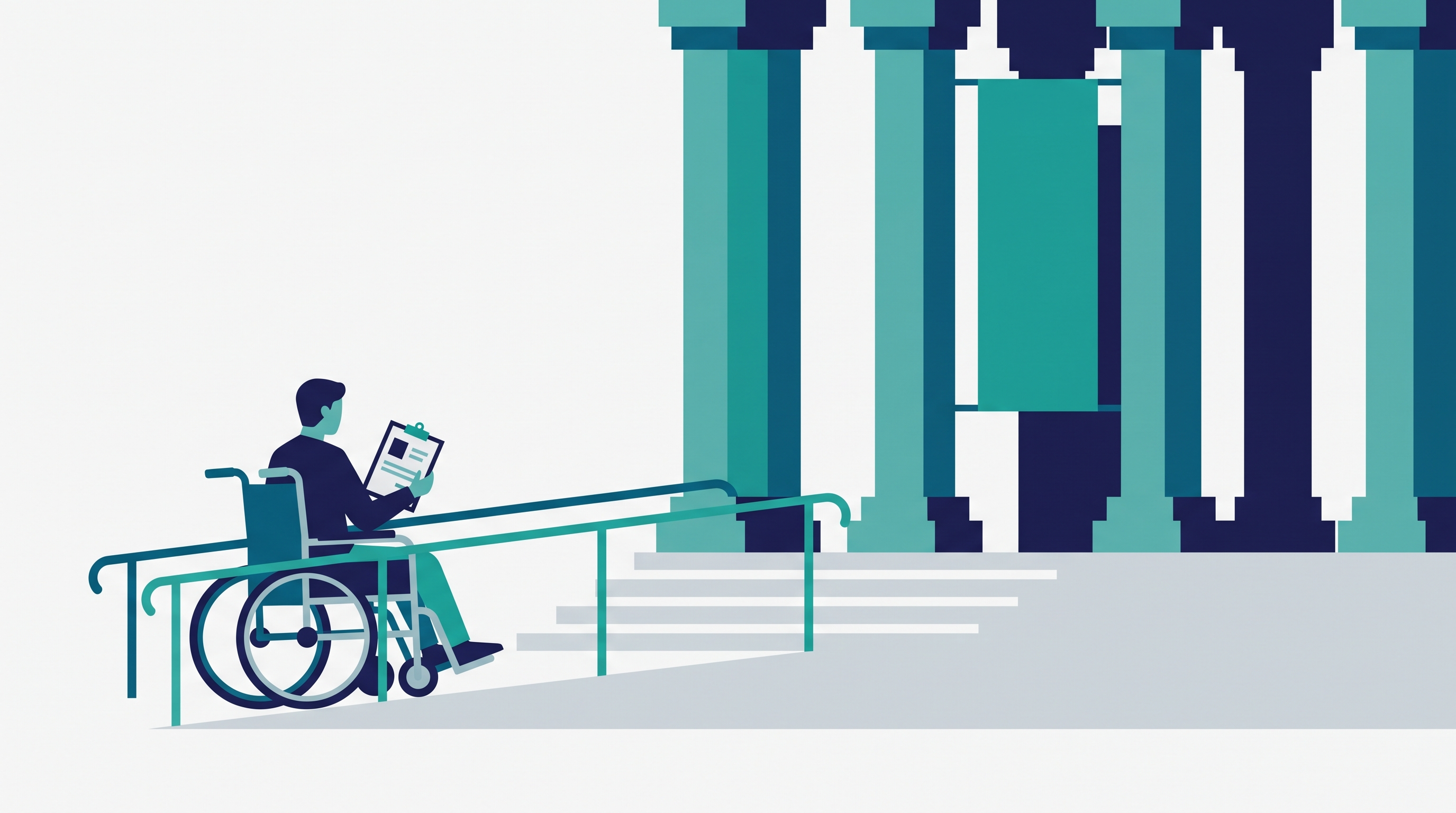
You planned a day at a world-famous Manhattan museum, but upon arrival, a broken lift or a steep set of stairs made the galleries unreachable. It is more than a minor annoyance. It is an act of exclusion that separates you from the city's cultural life. If you've faced these physical or communication barriers, you're likely ready to file a museum accessibility complaint Manhattan to hold the institution accountable.
We agree that the prospect of taking on a major institution feels intimidating, especially when you're already dealing with the sting of discrimination. This guide provides a clear path to filing your claim while explaining how you can seek a financial recovery without any out-of-pocket costs. You'll learn about the interplay between federal and local laws and why New York City provides some of the strongest protections in the country. ADA Help - NY disability discrimination claims is not a law firm; instead, we act as your proactive partner to handle the heavy lifting. We manage the entire claim process and connect you with independent contingency-fee attorneys through a free three-minute case check.
Key Takeaways
- Identify the physical and communication barriers that qualify as discrimination in Manhattan's public spaces.
- Learn why the New York City Human Rights Law often provides a better path for money damages than federal law alone.
- See how to document your experience at the scene to build a stronger case for your museum accessibility complaint Manhattan.
- Understand the benefits of professional case management over slow city portals like NYC311.
- Discover how to start a free three-minute case check to see if you qualify for a financial recovery without any out-of-pocket fees.
Do I have an accessibility case against a Manhattan museum?
You shouldn't have to struggle just to enjoy a cultural exhibit. If you encountered a barrier at a Manhattan museum, you might have a valid claim. A claim is simply a formal request for justice after you've faced discrimination. In Manhattan, museums must follow Title III of the Americans with Disabilities Act (ADA). This federal law requires public spaces to be accessible to everyone. You pay for your ticket just like every other visitor. You deserve the same access to the art and history on display.
Determining if your experience qualifies for a museum accessibility complaint Manhattan doesn't have to be confusing. At ADA Help - NY disability discrimination claims, we provide a free three-minute check to see if your situation meets the legal criteria for a case. We look for both physical and communication barriers that prevented you from having a full, equal experience. We handle the heavy lifting of gathering your information so you don't have to worry about the initial paperwork or complex forms. Starting your museum accessibility complaint Manhattan begins with understanding your rights under both federal and local laws.
To better understand what accessibility looks like in a museum setting, watch this helpful video:
What counts as a museum accessibility violation?
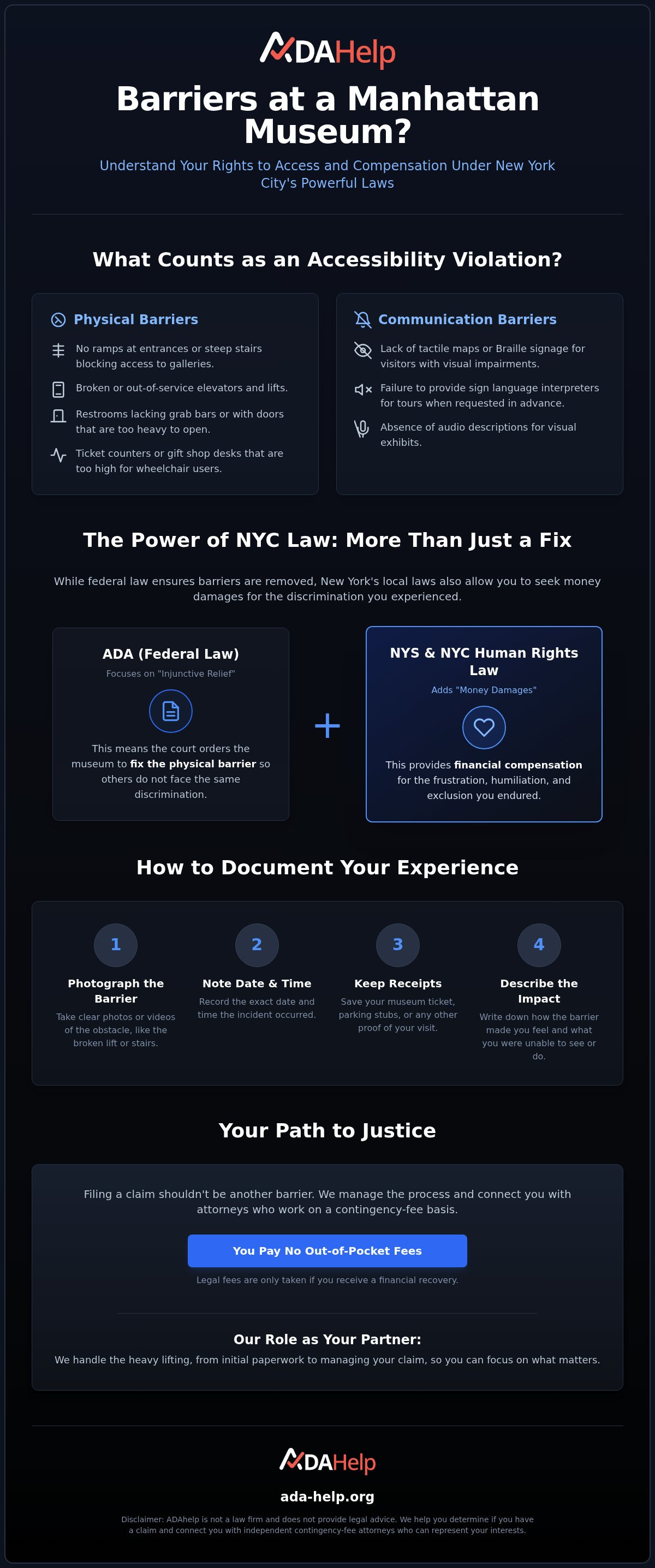
Many Manhattan museums are housed in historic buildings; however, that doesn't excuse them from modern standards. The same physical and communication problems show up across the city's cultural institutions, including our library accessibility complaint guide. Violations often fall into two categories: physical and communication. If you cannot get to a gallery because an elevator is broken, that is a violation. If there is no ramp at the main entrance, that is a barrier. Other common issues include:
- Restrooms that lack grab bars or have doors too heavy to open.
- Service counters at ticket booths or gift shops that are too high for wheelchair users.
- Failure to provide sign language interpreters for scheduled tours when you requested them in advance.
- Lack of tactile maps or Braille signage for visitors with visual impairments.
What is your case worth?
It is natural to wonder about the outcome of your case. Under federal law, the goal is often injunctive relief. This means the court orders the museum to fix the physical barrier so it doesn't happen again. But for New Yorkers, the law offers more. The New York City Human Rights Law (NYCHRL) and the New York State Human Rights Law (NYSHRL) allow for money damages to compensate you for the frustration and exclusion you experienced. Typical recovery amounts vary based on the specific facts of your incident. Because ADA Help - NY disability discrimination claims connects you with independent contingency-fee attorneys, you never pay out-of-pocket for these services. Fees are only taken if you receive a recovery.
Common ADA and NYCHRL violations in public spaces
Museums in Manhattan are legally defined as places of public accommodation. This status means they have a legal duty to ensure every visitor can enjoy their collections regardless of physical or mental disability. While the federal Americans with Disabilities Act sets a national standard, the New York City Human Rights Law (NYCHRL) provides even stronger disability protections. It is one of the most protective and broad anti-discrimination laws in the United States. It requires museums to go beyond simple fixes and ensure you have a truly equal experience. The same public accommodation rules apply to other venues, as we cover in our retail store accessibility complaint guide.
If you have struggled with these issues, you may have searched for How to File an ADA Complaint. While the federal process is important, a museum accessibility complaint Manhattan often finds more success through local channels. This is because the NYCHRL allows for money damages that federal law does not. Our team at ADA Help - NY disability discrimination claims focuses on these local protections to help you get the justice you deserve. You can see if you qualify for a claim in just a few minutes.
Physical barriers in historic Manhattan institutions
Many of Manhattan's most famous museums are housed in buildings that are over a century old. While these structures are beautiful, they often hide significant barriers. Narrow doorways in older wings frequently fail to accommodate standard wheelchairs. Heavy stone or bronze doors without automatic openers or push buttons turn a simple entrance into an impossible task. If you have to rely on the help of others just to enter a room, the museum is failing its legal duty. Exhibits placed at heights that aren't viewable from a seated position also effectively hide the art from wheelchair users and children alike.
In fiscal year 2025, the NYC Commission on Human Rights identified 305 instances of public accommodation discrimination where barriers made access difficult. These are not just minor issues; they are violations of your civil rights. When an institution prioritizes historic preservation over your ability to move through a space, they are likely violating the NYCHRL's requirement for reasonable accommodations. Museums must make these changes unless they can prove it would cause an undue hardship, which is a very high bar for large Manhattan institutions.
Service and communication failures
Discrimination isn't always made of brick and mortar. Service failures are just as common and just as illegal. Some museums still struggle with staff members who are not trained on accessibility protocols. This often leads to visitors being wrongly told their service animals are not allowed in galleries. Other common failures include a lack of assistive listening devices for theater presentations or guided tours. If you can't hear the lecture or see the film, you aren't getting the experience you paid for. Filing a museum accessibility complaint Manhattan is the first step toward making these institutions better for everyone. These communication barriers are clear violations that can support a strong claim for recovery.
How to document a museum accessibility incident
The moment you realize a barrier has blocked your access; your focus should shift to gathering evidence. Documentation is the most critical part of a successful museum accessibility complaint Manhattan. You don't need to be a legal expert to do this well. You just need to be thorough. Clear evidence makes the case management process much faster; allowing our team at ADAhelp to organize your claim and connect you with an attorney more efficiently. We handle the heavy lifting of building your file; but the details you collect at the scene are the foundation of your recovery.
Start by recording the exact date and time of your visit. Manhattan museums can be crowded; and staff shifts change frequently. Having a precise timestamp helps verify who was on duty and what the conditions were like during your visit. If you wait even a few days; important details can become fuzzy. Write everything down immediately while the frustration and the facts are still fresh in your mind.
Capture visual and written evidence
Photos are often the most undeniable proof of a violation. If an elevator is broken; take a picture of the "out of service" sign or the closed doors. If a ramp is blocked by equipment or a doorway is too narrow for your wheelchair; use your phone to capture the obstruction. These visuals prove that the museum failed to maintain a clear path of travel. When you take these photos; try to include a recognizable landmark in the museum to prove exactly where the incident occurred.
- Take wide shots to show the context of the barrier within the gallery.
- Capture close-up photos of specific issues like high counters or missing Braille.
- Write a short summary describing how the barrier affected your visit.
- Note the specific floor; room name; or exhibit title where the issue happened.
Identify staff and witnesses
If you spoke to a staff member about the problem; their identity is vital for your museum accessibility complaint Manhattan. Ask for their name and job title. If they refuse to give it; note their physical description and where they were stationed. Their response to your request for help is a key part of your claim. For example; if a security guard told you that "the elevator has been broken for weeks;" that statement shows the museum had notice of the problem but failed to fix it.
Don't forget about other visitors. If someone else saw you struggling with a heavy door or heard a staff member's discriminatory remarks; ask for their name and phone number. Witnesses can provide an objective account that strengthens your case. Finally; always save your proof of visit. Keep your physical ticket stub or save the digital receipt in your email. This proves you were a paying guest entitled to full access under the New York City Human Rights Law. Once you have these pieces together; you can start a free three-minute case check to see if you qualify for a financial recovery.
Why filing through ADAhelp is better than NYC311
If you encounter a barrier at a museum, your first instinct might be to call 311. It's the standard city portal for reporting broken sidewalks or noisy neighbors. But reporting a museum accessibility complaint Manhattan to a city agency is not the same as filing a claim for your own recovery. The city's process is often slow; it focuses on administrative records rather than your personal experience. While the city might eventually send an inspector to the site, that action doesn't help you recover for the exclusion you already faced. We see the same gap in other public accommodation cases, such as our restaurant accessibility complaint guide. You're left waiting for a system that isn't designed to prioritize your individual needs.
We focus on the New York State Human Rights Law (NYSHRL). This is the state-wide law that protects you against discrimination in all public spaces, including every museum in the five boroughs. While the city's 311 system might eventually result in a fine for the museum, that money goes into the city's general fund. It does nothing to compensate you for your lost time or the frustration of being turned away. By using a professional case management service like ADAhelp, you are choosing a path that prioritizes your own rights and potential recovery. We handle the heavy lifting of organizing your evidence, verifying the museum's history of violations, and ensuring your claim is positioned for success.
The difference between reporting and filing a claim
Reporting to 311 is a passive act. You tell the city about a problem and wait for a bureaucrat to take notice. Maybe they fix a heavy door in six months; maybe the report gets lost in a stack of paperwork. Filing a museum accessibility complaint Manhattan through ADAhelp is a proactive step toward real justice. We connect you with independent attorneys who understand the deep nuances of both the NYSHRL and the NYCHRL. These lawyers work on a contingency basis, which means they are motivated to get the best possible result for you. Their goal is to hold the museum accountable for the specific harm caused to you, providing a level of personal attention that a city hotline simply cannot match.
No out-of-pocket costs for New Yorkers
Many people hesitate to seek help because they fear high legal bills or complex contracts. We have removed that barrier entirely. Our case check is completely free and takes only three minutes of your time. You don't have to worry about hourly rates, hidden fees, or expensive retainers. Because the attorneys we work with use a contingency model, the financial risk stays with the service providers and the legal team; it never falls on you. If there is no recovery, you don't owe a single cent out of your own pocket. This ensures that every New Yorker has a clear path to justice regardless of their current financial situation. You can start your free case check today to see if your experience qualifies for a claim.
Start your free three-minute case check
You shouldn't have to carry the burden of a museum's failure to provide access. If you were excluded or treated unfairly; taking action is the only way to ensure things change. Starting a museum accessibility complaint Manhattan is a direct path to justice. You don't need to research complex laws. You don't need to fill out confusing government forms. Our online tool identifies if you have a claim in just three minutes. It is fast. It is simple. It is built for real New Yorkers.
Delaying your claim only helps the museum. Evidence can disappear; and staff members often move on to new jobs. By acting now; you preserve the details of your experience while they are still fresh. We manage the entire process for you. You can focus on moving forward while we handle the heavy lifting. Our goal is to turn your frustration into a clear path toward a resolution. Use our online tool for an immediate check right now.
How our case management works
Our process is streamlined to save you time. First; you provide the basic facts of your visit through our site. You'll tell us which museum you visited and what barriers you faced. We then evaluate these facts against the strict standards of the New York City Human Rights Law and the New York State Human Rights Law. We look for specific violations that often lead to a financial recovery. If your case qualifies; we manage the claim from start to finish. We handle all the filings with the proper authorities so you don't have to.
Connect with a New York attorney
If our evaluation shows a clear violation; we connect you with an independent New York attorney. These lawyers specialize in Manhattan accessibility cases. They have a deep understanding of the local court system and know how to hold large cultural institutions accountable. Because they work on a contingency-fee basis; you never have to worry about the cost of hiring a lawyer. They only get paid if you win a recovery. You get the benefit of expert legal representation with zero out-of-pocket risk. It's time to hold the museum accountable for the barriers they put in your way. Start your free three-minute case check now.
Where to File: Agencies & Deadlines
Once you have documented the barrier, you have more than one place to bring your museum accessibility complaint Manhattan. Each agency has its own scope and its own filing window, so it helps to know where your case fits before you submit anything.
- U.S. Department of Justice (DOJ): Investigates ADA Title III complaints against places of public accommodation, including museums. There is no fixed filing deadline, but the DOJ encourages filing as soon as possible after the barrier is identified. Complaints can be filed through ada.gov.
- New York State Division of Human Rights (DHR): Handles NYSHRL complaints statewide. You generally have three years to file for acts occurring on or after February 15, 2024. Learn more at dhr.ny.gov.
- NYC Commission on Human Rights (CCHR): Enforces the NYCHRL for museums within the five boroughs. The filing deadline is typically one year from the discriminatory act. Details are available at nyc.gov/cchr.
- U.S. Equal Employment Opportunity Commission (EEOC): Primarily covers workplace disability discrimination rather than visitor access, but if a museum also denied you a job or a workplace accommodation, EEOC charges typically must be filed within 300 days in New York.
Filing with more than one agency is often possible, but a case manager can help you avoid conflicting claims and choose the venue most likely to secure both a fix and compensation. If you are unsure which route fits your situation, our team can walk you through it during your free case check.
Take the Next Step Toward Equal Access in Manhattan
You have the right to enjoy every gallery and exhibit in this city without facing illegal barriers. As you have learned, documenting a violation at the scene is your most powerful tool for justice. While federal law focuses on fixing physical problems, the local New York City Human Rights Law provides a path for real financial recovery. Filing a museum accessibility complaint Manhattan shouldn't be a source of added stress. It is a way to hold institutions accountable and ensure the city's cultural heart remains open to everyone.
We are here to handle the heavy lifting for you. With our specialized New York expertise, we manage the entire process of organizing your claim and connecting you with independent attorneys. There are no upfront fees, and our contingency model means you never pay out-of-pocket costs. You only pay if you win a recovery. The path to resolution is simple, fast, and entirely focused on your rights as a New Yorker. Don't let your experience go unaddressed. Start your free three-minute case check today and let us help you move forward with confidence.
Frequently Asked Questions
Can I file a complaint against a museum if I did not get injured?
You do not need a physical injury to file a museum accessibility complaint Manhattan. Discrimination occurs the moment you are excluded from a public space or denied a service because of a disability. Under the New York City Human Rights Law; the emotional distress and frustration of being turned away are valid grounds for a claim. These laws focus on your right to equal access; ensuring that museums remove barriers before someone gets hurt.
How long do I have to report an accessibility violation in Manhattan?
Your deadline depends on where you file your museum accessibility complaint Manhattan. For the NYC Commission on Human Rights; you have one year from the incident. If you file a lawsuit under the New York State Human Rights Law or the New York City Human Rights Law; you generally have three years. Federal ADA claims in New York also follow a three-year limit. It is best to act quickly while evidence is fresh and witnesses are available.
What is the difference between a reasonable accommodation and a barrier?
A barrier is a physical or communication obstacle that blocks your access; such as a high counter or a broken elevator. A reasonable accommodation is a change the museum makes to its environment or policies to ensure you can participate. This might include providing a sign language interpreter or allowing a service animal. If a museum refuses to provide a necessary accommodation or fails to remove a barrier; they may be violating New York discrimination laws.
Do I need to hire a lawyer myself to file a museum complaint?
You do not need to find or hire a lawyer on your own. ADAhelp manages the intake process and evaluates your claim for free. If we determine you have a valid case; we connect you with independent attorneys who specialize in New York accessibility laws. These lawyers work on a contingency basis; meaning they handle the legal work while you focus on your daily life. We handle the heavy lifting of organizing your information.
What if the museum is in a very old or historic building?
Being a historic institution does not excuse a museum from following accessibility laws. While older Manhattan buildings face unique challenges; they must still remove barriers whenever it is "readily achievable" to do so. If structural changes are impossible; the museum must provide alternative ways to access the exhibits. The New York City Human Rights Law sets a very high bar for museums to prove that providing access would cause an undue hardship.
Will it cost me any money to start my claim with ADAhelp?
Starting your case check with ADAhelp costs you nothing. We offer a free three-minute evaluation to see if you qualify for a claim under New York law. You will never pay any out-of-pocket fees for our case management services. The independent attorneys we connect you with only receive a fee if they successfully recover money for you. This model ensures that every New Yorker can seek justice without any financial risk or upfront costs.
How much money can I get for a museum accessibility violation?
Recovery amounts vary significantly based on the specific facts of your case. While the federal ADA typically focuses on fixing the physical barrier; New York laws allow for compensatory money damages. This can include payment for emotional distress and the loss of enjoyment of a public space. Typical recovery ranges depend on the severity of the exclusion and the museum's history of violations. We help determine if you qualify for a financial recovery during our check.
What happens after I complete the three-minute case check?
After you finish the three-minute check; our team reviews your information to see if a violation occurred. We look for specific breaches of the NYCHRL or NYSHRL. If your situation qualifies; we will contact you to gather more details and document the incident. We then connect you with an independent attorney who will manage the legal filing. Our goal is to make the path from frustration to resolution as simple as possible for you.

Article by
ADA Help
Written by the ADAhelp editorial team and reviewed for accuracy before publishing. ADAhelp helps New Yorkers find out if they have a disability discrimination claim and manages the process end to end, working with independent attorneys who handle the legal work. We are not a law firm and do not provide legal advice.
Disclaimer
This article is general information about New York law, not legal advice, and reading it does not create an attorney-client relationship. ADAhelp is a case-management and intake service, not a law firm; legal representation is provided by independent attorneys. Recovery amounts and timelines vary by case, and past outcomes do not guarantee future results. For advice about your specific situation, speak with a qualified attorney or start the free case check.
Tags
Discriminated against in New York because of a disability?
A free three-minute check tells you if you can pursue a claim.
Check my case →New York onlyNo upfront costIndependent NY attorneysFree 3-minute check