Apartment Building Accessibility Issues NYC Checklist
Reviewed for accuracy by the ADAhelp team before publishing. ADAhelp is not a law firm; legal work is handled by independent New York attorneys.
Facing apartment building accessibility issues NYC landlords ignore? Use our checklist to see if you have a claim for money damages. Start a free case check.
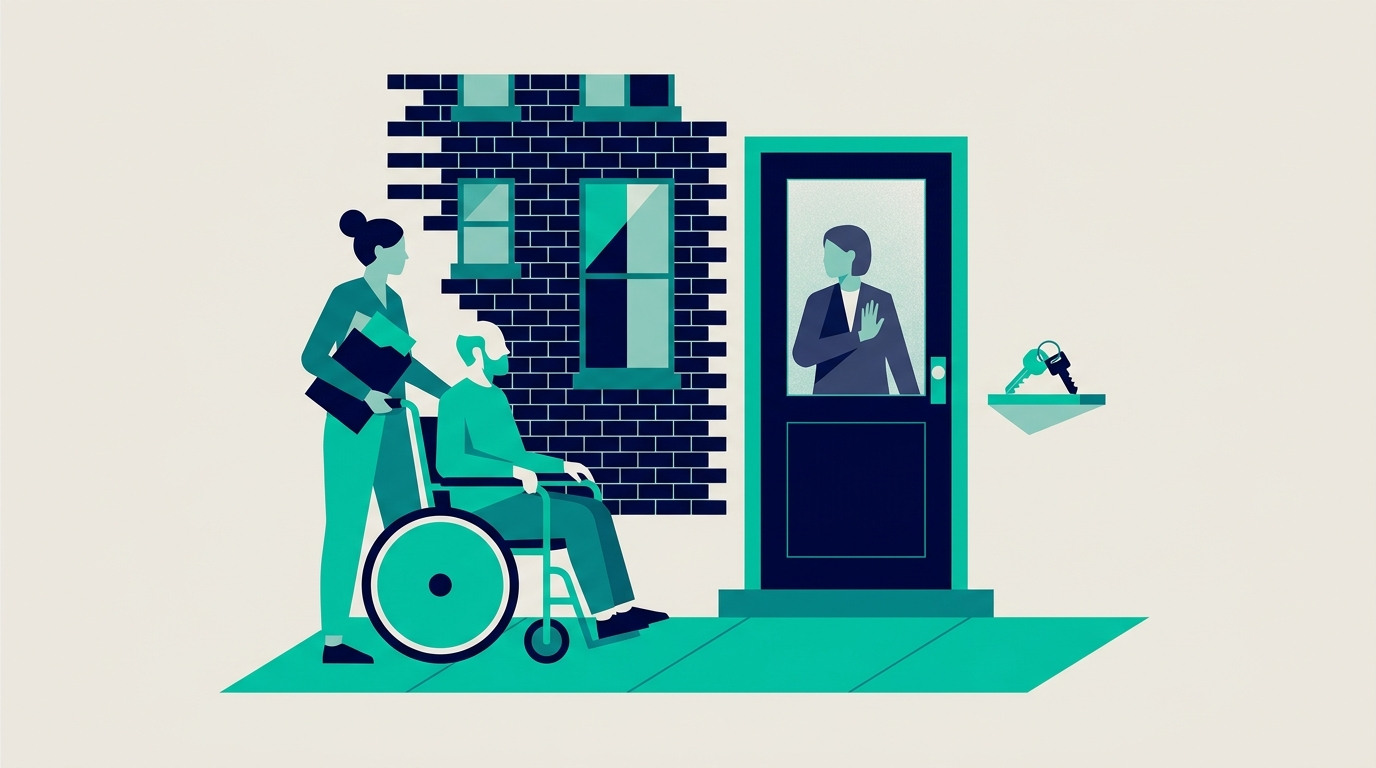
What if the heavy lobby door or the high threshold at your entrance isn't just a daily annoyance, but a violation of your civil rights? For many New Yorkers, apartment building accessibility issues NYC landlords neglect make simple tasks like doing laundry or visiting the gym nearly impossible. You pay your rent like everyone else; you deserve the same access to every part of your building. It's frustrating to feel trapped by narrow doorways or blocked from amenities by a lack of ramps, and you shouldn't have to navigate these barriers alone.
We understand that these obstacles affect your quality of life and your independence. This article will help you identify common violations under the New York City Human Rights Law and the federal Americans with Disabilities Act. You'll learn how to hold your landlord accountable and seek the money damages you may be owed for this discrimination. While the ADA can force a landlord to fix a doorway, local New York laws are often the key to receiving financial compensation for the trouble you've faced.
We'll walk you through a checklist of violations in buildings built after March 13, 1991. ADAhelp isn't a law firm and doesn't provide legal advice; instead, we help you see if you have a claim and connect you with independent lawyers. You'll discover how to start a free case check to seek compensation without any out-of-pocket costs. Our process is designed to be stress-free, ensuring the burden of the work stays off your shoulders.
Key Takeaways
- Identify common apartment building accessibility issues NYC landlords often hide, like narrow bathroom doors and high floor thresholds.
- Use our checklist to evaluate your individual unit and building amenities for violations of your civil rights.
- See how New York City laws provide a path to money damages that federal regulations typically do not cover.
- Learn to document barriers with simple photos and logs to build a strong foundation for your claim.
- Find out how a free three-minute case check can connect you with an attorney with no upfront costs.
Common Accessibility Barriers in NYC Apartments
Living in New York often means compromising on space; however, you should never have to compromise on your civil rights. Many developers in the five boroughs prioritize fitting as many units as possible into a small footprint. This often leads to apartment building accessibility issues NYC tenants shouldn't have to face. These barriers aren't just minor annoyances. If your building was built after March 13, 1991, specific legal standards apply. These requirements are set by the Americans with Disabilities Act (ADA) and bolstered by the New York City Human Rights Law (NYCHRL).
Identifying these violations is the first step toward holding a landlord accountable. It's strikingly common to find narrow bathroom doors in luxury buildings that won't fit a standard wheelchair. If you can't use your own bathroom or get into your kitchen, that is discrimination. Developers often take calculated risks. They hope you won't know the law. When you spot these issues, you move from being a frustrated tenant to an active advocate for your own rights.
To better understand how these standards apply to residential construction, watch this helpful video from the NYC Department of Buildings:
Inaccessible Entryways and Thresholds
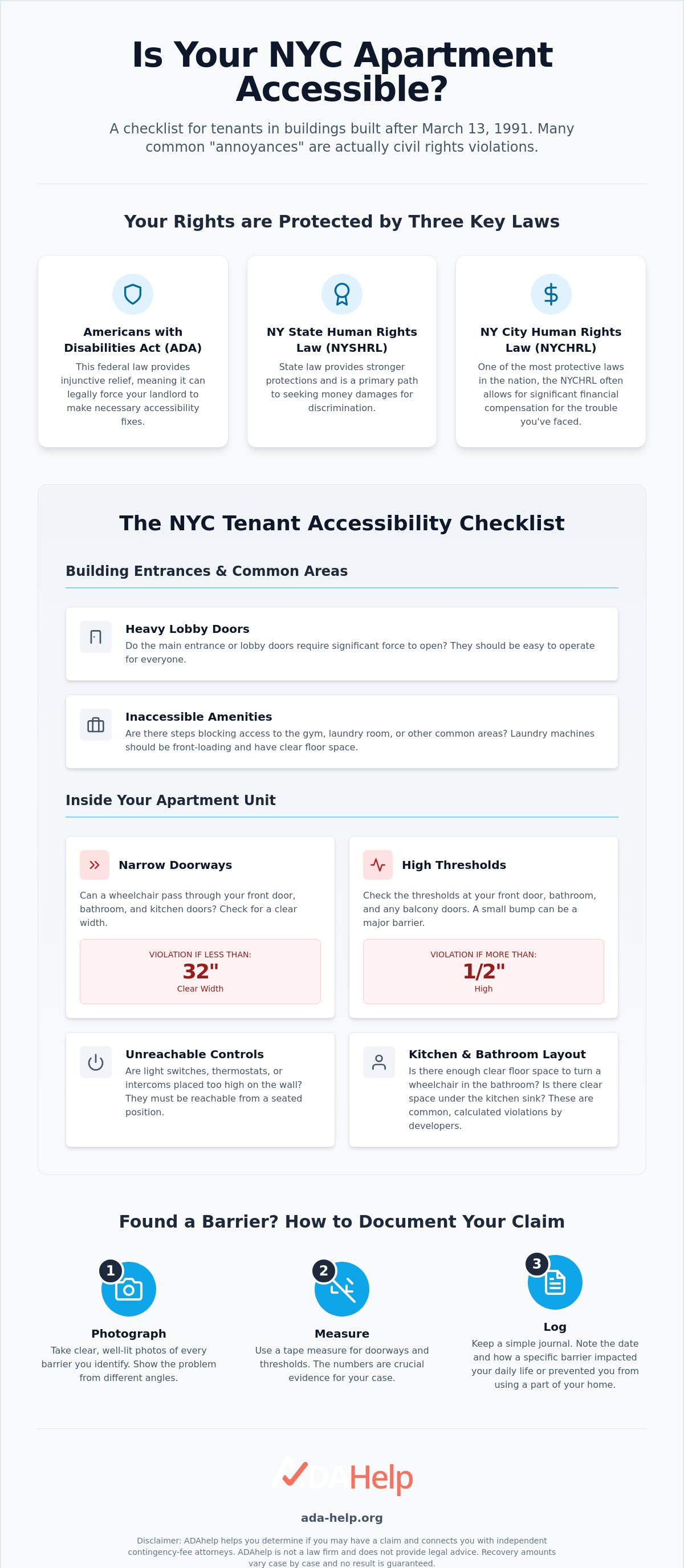
Your journey home shouldn't be an obstacle course. Start by checking the heavy lobby doors. If they require significant force to open, they may be out of compliance. Look at the transition from your living room to your balcony or terrace. If there is a step up, it's likely a violation. Measure the thresholds at your front door and bathroom. If they exceed half an inch, they are barriers to your mobility. These small bumps are walls for someone using a wheelchair. They deny you the equal enjoyment of your home.
Interior Obstacles and Controls
Accessibility must continue inside your four walls. Light switches, thermostats, and intercoms must be reachable from a seated position. If you have to struggle to reach your climate controls, the developer failed to follow the law. This extends to building amenities too. Common area washing machines and dryers must be front-loading and usable for everyone. Kitchen counters and sinks should also have clear floor space for a wheelchair. If these features are missing, you may have a case for money damages. Every barrier you find is evidence. At ada-help.org, we help you determine if these issues qualify for a claim. We aren't a law firm; instead, we connect you with experts who can help you seek compensation.
The NYC Tenant Accessibility Checklist
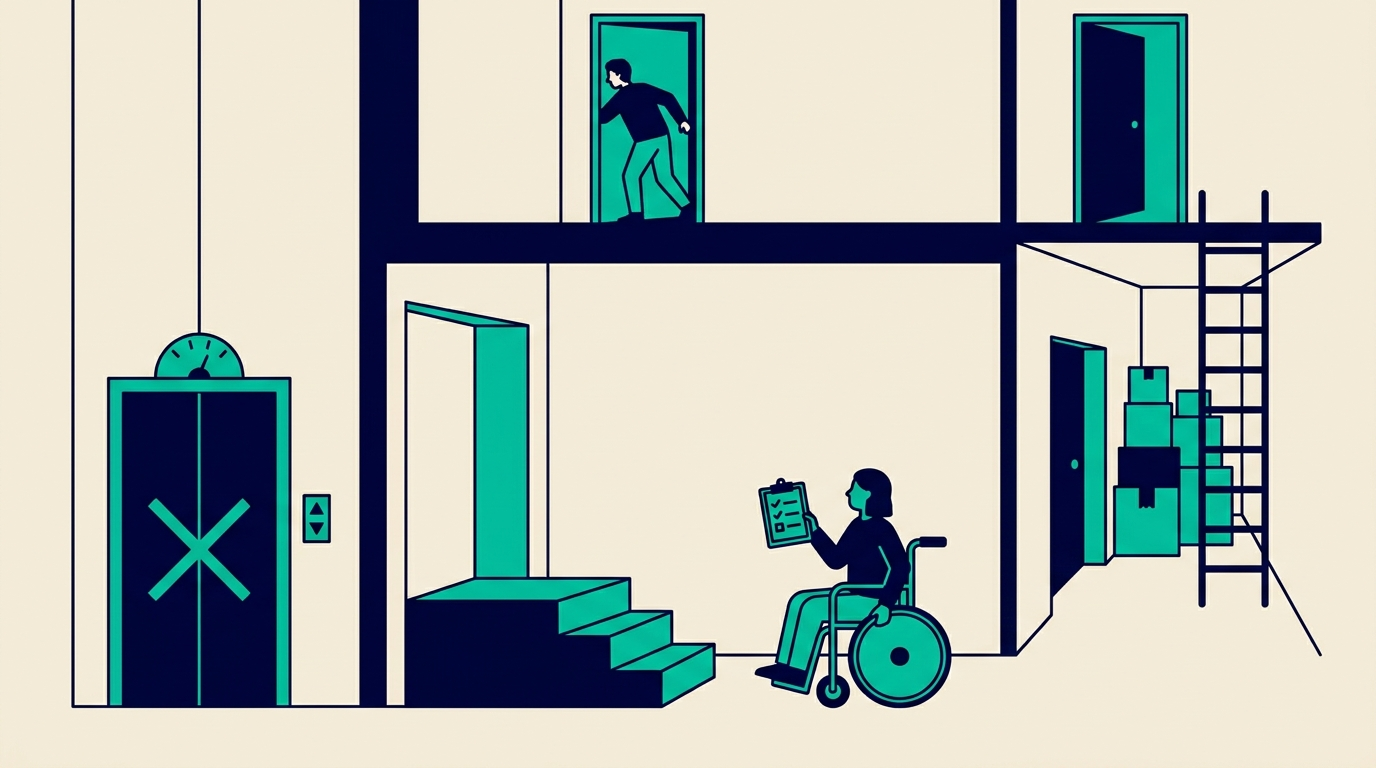
You should be able to live in your apartment without struggling to reach the sink or fit through your own bathroom door. Many tenants assume their building is simply old or that small barriers are just part of city living. This is often not true. Use this checklist to identify apartment building accessibility issues NYC landlords are legally required to address. As you go through your daily routine, carry a notebook or your phone. Documenting every barrier is the first step toward understanding if you have a valid claim for money damages.
According to the HPD Tenant Rights and Responsibilities, landlords must keep buildings safe and accessible. If your building was constructed after March 13, 1991, it must meet specific design standards under the New York City Human Rights Law (NYCHRL). Barriers in these newer buildings are almost always legal violations rather than mere inconveniences. Checking both your individual unit and the shared spaces will help you build a complete picture of the discrimination you are facing.
Bathroom and Kitchen Standards
Start with the rooms you use most. Your bathroom and kitchen doors must be wide enough for a wheelchair to pass through; this usually means a minimum of 32 inches of clear width. Inside the bathroom, there must be enough floor space for a wheelchair to make a full turn or a T-shaped turn. Check your cabinets and appliances as well. You shouldn't have to stand up or reach dangerously high to use your microwave, stove, or sink. If you find yourself unable to use these basic features of your home, you are likely dealing with a violation. These interior obstacles are often the strongest evidence in a housing discrimination case.
Common Area Access
Accessibility doesn't stop at your front door. Walk through the building and look at the amenities you pay for. Are the mailboxes at a height you can reach from a seated position? Typically, they should be between 15 and 48 inches from the floor. Visit the gym, the laundry room, and the rooftop lounge. There must be an accessible route to every one of these spaces. Check the elevators for braille numbering and audible signals that tell you which floor you have reached. If these features are missing, the building is failing its tenants. You can start a free case check to see if these common area barriers qualify you for financial compensation. We help you gather this information so you don't have to handle the heavy lifting alone.
Understanding Your Legal Protections in New York
Do you have a case for the barriers in your home? If your building was constructed after March 13, 1991, and contains apartment building accessibility issues NYC laws prohibit, the answer is likely yes. What is your case worth? While every situation is different, New York laws allow you to seek money damages that go far beyond just fixing a physical barrier. You deserve compensation for the daily frustration and loss of independence these violations cause. Understanding which laws protect you is the first step toward a successful claim.
The federal Americans with Disabilities Act (ADA) is the baseline for accessibility across the country. It is a powerful tool, but it has limits for individual tenants. In most housing cases, the ADA only provides what is called injunctive relief. This means a court can order your landlord to fix a heavy door or widen a hallway, but it won't necessarily result in a check being written to you. To receive financial compensation, we look to the New York State Human Rights Law (NYSHRL) and the New York City Human Rights Law (NYCHRL). These local protections are among the strongest in the nation, and they cover more than physical barriers. If a landlord refused to rent to you or pushed you out, learn what to do when you are denied housing because of a disability in New York.
Injunctive Relief vs Money Damages
It is vital to know the difference between getting a barrier fixed and being compensated for the discrimination. Injunctive relief focuses on the building. It ensures that the landlord brings the property up to code so you can move freely. Money damages focus on you. Under the NYCHRL, you can seek payment for emotional distress caused by being trapped in an inaccessible home. In some cases, you may even be eligible for punitive damages. These are typical in cases where a landlord or developer willfully ignored the law. These financial awards are meant to hold the property owner accountable for the harm they caused you.
Who is Responsible for the Violation?
Determining who to hold accountable can feel like a maze, but you don't have to do it alone. Landlords and property owners are the primary targets in most housing discrimination claims. They have a legal duty to provide a home that meets accessibility standards. However, the responsibility often goes deeper. Developers and architects can be held liable if the building was designed with flaws from the start. Management companies are also frequently included in claims, especially if they ignored your requests for help. The same accountability applies in other residential settings, including assisted living facility discrimination in New York. At ada-help.org, we help you identify every responsible party. We are not a law firm, but we specialize in managing these details and connecting you with independent contingency-fee attorneys. You won't pay anything out-of-pocket to start this process.
How to Document and Report Building Violations
Recording the details of your situation is the only way to prove discrimination. While filing a 311 report might get an inspector to visit, it won't help you recover money damages. You need a private record of the apartment building accessibility issues NYC developers left behind. Start by taking clear photos of every barrier from multiple angles. Use a ruler or tape measure in the photo to show the exact size of the problem. Don't wait for your landlord to make repairs before you seek help. If the barrier is fixed before it's documented, your chance for compensation may vanish.
Your documentation should focus on how the building fails to meet the standards of the New York City Human Rights Law (NYCHRL). While federal laws like the ADA require buildings to be fixed, New York's local laws are what allow you to seek financial recovery for the discrimination you've faced. Keeping a thorough record ensures that when you speak with an attorney, the facts are already on your side. It turns your daily struggle into a structured legal claim.
Taking Accurate Measurements
Numbers don't lie. Measure the clear width of your bathroom and kitchen doorways when the door is open at a 90-degree angle. It should be at least 32 inches. Check the height of the thresholds at your front door and leading to your balcony. If it's higher than half an inch, it's a violation. Record the height of your light switches and mailboxes too. These measurements are the foundation of your case. They provide the factual weight needed to move your claim forward without the need for complex legal theories.
Keeping a Daily Impact Log
A photo shows the barrier; a log shows the harm. Write down every time you can't use the building's gym, laundry room, or rooftop lounge because of an obstacle. Note instances where you had to ask a neighbor for help just to enter the lobby or use an amenity. Be specific about how these barriers make you feel. Describe the frustration, physical pain, or loss of dignity caused by being denied access to your own home. Include the dates and times of every conversation you have with management about these issues. This record proves the ongoing nature of the discrimination and supports your claim for emotional distress damages.
You can start your journey toward a resolution today. Use our free three-minute case check to see if your documentation supports a claim for money damages. We handle the information management and connect you with independent attorneys who work on a contingency basis. You never pay out-of-pocket to hold your landlord accountable for the barriers in your building.
Turning Your Accessibility Issue into a Case
Do you have a case for the apartment building accessibility issues NYC developers left in your home? If your building was built after 1991 and you face barriers like narrow doors or high thresholds; the answer is often yes. What is your case worth? While every situation is unique, typical recoveries for NYC housing discrimination include money damages for the emotional distress and daily inconvenience you've suffered. You shouldn't have to pay a lawyer hundreds of dollars just to see if you have a valid claim.
ADAhelp provides a clear, low-risk path to resolution. We are not a law firm and we do not provide legal advice. We act as a case-management service for Real New Yorkers who are tired of being ignored by their landlords. We handle the heavy lifting of gathering information and organizing the facts of your situation. Our goal is to turn your frustration into a stress-free process that holds property owners and management companies accountable for their neglect.
Our service is built on a contingency model. This means there are zero out-of-pocket costs for you. We only take a fee if we successfully resolve your claim through the independent attorneys we work with. The financial risk lies with the service providers; not with you. This setup ensures that every New Yorker has access to fairness regardless of their current financial situation. If we don't win; you don't pay.
Our Free Three-Minute Case Check
How do you start? Our free three-minute case check is designed to be fast and simple. You provide basic details about your building and the specific obstacles you face daily. Our team then evaluates your situation against the strict requirements of the New York City Human Rights Law (NYCHRL) and the New York State Human Rights Law (NYSHRL). We look for the violations you documented in your checklist; such as inaccessible mailboxes or heavy lobby doors. This check gives you an immediate understanding of your standing without any financial commitment.
No-Risk Case Management
Once we determine you have a potential claim, we manage the intake process for you. We connect you with independent contingency-fee attorneys who specialize in New York accessibility laws. These experts know how to seek the money damages that the federal ADA doesn't typically provide for individual tenants. You can focus on your life while we manage the claim filing and communication. It's a practical way to fix the barriers in your building while seeking the financial compensation you deserve. Start your journey toward a more accessible home today.
Take Control of Your Living Situation
You now have the tools to identify the barriers in your home. You know that narrow doorways, high thresholds, and heavy lobby doors aren't just daily annoyances; they are violations of your civil rights. Living with apartment building accessibility issues NYC landlords refuse to fix can feel isolating. However, you are not alone in this fight. New York City and State laws provide a clear path to hold property owners accountable and seek money damages for the discrimination you've experienced.
ADAhelp is here to handle the heavy lifting for you. We use our NYC-specific expertise to evaluate your situation and connect you with independent attorneys. Because we operate on a contingency-fee model; there are no out-of-pocket costs for our case management services. You can focus on your daily life while we help you build a strong case for the compensation you deserve. This is a zero-risk way to turn your frustration into a plan for justice.
Don't let another day pass in an inaccessible building. Start your free three-minute case check now to see if you have a claim. We are ready to help you move toward a stress-free resolution and a more accessible future. You deserve a home that respects your rights.
Where to File: Agencies & Deadlines
If you decide to pursue a formal complaint over apartment building accessibility issues NYC landlords refuse to fix, filing deadlines matter. Missing a deadline can end your claim before it starts, so note the window for each agency. For a step-by-step walkthrough, see our guide on how to file an ADA complaint in New York.
- NY State Division of Human Rights (DHR) — dhr.ny.gov. Deadline: 3 years for conduct on or after February 15, 2024; otherwise 1 year.
- NYC Commission on Human Rights (CCHR) — nyc.gov/site/cchr. Deadline: 1 year to file an administrative complaint, or 3 years to sue in court.
- U.S. Department of Justice (ADA) — ada.gov. File an ADA complaint about accessibility barriers.
- EEOC — eeoc.gov. Deadline: 300 days (for employment-related disability discrimination).
Frequently Asked Questions
Do I have a case if my building was built before the ADA?
Yes; you may still have a valid claim even in an older building. While federal construction standards apply to buildings finished after March 13; 1991; the New York City Human Rights Law requires landlords to provide reasonable accommodations regardless of the building's age. This means a landlord must often make changes to policies or physical structures to ensure you can use your home. If a landlord refuses a reasonable request for access; they may be liable for discrimination.
How much money can I get for an accessibility violation in NYC?
Typical recovery amounts vary significantly based on the specific facts of your situation. New York City laws are unique because they allow for compensatory damages for emotional distress and the loss of the use of your home. In cases where a landlord's neglect is particularly severe; punitive damages may also be available. Because every case is different; there is no guaranteed payout; but local laws are designed to provide meaningful financial compensation for the harm you've suffered.
Can my landlord evict me for reporting accessibility issues?
No; it is strictly illegal for a landlord to retaliate against you for asserting your rights. The NYCHRL and NYSHRL protect tenants from being threatened; harassed; or evicted after reporting apartment building accessibility issues NYC landlords are required to fix. If your landlord tries to terminate your lease or increase your rent because you sought a case check; you may have an additional legal claim for retaliation. We help protect you by documenting every interaction with your management company.
Is the case check really free?
Yes; our initial evaluation and case-management services are completely free to you. We never ask for upfront payments or hourly fees. If we determine you have a claim and connect you with an independent attorney; they work on a contingency-fee basis. This means their fees are only paid if you receive a financial recovery. You never have to worry about out-of-pocket costs to start your journey toward a more accessible home.
What if I am a renter and not the building owner?
Your rights as a renter are fully protected under New York law. You don't need to own your apartment to demand that it be accessible. Landlords are responsible for ensuring that both your individual unit and all common areas like gyms; laundries; and lobbies meet legal standards. If you are a "Real New Yorker" paying rent for an inaccessible space; you have the right to seek both a fix for the barriers and money damages for the discrimination.
How long does an accessibility discrimination claim take in New York?
The timeline for a claim depends on how quickly the landlord or their insurance company responds. Some cases reach a settlement in a few months; while more complex situations involving structural changes may take longer. Our role is to streamline the process by handling the heavy lifting of information gathering and case management. We work to move your claim forward as efficiently as possible so you can get results without unnecessary delays.
What is the difference between ADAhelp and a law firm?
ADAhelp is a case-management and intake service; not a law firm. We don't provide direct legal advice. Instead; we act as your advocate by evaluating your situation and determining if you have a valid claim under New York laws. If you do; we connect you with independent; experienced attorneys who handle the legal filings and negotiations. We manage the initial burden of the process so you can focus on your life while your case moves forward.

Article by
ADA Help
Written by the ADAhelp editorial team and reviewed for accuracy before publishing. ADAhelp helps New Yorkers find out if they have a disability discrimination claim and manages the process end to end, working with independent attorneys who handle the legal work. We are not a law firm and do not provide legal advice.
Disclaimer
This article is general information about New York law, not legal advice, and reading it does not create an attorney-client relationship. ADAhelp is a case-management and intake service, not a law firm; legal representation is provided by independent attorneys. Recovery amounts and timelines vary by case, and past outcomes do not guarantee future results. For advice about your specific situation, speak with a qualified attorney or start the free case check.
Tags
Discriminated against in New York because of a disability?
A free three-minute check tells you if you can pursue a claim.
Check my case →New York onlyNo upfront costIndependent NY attorneysFree 3-minute check