Inaccessible Retail Store Complaint Brooklyn: ADA Rights
Reviewed for accuracy by the ADAhelp team before publishing. ADAhelp is not a law firm; legal work is handled by independent New York attorneys.
Filed an inaccessible retail store complaint Brooklyn? Learn how NYCHRL lets you seek money damages, not just a 311 report. Free case check, no upfront cost.
Why should you be the one to pay the price when a Brooklyn shop owner refuses to fix a broken ramp or a narrow doorway? You likely felt frustrated and ignored after being blocked from entering a local store. It is exhausting to deal with physical barriers that stop you from shopping like everyone else. You deserve more than an apology or a 311 report that might not lead to real change.
This guide explains how to turn that experience into a successful disability discrimination claim. Filing an inaccessible retail store complaint Brooklyn is the first step toward removing the barrier and securing financial recovery. While the federal Americans with Disabilities Act requires stores to fix access issues, the New York City Human Rights Law and New York State Human Rights Law allow you to seek money damages for the discrimination you suffered. Typical recovery amounts vary by case, but these local laws are designed to compensate you for the harm caused.
We will break down the simple process of starting a claim without any out of pocket costs. You will learn how to tell if you have a case and how ADAhelp manages the heavy lifting for you. We connect New Yorkers with independent attorneys who work on a contingency basis; they only get paid if you win. Let's look at how you can hold local businesses accountable while getting the justice you deserve.
Key Takeaways
- Learn why the New York City Human Rights Law often provides better financial recovery for discrimination than the federal ADA alone.
- Understand how filing an inaccessible retail store complaint Brooklyn differs from a 311 report by focusing on your compensation rather than city fines.
- Identify common physical barriers like heavy doors or high counters that give you the right to file a claim against a store.
- Discover how to document barriers quickly with your phone to build a strong case for your attorney.
- Get a free three minute case check to see if you qualify for professional case management without any out of pocket costs.
What counts as an inaccessible retail store in Brooklyn?
An inaccessible store is any retail business that prevents people with disabilities from equal access. It is not just about being able to see the products; it is about being able to reach them, buy them, and move through the space safely. If a shop makes it difficult or impossible for you to use their services because of a disability, they are likely in violation of the law. Under ADA Title III, a retail accessibility violation is a failure to remove architectural or communication barriers in existing facilities when such removal is readily achievable.
Many Brooklyn shops operate in historic buildings with narrow footprints. This does not give them a free pass to ignore your rights. While the federal ADA focuses on fixing the building, the New York City Human Rights Law (NYCHRL) and the New York State Human Rights Law (NYSHRL) focus on the discrimination you experienced. If you are considering filing an inaccessible retail store complaint Brooklyn, you need to look beyond the front door. Barriers can exist in every corner of a shop, from the entrance to the checkout counter.
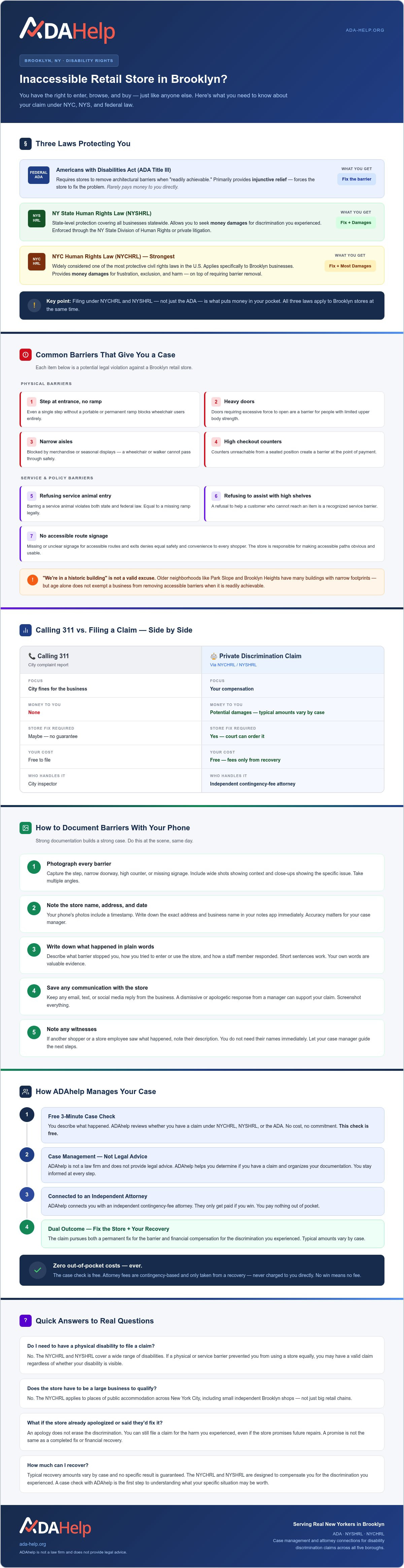
Common physical barriers in Brooklyn shops
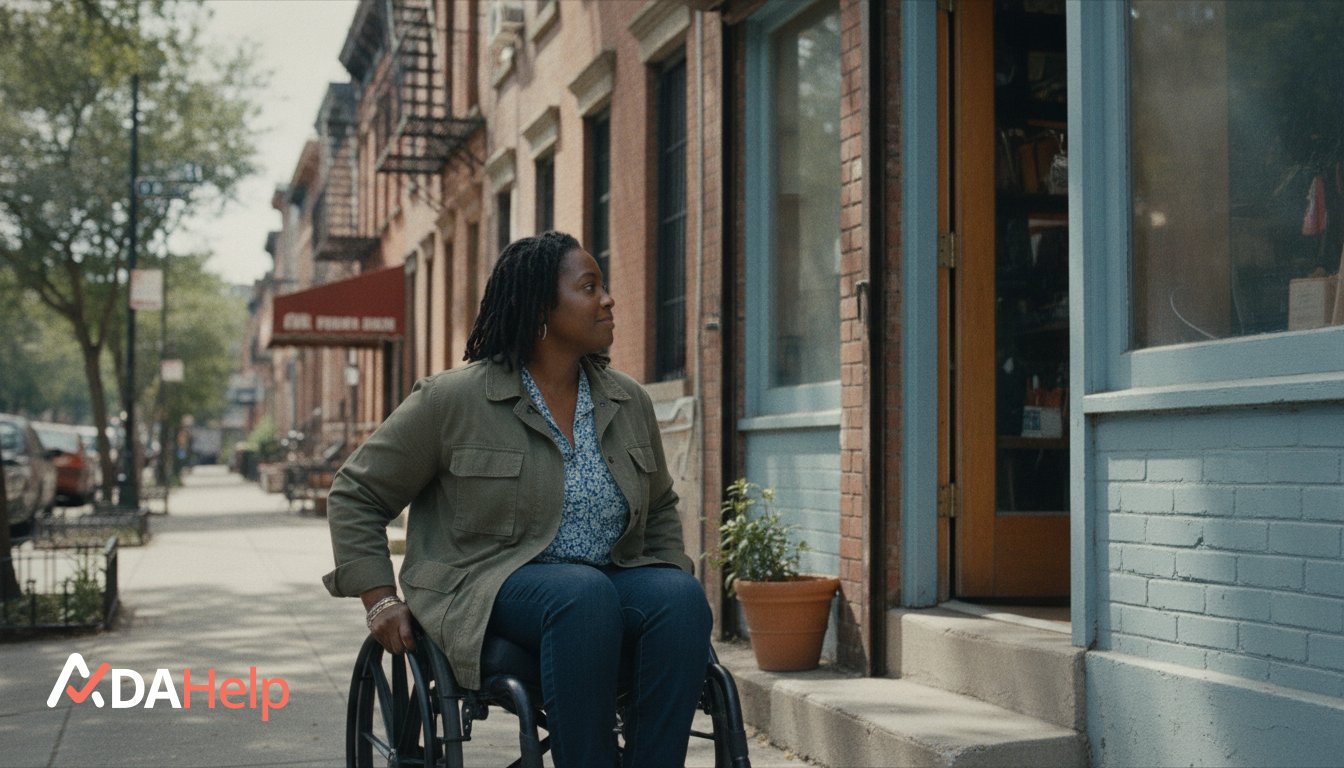
Physical barriers are the most obvious signs of discrimination. You might find a single step at the entrance without a permanent or portable ramp, which effectively bars wheelchair users from entering. Even if you can get inside, heavy doors that require too much force to open manually can be a major obstacle for people with limited mobility or upper body strength. These issues are common in older neighborhoods like Park Slope or Brooklyn Heights, but age is rarely a valid excuse for poor access.
Once you are in the store, the layout must remain accessible. Narrow aisles blocked by merchandise or seasonal displays are frequent problems in crowded Brooklyn shops. If a wheelchair or walker cannot pass through the aisles, the store is inaccessible. High checkout counters that are unreachable from a seated position also create a barrier during the payment process. Each of these examples provides grounds for an inaccessible retail store complaint Brooklyn. The same pattern shows up across the city — see our guide to a restaurant accessibility complaint in NYC for another example of how these barriers play out beyond retail.
Service and communication barriers
Discrimination is not always made of brick and mortar. Sometimes, it is about how a business treats you or how they share information. A refusal to assist a customer who cannot reach an item on a high shelf is a service barrier. If the store lacks clear signage for accessible routes or exits, they are failing to provide the same level of safety and convenience to every shopper.
One of the most frequent issues involves service animals. Policies that prevent service animals from entering a store are a direct violation of both state and federal law. These policy failures are just as significant as a missing ramp. They prove that the business has not taken the necessary steps to welcome all New Yorkers. Documenting these interactions is vital for your case management process. We cover similar service failures in our guide to filing a gym accessibility complaint in New York.
Understanding your rights under New York City Human Rights Law
You have rights that go far beyond federal law. While the Americans with Disabilities Act (ADA) is a vital federal tool for fixing physical barriers, the New York City Human Rights Law (NYCHRL) offers even stronger protections. Brooklyn businesses are required to follow city, state, and federal accessibility rules simultaneously. The NYCHRL is widely considered one of the most protective civil rights laws in the United States. If you encounter a barrier, filing an inaccessible retail store complaint Brooklyn ensures you are using every legal tool available to protect your dignity.
Injunctive relief vs. money damages
It is helpful to understand what you can actually get from a claim. The federal ADA primarily provides "injunctive relief." This means a court can force a store to install a ramp or widen a doorway. However, it rarely provides money to the person who was discriminated against. In contrast, the NYCHRL allows you to seek money damages for the frustration and exclusion you experienced. By working with a case manager at ADA Help - NY disability discrimination claims, you can pursue both a permanent fix for the store and financial compensation for yourself. This dual approach ensures the business fixes the problem while acknowledging the harm they caused you.
Why local Brooklyn laws matter for your case
Local laws are often more effective for New Yorkers. The NYCHRL and the New York State Human Rights Law (NYSHRL) both provide paths to financial recovery that the federal ADA does not. These laws apply to almost all retail stores in Brooklyn, regardless of how many employees they have or how small the shop is. Many federal rules have exemptions for very small businesses, but NYC laws are much broader. Local courts in the city often favor the rights of the individual when businesses fail to provide equal access. While typical recovery amounts vary based on the specific details of your experience, these payouts are usually only possible through local or state claims rather than federal ones.
You don't have to choose between a more accessible neighborhood and a fair settlement. You can achieve both goals at once. Using the NYCHRL alongside the ADA creates a powerful incentive for business owners to take your rights seriously. It turns a bad afternoon at a shop into a formal demand for justice. Starting an inaccessible retail store complaint Brooklyn is the most direct way to hold local businesses accountable for their failure to follow the law.
Reporting to 311 vs. filing a private discrimination claim
Many New Yorkers reach for their phones to call 311 as soon as they see a barrier. It is a natural reaction when you can't get into a shop on Fulton Street or Atlantic Avenue. However, you should understand what happens after you hang up. Reporting a store to 311 notifies the Department of Buildings or another city agency about a potential code violation. If the city finds a problem, they might issue a fine. The catch is that any money collected from those fines goes straight to the city treasury; it doesn't go to you. While a city report might eventually result in a building fix, a private claim managed by experts ensures the focus remains on your right to compensation for an inaccessible retail store complaint Brooklyn.
The limits of city agency enforcement
City inspectors are often overwhelmed. It may take weeks or even months for an inspector to visit a Brooklyn shop after you file a report. When they do arrive, they only check for specific building code violations. They aren't looking at the emotional or social impact the barrier had on your life. The city does not represent you; they represent the public interest. They won't help you gather evidence for a legal claim or negotiate a settlement for your specific experience. You're essentially left waiting on a system that isn't built to provide you with individual justice.
The benefits of professional case management
Professional case management fills the gaps left by city agencies. It helps you organize your facts so your claim is as strong as possible from day one. You don't have to guess which forms to fill out or which office to visit. Instead, you get connected to independent attorneys who work on a contingency basis. This means they only get paid if you receive a recovery. This model removes the financial risk from your shoulders entirely.
Professional help ensures your inaccessible retail store complaint Brooklyn is filed with the correct state or city authority, such as the New York State Division of Human Rights. By choosing case management over a simple 311 call, you're taking a proactive step toward real accountability and financial recovery. You get a partner who handles the paperwork and the follow-up while you focus on your daily life. This approach turns a frustrating experience into a structured path toward a fair resolution.
How to document accessibility barriers at a Brooklyn store
Evidence is the most important part of any discrimination complaint. You don't have to be a professional inspector to gather the information needed for an inaccessible retail store complaint Brooklyn. Acting quickly is your best strategy. Store owners may move displays or fix ramps once they realize a complaint is coming. Capturing the barrier exactly as you found it ensures the truth is preserved for your case manager. Clear photos can prove a store is inaccessible by providing undeniable visual proof that a wheelchair or walker cannot pass through the space.
Visual evidence and measurements
Start with your phone. Take photos of the barrier from several different angles to show the full context of the problem. You must include photos of the store name and the specific address in Brooklyn so there is no confusion about which business is responsible. If it is safe and you have a measuring tape, show the exact aisle width or step height. These measurements are concrete data points that help prove the business is violating specific accessibility standards. Visual proof makes it much harder for a store owner to deny the existence of a barrier.
Recording the details of the incident
Details fade quickly, so record them as soon as you leave the shop. Write down the exact date and time you tried to enter or move through the store. Note the names or physical descriptions of any staff members you spoke with during the incident. If you asked for a reasonable accommodation and were denied, keep a record of exactly what was said. These notes help your attorney understand the store's intent and their level of compliance with New York City laws. Your personal account of the event is a vital piece of the puzzle.
Witnesses and receipts
Witnesses can provide powerful support for your claim. If other people saw the incident, ask for their contact information. They can confirm that you were excluded from the store or treated unfairly. If you managed to make a purchase despite the barrier, save your receipt as proof that you were a customer at that location. You should also note if other customers were struggling with the same barrier at the same time. This shows that the problem is a systemic failure rather than a one-time accident. Once you have gathered this information for your inaccessible retail store complaint Brooklyn, you can start a free three minute case check to see if your documentation is enough to move forward with a claim.
How ADA Help - NY disability discrimination claims manages your Brooklyn accessibility case
You've gathered your evidence. You've documented the barriers. Now you need a partner to move the process forward. ADA Help - NY disability discrimination claims offers a free three minute case check specifically for Brooklyn residents. We help you determine if the retail store violated the ADA or NYC laws. Our team handles the heavy lifting of information gathering and the claim filing process. We then connect you with independent attorneys who work on a contingency fee basis. This means you don't have to face the legal system alone or worry about the cost of professional help. We act as your guide through a system that can often feel cold or confusing.
Our focus is on making sure your inaccessible retail store complaint Brooklyn is taken seriously. We aren't a law firm; we are case managers who specialize in New York accessibility claims. We know how to organize your photos, notes, and witness statements into a package that clearly shows a violation of the New York City Human Rights Law. By handling the administrative work, we let you focus on your daily life while we push for the resolution you deserve.
No upfront costs or out-of-pocket risks
One of the biggest barriers to justice is the cost of legal help. We've removed that barrier. The initial case evaluation is completely free. You never pay an hourly rate for our case management services. We believe that your right to an accessible neighborhood shouldn't depend on your bank account. Fees are only taken from a successful recovery or settlement. If there is no recovery, you owe nothing. This model puts the financial risk on the service providers and attorneys rather than on you. It ensures that the focus stays on getting you the results you deserve without any financial stress.
Starting your Brooklyn retail complaint today
You don't have to wait for city inspectors to eventually show up at a shop in Williamsburg or Bedford-Stuyvesant. You can start the process online in just a few minutes. We focus on real New Yorkers who want to see physical barriers removed from their communities. Every successful inaccessible retail store complaint Brooklyn makes the city a little more welcoming for everyone. By filing a claim, you're not just seeking your own recovery; you're forcing a business to follow the law.
Learn more about ADA Title III case management New York to see how we protect your rights. Our goal is to make the process as stress-free as possible. You've already dealt with the frustration of the barrier; let us handle the frustration of the paperwork. We help you turn a bad experience into a clear path toward resolution with minimal friction.
Take Control of Your Access Rights Today
You don't have to accept being excluded from your local shops. Filing an inaccessible retail store complaint Brooklyn is a powerful way to demand the respect you deserve. You've learned that while federal rules fix physical barriers, New York's local laws provide a path to financial recovery for the discrimination you experienced. Documentation is your strongest tool; now it's time to put that evidence to work.
ADA Help - NY disability discrimination claims acts as your advocate by handling the complicated paperwork and organization required for a successful claim. As New York discrimination specialists, we provide a free case evaluation to see if you qualify for professional management. Our contingency model means there is no recovery, no fee; you never pay out of pocket for our help. We connect you with independent attorneys who are ready to stand up for your civil rights.
Start your free three-minute case check now.
You deserve to move through your neighborhood with dignity and ease. Let's work together to remove these barriers and secure the justice you are owed.
Where to File: Agencies & Deadlines
Once you have your documentation together, you have more than one place to bring your inaccessible retail store complaint Brooklyn. Each agency has its own scope and its own filing window, so it helps to know where your case fits before you submit anything.
- NYC Commission on Human Rights (CCHR): Handles NYCHRL claims against Brooklyn businesses. Complaints generally must be filed within one year of the incident, though you can also go straight to court within three years. Details and the online complaint form are on the NYC Commission on Human Rights website.
- New York State Division of Human Rights (DHR): Handles NYSHRL claims and generally allows up to three years from the date of the discriminatory act. Learn more at dhr.ny.gov.
- U.S. Department of Justice (DOJ): Investigates ADA Title III complaints against places of public accommodation, including retail stores. There is no fixed filing deadline, but the DOJ encourages filing as soon as possible after the barrier is identified. Complaints can be filed through ada.gov.
- U.S. Equal Employment Opportunity Commission (EEOC): Primarily covers workplace disability discrimination rather than retail access, but if the same store also denied you a job or a workplace accommodation, EEOC charges typically must be filed within 300 days in New York.
Filing with more than one agency is often possible, but a case manager can help you avoid conflicting claims and choose the venue most likely to secure both a fix and compensation. For a broader look at getting help with ADA issues in the borough, see our guide to finding help for an ADA violation in Brooklyn. If you are unsure which route fits your situation, our team at ADA Help - NY disability discrimination claims can walk you through it during your free case check.
Frequently Asked Questions
Do I need a lawyer to file an inaccessible retail store complaint in Brooklyn?
You do not need a lawyer to start the process of reporting discrimination. ADAhelp provides intake and case management services to help you determine if you have a valid claim. If your situation qualifies, we connect you with independent contingency fee attorneys who handle the legal work. This ensures you have professional representation without needing to find a lawyer on your own or pay hourly fees.
How much money can I get from an accessibility lawsuit in NYC?
Financial recovery depends on the specific details of your experience and the laws applied to your case. While the federal ADA usually only forces a business to fix the physical barrier, the New York City Human Rights Law allows for money damages. Typical recovery amounts vary significantly from case to case. There are no guaranteed payouts, but these local laws are designed to compensate you for the discrimination you faced.
How long does it take to resolve a disability discrimination claim against a store?
The timeline for a claim depends on whether the store owner chooses to settle quickly or fight the case in court. Some claims are resolved in a few months through negotiation. Others may take longer if they require extensive documentation or formal legal proceedings. Our case management team works to keep your claim moving forward as efficiently as possible to avoid unnecessary delays in the process.
Can a store be sued if they have a portable ramp but do not use it?
Yes, a store can be held liable if they fail to provide access even if they own a portable ramp. If the ramp is locked away or staff refuses to set it up, it constitutes a barrier to entry. Simply owning equipment is not enough to meet the requirements of the law. The store must ensure that all customers can enter and move through the space safely at all times.
What if the store is in an old building that says it is "grandfathered" in?
The idea of being grandfathered in is a common myth that does not apply to disability access laws. Both the ADA and the New York City Human Rights Law require businesses to remove barriers when it is readily achievable to do so. Even historic buildings in Brooklyn must make reasonable modifications to ensure people with disabilities have equal access. Age is not a valid excuse for ongoing discrimination.
Will filing a complaint cost me any money out of my own pocket?
No, starting an inaccessible retail store complaint Brooklyn through our service does not cost you any money upfront. Your initial case evaluation is completely free. The independent attorneys we work with operate on a contingency fee basis. This means their fees are only taken from a successful recovery or settlement. If you do not win your case, you do not owe any out of pocket costs for their services.
Can I file a complaint if I was not physically injured at the store?
You do not need to suffer a physical injury to file a discrimination claim. The harm in these cases is the violation of your civil rights and the emotional distress of being excluded. If a store's physical barriers prevented you from shopping or using their services, you have grounds for a complaint. The law protects your right to equal access regardless of whether you were physically hurt during the incident.
What is the difference between a 311 report and a human rights claim?
A 311 report is a notification to a city agency that may result in a building code fine paid to the city treasury. A human rights claim is a private action that seeks justice and financial compensation for you personally. While 311 might eventually get a ramp installed, it does nothing to address the discrimination you experienced. A formal claim under the NYCHRL focuses on your recovery and your rights.

Article by
ADA Help
Written by the ADAhelp editorial team and reviewed for accuracy before publishing. ADAhelp helps New Yorkers find out if they have a disability discrimination claim and manages the process end to end, working with independent attorneys who handle the legal work. We are not a law firm and do not provide legal advice.
Disclaimer
This article is general information about New York law, not legal advice, and reading it does not create an attorney-client relationship. ADAhelp is a case-management and intake service, not a law firm; legal representation is provided by independent attorneys. Recovery amounts and timelines vary by case, and past outcomes do not guarantee future results. For advice about your specific situation, speak with a qualified attorney or start the free case check.
Tags
Discriminated against in New York because of a disability?
A free three-minute check tells you if you can pursue a claim.
Check my case →New York onlyNo upfront costIndependent NY attorneysFree 3-minute check