
NY Public Transportation Accessibility Complaint: Rights
Reviewed for accuracy by the ADAhelp team before publishing. ADAhelp is not a law firm; legal work is handled by independent New York attorneys.
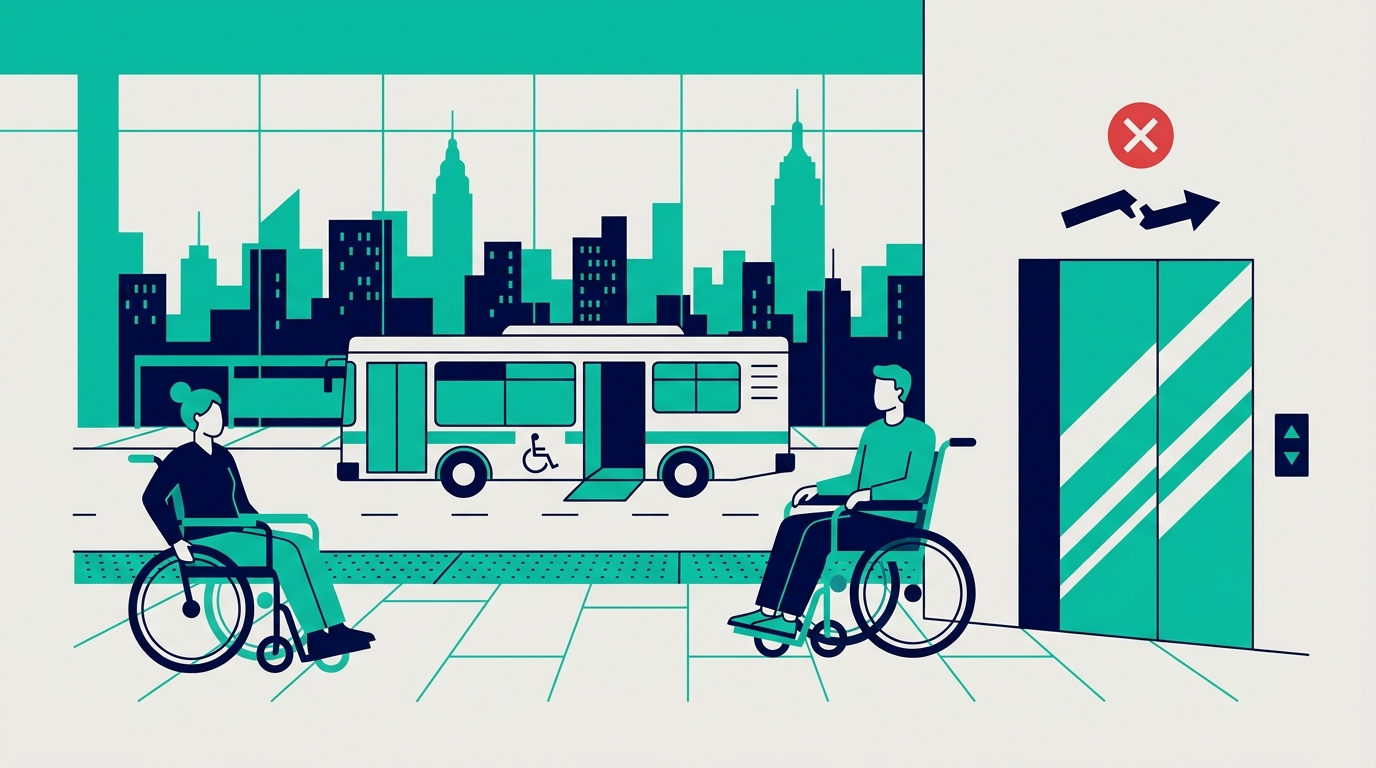
Denied access by a broken elevator? Your NY public transportation accessibility complaint could lead to compensation. Learn your rights and start a free case...
How much time have you wasted waiting for a subway elevator that was "out of service" yet again? It is more than just a daily inconvenience; it is a violation of your rights. If you have been physically excluded from a station or forced to take a long detour because of a broken lift, you may have grounds for a NY public transportation accessibility complaint. At ADA Help - NY disability discrimination claims, we understand that feeling ignored by large transit agencies is exhausting. You deserve a system that works, and you shouldn't have to fight for basic access alone.
You can hold these agencies accountable and seek financial compensation for the discrimination you've faced. While the federal ADA focuses on fixing the system, the New York State and City Human Rights Laws allow for money damages. We make the process simple by handling the case management for you. ADA Help - NY disability discrimination claims is not a law firm; instead, we connect you with independent contingency fee attorneys who only get paid if you win. This means there are no out of pocket costs to you. We will show you how to identify violations and how to start a free three minute case check to see what your claim is worth.
Key Takeaways
- Identify specific transit barriers that violate your rights, such as broken subway elevators or inaccessible bus ramps.
- Learn why the New York State Human Rights Law and City Human Rights Law are the primary paths to seeking financial compensation.
- Discover the exact steps to file a NY public transportation accessibility complaint, including how to document evidence and identify the responsible agency.
- Understand how ADAhelp manages your claim and connects you with contingency fee attorneys at no out of pocket cost.
- Find out how to start a free three minute case check to see if your experience entitles you to a recovery.
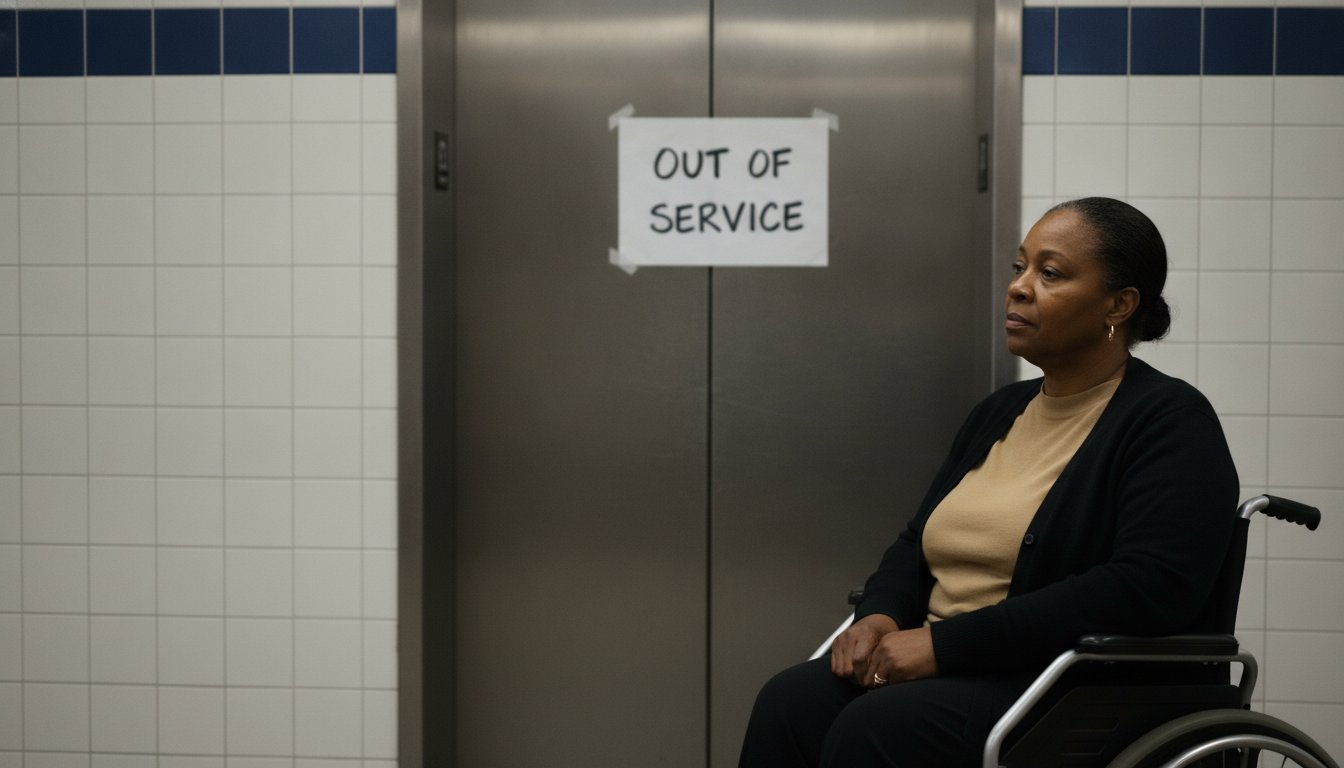
What counts as a public transportation accessibility violation in New York?
A violation occurs the moment the transit system denies you the same access provided to everyone else. It isn't just about a minor delay; it is about being physically excluded from the city's infrastructure. New York laws protect your right to use subways, buses, and paratransit services without facing discriminatory hurdles. While the federal Americans with Disabilities Act (ADA) sets the national standard for access, the New York State Human Rights Law and the New York City Human Rights Law provide the path for you to seek money damages for these failures. If you've been left on a platform because of a broken lift, you may have the basis for a NY public transportation accessibility complaint. For a closer look at how these violations are treated under the law, see our guide to public transportation disability discrimination in New York.
Do you have a case? Typically, any barrier that prevents you from using the service as intended counts. This includes both the equipment and the people running the system. We help you determine if your experience meets the legal criteria for a claim through a free three minute case check at ada-help.org. We focus on the heavy lifting of case management so you can focus on your life.
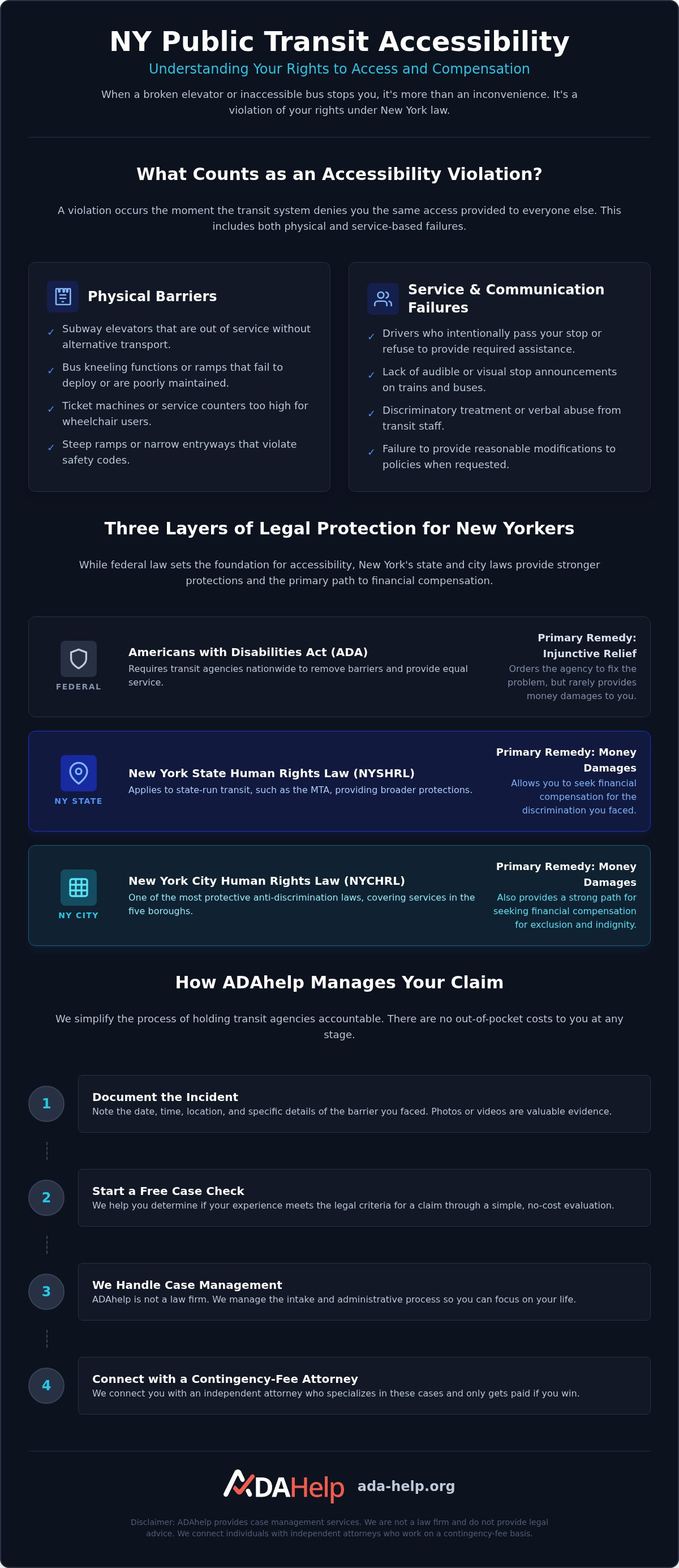
Physical barriers in the transit system
Physical barriers are the most visible violations. Broken elevators are a constant issue in the MTA subway system, often leaving riders stranded or forced to travel miles out of their way. Between May 2025 and May 2026, the city made progress by making 39 bus stops physically accessible and upgrading over 7,000 pedestrian ramps, but thousands of barriers still remain. A violation exists if you encounter:
- Subway elevators that are out of service without adequate alternative transport.
- Bus kneeling functions or ramps that fail to deploy or are poorly maintained.
- Ticket machines or service counters that are too high for wheelchair users to reach.
- Steep ramps or narrow entryways that do not meet current safety codes.
Service and communication failures
Accessibility is about more than just ramps; it is about how the service is delivered. When you file a NY public transportation accessibility complaint, you are often highlighting human error or systemic neglect. For example, if a bus driver sees you waiting in a wheelchair and intentionally passes your stop, that is a direct violation of your rights. Service failures also include:
- Drivers who refuse to secure a mobility device or provide required assistance.
- The lack of audible or visual stop announcements on trains and buses.
- Discriminatory treatment or verbal abuse from paratransit intake agents.
- Failure to provide reasonable modifications to policies when requested.
The MTA keeps records of these complaints for seven years, so documenting your experience immediately is vital. Whether the issue was a broken machine or a dismissive employee, these incidents create a record of discrimination that can lead to a successful claim.
Your rights under New York State and City laws
Most New Yorkers assume that a broken elevator or a failed bus ramp is just a frustrating part of city life. It isn't. When you file a NY public transportation accessibility complaint, you are using three distinct layers of legal protection. Understanding these laws is the first step toward moving from frustration to recovery. While federal law sets the floor for accessibility, New York laws provide the ceiling for your protection.
The federal Americans with Disabilities Act (ADA) is the starting point. It requires transit agencies to remove physical barriers and provide equal service. However, the ADA usually only offers injunctive relief. This is a legal term meaning the court can order an agency to fix the problem. It rarely results in money being paid to the person who was discriminated against. This is why federal law alone is often not enough for real justice.
New York State and City laws go much further. The New York State Human Rights Law (NYSHRL) applies to state-run transit like the MTA. The New York City Human Rights Law (NYCHRL) covers services within the five boroughs. Both of these statutes allow you to seek money damages for the indignity and exclusion you faced. You can review official NYC transportation accessibility resources to see the specific standards the city must meet. If you believe your rights were ignored, you can start a free case check to see if you qualify for a claim.
Why the NYCHRL is a powerful tool
The NYCHRL is one of the strongest civil rights laws in the country. It applies to every bus, subway station, and ferry within New York City. This law recognizes that exclusion causes real emotional and physical harm. It does not matter if the transit agency eventually fixes the broken elevator. The violation happened the moment you were denied access. Under the NYCHRL, you can hold the agency accountable for that specific moment of discrimination.
Access vs. financial recovery
There is a major difference between fixing a barrier and compensating a victim. Injunctive relief helps the community by forcing the MTA to repair equipment. Financial recovery helps you by acknowledging the time you lost and the stress you endured. Money damages are designed to compensate you for the specific incident you faced. While typical recovery amounts vary case by case based on the facts, they provide a level of personal justice that a simple repair cannot offer. We handle the case management to help you determine which type of recovery is possible for your situation. If the exclusion you faced happened somewhere other than transit, our guide to public access discrimination in New York covers the same money-damages framework for other public spaces.
Common transit barriers in New York City
New York has one of the oldest transit systems in the world. This often translates to a system that is hostile to people with disabilities. While the city spent over $12.5 million on sidewalk repairs between 2025 and 2026, the transit system itself remains full of obstacles. Encountering these barriers isn't just an annoying part of your commute; it is often a legal violation. If you've been stranded or excluded because of these failures, filing a NY public transportation accessibility complaint is your path to accountability. You shouldn't have to plan your entire day around the hope that an elevator actually works.
Do you feel like the system is working against you? It often is. Whether it's a subway station, a city bus, or a commuter train, the law requires these services to be usable for everyone. When they aren't, the burden shouldn't fall on you to just "deal with it." We help you identify if these barriers entitle you to financial recovery through a free case check at ada-help.org.
Subway and bus violations
The subway system is notorious for its lack of elevators. Even when a station is labeled as "accessible," the elevator is frequently out of service. This creates a dangerous trap. You might enter the system at one station only to find your exit is impossible at the next. Wide gaps between the train car and the platform also pose a significant risk for wheelchair users. These gaps can lead to serious injury or being stuck. On the street, buses must have working kneeling functions and ramps. If a driver sees you and keeps going, or if the ramp is broken, they have denied you service. They are also required to ensure priority seating is available for passengers with disabilities. A NY public transportation accessibility complaint can highlight these systemic failures and push for real change.
Paratransit and Access-A-Ride issues
Access-A-Ride is legally supposed to provide service that is comparable to the subway and bus system. It often fails this standard miserably. Excessive delays or "no-shows" can leave you stranded on a sidewalk for hours. This isn't just bad service; it is a failure to provide equal access. You might also face discriminatory denials when applying for paratransit eligibility. If the vehicle sent for your trip cannot accommodate your mobility device, the agency has failed its legal duty. Commuter lines like the Long Island Rail Road (LIRR) and Metro-North must also follow these rules. They are required to provide accessible restrooms and level boarding. When these systems fail, they disrupt your ability to work and travel freely. We handle the heavy lifting of managing your claim so you can focus on getting where you need to go.
How to file a public transportation accessibility complaint in NY
Filing a NY public transportation accessibility complaint shouldn't be a second job. You have already dealt with enough stress just trying to get from point A to point B. To move forward, you must follow a few specific steps to protect your rights and your potential recovery. When you document the incident correctly, you turn a frustrating moment into a legal record that transit agencies cannot ignore.
Do you have a case? Most New Yorkers aren't sure where to start. We make this simple by managing the intake process for you. You can start with a free three minute case check to see if your situation entitles you to financial compensation. We handle the heavy lifting of case management so you don't have to guess which forms to fill out or which agency to contact.
Gathering your evidence
Documentation is your strongest tool. Transit agencies often rely on a lack of proof to dismiss claims. Start by taking clear photos of the barrier. This might be a "closed" sign on a subway elevator or a bus ramp that refuses to move. You must also record the details of the incident while they are fresh. Note the bus or train car number and the exact time of day. If a transit employee was involved or witnessed the event, try to get their name or badge number. The MTA keeps records of accessibility complaints for seven years, but your personal evidence is what makes a claim undeniable. If you were forced to take a taxi or Uber because the train was inaccessible, save those receipts as well.
Choosing the right filing authority
You have several options for where to file, but they offer very different results. The Federal Transit Administration (FTA) Office of Civil Rights handles federal ADA complaints. You must file with the FTA within 180 days of the incident. However, the FTA usually only forces the agency to fix the physical problem. They do not award you money for your trouble. If you are seeking money damages for the discrimination you faced, you must look to state or city authorities.
The New York State Division of Human Rights and the NYC Commission on Human Rights handle claims under the broader NYSHRL and NYCHRL. These laws recognize the emotional and physical harm caused by exclusion. For complex issues, the MTA typically reviews matters within 15 business days, but their internal review is not a substitute for a legal claim. We connect you with independent contingency fee attorneys who specialize in these New York specific laws. This means you never pay out of pocket; fees are only taken if you receive a recovery. Because the MTA and other transit operators are government agencies, our guide to disability discrimination by government agencies in NY walks through additional accountability options.
Where to File: Agencies & Deadlines
Multiple agencies enforce accessibility rights, and each has its own deadline. The U.S. Department of Justice oversees ADA Title II complaints against public transit systems, though its process focuses on compliance rather than monetary awards. For state-level claims, the New York State Division of Human Rights accepts complaints under the NYSHRL, generally within one to three years depending on the claim. Within the five boroughs, the NYC Commission on Human Rights enforces the NYCHRL and allows up to three years to file. If your transit experience overlapped with a workplace issue, such as being denied accommodations by a transit employer, the Equal Employment Opportunity Commission handles those claims separately, typically within 300 days. Because each agency has a different statute of limitations, documenting your incident and starting your free case check as soon as possible protects your options.
How ADAhelp manages your transit discrimination claim
Dealing with a transit agency after being excluded from a station is exhausting. You have already faced the physical barrier. Now you face a wall of bureaucracy. Filing a NY public transportation accessibility complaint shouldn't be your burden to carry alone. This is where ADAhelp steps in. We provide expert case management specifically for New Yorkers who have experienced disability discrimination in public spaces.
We are not a law firm. We do not provide legal advice. Our role is to act as your proactive partner and guide. We know the specific landscape of New York transit laws. We understand how the MTA and other regional agencies operate. Our team handles the difficult work of information gathering and filing so you don't have to. We turn your frustration into a clear path toward resolution.
Our process for New York transit users
We start with a quick online evaluation. This helps us understand the specifics of your situation. Did a bus driver pass you by? Was the only elevator at your station broken without notice? We review these details against the frameworks of the New York City Human Rights Law (NYCHRL) and the New York State Human Rights Law (NYSHRL). As mentioned earlier, these laws are your best path to seeking financial recovery for the harm you've suffered.
Most transit agencies offer simple feedback forms. These forms rarely lead to anything more than a generic apology. We do more. We manage the actual paperwork and case details. We ensure your claim is positioned correctly from the start. Once we determine you have a valid claim, we connect you with independent attorneys who specialize in disability rights. These lawyers work on a contingency basis. This means they only get paid if you receive a successful recovery. You can stop worrying about the transit agency bureaucracy and let us handle the heavy lifting.
No risk to start your recovery
The biggest barrier to justice is often the fear of high costs. We have removed that barrier. The initial case check is always free for any New Yorker. You will never pay out-of-pocket for our case management services. Our goal is to make the path to resolution as stress-free as possible. We only succeed when you do.
You have rights under the law. You deserve to be compensated for the indignity of being excluded from the city's transit system. Don't let a bad experience go unaddressed. You can take the first step right now without any financial risk. Start your free three-minute case check today. We are ready to help you hold the system accountable and secure the recovery you deserve.
Hold the transit system accountable
You have the right to move through New York City without facing physical barriers or discriminatory service. As we have discussed; a broken elevator or a failed bus ramp is often a violation of the NYSHRL and NYCHRL. These laws exist to ensure you receive both equal access and financial compensation for the exclusion you've endured. Filing a NY public transportation accessibility complaint is the first step toward getting the justice you deserve. You shouldn't have to manage a complex bureaucracy while already dealing with the daily challenges of an inaccessible system.
Our team at ADAhelp has the New York specific expertise to handle the heavy lifting for you. We manage the intake and case details so you can focus on your life. There are no out of pocket fees; and our case management is entirely risk free. We connect you with independent attorneys who only get paid if you receive a recovery. Don't let your experience be ignored by large transit agencies. Start your free three-minute case check today and see what your claim is worth. You deserve a city that works for you.
Frequently Asked Questions
Can I sue the MTA for a broken subway elevator?
Yes, you can seek a claim against the MTA if a broken elevator denied you access to the transit system. While federal law focuses on forcing the agency to fix the equipment, the New York City Human Rights Law allows you to seek money damages for the incident. If you were stranded or excluded, you have the right to hold the agency accountable for the harm you experienced. We help you determine if your situation qualifies for a financial recovery.
How long do I have to file an accessibility complaint in New York?
You have 180 days to file a federal complaint with the FTA Office of Civil Rights. For state and city claims, it is best to act as soon as possible to ensure your evidence is fresh. Timely filing is a critical part of a NY public transportation accessibility complaint. The MTA keeps internal records for seven years, but your personal documentation is what proves your specific experience and supports your claim.
What kind of compensation is typical for a transit ADA violation?
Typical recovery amounts vary case by case depending on the specific facts of the discrimination. Compensation is designed to address the emotional harm and physical exclusion you faced while trying to use public services. While results are never guaranteed, New York laws specifically allow for money damages that federal law does not provide. An independent attorney can evaluate your specific incident to estimate what your potential recovery might be worth.
Do I need to hire a lawyer to file a complaint against the MTA?
You are not required to hire a lawyer to submit a basic complaint form. However, transit agencies have large legal teams to protect their interests, which can make getting a recovery difficult on your own. ADAhelp connects you to independent contingency fee attorneys who understand the New York legal system. They handle the complex legal filings so you don't have to. This gives you professional representation without any upfront or out of pocket costs.
What if the transit agency says the station is too old to be accessible?
Historical status does not exempt the MTA from its legal duty to provide access. While they may not be required to renovate every station immediately, they must offer reasonable modifications and alternative transportation routes. If the agency fails to provide these or ignores their own accessibility plans, they may be in violation of the law. You still have protected rights even when traveling through the oldest parts of the city's transit system.
Is there a cost for ADAhelp to evaluate my transit claim?
No, there is absolutely no cost for our evaluation. ADAhelp provides free case checks and contingency based case management for all New Yorkers. You never pay us out of pocket. If your NY public transportation accessibility complaint leads to a successful recovery, fees are only taken from that final amount. This ensures that every individual can seek justice for discrimination regardless of their personal financial situation.

Article by
ADA Help
Written by the ADAhelp editorial team and reviewed for accuracy before publishing. ADAhelp helps New Yorkers find out if they have a disability discrimination claim and manages the process end to end, working with independent attorneys who handle the legal work. We are not a law firm and do not provide legal advice.
Disclaimer
This article is general information about New York law, not legal advice, and reading it does not create an attorney-client relationship. ADAhelp is a case-management and intake service, not a law firm; legal representation is provided by independent attorneys. Recovery amounts and timelines vary by case, and past outcomes do not guarantee future results. For advice about your specific situation, speak with a qualified attorney or start the free case check.
Tags
Discriminated against in New York because of a disability?
A free three-minute check tells you if you can pursue a claim.
Check my case →New York onlyNo upfront costIndependent NY attorneysFree 3-minute check