Housing Disability Discrimination New York: Your Rights
Reviewed for accuracy by the ADAhelp team before publishing. ADAhelp is not a law firm; legal work is handled by independent New York attorneys.
Facing housing disability discrimination in New York? Learn your 2026 rights, spot illegal practices, and start your free case check to seek money damages.
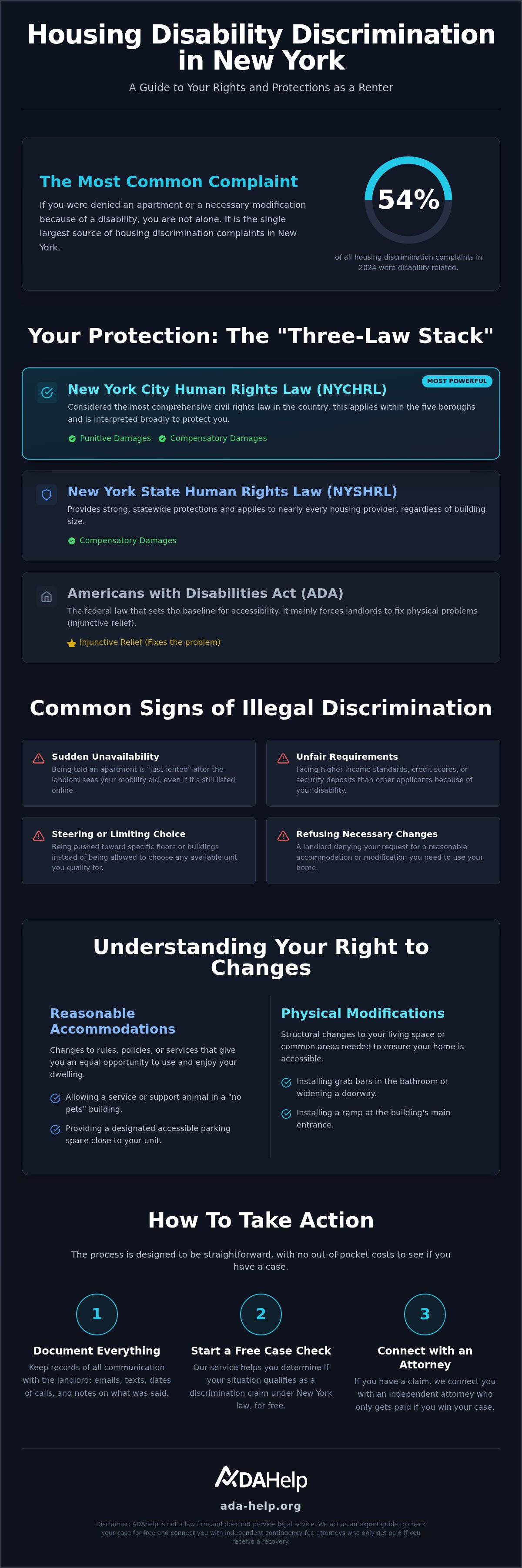
Did you know that over 54% of all housing discrimination complaints in 2024 were related to a disability? If you are facing eviction or were rejected for a new apartment; you are likely dealing with housing disability discrimination New York landlords often try to hide. It is frustrating to be told a building entrance cannot be made accessible or that you must pay for your own modifications. You deserve a home that meets your needs without the stress of illegal barriers.
We understand that the legal system feels cold; however; you don't have to handle this alone. This guide identifies illegal housing practices and shows you how to start your free New York disability claim today. We will explain the latest 2026 updates to the New York State Human Rights Law and how city specific protections can lead to money damages. ADA Help - NY disability discrimination claims is not a law firm and does not provide legal advice. Instead; we act as your expert guide to check your case for free and connect you with independent attorneys who only get paid if you win.
Key Takeaways
- Learn how to identify housing disability discrimination New York property owners use to deny leases or charge higher fees based on your condition.
- Discover how the "three-law stack" allows you to seek money damages under state and city rules.
- Spot common red flags; such as landlords claiming an apartment is "no longer available" after seeing your mobility aid.
- Understand the legal difference between changing building rules and making structural changes to your living space.
- Learn how to document your situation and start a free three-minute case check without any out-of-pocket costs.
What is Housing Disability Discrimination in New York?
Housing disability discrimination New York occurs when a landlord; property manager; or co-op board treats you differently because of a physical or mental impairment. This behavior is illegal in nearly every type of housing; including private rentals; condos; and public housing projects. You have a case if you were denied a lease; charged a higher security deposit; or refused a necessary accessibility change. Discrimination is not always a direct rejection. It also includes the failure to provide the modifications you need to use your home safely. Whether you are a current tenant or an applicant; you have the right to be judged on your ability to meet lease terms rather than your medical status.
You might wonder what your case is worth. While federal law helps fix physical barriers; the New York City Human Rights Law and state laws are what typically lead to money damages for the frustration you've faced. At ADA Help - NY disability discrimination claims; we check your situation for free. If you have a claim; we connect you with independent attorneys who work on a contingency-fee basis. This means you never pay out-of-pocket fees. They only get paid if you receive a recovery. This system ensures that seeking justice is stress-free and low-risk for you.
Does my situation count as a disability?
New York laws use a very broad definition of disability. It covers physical; medical; mental; or psychological impairments. This includes visible disabilities like using a wheelchair or walker. It also protects you if you have non-visible conditions; such as chronic illness; heart disease; or mental health struggles. You are even protected if a landlord only perceives you as having a disability. If they treat you poorly because they think you are "sick" or "unfit" to live there; they are breaking the law. If your condition limits a major life activity; you likely qualify for protection under the state and city law stack.
Common illegal actions by New York landlords
Discriminatory behavior is often subtle. Landlords might not say "no" directly; but their actions tell a different story. You should look out for these specific red flags. Landlords might refuse to show you an available apartment once they see your mobility device. They may apply higher income or credit score requirements just because you have a disability. Some buildings try to steer tenants with disabilities to specific floors or buildings instead of letting them choose their preferred unit. If you've been told an apartment was "just rented" when it is still listed online; you may be facing illegal housing disability discrimination New York. Documenting these interactions is the first step toward holding them accountable.
The Three-Law Stack Protecting New York Renters
Your protection doesn't just come from one single rule. It's a "three-law stack" that covers you from the federal level down to your local block. This combination is why housing disability discrimination New York cases often have stronger outcomes than in other states. The Americans with Disabilities Act (ADA) is your foundation. It sets the baseline for accessibility across the country. However; the ADA usually only provides what is called "injunctive relief." This means the court orders the landlord to fix the physical problem; like installing a ramp or widening a door. It doesn't usually result in a financial payout for the tenant.
This is where the New York State Human Rights Law (NYSHRL) and the New York City Human Rights Law (NYCHRL) provide additional strength. The state law applies to nearly every housing provider; no matter how small the building is. In 2025; the New York State Division of Human Rights awarded nearly $1 million in financial compensation to victims of housing discrimination. This shows that the state is getting much more aggressive about enforcement. If you aren't sure which law applies to your building; ADA Help - NY disability discrimination claims can check your situation for free.
Why the NYC Human Rights Law is unique
If you live in the five boroughs; the NYCHRL is your most powerful tool. It is widely considered the most comprehensive civil rights law in the country. The NYCHRL allows for "punitive damages." These are financial penalties meant to punish a landlord for particularly bad behavior. The city law is also interpreted "liberally." This means if a situation is unclear; the court is instructed to lean toward protecting you. Because of this; typical recovery amounts in NYC are often higher than in cases that only use federal law.
How state and city laws provide compensatory damages
State and city laws focus on "compensatory damages." These are payments meant to cover the actual harm you suffered. This includes out-of-pocket costs like moving expenses or higher rent if you were forced to find a new apartment. It also covers "emotional distress." Facing discrimination is painful and exhausting. These laws recognize that pain. Typical amounts vary case by case; but they ensure the landlord pays for the human cost of their actions; not just the cost of a construction project. We focus on these state and city protections to help you find the best path forward.
Common Signs of Illegal Housing Discrimination
Do you have a case for housing disability discrimination New York landlords often try to hide? In 2024; over 54% of all housing discrimination complaints nationwide were related to disability. This makes it the leading basis for housing legal action. Discrimination is not always as obvious as a landlord saying they won't rent to you. It is often hidden behind excuses and extra costs that other tenants don't have to pay. If you feel like you're being treated differently; you probably are.
You should watch for these red flags during your apartment search or while living in your current home. Landlords might claim an apartment is "no longer available" only after they see your mobility device or hear about your condition. They might also try to charge you a "disability deposit" or require extra insurance. These are illegal. You cannot be forced to pay more for a home just because you have a disability. Other common signs include ignoring your request for an accessible parking space or refusing to move you to a lower-floor unit when one becomes available.
Service animals and "No-Pets" policies
Service animals and emotional support animals are not pets. They are tools for living. Under New York laws; you cannot be banned from an apartment for having a necessary animal; even in a "no-pets" building. As of May 22; 2026; federal HUD guidance has shifted to focus enforcement on trained service animals. However; New York state and city laws remain broader. They continue to protect your right to keep an untrained assistance animal if it helps with your disability. Landlords cannot charge you "pet rent" or extra fees for these animals. If they try; they are violating your rights.
Inaccessible common areas and entrances
Your right to a home includes the right to enter and exit it safely. New York buildings must provide an accessible "path of travel" for everyone. This means ramps must be kept clear and elevators must be in working order. In the first four months of fiscal year 2026; the NYC Commission on Human Rights secured 50 accessibility modifications for residents. This was a significant increase from the previous year. If your landlord allows a ramp to stay blocked or refuses to fix a broken elevator that you rely on; they are failing their legal duty. Heavy doors that are impossible to open or blocked hallways are also serious violations. You deserve a building that respects your independence.
Reasonable Accommodations vs. Physical Modifications
Do you have a case for housing disability discrimination New York if your landlord refuses to change a building rule? The answer is often yes. To protect yourself; you must know the difference between two key terms. An accommodation is a change in a rule or policy. A modification is a physical structural change to the building. Both are essential for your independence. Landlords must grant these requests unless they can prove the change causes an "undue burden" or fundamentally alters their business. In most situations; they cannot simply ignore you.
Understanding these rights helps you spot illegal behavior early. For example; an accommodation might be allowing you to keep a service animal despite a "no-pets" rule. A modification might be installing a ramp at the front entrance or adding grab bars to your bathroom. If your landlord refuses either without a valid reason; they may be breaking the law. If your request was ignored or denied; you can start your free case check today to see if you have a claim for money damages under city or state laws.
Who pays for accessibility changes in New York?
One of the biggest points of confusion is who covers the cost. In many parts of the country; tenants must pay for modifications. However; New York City is different. Under the New York City Human Rights Law; landlords are generally responsible for the cost of modifications in common areas. You don't have to pay for a ramp that serves the entire building. While older buildings have different requirements than new construction; the "undue burden" threshold is very high. This means the landlord must prove that the cost would truly bankrupt them; which is rarely the case for large New York housing providers.
Requesting an accommodation the right way
You can protect your rights by following a simple process. Always submit your request in writing and keep a dated copy for your records. You don't need to provide your entire medical history or a full list of your medications. You only need to provide proof from a medical professional that the change is necessary for your disability. Once you make the request; the landlord must engage in a "dialogue" with you. It's an interactive process to find a solution. They cannot give you a flat "no" without exploring other options first. If they refuse to talk or demand unnecessary medical files; they are likely violating your rights under the NYSHRL and NYCHRL.
Filing Your Housing Discrimination Claim in New York
Do you have a case for housing disability discrimination New York? If a landlord ignored your request for a ramp or denied your apartment application because of your condition; you likely have a claim worth pursuing. What is it worth? While payouts vary case by case; typical recoveries for emotional distress and moving costs under city laws can be substantial. The first step is to gather your evidence before the details fade. Document every interaction with the landlord or building board. Write down the dates; times; and the specific words they used. Save every email; text message; and letter regarding your housing request or rejection. This paper trail is the most important part of your case. Even a simple text message where a landlord says an apartment is "not a good fit" after learning about your disability can be powerful evidence.
You must act quickly to protect your rights. For incidents occurring on or after February 15; 2024; you generally have three years to file a complaint with the New York State Division of Human Rights. However; waiting too long makes it harder to find witnesses or recover records. Instead of handling the paperwork yourself; you can use a case management service to handle the heavy lifting for your housing disability discrimination New York claim. We help you organize your evidence and determine if your situation meets the legal standards for a claim. Government websites can be intimidating and often require you to do all the legwork. We provide a streamlined alternative that keeps you in control without the headache of government bureaucracy.
Where to File: Agencies & Deadlines
You are not limited to a single path. Depending on where you live and the type of housing involved, several agencies can investigate a housing disability discrimination New York claim:
- New York State Division of Human Rights (DHR): Covers nearly all housing providers statewide. File within three years of an incident occurring on or after February 15, 2024, through dhr.ny.gov.
- NYC Commission on Human Rights (CCHR): If you live in one of the five boroughs, CCHR enforces the NYC Human Rights Law and can pursue punitive damages. File a complaint through nyc.gov/cchr.
- U.S. Department of Justice (DOJ): Handles pattern-or-practice Fair Housing Act cases and ADA referrals. Complaints can be filed through ada.gov.
- Equal Employment Opportunity Commission (EEOC): If your situation overlaps with employer-provided housing or retaliation at work, the EEOC handles the employment side of a disability discrimination claim, generally within 300 days.
Filing with the wrong agency, or missing a deadline, can permanently close the door on money damages. A free case check can help you confirm which agency and deadline apply to your situation.
How does the ADAhelp process work?
We make the process simple and stress-free. ADAhelp is not a law firm and does not provide legal advice; however; we are experts at managing your claim. Start with our free three-minute case check to see if you have a valid claim. If you do; we manage the entire process for you. We gather the necessary information and connect you with independent contingency-fee attorneys. These lawyers focus on the specific state and city laws that lead to money damages. You don't have to visit a government office or figure out complex forms alone. We stay by your side until your case reaches a resolution.
Are there upfront costs for my claim?
You never have to worry about the cost of seeking justice. You never pay out-of-pocket for our case management services. Our service is contingency-based; which means we only get paid if your case is successful. We take on the financial risk so you can focus on your housing situation and your health. This low-risk path ensures that every New Yorker has a chance to hold discriminatory landlords accountable. It shouldn't cost you a fortune to fight for a fair place to live. Start your free case check today to protect your rights and find out what your claim is worth.
Take Control of Your Housing Rights
You shouldn't have to fight for a basic place to live. New York housing laws are designed to protect your independence and provide a path to justice when landlords fail to follow the rules. Whether you were denied an apartment or refused a necessary ramp; your experience matters. The combination of city and state laws often leads to financial recovery for the emotional distress caused by housing disability discrimination New York property owners might attempt. Keeping your records and documentation is your best tool to hold them accountable.
Don't let the fear of legal costs stop you from moving forward. Our case management process is built for real New Yorkers who need a proactive partner. We handle the heavy lifting of organizing your evidence and determining if you have a claim. There is no financial risk to you because our model is contingency-based. This means there is no fee unless you receive a recovery. You can find out where you stand in just a few minutes with our specialized evaluation.
Start your free three-minute case check now to see if you have a claim. We are here to help you turn a frustrating situation into a clear resolution. You deserve a home that respects your rights.
Frequently Asked Questions
Can a landlord in New York refuse to rent to me because I use a wheelchair?
No; a landlord cannot refuse to rent to you simply because you use a wheelchair. This is a clear example of housing disability discrimination New York laws are designed to stop. You have the right to equal access in all housing; including private rentals and co-ops. If a landlord claims a unit is "not accessible enough" for you; they are likely violating your rights and could be liable for damages.
Do I have to pay a pet deposit for my service animal in NYC?
No; you do not have to pay a pet deposit or pet rent for a service or support animal in New York City. These animals are considered medical tools rather than pets. Even if the building has a strict "no-pets" policy; you must be allowed to keep your animal without extra fees. Charging you more because of your assistance animal is illegal under both city and state human rights laws.
Who pays for a ramp to be installed in a New York apartment building?
In New York City; the landlord is generally responsible for the cost of installing a ramp in common areas. While federal law sometimes allows landlords to pass costs to tenants; the New York City Human Rights Law is much stricter. Landlords must prove a significant financial hardship; known as an undue burden; to avoid this cost. You should not be forced to pay for building-wide accessibility modifications.
How long do I have to file a housing discrimination claim in New York?
You have three years to file a complaint for incidents that occurred on or after February 15; 2024. This deadline applies to filings with the New York State Division of Human Rights. However; it is always better to act quickly while your evidence is fresh. Missing these strict deadlines can prevent you from seeking money damages for the harm you've suffered during your housing search or tenancy.
Can I be evicted if I develop a disability while living in my apartment?
No; you cannot be evicted just because you develop a disability. Your landlord is legally required to work with you to provide reasonable accommodations that allow you to stay in your home. This might include allowing a live-in aide or making physical changes to your unit. Evicting a tenant because their medical needs have changed is a serious violation of state and city human rights laws.
What is the difference between the NYC Human Rights Law and the ADA?
The main difference is the type of relief you can receive. The ADA is a federal law that focuses on fixing physical barriers; like adding a lift or a ramp. The NYC Human Rights Law is much broader and allows you to seek money damages for emotional distress. It also allows for punitive damages to punish landlords for their behavior; which the federal ADA does not typically offer.
What kind of money can I recover in a housing discrimination case?
You can recover compensatory damages for your actual losses and emotional pain. This includes the cost of finding a new home or the mental toll of being rejected. Typical amounts vary case by case and depend on the severity of the landlord's actions. In New York City; you may also be eligible for punitive damages if the housing disability discrimination New York landlord's actions were willful or malicious.
Does ADAhelp provide a free case review for housing issues?
Yes; ADAhelp offers a free three-minute case check for anyone facing housing issues. We help you determine if you have a valid claim for discrimination without any upfront cost. If you do; we connect you with independent attorneys who work on a contingency-fee basis. This means you never pay out-of-pocket fees and only pay if you receive a recovery from the landlord or building owner.

Article by
ADA Help
Written by the ADAhelp editorial team and reviewed for accuracy before publishing. ADAhelp helps New Yorkers find out if they have a disability discrimination claim and manages the process end to end, working with independent attorneys who handle the legal work. We are not a law firm and do not provide legal advice.
Disclaimer
This article is general information about New York law, not legal advice, and reading it does not create an attorney-client relationship. ADAhelp is a case-management and intake service, not a law firm; legal representation is provided by independent attorneys. Recovery amounts and timelines vary by case, and past outcomes do not guarantee future results. For advice about your specific situation, speak with a qualified attorney or start the free case check.
Tags
Discriminated against in New York because of a disability?
A free three-minute check tells you if you can pursue a claim.
Check my case →New York onlyNo upfront costIndependent NY attorneysFree 3-minute check